Feeds:
Posts
Comments

Archive for the ‘accidents’ Category

Link to the full report

What?

The blowout in the Gulf of Mexico could have been prevented if the last-line of defence—the blind shear ram on the blowout preventer, located at the well head on the ocean floor—had activated and crushed the drill pipe. Given the importance of this equipment, and the evident dangers of relying on a single device, we urge the HSE to consider prescribing specifically that blowout preventers on the UK Continental Shelf should have two blind shear rams.

Comments:

  1. The UK government should NOT be commenting on the BOP failure until the US government has completed its forensic testing and investigation.
  2. The Committee has apparently not paid any attention to the testimony on the BOP issues or the other BOP information that has surfaced.  Have they not seen the comments from BP and Transocean or the videos shot on the Q4000?
  3. Would it have been appropriate for the US government to publish a report on Piper Alpha before Lord Cullen had completed his review?

Read Full Post »

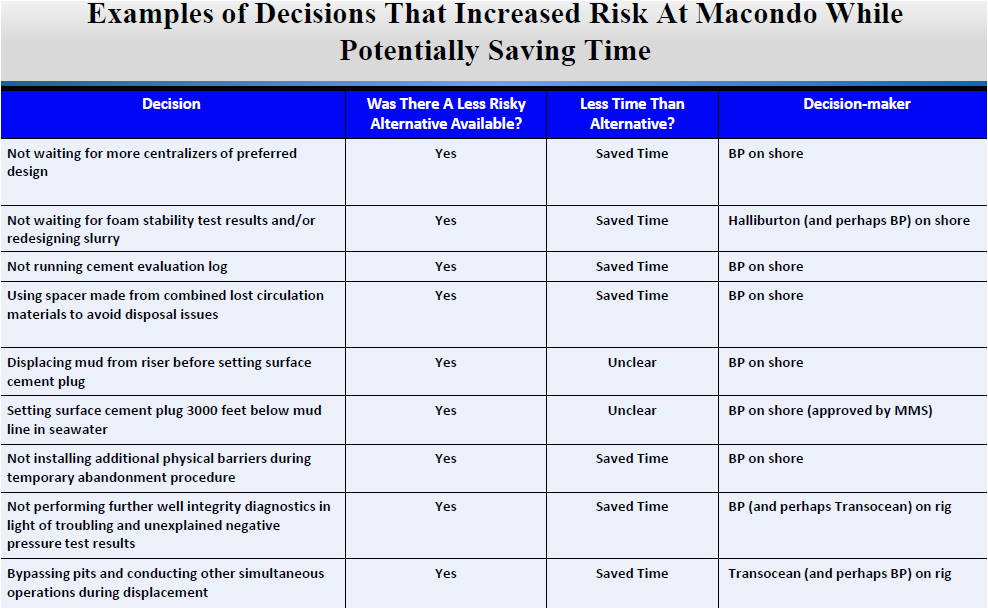
click on table to enlarge

Click for the chapter on the causes of the blowout

Read Full Post »

The UK Energy and Climate Change Committee has released its report entitled “UK Deepwater Drilling – Implications of the Gulf of Mexico oil spill.” We’ll post the report as we get a link.

Here’s the gist:

A moratorium on oil drilling in deep waters off Britain would undermine the country’s energy security, according to a report by lawmakers published on Thursday in response to the BP spill disaster last year.

Read Full Post »

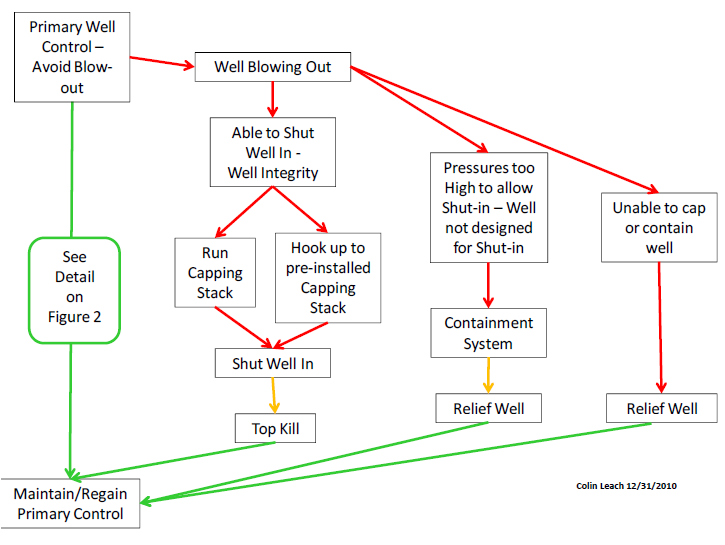
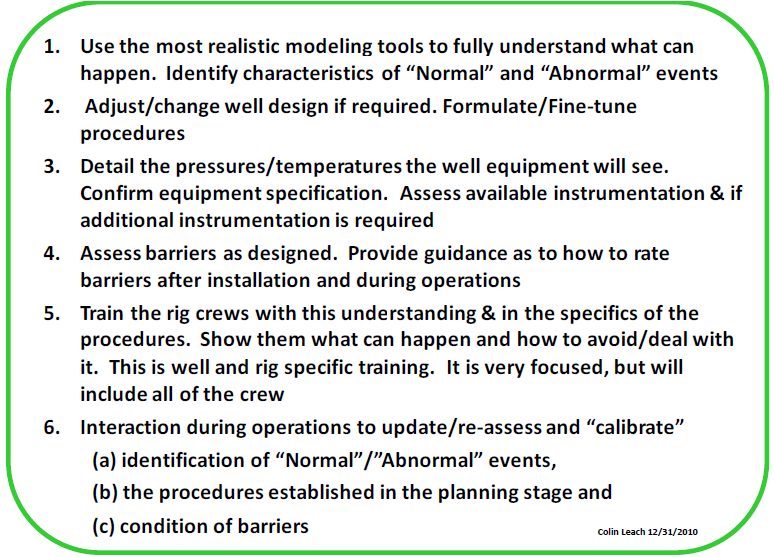
Colin Leach has provided a nice overview of the loss of well control scenarios for a deepwater well (Figure 1), and a concise, but comprehensive, summary of the critical elements of a well control program (Figure 2).   Click on either figure to enlarge.

We appreciate Colin’s continued leadership and initiative on well control issues.

Figure 1: Well Control Activities in Deep Water

Figure 2: Activities Focused on Maintaining Primary Well Control

Read Full Post »

Good article on the oil and gas industry safety institute proposal.

Read Full Post »

A colleague sent a link to a Marathon Oil Company Macondo presentation that was posted by the Houston Chronicle. The presentation was intended for internal training and discussion purposes.

Firstly, I applaud Marathon for ensuring that the blowout is studied and debated within the company. Hopefully, they did the same thing for Montara, have a good internal system for studying accidents throughout the industry, and thoroughly investigate all of Marathon’s incidents and near misses.

I thought Marathon’s comments about safety culture were particularly interesting, including these on slide 58:

Although harder to define and measure, and even more difficult to regulate, we pointed to our culture as the single most important differentiating attribute when comparing us to BP.

In a recent meeting with an individual who has numerous dealings with BP, he observed that regardless of the purpose of the gathering (planning session to morning rig call), it is almost impossible to determine who is ultimately responsible and accountable for the operation being discussed. Evidence of this exists in the very report this presentation was derived from.
I wonder what convinces Marathon that their safety culture is superior. The above anecdote, while interesting, doesn’t tell us much. Prior to Macondo (and perhaps even after the blowout), I’ll bet most BP employees thought that they had a strong safety culture. Ditto for Transocean. Does Marathon have any better evidence demonstrating the strength of their safety culture? If not, what makes them so confident? Does Marathon have a process for assessing and monitoring the attitude and commitment of their employees? Have they conducted regular internal surveys to gauge safety culture? My sense is that they have not. If they had, they could make their case without the very subjective comparison with BP.

Read Full Post »
BOE applauds retired offshore regulators Ian Whewell (UK HSE) and John Clegg (NOPSA Australia) for their excellent participation in yesterday’s hearings. No one is wiser than a retired regulator. 😉

Also, Magne Ognedal overcame technical glitches to make an important long-distance contribution from Norway.  Those who have not yet read our interview with Magne should take the time to do so.  In this interview, which was conducted before Macondo, Magne concisely answers most of the questions about the Norwegian regime and regulatory philosophy that have arisen since the blowout.

Read Full Post »

In addition to suing for damages, the Justice Department is seeking civil penalties.  The amount has not been specified.

In the complaint, the United States alleges violations of federal safety and operational regulations, including:

  • Failure to take necessary precautions to secure the Macondo Well prior to the April 20th explosion;
  • Failure to utilize the safest drilling technology to monitor the well’s condition;
  • Failure to maintain continuous surveillance of the well; and
  • Failure to utilize and maintain equipment and materials that were available and necessary to ensure the safety and protection of personnel, property, natural resources, and the environment.

Read Full Post »

President-elect Dilma joked recently that the oil discoveries were just the latest proof that God is Brazilian. And economists from Goldman Sachs no less are predicting that Brazil — along with Russia, China and India — will dominate the world economy in the 21st century.

If you didn’t see the 60 Minutes story on Brazil, you can view it here. With regard to the significance of Brazil’s recent deepwater discoveries, OGX owner Eike Batista offered the following:

Oh, it, it means we should be producing in excess of six million barrels a day. So it’ll put us in among the third, fourth largest producer in the world. Massive exporting.

According to this blog entry, Batista forecasts this 6 million bopd production rate (more than double the current output) by 2020!

Like other offshore producers, Brazil has experienced its tragedies, most notably the sinking of the P-36 production platform that resulted in 11 fatalities. Petrobras and Brazil have recovered nicely from that disaster, but outstanding safety performance is critical if they are to sustain their offshore success.

Read Full Post »

Agenda

Live Webcast

Read Full Post »

« Newer Posts - Older Posts »