Feeds:
Posts
Comments

Archive for the ‘accidents’ Category

While C-SPAN has broadcast some of the proceedings, the Deepwater Horizon Joint Investigation hearings have inexplicably not been streamed live by the Coast Guard (USCG) and Department of the Interior (DOI).  The National Commission and Chemical Safety Board streamed their hearings live, but the USCG and DOI have not done so.  Why? This is perhaps the most significant accident in the history of the US offshore oil and gas program, and the most notable worldwide offshore disaster since Piper Alpha in 1988. Eleven men died on the Deepwater Horizon.  Economic costs will total in the tens of $billions. Major regulatory changes, some of which don’t appear to address identified risks, are being imposed.

The upcoming hearings are particularly important because the BOP issues that will be discussed have enormous international significance. In this era, the world shouldn’t have to travel to New Orleans to observe the hearings, rely on sketchy press reports, or wait months for transcripts to be released. (And how is it that the Montara Inquiry Commission in Australia was able to post transcripts within hours after the conclusion of each day’s hearing?)

Accident prevention is dependent on complete and timely information.  Had more people paid attention to Montara, Macondo may have been prevented. The upcoming Deepwater Horizon BOP hearings are of critical importance, and should be streamed so that all interested parties can follow the proceedings.

Read Full Post »

A shortened and simplified summary from information provided in the DNV report:

  1. The Upper Variable Bore Rams (VBRs) were closed prior to the Emergency Disconnect Sequence (EDS) activation at 21:56 on April 20, 2010.
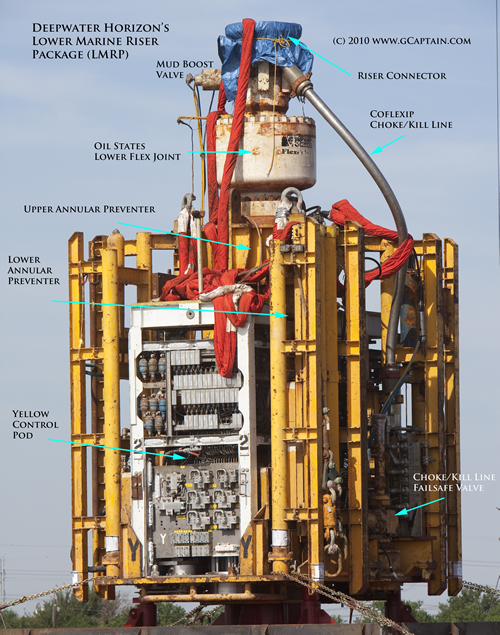
  2. A drill pipe tool joint was located between the Upper Annular Preventer (closed) and the Upper VBRs (also closed). Forces from the flow of the well pushed the tool joint into the Upper Annular element. Because the tool joint was trapped beneath the closed annular preventer (and could not move upward), forces from the flowing well caused the pipe to push upward and buckle.
  3. The drill pipe deflected until it contacted the wellbore just above the Blind Shear Ram (BSR).  The portion of the drill pipe located between the shearing blade surfaces of the BSR was off center and held in this position by buckling forces.
  4. A portion of the pipe cross section was outside of the intended BSR shearing surfaces and did not shear as intended.
  5. As the BSR closed, a portion of the drill pipe cross section became trapped between the ram block faces, preventing the blocks from fully closing and sealing.
  6. Since the deflection of the drill pipe occurred from the moment the well began flowing, trapping of the drill pipe would have occurred regardless of which means initiated the closure of the BSR.
  7. In the partially closed position, flow continued through the drill pipe trapped between the ram block faces and subsequently through the gaps between the ram blocks.
  8. When the drill pipe was sheared on April 29, 2010, using the Casing Shear Ram (CSR), the flow expanded through the open drill pipe at the CSR and up the entire wellbore to the BSR and through the gaps along the entire length of the block faces and around the side packers. The CSR was designed to cut tubulars, not seal the well bore.

sheared off-center drill pipe

Read Full Post »

Just released.

The DNV report will be discussed in the upcoming hearings:

The Bureau of Ocean Energy Management, Regulation and Enforcement (BOEMRE)/U.S. Coast Guard (USCG) Joint Investigation Team, which is examining the Deepwater Horizon explosion and resulting oil spill, today announced that it will hold a seventh session of public hearings the week of April 4, 2011. The hearings, which will focus specifically on the forensic examination of the Deepwater Horizon blowout preventer (BOP), are scheduled to take place at the Holiday Inn Metairie, New Orleans Airport, 2261 North Causeway Blvd., Metairie, La.

Read Full Post »

Professor Robert Bea

Bob Bea

Dr. Bob Bea, UC Berkeley Center for Catastrophic Risk Management, and his Deepwater Horizon Study Group have issued their final report on the Macondo blowout. I look forward to reading the full documents.

Bob has been at the vanguard on risk management issues for many years. While he jokes that there are two things engineers can’t deal with – uncertainty and people, Bob is an engineer who understands both! Kudos to Bob and his group for their leadership and initiative.

Read Full Post »

Our oil spill expert, Cheryl Anderson, has been monitoring the Gulf of Mexico slick reports, and has provided the following update:

Excerpt from a NOLA.com article below published 4-5 hours after yesterday’s Coast Guard media briefing regarding the source of the latest slick in Louisiana state waters :

A state official, speaking on condition of anonymity because of a continuing Coast Guard investigation, said the Department of Wildlife and Fisheries traced the emulsified oil on the west side of the river to its apparent source at West Delta Block 117. He said tests by a state-contracted lab confirmed that was the source of the oil.

Wildlife and Fisheries officials found the source of the oil Monday evening and encountered workers in a boat trying to restore a cap on the well using a remotely operated submarine.

There was a USCG Media Briefing at 2 pm local time Monday [4-5 hours before the NOLA.com article was published]. The briefing confirmed that the 100-mile sheen on Saturday was not petroleum, just sediments from water disturbances.

With regard to the most recent slick, the Coast Guard said:

–no source had been identified,

–no active spill incidents had been identified,

–spill had been Federalized,

–testing showed that it was Louisiana crude, and

–LSU was still working on the tests to see if the oil matched the Macondo well or any recorded previous spill incident.

Read Full Post »

Per the Platts Oilgram report that we posted on 17 March, here is the complete court filing..

These are the additional tests recommended by BP’s consultant Ralph Linenberger:

  • Removal and forensic analysis of each annular element
  • Hydraulic signature testing of the annular preventer operator and ram preventers operators
  • Disassembly and inspection of the annular preventer and ram preventer bonnets
  • Laser scanning of (i) the entire BOP wellbore; (ii) the upper annular packer and upper annular cap; (iii) the inside of the riser kink; and (iv) the wellbore-facing surfaces of the casing shear ram bonnets
  • Hydraulic circuitry pressure test
  • ST lock circuit confirmation
  • Solenoid pie connector pin measurement and corresponding female receptacle analysis.

Is anyone else surprised that some (all?) of these tests hadn’t already been conducted? That would seem to be the biggest revelation from the BP court filing.

Read Full Post »

Air France flight 447 went down June 1, 2009, amid an intense, high-altitude thunderstorm

Specialists are launching a fourth undersea search effort next week for the plane’s so-called black boxes, or flight recorders.

‘We are convinced if we find the black boxes we’ll be able to reconstruct what really happened on this tragic flight Air France 447,’ Enders said. Airbus officials say the search is a company priority.

Air France and Airbus will finance the estimated $12.5 million cost of the new search, in which three advanced underwater robots will scour the mountainous ocean floor between Brazil and western Africa, in depths of up to 4,000 meters (13,120 feet).

Already $27.5 million has been spent on three previous search attempts that failed to find Flight 447’s voice and data recorders.  Daily Mail

Aviation safety proponents have argued that it’s time to start replacing black boxes with satellite systems that stream critical data real time. Similarly, as we have previously suggested, it’s time for real time monitoring of wellhead and BOP pressures and functions. This relatively inexpensive improvement would support testing and maintenance programs, improve our understanding of BOP performance, assist with well control decisions, and facilitate investigations.

Read Full Post »

“After extensive review and development, the oil and natural gas industry has approved the creation of the Center for Offshore Safety, which will promote the highest level of safety for offshore operations, through an effective program that addresses management practices, communication and teamwork, and which relies on independent, third-party auditing and verification,” said Jack Gerard, API president and CEO. “The board directed API to further develop the operational framework and timeline for the center—working with other industry stakeholders—to enhance industry safety and environmental performance.”API Announcement

Comments:

  1. Encouraging decision.
  2. Organizational details will be critical.
  3. It’s good that the center will be affiliated with the standards function and located in Houston (not Washington).
  4. Member support must be consistent and sustained.
  5. Operating companies that are not API members should be involved.
  6. Non-US companies should be welcome.
  7. Contractors and service companies should be involved.
  8. The focus should not be solely on deepwater operations.  Most major accidents have occurred on the shelf, and most of the contributing factors to Macondo were not deepwater related.
  9. A comprehensive, verified international incident data base is critical.

Read Full Post »

Déjà vu?

As was the case with Macondo, great minds have already figured out what went wrong at Fukushima and who is to blame.

Here’s what they tell us. Sound familiar?

  1. The company cut corners to save money!
  2. There wasn’t enough government oversight!
  3. Management failed to properly assess the risks!
  4. The regulator is corrupt!
  5. Warnings were ignored!
  6. The operation is not safe in that environment!
  7. The company and industry have a poor safety culture!
  8. Our country’s regulations are much more stringent!
  9. It couldn’t happen here!
  10. The threat is spreading; people in Panic-stan are in danger!

I’m no nuclear power advocate, but it would be nice if everyone focused on fixing the problem, protecting those who are truly endangered, and restroring some sense of normalcy in Japan. There will be plenty of time to investigate and find fault.

By the way, do you remember the fear mongering about Macondo oil on East Coast beaches?

Read Full Post »

From Platts Oilgram News:

BP seeks Macondo BOP access to perform tests Washington—BP is seeking access to the Deepwater Horizon blowout preventer so it can run tests the company says the joint investigation has failed to perform. BP filed a motion in US District Court for the Eastern District of Louisiana in New Orleans March 9, asking Judge Carl Barbierto allow the company access to the BOP after the joint investigation being run by the US Coast Guard and the Bureau of Ocean Energy Management, Regulation and Enforcement, is finished with it. The BOP, a five-story stack of valves, sat atop BP’s Macondo well in the Gulf of Mexicoand failed to suppress a blowout April 20,2010. The blowout killed 11 workers fromTransocean’s Deepwater Horizon rig and triggered a massive oil spill. The joint investigation, under the supervision of the Department of Justice, has been conducting tests on the BOP at a NASA facility in Michoud, Louisiana. DNV Columbus washired to conduct the forensic tests and BP,Transocean, and Cameron, which made the BOP, have been observing.The test results are supposed to be delivered to the joint investigation by March 20. Hearings on the BOP are scheduled for the week of April 4. In its motion, BP said it submitted to the Joint Investigation Team a list of highly technical tests it felt should be conducted, but that the final list of approved tests did not include several of the items BP and other companies had requested.“BP, however, believes that performance of these forensic activities will add value to an analysis of why the BOP did not work as intended on April 20, and recommends they be completed,” the company said in its court brief.— Gary Gentile

Read Full Post »

« Newer Posts - Older Posts »