Attorney General Anil Nandlall today said that Guyana is closer to securing a Council of Legal Education-recognised law school.
Stabroek Times

Posted in Guyana, tagged Guyana, law school, oil wealth on September 27, 2022| Leave a Comment »
Attorney General Anil Nandlall today said that Guyana is closer to securing a Council of Legal Education-recognised law school.
Stabroek Times
Posted in energy policy, Offshore Energy - General, tagged Adriatic, Giorgia Meloni, Italy, offshore gas on September 26, 2022| Leave a Comment »

Meloni at the rally said Italy should exploit gas resources in the Adriatic Sea and not just look to buy gas from countries like Algeria, as Draghi has done, to wean Italians from supplies from Russia, given that country’s war against Ukraine.
AP
Posted in decommissioning, energy, Gulf of Mexico, Offshore Energy - General, tagged Cognac, Deepwater, EnVen, Gulf of Mexico, merger, Talos on September 26, 2022| Leave a Comment »
Sept 22 (Reuters) – Talos Energy Inc (TALO.N) said on Thursday it will buy EnVen Energy Corp, a private producer in the deepwater U.S. Gulf of Mexico, in a $1.1 billion deal including debt.
As the data below demonstrate, this is a significant merger from a regional perspective. In 2021, the combined company would have been the sixth largest GoM producer of both oil and gas. The two companies are operating 105 platforms, and their 8 deepwater (>1000′) platforms are 14% of the GoM total. Their compliance records, while not at Honor Roll levels, are better than the GoM average based on INCs/inspection. Some major decommissioning projects loom (see the second table below), and the extent to which the merged company is financially prepared for these obligations is unknown. Particularly noteworthy is the Cognac platform, which was the world’s first platform installed in >1000′ of water.
| EnVen | Talos | |
| 2021 Oil (MMbbls) | 9.6 | 17.5 |
| GoM oil rank | 13 | 7 |
| 2022 Gas (Bcf) | 12.6 | 34.8 |
| GoM gas rank | 16 | 9 |
| 2021/2022 well starts | 8 | 8 |
| platforms: total | 14 | 91 |
| platforms >1000′ | 4 | 4 |
| BSEE inspections | 37 | 176 |
| 2022 INCs (W, CSI, FSI) | 12/4/1 | 38/23/10 |
| INCs/inspection | 0.46 | 0.40 |
Decommissioning obligations of note:
| Platform | owner | type | water depth (ft) | installed |
| Amberjack | Talos | fixed | 1100 | 1991 |
| VK 989 | Talos | fixed | 1290 | 1994 |
| Ram Powell | Talos | TLP | 3216 | 1997 |
| GC 18 | Talos | fixed | 750 | 1986 |
| Cognac | EnVen | fixed | 1023 | 1978 |
| Lobster | EnVen | fixed | 775 | 1994 |
| Brutus | EnVen | TLP | 2900 | 2001 |
| Prince | EnVen | TLP | 1500 | 2001 |
Posted in Uncategorized, tagged Cajun music on September 23, 2022| Leave a Comment »
Posted in energy policy, Gulf of Mexico, Offshore Energy - General, tagged BOEM, CCS, Exxon, Lease Sale 257 on September 22, 2022| Leave a Comment »
Which bid was rejected? BOEM announced that 307 of the 308 high bids were accepted. One bid was rejected on fair market value grounds. The unsuccessful bid is not specified on the Sale 257 web page.
When can we expect a statement from Exxon on their intentions for the 94 blocks they acquired? Those 94 blocks (31% of the entire sale) are the elephant in the room, yet we have heard nothing from the company. Given Exxon’s apparent interest in using these leases for CCS purposes, and the tax credits and Federal funding associated with CCS projects (as per the Infrastructure Bill and Inflation Reduction Act), clarification regarding Exxon’s intentions would seem to be appropriate.
Posted in climate, energy policy, tagged climate, Jamie Dimon, JPMorgan on September 21, 2022| Leave a Comment »
Rep. Rashiba Tlaib: “Does your bank have a policy against funding new oil and gas products?” (I assume her script said “projects,” and that she misread it. She also butchered “Celsius,” a word that should be very familiar to such a climate expert.)
Jamie Dimon: “Absolutely not and that would be the road to Hell for America.”
Posted in energy policy, tagged SPR milestones, Strategic Petroleum Reserve on September 21, 2022| Leave a Comment »
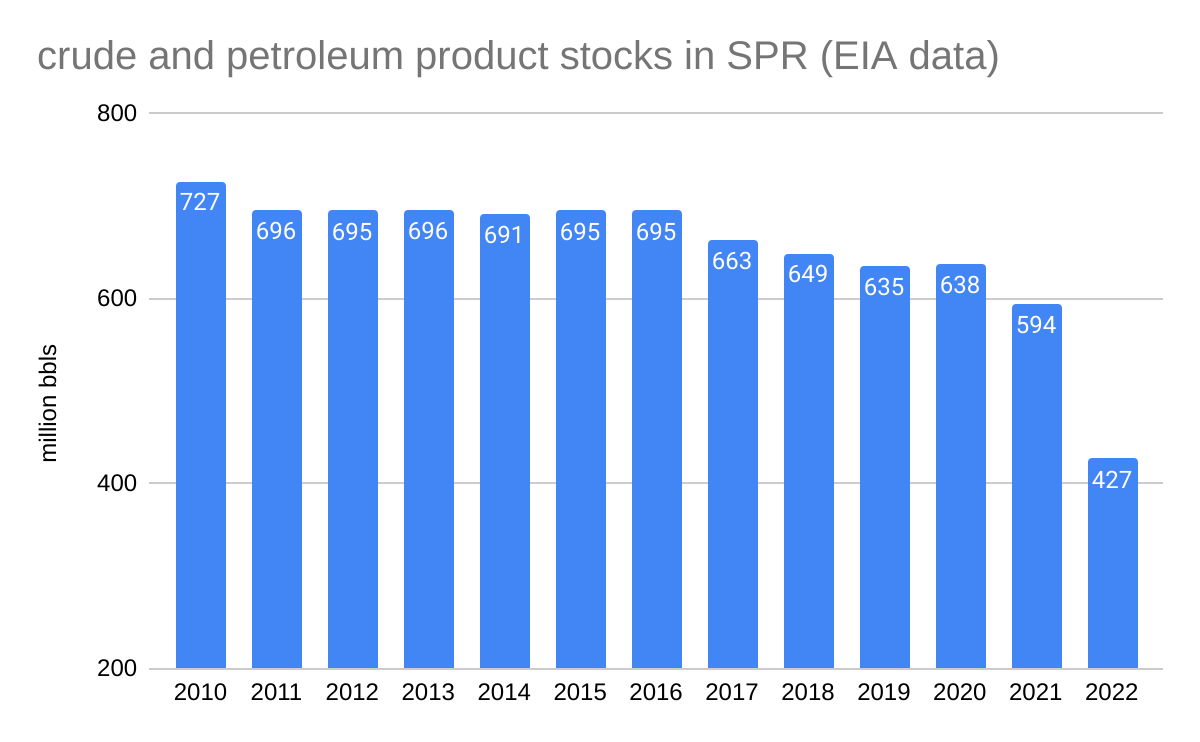
WASHINGTON, D.C.— The U.S. Department of Energy’s (DOE) Office of Petroleum Reserves today announced a Notice of Sale of up to 10 million barrels of crude oil to be delivered from the Strategic Petroleum Reserve (SPR) in November 2022.
DOE
Posted in energy policy, tagged Amin Nasser, Aramco, energy realities, OPEC, Rystad on September 21, 2022| Leave a Comment »
Per Offshore-Energy.biz, comments by Aramco President and CEO, Amin H. Nasser, at the Schlumberger Digital Forum:
“When you shame oil and gas investors, dismantle oil- and coal-fired power plants, fail to diversify energy supplies (especially gas), oppose LNG receiving terminals, and reject nuclear power, your transition plan had better be right. Instead, as this crisis has shown, the plan was just a chain of sandcastles that waves of reality have washed away.”
“the warning signs in global energy policies were flashing red for almost a decade,” adding that investments in oil and gas decreased from $700 billion to a little over $300 billion, which is more than 50 per cent between 2014 and 2021.
“this is the moment to increase oil and gas investments, especially capacity development.”
Aramco is working to increase its oil production capacity to 13 million barrels per day by 2027 and grow its gas production by more than half through 2030.
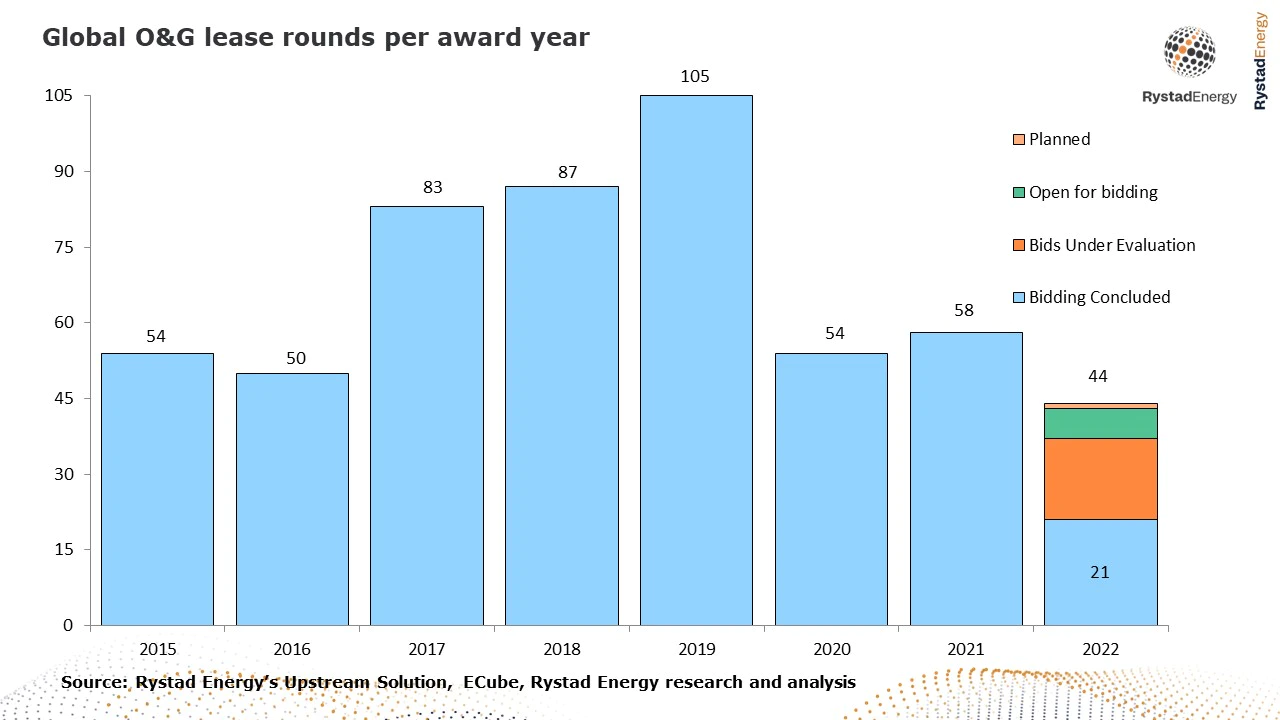
Meanwhile, Rystad reports a further reduction in global oil and gas licensing, with help from the US govt:
Posted in drilling, Gulf of Mexico, Offshore Energy - General, Regulation, well control incidents, tagged macondo, OCS Order 2, safety record, Well Control Rule on September 20, 2022| Leave a Comment »

Contrary to some post-Macondo commentary, well control has always been the highest priority of the US offshore regulatory program. This was the case regardless of the administration, party in power, responsible bureau, or politics of the day. The first specific well control requirements were in OCS Order No. 2 (Drilling) which dates back to 1958.
Continuous improvement must always be the objective; hence the many revisions to these regulations over the years.
BSEE’s recently proposed Well Control Rule includes updates that should be reviewed by all who are interested in drilling safety and well control regulations. I will be submitting comments to the docket and will post some of those comments on this blog. I hope others take the time to review the relatively brief BSEE proposal and submit comments
Industry comments are typically consolidated which limits the technical discussion and diversity of input. Consensus industry recommendations tend to be less rigorous from a safety perspective than some companies might submit independently. There are also far fewer operating companies than there were in the past. Most of you surely remember Texaco, Gulf, Getty, Amoco, Arco, Mobil, Unocal, and other important offshore operators that have merged into even larger corporations. This further limits the diversity of input.
Of course, the operating company is fully accountable for any safety incident at an OCS facility, including well control disasters like the 1969 Santa Barbara and 2020 Macondo blowouts. This should be ample incentive for comprehensive safety management programs. Unfortunately, risk management, culture, and human/organizational factors are complex, and good intentions don’t always lead to good results.
Although the operating company is legally accountable, the regulator and industry as a whole also bear some responsibility for safety performance. What is the purpose of the regulator if not to prevent safety and environmental incidents? Also, the industry can do better in terms of assessing data, updating standards, and publicly calling out poor performance.
On a more positive note, the offshore industry has collectively had some spectacular well control successes. Perhaps most impressive is this: Prior to 2010, 25,000 wells had been drilled in US Federal waters over the previous 25 years without a single well control fatality, an offshore safety record that was unprecedented in the U.S. and internationally. That number of offshore wells over a 25 year period is by itself a feat that will never again be achieved in any offshore region worldwide. The well control safety record makes that achievement extraordinary.
Posted in climate, energy policy, Offshore Energy - General, tagged climate task force, energy policy, EO 14082, White House on September 19, 2022| Leave a Comment »
Per Executive Order 14082, September 12, 2022, yet another White House office and task force has been established to coordinate (direct?) the 26 Federal Departments (plus many bureaus and offices) with energy and climate responsibilities.
Sec. 3. White House Office on Clean Energy Innovation and Implementation. There is hereby established the White House Office on Clean Energy Innovation and Implementation within the Executive Office of the President, which shall coordinate the policymaking process with respect to implementing the energy and infrastructure provisions of the Act and other essential initiatives. The White House Office on Clean Energy Innovation and Implementation shall have a staff headed by the Senior Advisor for Clean Energy Innovation and Implementation; shall have such staff and other assistance as may be necessary to carry out the provisions of this order, subject to the availability of appropriations; and may work with established or ad hoc committees and interagency groups.
Sec. 4. ‘‘There is hereby established a National Climate Task Force (Task Force). The Task Force shall be chaired by the Senior Advisor for Clean Energy Innovation and Implementation. The National Climate Advisor shall serve as Vice Chair.’’
Task Force Membership:
(i) the Secretary of the Treasury; (ii) the Secretary of Defense; (iii) the Attorney General; (iv) the Secretary of the Interior; (v) the Secretary of Agriculture; (vi) the Secretary of Commerce; (vii) the Secretary of Labor; (viii) the Secretary of Health and Human Services; (ix) the Secretary of Housing and Urban Development; (x) the Secretary of Transportation; (xi) the Secretary of Energy; (xii) the Secretary of Education; (xiii) the Secretary of Homeland Security; (xiv) the Administrator of the Environmental Protection Agency; (xv) the Director of the Office of Management and Budget; (xvi) the Director of the Office of Science and Technology Policy; (xvii) the Administrator of the Small Business Administration; (xviii) the Chair of the Council on Environmental Quality; (xix) the Assistant to the President for National Security Affairs; (xx) the Assistant to the President for Domestic Policy; (xxi) the Assistant to the President for Homeland Security and Counterterrorism; (xxii) the Assistant to the President for Economic Policy; (xxiii) the Administrator of the National Aeronautics and Space Administration; (xxiv) the Chief Executive Officer of the Corporation for National and Community Service; (xxv) the Administrator of General Services; (xxvi) the White House Infrastructure Coordinator; and (xxvii) the heads of such other departments, agencies, and offices as the Chair or Vice Chair may from time to time invite to participate.’’
Over the years, the work of cabinet departments has been increasingly directed by the White House, such that cabinet officials confirmed by the Senate are often subordinate to White House staff. Critics contend that the centralization of energy and climate policy in the White House has delayed and altered important Departmental actions. Did the White House climate office author this rather extreme statement in the introductory text for the proposed 5-year leasing plan?
“The long-term nature of OCS oil and gas development, such that production on a lease can continue for decades makes consideration of future climate pathways relevant to the Secretary’s determinations with respect to how the OCS leasing program best meets the Nation’s energy needs.“ (Interpretation: offshore oil and gas production must be throttled down to correspond with the climate office’s energy fantasies.)
 Bud's Offshore Energy (BOE)