This week I’ll be posting background information, new details, and personal opinions about the April 20, 2010 Macondo tragedy. As a prelude, I wanted to share this touching tribute to the 11 men who died on the Deepwater Horizon. These American heroes gave their lives exploring for energy to power our economy. The video is introduced by singer Trace Atkins, a former Gulf of Mexico rig worker.
… to be able to speak openly and candidly about issues that have been an important part of my professional life for 50 years. Thankful for our First Amendment rights; they must be protected.
Whether you represent Big Oil, Big Gas, Big Wind, Big Green, Big Climate, Big Stick (regulators 😀), Big Swamp (Washington DC friends 😉), or none of the above, thank you for visiting this modest, independent, and rather obscure blog.
Over the next couple of weeks, I will be posting about an interesting study that links compliance and safety, some unpublished thoughts on the Macondo blowout 12 years later, and comments on the industry push for carbon sequestration in the Gulf of Mexico (sorry advocates, I’m not a fan).
Regardless of your faith, nationality, political views, or thoughts about world events and offshore energy, I hope you have the opportunity to spend time with friends and family this weekend.
U.S. crude oil production in the forecast averages 12.0 million b/d in 2022, up 0.8 million b/d from 2021. We forecast production to increase another 0.9 million b/d in 2023 to average almost 13.0 million b/d, surpassing the previous annual average record of 12.3 million b/d set in 2019.
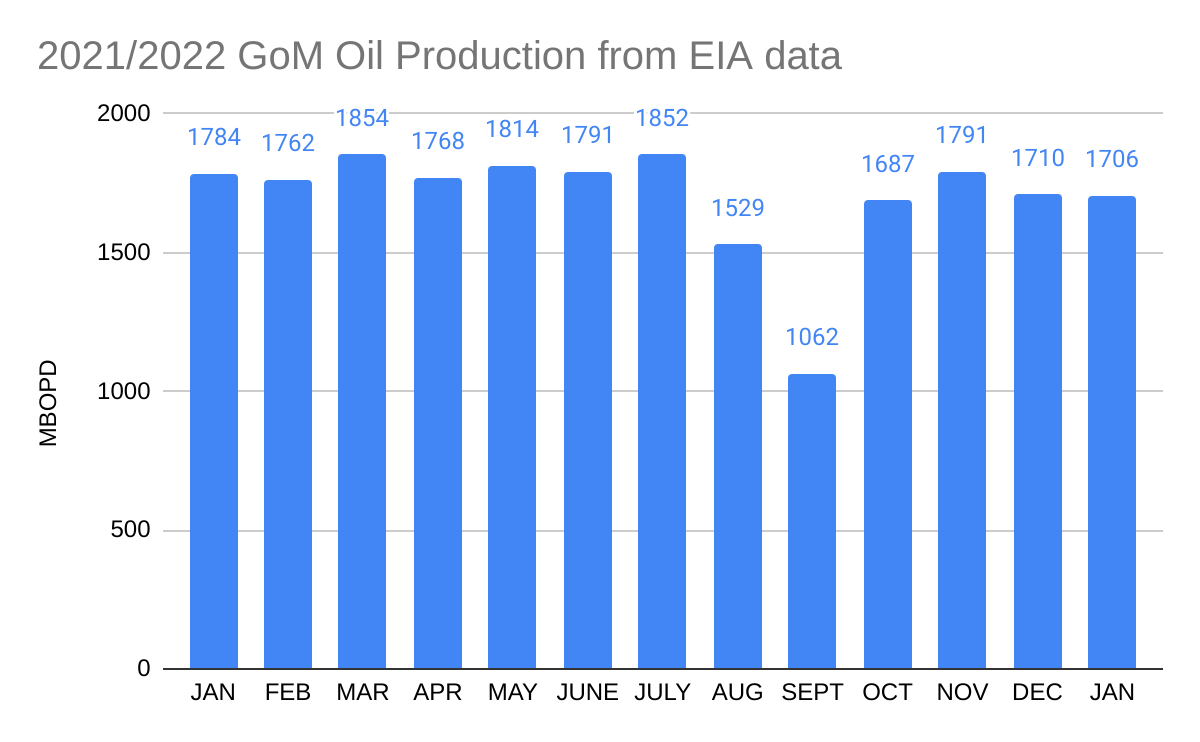
The short-term forecast doesn’t say how much of that production will come from the Gulf of Mexico. Last year, EIA forecast 2022 Gulf production to average 1.75 BOPD which seems about right based on the the most recent production data.
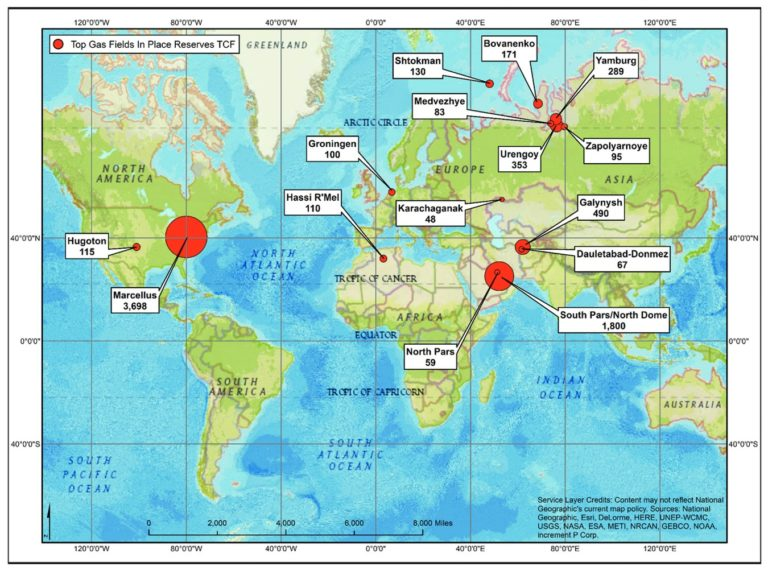
Linked is a good article by geologist Gregory Wrightstone about the stunning non-conventional natural gas resource potential of the Appalachian Basin of the eastern US. Unsurprisingly, development of these resources is constrained by pipeline capacity and the legal and administrative challenges associated with new pipeline construction. Also note that New York has blocked development of its natural gas resources. Fortunately, Pennsylvania, West Virginia, and Ohio have shown better judgement.
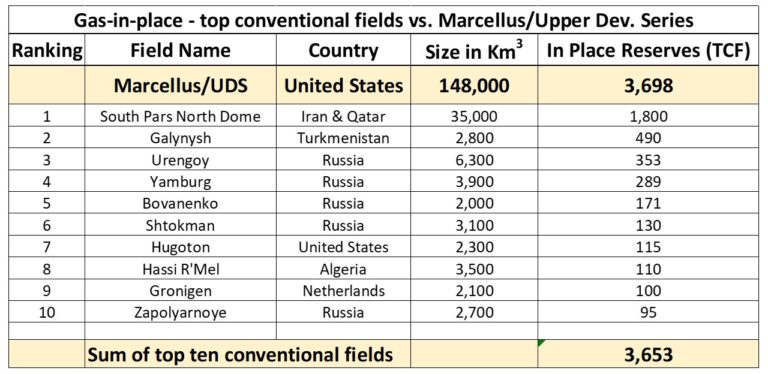
According to Bill Zagorski, who was given the moniker of the “Father of the Marcellus,” the gas-in-place of the Marcellus dwarfs all conventional fields in the world. The size is so large that the ten largest conventional fields in the world combined do not equal the in-place reserves of the Marcellus.
Murphy’s six partners all appear to be investment companies. This type of support is essential given the reduced Gulf of Mexico participation by some of the major oil companies. Ridgewood Energy has the largest stake among the Murphy partners. In the “old days,” the partners were typically other exploration and production companies.
The Unleashing American Energy Act requires a minimum of two oil and gas lease sales to be held annually in available federal waters in the Central and Western Gulf of Mexico Planning Area, and in the Alaska Region of the Outer Continental Shelf.
The Securing American Energy and Investing in Resiliency Act requires the Department of the Interior to conduct all remaining offshore oil and gas lease sales in the current leasing plan and issue leases won as a result of Lease Sale 257.
The Strategy to Secure Offshore Energy Act requires the publications of the 2022-27 plan for offshore oil and gas lease sales by the time the current plan expires on June 30, 2022.
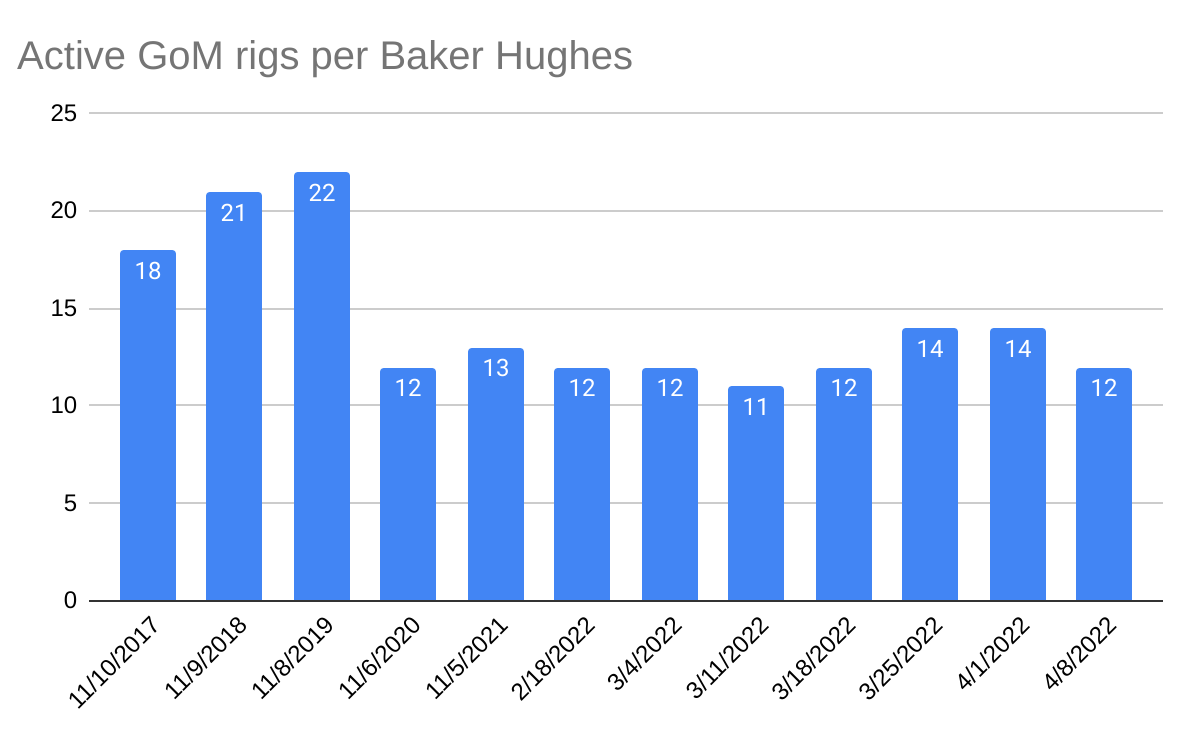
Deepwater production is noteworthy for widely dispersed surface structures supplemented with subsea systems. In the past 30 years, the total number of Gulf of Mexico platforms declined by 50% while the oil production doubled. Of course, this level of production is not sustainable without regular lease sales and increased exploration. In that regard, the signs are not good.
435 GoM shelf platforms have been removed in just the last 5 years (2017-2021). The loss of platforms is accompanied by a loss of marine habitat that the rigs-to-reefs program has partially compensated for. There have been a number of other interesting proposals for the use of old platforms, some more serious than others.
Current number of Gulf of Mexico platforms by water depth:
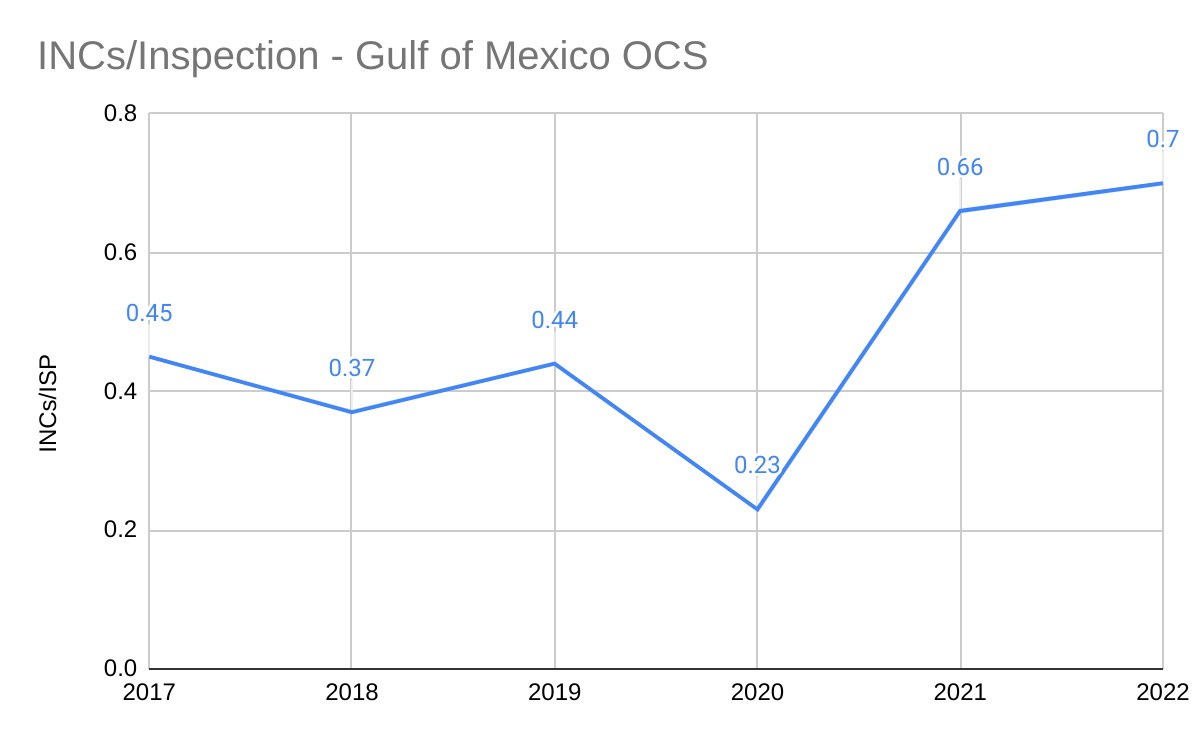
Per BSEE’s online Incident of Non-Compliance (INC) data, 4 operating companies accounted for 64% of the INCs during Q1 of 2022 (see chart below). Fieldwood was once again cited for the most INCs (132), but GOM Shelf LLC had the highest INC/inspection ratio (1.53). All 55 of the Whitney Oil & Gas INCs resulted in Facility Shut-In orders. Whitney was cited for failing to comply with damage inspection and records requirements following Hurricane Ida.
The overall violations rate during Q1 of 2022 was essentially unchanged from 2021. A number of companies had outstanding records. We’ll comment on them later in the year.
This WSJ report, if accurate, reflects the mindset that you can increase oil production on demand when absolutely necessary, and avoid committing to longer term oil and gas supplies. The goal of such thinking is to address supply crises without alienating the uncompromising climate ultras. You suspend lease sales, deny new pipelines, and demonize oil and gas and the people who produce it. When supplies tighten and prices spike, you tap the strategic reserve, appeal to OPEC, talk to Venezuela and Iran, and ask Canada to ship more oil in rail cars or trucks (but no new pipelines please!). .
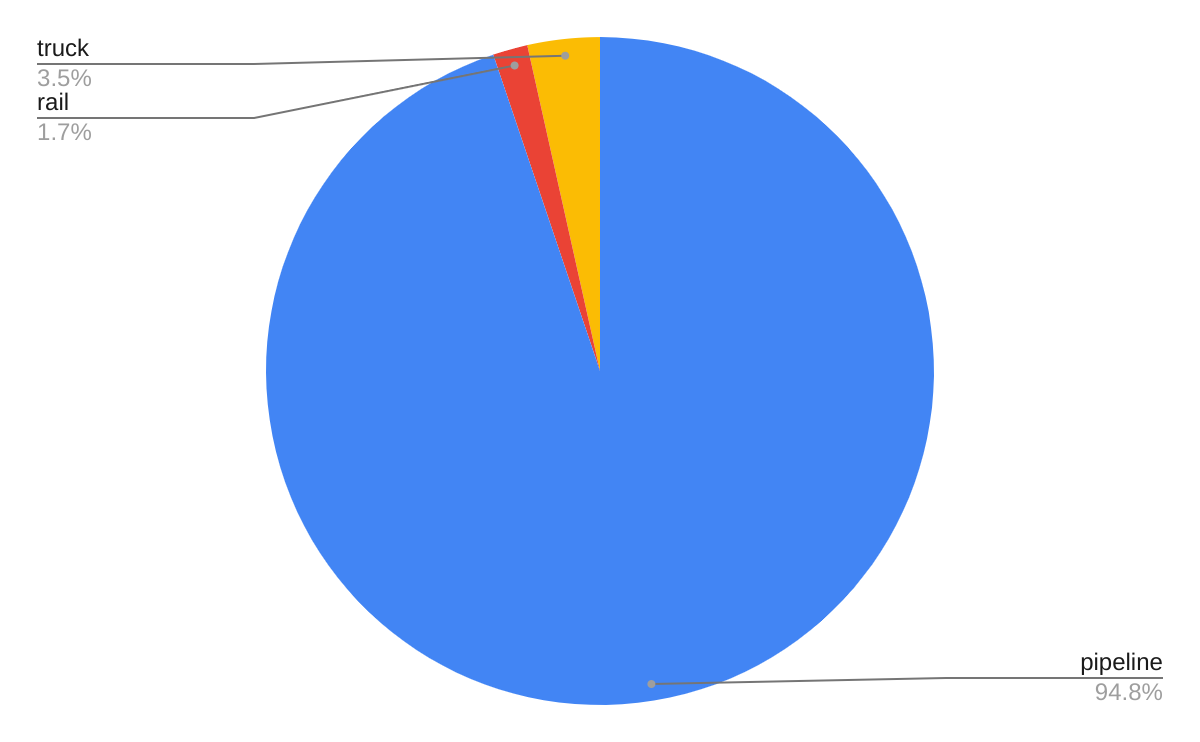
Below is a pie chart constructed using data from a 2018 DOT report to Congress. For logistical and economic reasons, pipelines are overwhelmingly the crude oil transport method of choice. Rail cars and trucks are called on where there are no pipeline options.
Looking at the systems, one would assume that pipelines have safety and environmental advantages. Loading and unloading hundreds of tanks would seem to be inviting spills, although most would presumably be small. The DOT data bear this out. On a volume transported basis, spill incidents occurred nearly 15 times more frequently for rail cars and trucks than they did for pipelines.
For pipeline(s), an incident occurred approximately once every 720 million gallons of crude oil shipped. For rail, an incident occurred approximately once every 50 million gallons of crude oil shipped. For truck(s), an incident occurred approximately once every 55 million gallons of crude oil shipped.
Looking at the percentage spilled, pipelines also had a significant (7.6 times) advantage over rail, but only a slight advantage over trucks.
Volume of Crude Oil Shipped and Spilled by Pipeline, Rail, and Truck, 2007-2016
Pipeline
volume shipped (k gal)
1,298,630,088
volume spilled (k gal)
13,161
% spilled
0.0010%
Rail
volume shipped (k gal)
23,052,960
volume spilled (k gal)
1,751
% spilled
0.0076%
Truck
volume shipped (k gal)
47,894,868
volume spilled (k gal)
521
% spilled
0.0011%
Because fatalities or hospitalizations were extremely rare, DOT chose not to normalize those data. There were a total of 3 fatalities associated with both pipeline and truck shipments. While no fatalities were associated with rail shipments, DOT noted that 47 deaths resulted from a crude oil derailment in Lac Megantic, Quebec in 2013. BOE further reminds readers that this train was transporting Bakken crude from North Dakota to a refinery in St. John, New Brunswick.
The bottom line is that you have to plan ahead to satisfy future supply needs. This is particularly true for the offshore sector where the lead times are longer, but the production volumes relative to the number of wells and facilities are higher (a good thing). The need for oil and gas is not going away, nor are threats to energy security. There are plenty of people in the U.S. Department of the Interior who understand this. Empower them to safely expedite leasing, exploration, and development!



 Bud's Offshore Energy (BOE)