Feeds:
Posts
Comments

Archive for June, 2010

Michael Bromwich

Michael Bromwich, a former Federal prosecutor, will lead the reorganization of the Minerals Management Service into two new bureaus and a minerals revenue office.  I hope he meets as many MMS personnel as time allows.  He will be pleasantly surprised by their knowledge, integrity, and commitment.

In addition to former Senator Bob Graham and former EPA Administrator Bill Reilly, President Obama named the following individuals to head the National Commission on the BP Deepwater Horizon Oil Spill and Offshore Drilling:

Frances G. Beinecke: President of the Natural Resources Defense Council (NRDC), a non-profit corporation that works to advance environmental policy in the United States and across the world.

Donald “Don” Boesch: President of the University of Maryland Center for Environmental Science, where he is also a professor of Marine Science and vice chancellor for Environmental Sustainability for the University System of Maryland.

Terry D. Garcia: Executive vice president for mission programs for the National Geographic Society.

Cherry A. Murray: Appointed dean of the Harvard School of Engineering and Applied Sciences (SEAS) and the John A. and Elizabeth S. Armstrong Professor of Engineering and Applied Sciences in July 2009, and the past president of the American Physical Society.

Frances Ulmer: Chancellor of the University of Alaska Anchorage (UAA), Alaska’s largest public university.

Read Full Post »

BOP Testing Timeline

Transocean’s interim report is circulating online.  Click here: Transocean Investigation

Read Full Post »

A BP plan review prepared in mid-April recommended against the full string of casing because it would create “an open annulus to the wellhead” and make the seal assembly at the wellhead the “only barrier” to gas flow if the cement job failed. Despite this and other warnings, BP chose the more risky casing option, apparently because the liner option would have cost $7 to $10 million more and taken longer.

While the circumstances and details differ significantly, Montara (Timor Sea blowout) flashed across my mind repeatedly while reading this informative letter from Chairmen Waxman and Stupak to BP.  Common themes:

  1. Well integrity roulette: high risk well design
  2. Suspect production casing cement job
  3. Only one questionable barrier above the cement
  4. Multiple poor decisions on barriers
  5. Schedule concerns, time and efficiency pressure
  6. Failure to run Cement Bond Log and conduct confirming tests
  7. Mud weight and conditioning issues

Read Full Post »

The Unified Command’s collegial atmosphere seems to have given way to letter writing and public posturing.  Agency and company logos are no longer side-by-side on the official response website banner and joint briefings ended shortly after the Top Kill disappointment.  What all this means for future emergency response operations and the Unified Command concept remains to be determined.  Major spill response exercises and table-top drills cannot simulate the stress associated with a long battle like Macondo, and the resulting legal, administrative, and political tension.

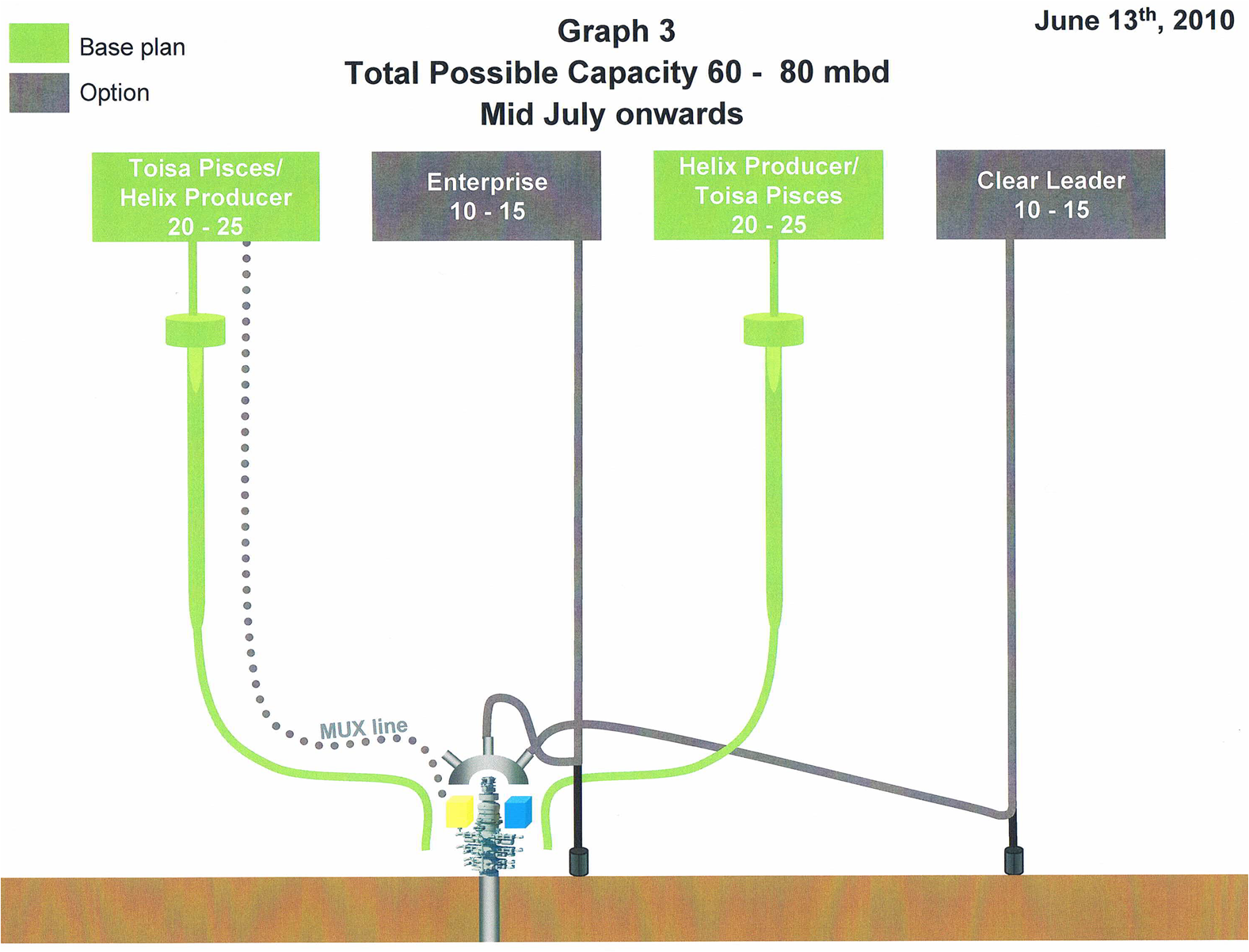
In any event, a 13 June letter from Doug Suttles to Admiral Watson outlines BP’s impressive production strategy for the Macondo, pending completion of the relief well.  Most elements of this collection and production plan had been previously identified.  However, I was surprised by the following sentence on page 3:

Install a new LMRP cap with sufficient seal integrity to ensure a successful relief well kill operation.

I believe this is the first time BP has suggested that the success of the relief well was in any way linked to seafloor capping or wellhead intervention operations.  I assume BP is simply acknowledging that the kill operation would be easier if flow from the cap is constrained and back-pressure imposed on the flowing well.  Perhaps BP would like to elaborate.

Read Full Post »

From the Philadelphia Inquirer:

“Our preliminary investigation found there was a failure to the blowout preventer,” the DEP’s Weaver said Monday. “The blowout preventer did not function properly. If it had, there would not have been a blowout. The company also confirmed that the blowout preventer failed.”

The Pennsylvania Department of Environmental Protection is investigating.

Read Full Post »

Ponder this: What if the responsible party was not BP or one of the other “supermajors” (i.e. Shell, Chevron, ConocoPhillips, ExxonMobil, and Total)? This would have been the likely scenario:

  1. The responsible party, which we’ll call Company XYZ, would have quickly exhausted its financial resources, including insurance.  Bankruptcy would be a high probability.
  2. XYZ would have to control costs and would not contract a second relief well rig, employ an armada of support vessels and ROVs, fund protective barrier islands, or install a complex floating production system for oil containment and recovery purposes.  The Federal government could, of course, direct XYZ to do all of these things, but how could XYZ comply?
  3. The Oil Spill Liability Trust Fund would be exhausted.  The per barrel production and transportation fees would have to be quickly and  significantly increased to pay the ongoing spill response costs.
  4. XYZ would limit damage payments to the $75 million maximum specified in the Oil Pollution Act of 1990.  Congress could, of course, change that limit, but could they do so retroactively?
  5. In light of the above, the entire mess would become the responsibility of the Federal government.  The government would have to design and manage the relief well operations, subsea collection programs, and all aspects of the spill response.  All this would have to be accomplished amidst loud (think vuvuzela noise levels) public criticism, finger-pointing, and emergency hearings and litigation.  Multiply the current level of acrimony and discontent by 100 and you get a sense of how ugly this would be.

What happens to the Macondo field? We don’t know much about the size of the Macondo reservoir(s), but we have certainly learned about the impressive flow potential.  After the well is plugged and the regulatory issues are addressed, will BP seek to develop the field, assign their interests to other companies, or relinquish their leases?  Will BP even have the option of making these choices, or will the Federal government seek to disqualify the company from developing the field?

Relief well plans: While BP has done a better job of providing technical information, the precise relief well target has not been specified.  In that regard, BOE has received a number of complaints from engineers and other interested parties.  Since the region and nation are literally and figuratively dependent on this well for relief, the public needs to know more about the plan.  We now have the casing program details for the well that is flowing (thanks to DOE), so the key piece of information needed is the specific intercept point in the well bore.   We also need to know the suspected flow path(s) for the oil.  Surely BP and the Unified Command have an informed opinion on that important matter.  Again, the right to confidentiality on these matters was forfeited when the well blew out.

Read Full Post »

Yanks win: 1-1! 🙂

Read Full Post »

New 5MB hard drive to be used for spill rate estimates.

BOE exclusive: We have learned that the Flow Rate Technical Group (FRTG) has imported sophisticated new computer equipment (pictured above) which will finally settle the Macondo flow rate debate.  The dart boards used in making previous estimates are being shipped to the Smithsonian for public viewing 🙂

The FRTG has four teams of distinguished scientists and engineers, but only 2 have provided estimates – the Plume Team and the Mass Balance Team.  The Plume Team seems to be getting the most publicity, probably because their large range (20,000 – 40,000 bopd) includes the highest “official” flow estimate to date.  Before embracing these results, you may want to take a look at their statement and the summary paper, neither of which instills great confidence.

The Reservoir Modeling Team seems to be the best hope for a reasonably accurate estimate, but has yet to provide any findings.  Their approach is described below:

This team will describe the geologic formations as well as composition and pressures of the oil, natural gas, and other compounds that are being released.  Using open-hole logs; pressure, volume, and temperature data; core samples; and analog well or reservoir data; the team will populate computer models and determine flow rate from targeted sands in the well as a function of bottomhole pressure.

Don’t expect this controversy to be settled soon.

Read Full Post »

Read Full Post »

Has US bloodlust at BP gone too far?

Many will argue that BP deserves to die, and anger is entirely understandable. But critics should be careful what they wish for. America is a nation with a tradition of due process and everybody – even “big oil” – is entitled to a fair trial.

Read Full Post »

« Newer Posts - Older Posts »