Feeds:
Posts
Comments

Posts Tagged ‘well control’

Despite the vast differences in location and water depth, both the Montara and Macondo blowouts would have been prevented if negative pressure tests had been properly conducted and interpreted after the production casing had been set.

A negative pressure test simulates an underbalanced condition in which the formation pressure exceeds the pressure exerted by the fluid column.  The purpose of the test is to determine if there are leaks in the casing shoe track, casing, or seal assembly. At Macondo, the test was conducted and the evidence of inflow is quite clear.  Unfortunately, that evidence was misinterpreted.  See slides 14-17 in the linked presentation.

At Montara, the testimony suggests that a negative pressure test was not properly conducted.  PTTEP therefore had a false sense of security regarding the integrity of the casing shoe. See page 9 of this transcript.

Both wells subsequently flowed through the shoe track and inside production casing for a combined duration exceeding 5 months.

There are currently no industry standards for conducting and interpreting negative pressure tests.

Read Full Post »

“Can’t happen again” was the mantra of the OCS oil and gas program for 40 years after the Santa Barbara blowout.  “Can’t happen here” was the short-lived message of government and industry after last year’s Montara blowout in the Timor Sea.   Surprisingly, new versions of the “can’t happen” message have been heard since Macondo.  Companies have boasted that “it couldn’t happen to us,” and some government representatives have claimed that their regulatory regimes would have prevented the blowout.  The beat goes on.

Macondo will not be the blowout that ends all blowouts, and Macondo will not be the last major offshore accident.  We need to focus on reducing the risks of another disaster during drilling, production, or transportation, in deep or shallow water, arctic ice, and every other environment where operations are conducted. The new mantra, no matter where you operate or regulate, should be “CAN HAPPEN AGAIN.”  That is the attitude we need if we are to prevent future accidents.  We should preach the “CAN HAPPEN AGAIN” message loudly and clearly, no matter how many years (hopefully decades) elapse before the next major accident.

We’ve heard a lot of details about the shortcomings of the well design, the companies involved, and one of the regulators.  However, consistent with the CAN HAPPEN AGAIN message, we need to also look at the high-level management, leadership, and regulatory issues. How do we sustain outstanding performance and minimize the risks of major accidents?  Here are four suggestions that have received little attention since the blowout:

  1. Challenge industry.  One lesson I have learned from the Norwegians is to make industry take ownership for their problems. Instead of halting deepwater drilling for six months while the government attempts to fix the problems (real and perceived), we should have given offshore operators six months to develop a plan for not only preventing another Macondo, but reducing the risks of any major drilling, production, and pipeline accidents.  If the government wasn’t satisfied with the industry plan, operations could be curtailed until a good plan was developed.
  2. Improve management systems and cooperative industry programs.  US operators and contractors are understandably in a reactive mode with a goal of lifting the moratorium. However, the next disaster will not duplicate this one.  The offshore industry must provide the leadership needed to improve management systems and develop cooperative programs that will monitor performance, evaluate technology and procedures, and asses risks.
  3. Truly reorganize the OCS regulatory program by consolidating safety and pollution prevention functions into a single authority. Wells, platforms, and pipelines are integrated systems.  You can’t divide the components among regulators and expect the regime to function effectively and efficiently. That’s not possible. A few examples (there are may more): separate agencies should not regulate connecting OCS pipelines; separate agencies should not regulate offshore cranes based on the type of facility; and multiple agencies should not regulate the integrity of floating structures.  Because of the complexity of the OCS regime, regulatory and industry personnel spend too much time resolving and coordinating administrative and procedural matters.  This time would be better spent focusing on mission critical safety issues.   A single agency should be responsible and accountable for safety and pollution prevention at offshore facilities, including the review of plans, permit applications, and management systems, and the conduct of inspections and audits needed to assess performance and verify compliance.
  4. Request assistance from international regulatory partners. While numerous US entities have questioned regulators in Norway, the UK, Australia, Canada, and elsewhere, no one has actually asked these organizations for assistance.  In lieu of one or more of the official US inquiries, international regulators should have been called on to review the accident and the regulatory regime. Who has spent more time assessing regulatory options than other regulators?  Who knows more about establishing and achieving safety performance objectives? Who else is knowledgeable and objective, yet insulated from US political influences?

Read Full Post »

Here’s the link. This is a highly specialized and technical task, and no information has been provided on the inspection team. Other than employees of Cameron and their competitors, the pool of people who can perform a detailed inspection of BOP components is pretty small.   It would be interesting to know who is conducting this inspection.

Read Full Post »

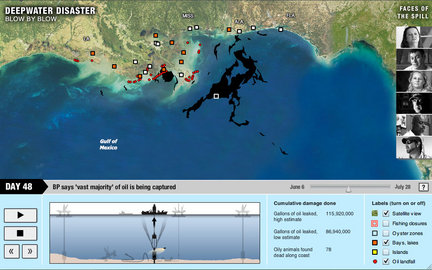
Click here or on the image above to see this excellent animation of the slick movement and well control efforts versus time.  Check it out; this is definitely worth viewing.

Read Full Post »

BOE has previously commented that completion of the Macondo relief well appeared to be unnecessary, and and that the intercept adds additional risk to the plugging and abandonment operation.  Pasted below are disconcerting Unified Command and BP statements about the intercept followed by BOE comments:

I have stated over and over again, let me be perfectly clear. I am the National Incident Commander. I issue the orders. This will not be done until we complete the bottom kill. Admiral Allen, 5 August 2010

Comment: While I believe Admiral Allen has performed well in the difficult and thankless job of incident commander (as did Admiral Landry before him) and wanted to make it clear that the government was in charge of this operation, this strong statement appears to have painted the Unified Command into a corner.

… in response to BP’s request to consider foregoing the relief well, the government scientific technical team has determined that the benefits of the bottom kill procedure outweighs the risks. (14 August letter from Admiral Allen to BP)

Comment: Reading between the lines, we assume that at least some BP engineers favored foregoing the relief well intercept, and wanted to proceed with a conventional plugging and abandonment operation.  Was their proposal given serious consideration?  How could it have been given the Admiral’s prior statements about completing the relief well?

We are currently working with BP engineers and our science team to look at test results and do investigations to lead us to the best way to mitigate any risk of intercepting the annulus and increasing the pressure in the annulus. Admiral Allen, 16 August

Comment: Much attention continues to be focused on mitigating the risks of an operation that appears to be unnecessary.

There are several reasons for the relief well to be completed, including demonstrating that the difficult procedure can be done, providing more scientific data about the leak and giving closure to an oil-weary public. BP CEO Bob Dudley, 29 August

Comments: This BP statement seems to contradict their prior request to forgo completion of the relief well.  With regard to Mr. Dudley’s rationale for completing the relief well, I’ll offer the following:

  1. If BP believes they need to demonstrate relief well intercept capability (not necessary in my view), they should drill into one of the thousands of depleted wells in the Gulf, not Macondo.
  2. This is not a risk-free science project.  Are the risks and delays justified?
  3. The “oil-weary public” needs an offshore industry that is committed to safety and pollution prevention, not symbolic gestures.

And in order to speed the process up, but also ensure that we had the right pressure controls on the well, I’ve signed a directive out to BP earlier this morning, directing them to take a series of measurements on the well head that would allow us to ascertain whether or not the seal in the ring – in the casing hanger were in place and had not lifted and, if that was the case, then to be able to put what we call a sleeve over the top of it that would basically walk that down to the point where it could withstand over one million pounds of pressure and would obviate the need to be able to cement the annulus at the top.

And subject to BP providing me the plans and the results of those tests, that would allow us to go ahead and proceed more quickly without having to cement the top of the annulus.  And based on a revised schedule from BP, we might be able to accelerate going ahead and finishing out the relief well. Admiral Allen, 10 September

Comment: Let me get this straight.  They are going to put off the cementing of the annulus, which will have to be done anyway and would provide a barrier should something go wrong with the intercept, so they can conduct tests (that would be unnecessary if they first cemented the annulus) for the purpose of expediting completion of the long-delayed relief well? Huh?

Read Full Post »
  • NOPSA has issued an excellent Health and Safety Performance Report for Australian offshore operations.  Here’s the link.
  • BOE fave Martin Ferguson has retained his energy post in the new government.  We trust that he will release the Montara Inquiry report without further delay.
  • Per Upstream, the destroyed West Atlas jackup rig is being removed from the Montara wellhead platform in the Timor Sea, and all wells have been secured with barriers.  In light of the lessons learned at Montara, can we assume that corrosion caps and well fluids are not being counted as barriers?  What is next for the Montara?  Will PTTEP be authorized to resume development of the field?  Should they be?

Read Full Post »

On 8-9 September, the International Regulators’ Forum (IRF) met in Herndon, Virginia, to address offshore safety issues in the wake of the Macondo and Montara blowouts.  This was the first extraordinary meeting in the IRF’s 17-year history.  In a statement released after the meeting, the IRF resolved to:

  • Provide leadership on safety and safety related regulatory matters for offshore oil and gas activities.  A strategic agenda will be discussed and adopted at the next IRF meeting in October in Vancouver.
  • Develop an audit protocol looking at BOP integrity and operational issues, for use by all IRF members to provide a consistent approach.
  • Continue to strengthen sharing of regulatory practice and experience and provide a sounding board for key initiatives of members.

These and other offshore safety issues will be discussed at the upcoming (18-20 October) IRF conference in Vancouver.  This conference is open to all interested parties.

Read Full Post »

Transocean slams the BP Macondo report:

However, rig owner Transocean slammed the report, saying: “This is a self-serving report that attempts to conceal the critical factor that set the stage for the Macondo incident: BP’s fatally-flawed well design.”

BOE Comment: At a time when the safety of oil and gas operations is rightfully under intense scrutiny, this ugly dispute further undermines public confidence in offshore exploration and development.  BP, Transocean, Halliburton, Cameron, and other feuding companies need to resolve their disputes so they can fully and credibly participate in the critical industry and governmental programs that are addressing offshore safety and pollution prevention issues.

Read Full Post »

Here is the link.

Our main interest was in the flow path and BOP issues:

Flow path:

The investigation team concluded that hydrocarbon ingress was through the shoe track, rather than through a failure in the production casing itself or up the wellbore annulus and through the casing hanger seal assembly.

BOP:

  1. The explosions and fire very likely disabled the emergency disconnect sequence
  2. The condition of critical components in the yellow and blue control pods on the BOP very likely prevented activation of another emergency method of well control, the automatic mode function (AMF), which was designed to seal the well without rig personnel intervention upon loss of hydraulic pressure, electric power and communications from the rig to the BOP control pods. An examination of the BOP control pods following the accident revealed that there was a fault in a critical solenoid valve in the yellow control pod and that the blue control pod AMF batteries had insufficient charge; these faults likely existed at the time of the accident.
  3. Remotely operated vehicle intervention to initiate the autoshear function, another emergency method of operating the BOP, likely resulted in closing the BOP’s blind shear ram (BSR) 33 hours after the explosions, but the BSR failed to seal the well.
BP’s flow path assessment is consistent with our expectations.  Early on, while most of the attention was focused on the annulus, we thought that flow inside the production casing was a distinct possibility.  With regard to the BOPs, BP’s explanation is a more complete than we expected at this time, given that the stack has just been recovered.
More to follow.

    Read Full Post »

    While we wait for the Bly Report (BP), Colin Leach (without the benefit of staff and access) has issued his concise and credible report on Macondo. I recommend that you take a few minutes to read it. Many thanks to Colin for his continued leadership on offshore safety issues.

    Read Full Post »

    « Newer Posts - Older Posts »