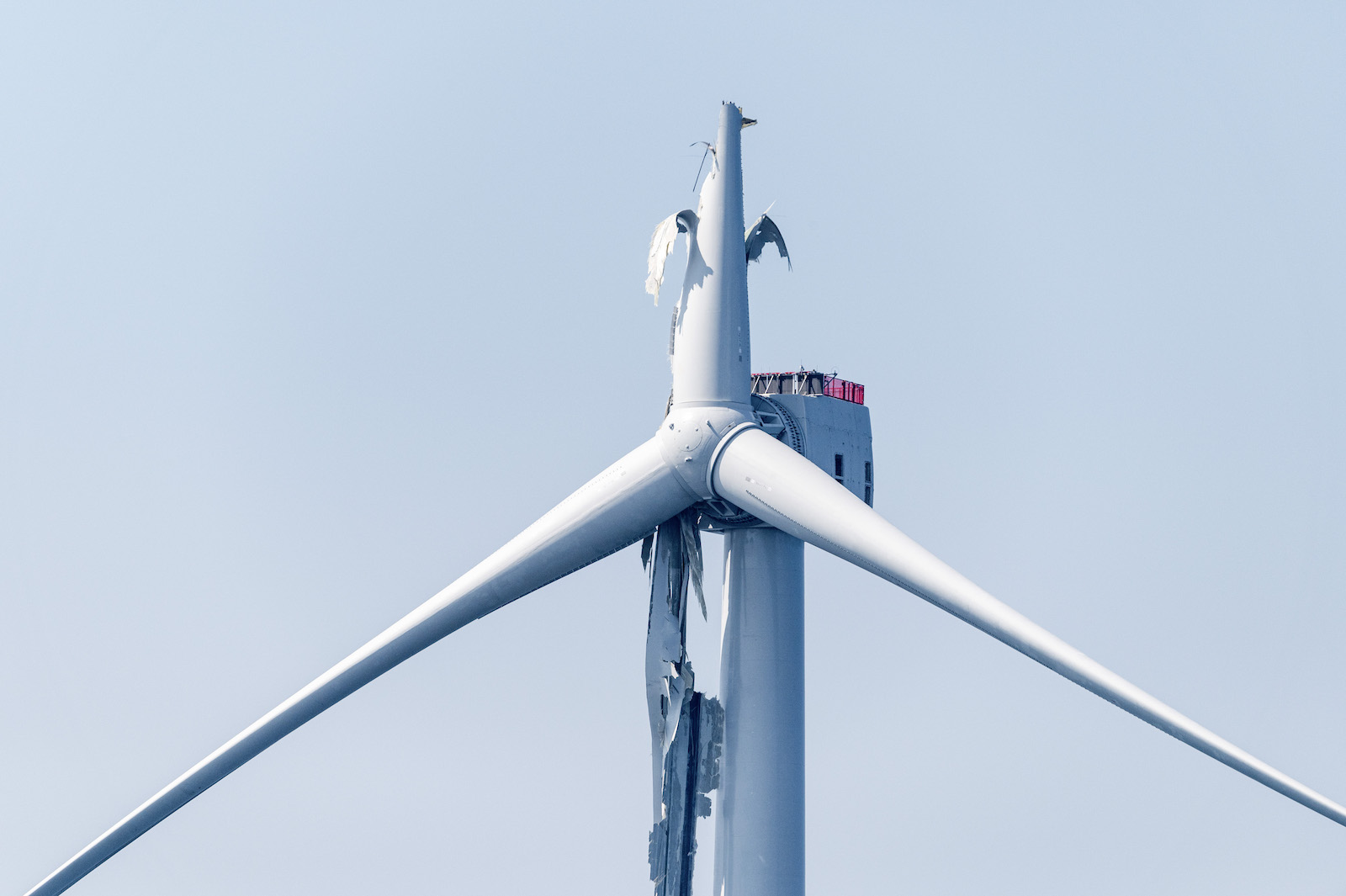
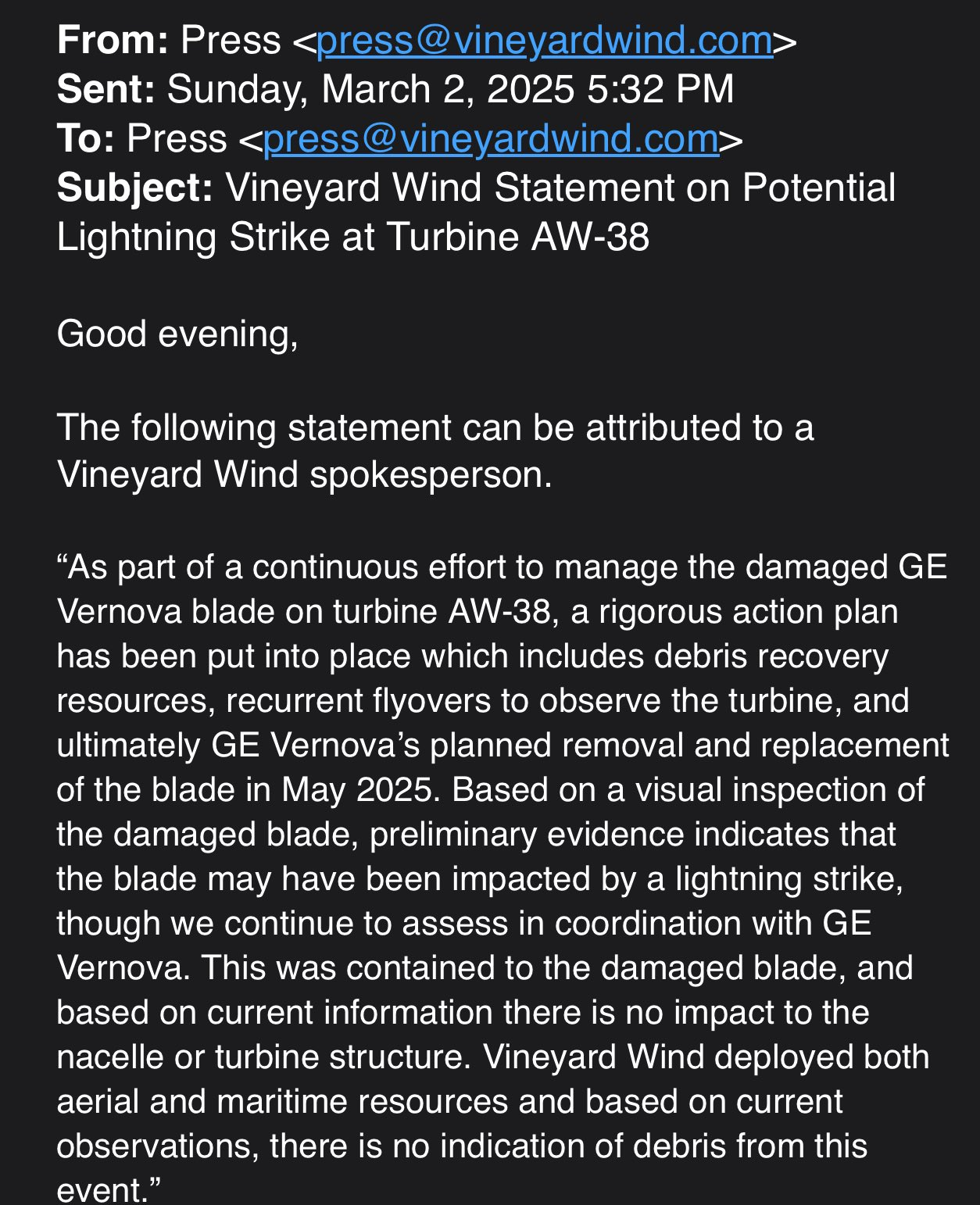
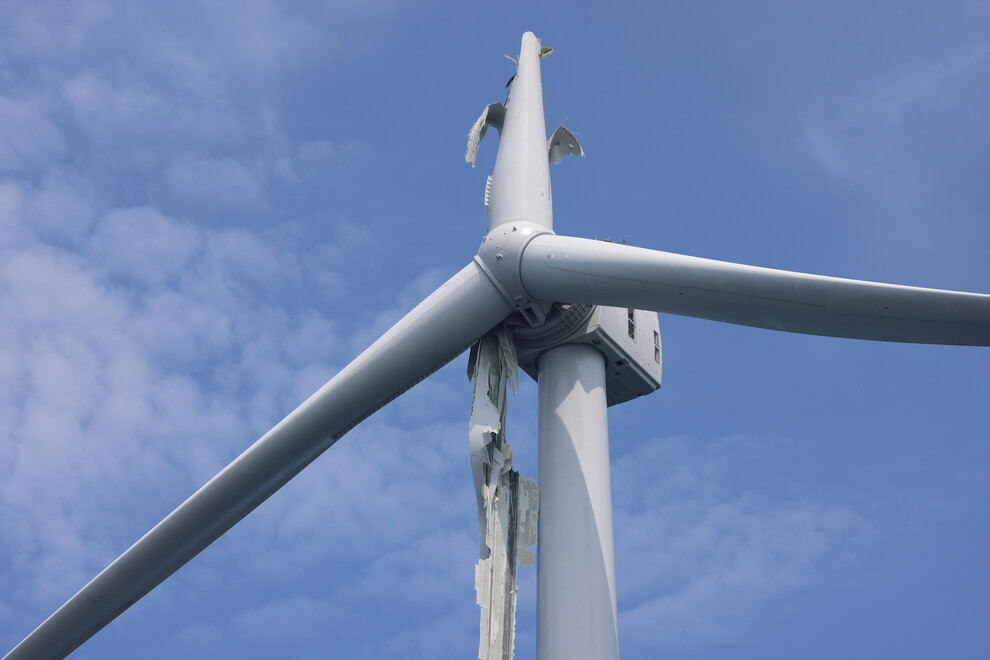
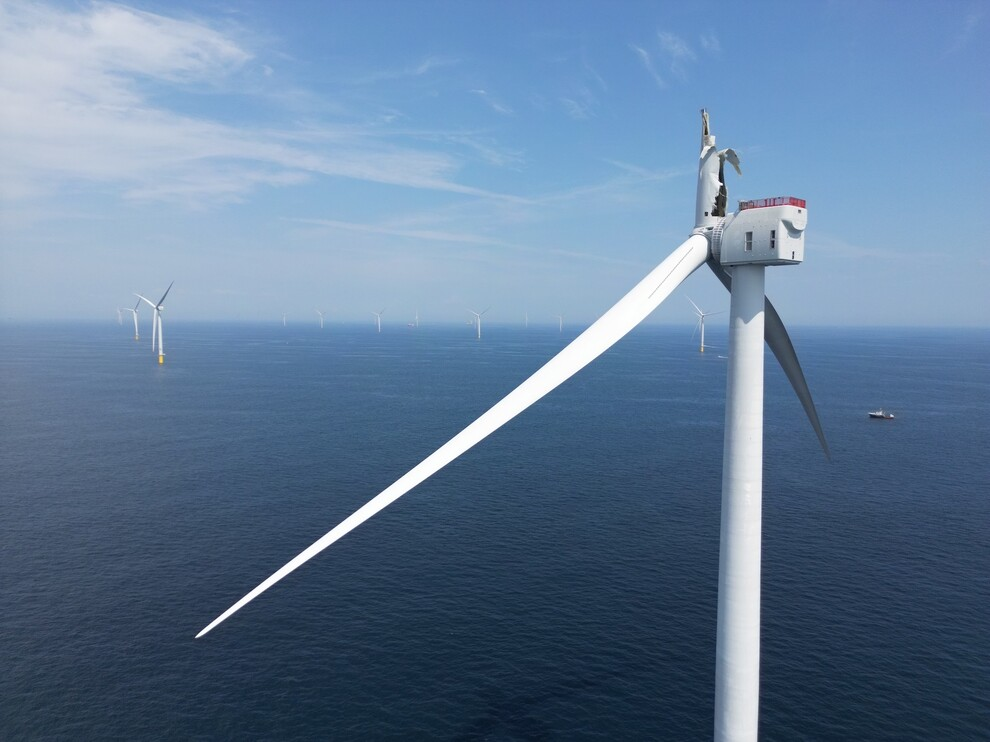
The same Vineyard Wind turbine blade that failed last summer has now been struck by lightning:
“Lightning struck the fractured stub of Vineyard Wind’s broken turbine blade in the early morning hours on Friday (2/27), according to representatives from Vineyard Wind and the Coast Guard. It was the remnants of the broken blade that snapped this July that were still attached to the turbine.”
“It appears the town (Nantucket) was not informed of the lightning strike by Vineyard Wind until it received media inquiries about it, over 48 hours after it happened.”
We “feel misled” Nantucket Select Board member Dawn Hill Holdgate gives State Rep Thomas Moakley and State Sen. Julian Cyr an earful on Vineyard Wind.
“We as a board, and the community at large even more vehemently, really feel misled by the representations we were given back in 2020…”
“The visual simulations we were given were not accurate.”
“The promises on the lighting, they have been fully lit for quite a long time now. That never should have happened.”
“The safety and the environmental impacts on the sea life are just far greater than the information we were provided when we were offered a financial settlement based on just the visual impact on our historic landmark, which is far more impactful than the simulations we were shown.”
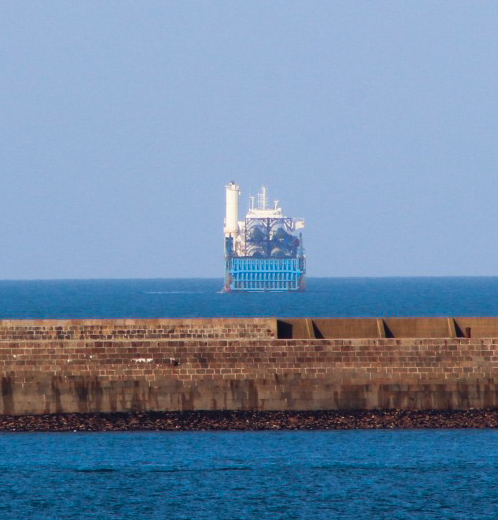
Blade replacement update: “They’ve removed four complete sets to date,” Nantucket Select Board chair Brooke Mohr said tonight. That would mean 12 of the 66 compromised blades Vineyard Wind is required to remove have been taken down.
Perhaps Nantucket should have added Jayden Daniels to their team! 😉
Although the SCOTUS declined to hear their challenge, the Nantucket group may still achieve their objective, at least in part, given the looming changes in Federal policy and the financial and operational challenges facing the offshore wind industry.
A recent Nantucket Current piece criticizes the Nantucket Select Board for failing to address community concerns about the attached Good Neighbor Agreement (GNA) with Vineyard Wind. In particular, any discussion about the GNA was throttled at a recent public forum on the SouthCoast Wind project.
Some key points from the article and related thoughts:
The GNA established a long-term relationship between Vineyard Wind and Nantucket. In essence, Nantucket became a partner and an advocate for the projects.
Sections 5.2 and 5.3 of the GNA are particularly striking and believed to be unprecedented in the history of Federal offshore energy programs.
Section 5.3 stipulates that “the Nantucket Parties shall use their reasonable best efforts to inform federal, state, and local elected officials of their support for the Projects” throughout the environmental, historical, and state review processes. Wow, nothing subtle about that directive!
By signing the GNA with Vineyard Wind, Nantucket withdrew from the important National Historic Preservation Act consulting process for these projects.
Vineyard Wind, New England Wind, and the other projects that are covered under the GNA will add approximately 350 turbines off Nantucket’s south shore beaches.
Given the partnership with Vineyard Wind, it’s difficult for Nantucket to challenge the mitigations for another project, SouthCoast Wind, which is not covered by the GNA.
The Nantucket GNA controversy should be carefully considered by other communities that are tempted by developer incentives to enter into agreements that may not be in their best long-term interest.
Will Nantucket exit (Nexit) the GNA? The pressure is building.
LM/GE Vernova turbine blade plant. Photo credited by the New Bedford Light to Jean-Philippe Thibault/Journal Gaspésie Nouvelles.
On Oct. 24, Radio Gaspesie reported serious data falsification allegations related to the manufacturing GE Vernova turbine blades at their Gaspé, Quebec facility. GE Vernova’s delay in commenting on those charges is surprising given their economic and legal implications in both Canada and the US.
GE Vernova has informed the New Bedford Light that they have taken corrective actions at their blade facility in Gaspé after an extensive internal review of their blade manufacturing and quality assurance program. However, they have yet to comment on the data falsification allegations.
Actions speak louder than words, and the Light reports that GE Vernova laid off nine managers and suspended 11 unionized floor workers at the Gaspé factory. A representative for the union informed the Light that the production manager has been dismissed and the general manager has resigned.
Neither Vineyard Wind nor BSEE, the Federal safety regulator for the Vineyard Wind project, has commented on the matter. BSEE’s investigation of the blade failure is still pending and has seemingly gotten more complicated as a result of the manufacturing issues.
In addition to legal proceedings in Quebec, GE Vernova and Vineyard Wind are subject to possible civil and criminal penalties in the US. Civil penalties, which are administered by BSEE, seem likely given the extensive pollution from turbine blade fragments.
Criminal penalties, which are possible if the data falsification charges are proven true, are imposed by the Dept. of Justice. The applicable criminal penalties statute is pasted below.
Any person who knowingly and willfully (1) violates any provision of this subchapter, any term of a lease, license, or permit issued pursuant to this subchapter, or any regulation or order issued under the authority of this subchapter designed to protect health, safety, or the environment or conserve natural resources, (2) makes any false statement, representation, or certification in any application, record, report, or other document filed or required to be maintained under this subchapter, (3) falsifies, tampers with, or renders inaccurate any monitoring device or method of record required to be maintained under this subchapter, or (4) reveals any data or information required to be kept confidential by this subchapter shall, upon conviction, be punished by a fine of not more than $100,000, or by imprisonment for not more than ten years, or both. Each day that a violation under clause (1) of this subsection continues, or each day that any monitoring device or data recorder remains inoperative or inaccurate because of any activity described in clause (3) of this subsection, shall constitute a separate violation.
See the translated excerpts below from a Radio Gaspesie report. This is a massive scandal if true.
“Yesterday, the vice-president of global operations at GE Vernova reportedly addressed all employees at the Gaspé plant to provide an update on the situation.
The investigation, led by GE Vernova’s lawyers, reportedly revealed that employees were asked by senior company executives to falsify quality control data. Data associated with a well-made blade was then associated with poorly made blades. Our sources indicate that this is a widespread practice in the industry.
The senior management of the Gaspé plant also allegedly implemented a points system that encouraged employees to skip verification steps, thus prioritizing production quantity over quality.
Our sources say the points system allegedly involved tight management oversight that bordered on intimidation of employees.
The oversized 107m blades that were produced in Gaspé for the construction of marine parks are said to be affected. The integrity of the entire production of the longest blades in America is currently being called into question.“
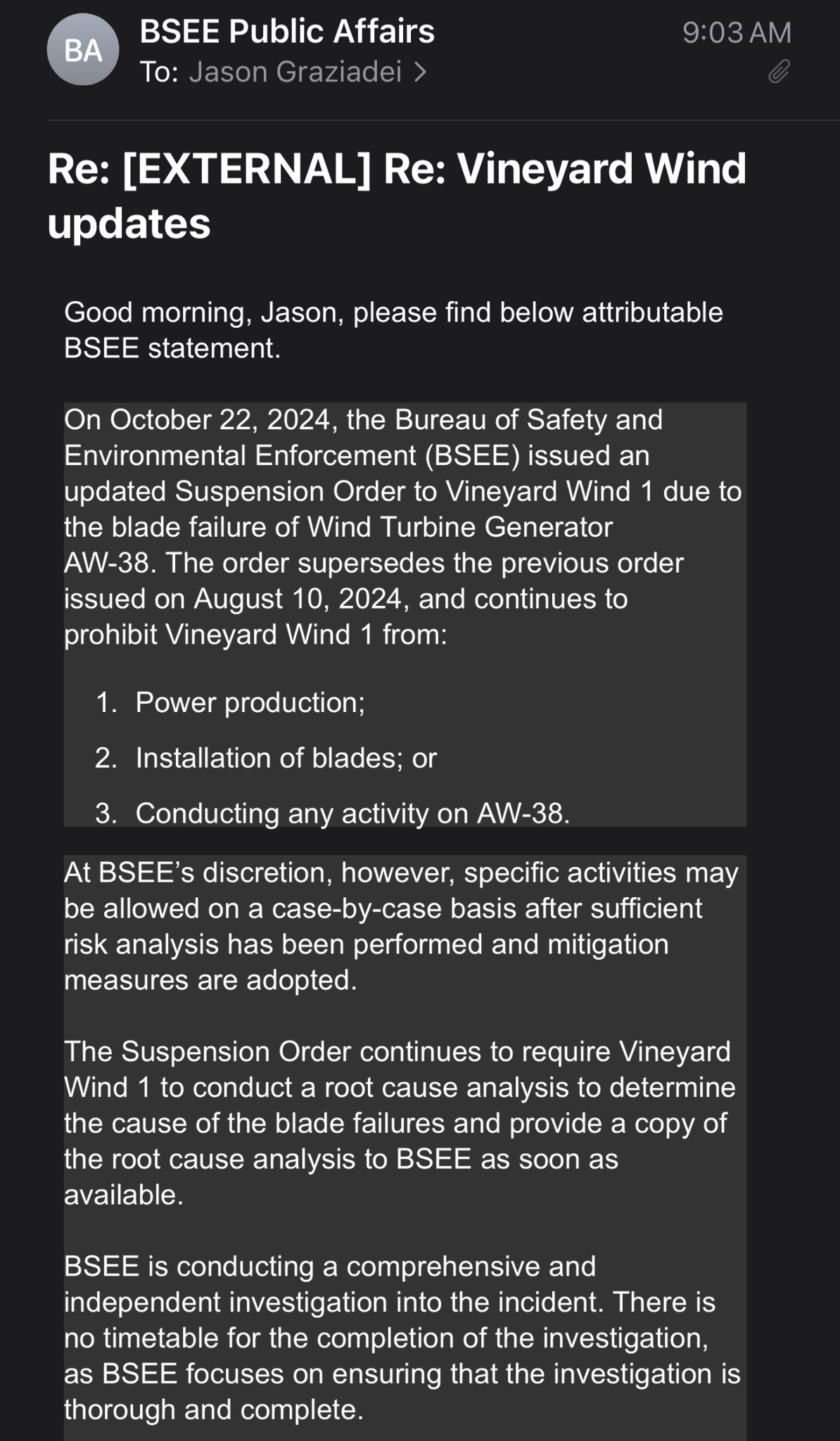
BSEE: Vineyard Wind is still prohibited from installing blades, producing power or conducting any activity on the damaged A-38 turbine.
GE: We are “really now getting to a point of shifting back to execution out at sea.” (Not at all what BSEE said.)
BSEE: BSEE may permit other specific activities after a risk analysis has been performed and mitigations adopted.
GE: We were “granted approval to return to installing new blades on turbines at the project once stringent safety and operational conditions are met.” (Positive spin of the BSEE statement implying that approval is assured.)
BSEE:Root cause analysis of the blade failure has not yet been provided to BSEE.
GE: “We have finalized root cause analysis and confirm the blade at issue at Vineyard Wind was caused by a manufacturing deviation from our factory in Canada.” (Then why doesn’t BSEE have the analysis? Is the Canadian plant being scapegoated?)
BSEE:No timetable for completion of BSEE investigation (This could present a dilemma for BSEE. How do you allow the resumption of blade installation and power generation before the investigation has been completed? Will the report be held until the Harris or Trump administration gives the go-ahead?)
BREAKING: Vineyard Wind and GE Vernova will be removing “some blades” from the wind farm following inspections and re-examination of ultrasound images, along with physical inspections of blades with “crawler” drones.
The attached letter was obtained by the Nantucket Current through a FOIA request. Key points:
Vineyard Wind power generation and blade installation suspension order remains in effect.
Vineyard Wind directed to conduct a site-specific study that evaluates the environmental harm and other potential damage from the blade failure, and to identify potential mitigation measures.
Vineyard Wind was required to submit a plan for the study by Oct. 11. It’s not clear whether the plan was submitted.
The study must include a mass balance of unrecovered debris material based on the weight of debris recovered and the weight of the subsea debris retrieved.
Comments:
The study requirement is appropriate given the significance of the blade incident and the implications for offshore wind development.
Why was a FOIA request needed to learn about the study requirement?