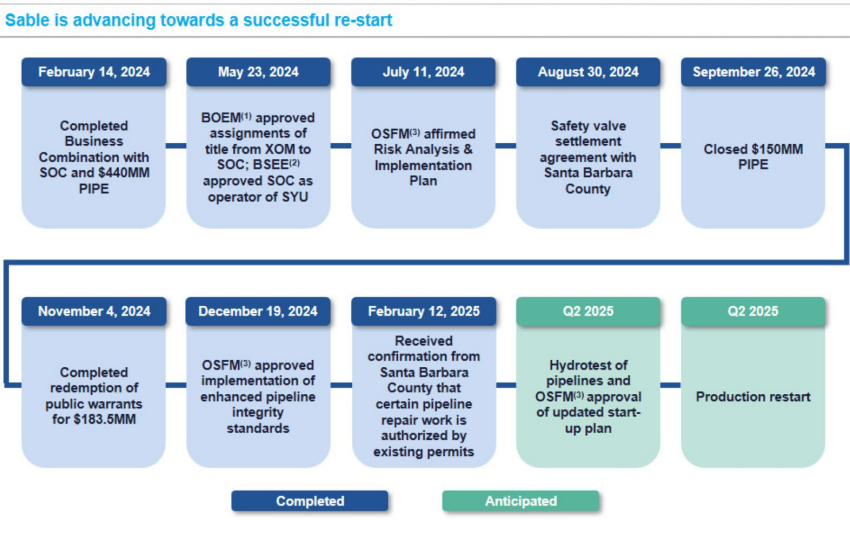
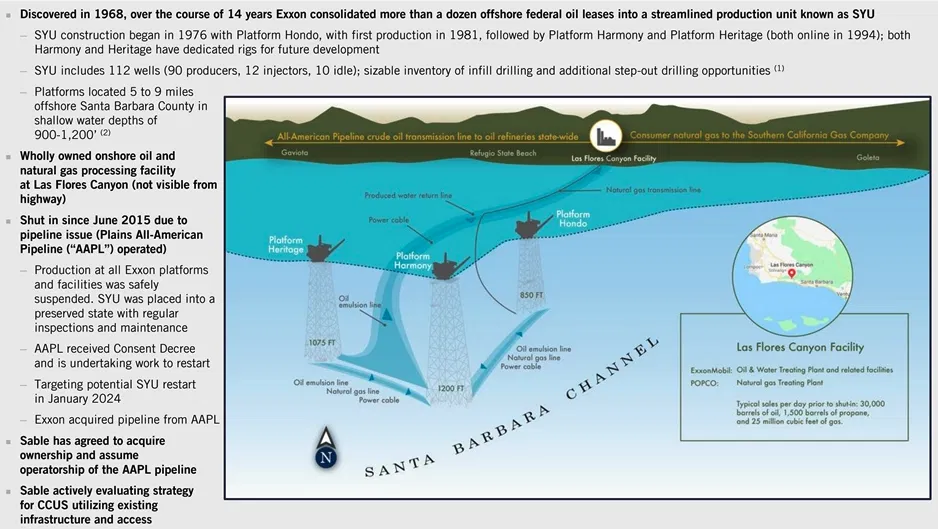
Attached is a recent Sable Offshore presentation for investors. Notably, Sable is now projecting to resume Santa Ynez Unit production in Q2 2025 (see slide below). John Smith thinks this is unrealistic, and I have to agree.
It’s tough for an offshore producer to succeed in California, but Sable is making a strong effort. Exxon must agree, because they have extended Sable’s first production deadline to 3/1/2026, which reflects a more plausible Q1 2026 restart. Additional extensions seem likely if necessary given that Exxon’s other options aren’t very attractive.
Santa Barbara resident Julia-Louis Dreyfus fires up the crowd. Photo Credit: Ingrid Bostrom, Independent
The Santa Barbara Independent and Noozhawk have closely followed the Sable saga and provided good coverage of the “Information Meeting.” BOE contributor John Smith followed the meeting online and shares his impressions.
Independent: “What was advertised as an informational meeting with eight state agencies that oversee Sable’s operations quickly became emotionally charged when the Environmental Defense Center’s Linda Krop and resident actor Julia Louis-Dreyfus were surprisingly called onto the stage to voice their opposition to the oil project.“
John Smith reports that the meeting got off to a good start before deteriorating:
Smith: “The CCC (Coastal Commission) presentation was interesting because it highlights their position and disagreement with SBC (Santa Barbara County) who determined permits were not required by Sable for maintenance and repair work. I think the agencies did a good job in sharing information on the status of permits, which if people were objective, may have alleviated many of their major concerns. Unfortunately, it went downhill at the end when EDC and Hollywood types were given the floor.”
Unsurprisingly, a State Senator facilitated the ambush:
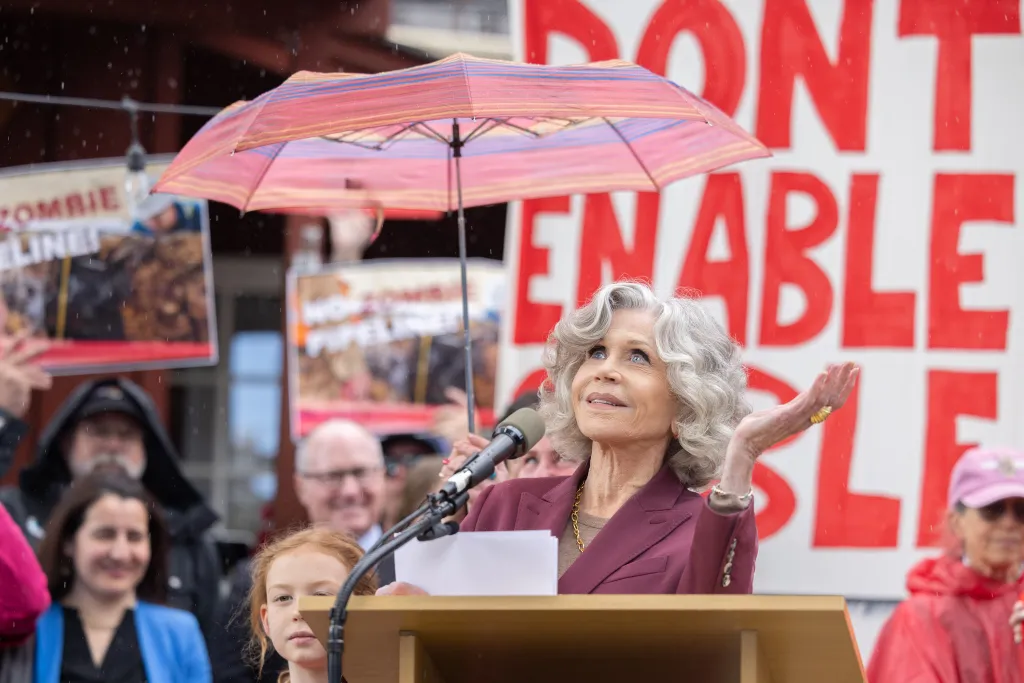
Independent: “When Senator Limón’s staff called to the stage the Environmental Defense Center’s chief counsel, Linda Krop — who hosted a star-studded press conference beforehand with state legislators, actors Julia Louis-Dreyfus and Jane Fonda, and Ventura-based Patagonia CEO Ryan Gellert, among others, outside the EDC’s headquarters — the town hall shifted gears from an info-session into a quasi-rally. Krop’s emotion-inciting words, followed by an angry, passionate speech from Louis-Dreyfus, put the room into a cacophony of cheers and jeers.“
Sable supporters (workers, not movie stars) were also in the house:
Independent: “Sable Offshore management, employees, contractors, labor, and supporters showed up today in good faith to participate in a town hall meeting where only government officials were on the agenda to present,” said Steve Rusch, Sable’s vice president of environmental and governmental affairs, in a statement. “Project opponents forced the moderators to give them dedicated time to present biased information and smear the project. The opponents’ self-serving fundraiser and rally was not an appropriate use of public resources.”
“Not one word was said about the working people,” a Sable employee and union member told the Independent after he walked out. “This is my home, too, and I’m going to fight, too…. Without this, we’re just unemployed.”
Interestingly, regulatory fragmentation, a topic that this blog has railed about, was mentioned by one of the Sable opponents, and I suspect the Sable supporters agree!:
Noozhawk: “One of the audience members was Ravid Raphael, who has lived in Goleta for the past 11 years. One of his concerns was that there are too many departments and that they are too fragmented.“
Jane Fonda (no one would question her credibility😉) – Photo Credit: Ingrid Bostrom, Independent
The Commission staff appears to be asserting Commission jurisdiction over already permitted activities in order to attempt to exert influence over Sable’s planned restart of the Santa Ynez Unit oil production operations. Jurisdiction over restart activities is entirely outside of the Commission’s jurisdiction and is separately regulated by other agencies.
Sable’s repair and maintenance activities (anomaly repairs, safety valve installation, and span remediation) are in compliance with applicable provisions of Santa Barbara County’s Coastal Zoning Ordinance (CZO), certified Local Coastal Program (LCP), and the Coastal Act. As such, no cease and desist order is warranted – whether issued by the Executive Director or the full Coastal Commission.
The onshore and offshore repair and maintenance work is fully authorized by coastal development permits previously approved by Santa Barbara County and the Commission. Therefore, those activities do not require new or amended coastal development permits and are not otherwise subject to the Commission’s jurisdiction or enforcement authority.
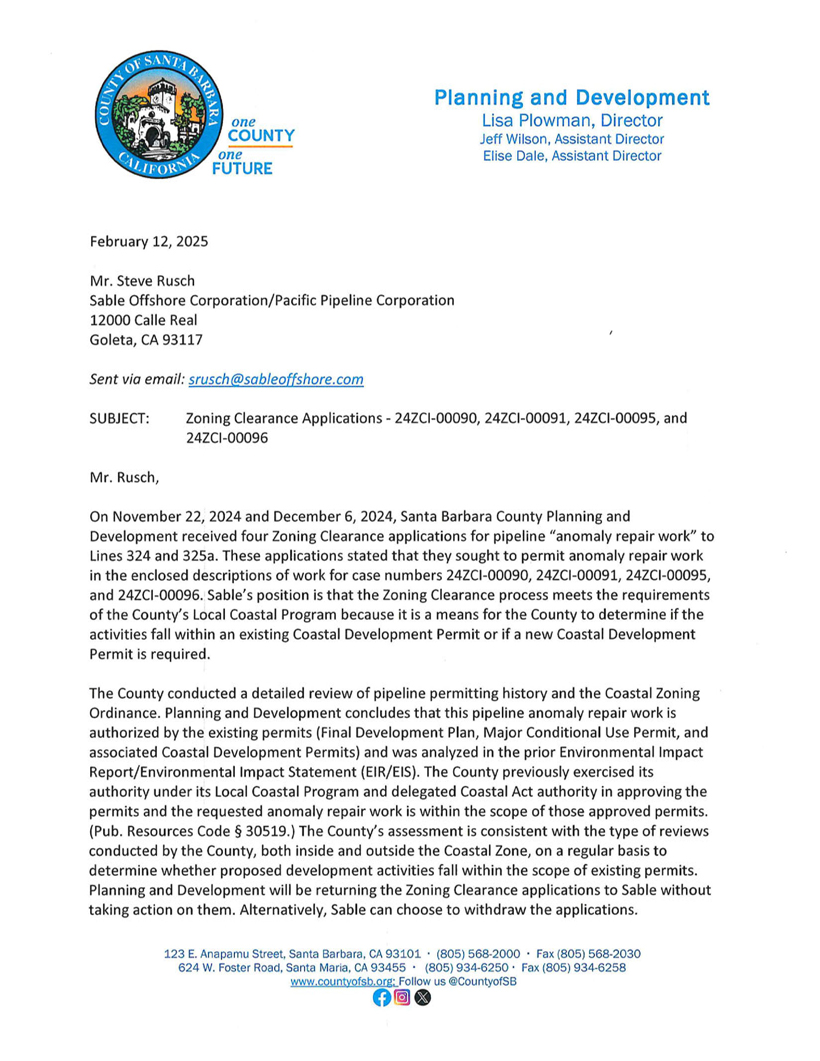
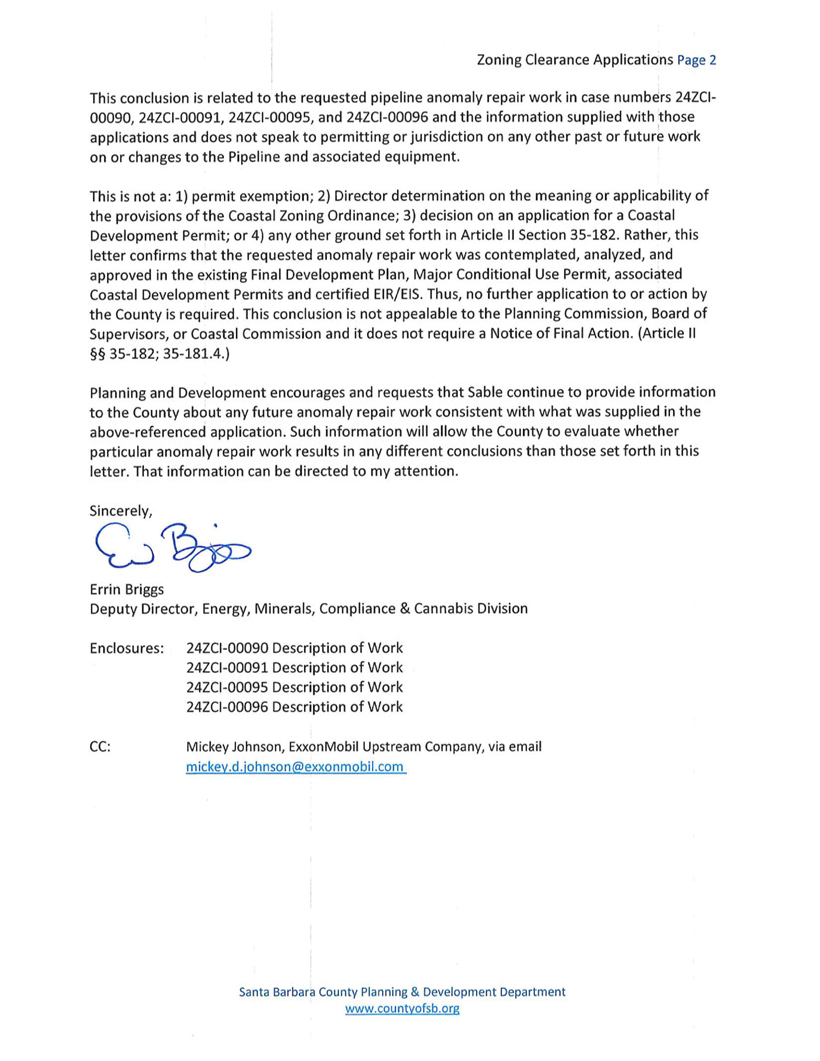
Onshore anomalies: Santa Barbara County reviewed the detailed information Sable submitted with Zoning Clearance applications in 2024 and confirmed in a letter dated February 12, 2025, that the anomaly repair work is authorized by the pipelines’ existing coastal development permits and, consistent with past practice, no new or separate Coastal Act authorization is required for Sable to perform the work. Commission staff has repeatedly ignored that the County — as the applicable agency with delegated LCP authority under the Coastal Act — expressly has confirmed that the anomaly repair work was authorized by the onshore pipelines’ existing Coastal Development Permit, Final Development Plan, and Conditions of Approval.
Onshore safety valves: Sable was required to undertake safety valve repair and maintenance activities pursuant to state law that the Coastal Commission supported. The safety valve repair work involves the exact same type of work as pipeline anomaly repairs, and Sable completed the safety valve work only after the County confirmed in writing that no further authorization from the County was required for the safety valves.
Offshore span remediation: Sable’s span remediation maintenance activities were fully contemplated and authorized within the original coastal development permit approved by the Coastal Commission for the Offshore Pipelines in 1988 and the Development and Production Plan approved by the Department of the Interior. The span remediation maintenance activities involve the placement of sand-cement bags beneath certain segments of the offshore pipelines to provide additional pipeline support. The exact same support enhancement (span remediation) activities have been performed in the past on these same offshore pipelines without requiring any new Coastal Act authorizations.
Sable has filed a lawsuit against the Commission in Superior Court in Santa Barbara County where it has asked the Court for damages and declaratory and injunctive relief to protect its vested rights to repair, maintain and operate the Santa Ynez Unit and Las Flores Pipeline Systems.
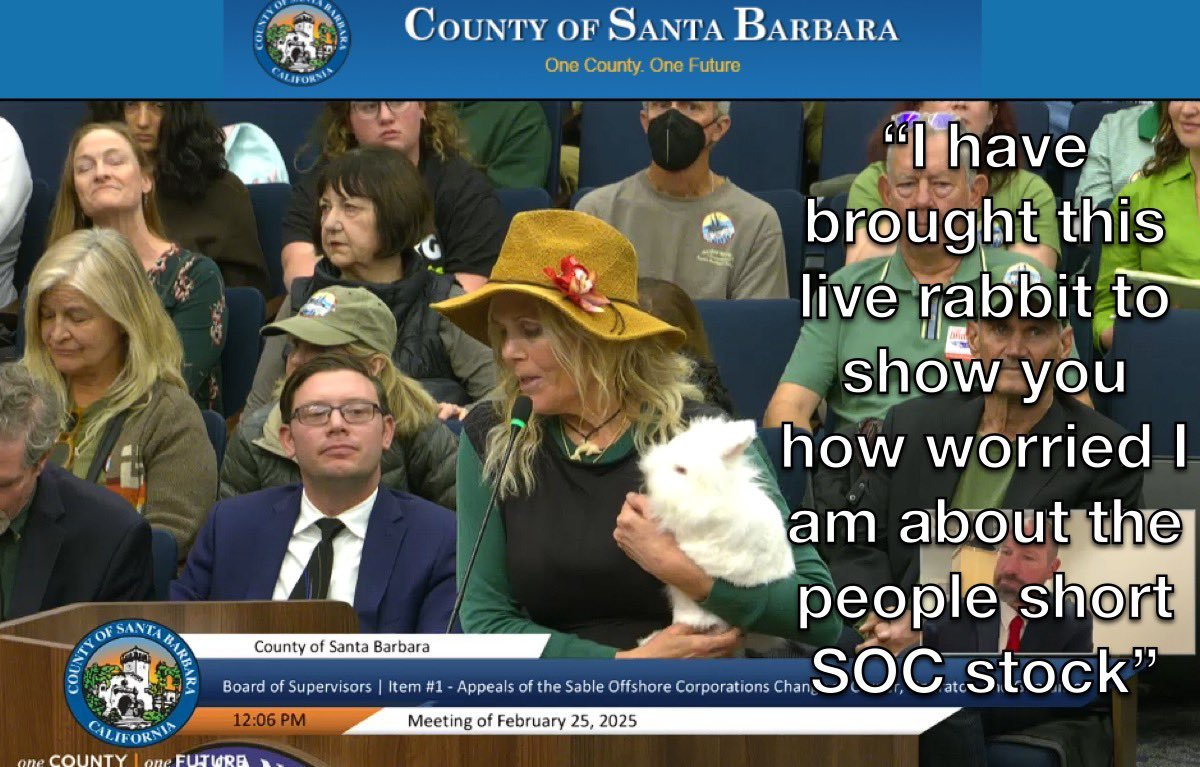
The Santa Barbara County Board of Supervisors tie vote on the transfer of permits from Exxon to Sable has both sides declaring victory! (And I thought I was the only one who was confused!)
“During Wednesday’s meeting of the county Planning Commission, Lisa Plowman, director of Planning & Development, expressed uncertainty about the future of the permits and said the split vote meant that the board took no action.
“We are in the process of (…) determining what that actually means in the long run for Sable and the opponents,” Plowman said.”
“The county has not in recent memory had a tie vote under this section. The county is looking into what happens next.”
Sables’ take: “Sable is pleased the appeals failed and the Planning Commission’s approval of the Santa Ynez Unit permit transfer to Sable stands. We look forward to continuing to work with the county to finalize the permit transfer and to safely restarting production as soon as possible.”
Environmental Defense Center’s take: “We applaud the Board of Supervisors’ decision to NOT transfer permits to Sable to operate a defective pipeline and dangerous processing facilities on our shores.”
Just when you thought this couldn’t get more complicated!😖😣
SANTA BARBARA, Calif. — A controversial oil project on California’s Central Coast remains unresolved after the Santa Barbara County Board of Supervisors deadlocked 2-2 on a vote regarding a permit transfer for a pipeline linked to the 2015 Refugio oil spill. The stalemate means Sable Offshore Corp.’s application remains pending without approval or denial, leaving the next steps up to the company.
“They still have a pending application with no action taken on it,” said Kelsey Gerckens Buttitta, public information officer with Santa Barbara County. “It hasn’t been approved or denied. It’s now up to Sable to decide what to do next.”
The Board voted 2-2 to uphold the approval of the transfer of permits from Exxon to Sable. The tie vote meant the appeal of the previous approval failed.
Interestingly, one of the Supervisors reportedly slammed the California Coastal Commission for being politically motivated and abusing the law.
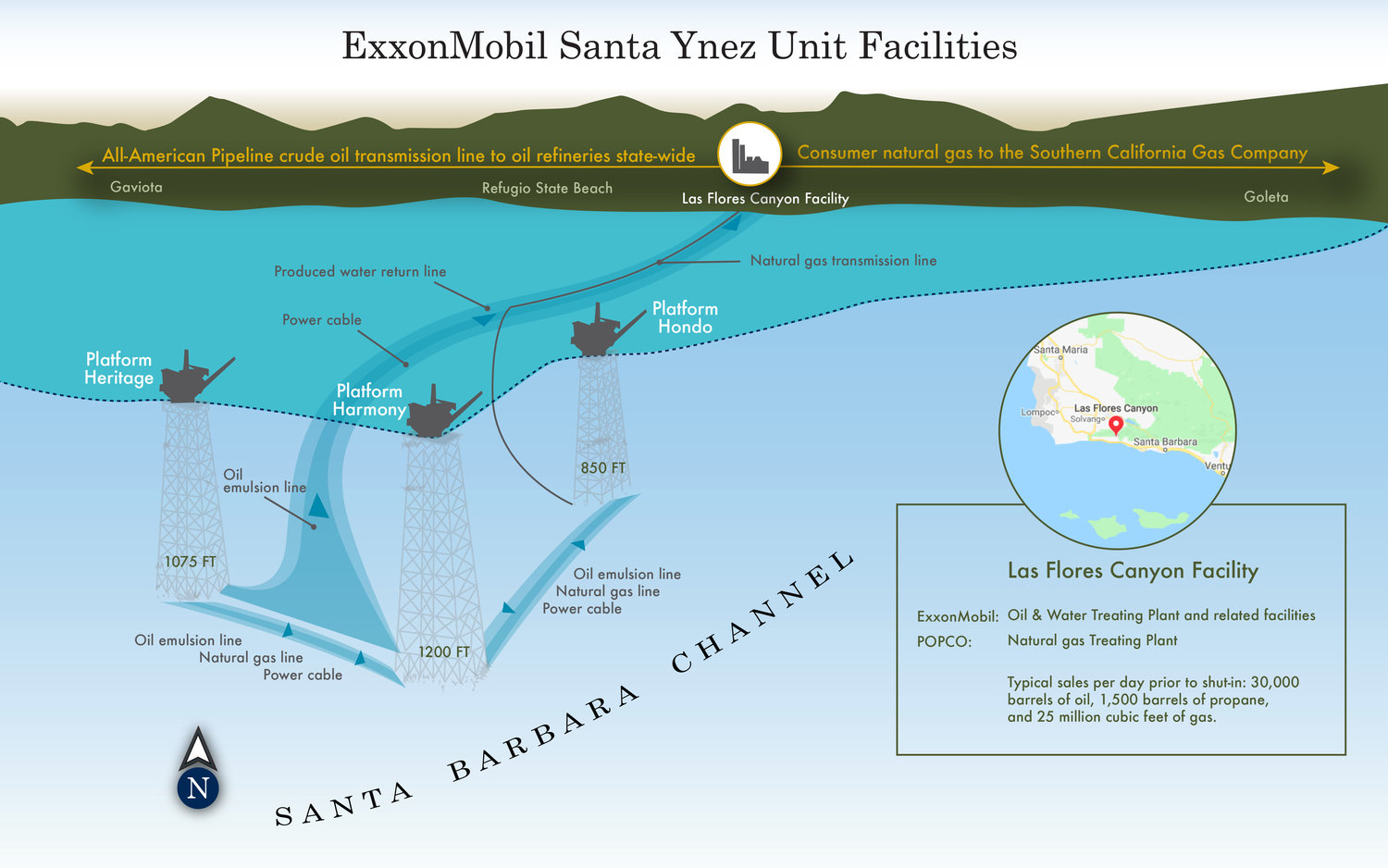
This will be the Board’s “first and last chance to have any influence over restarting the pipeline, and thus allowing the three offshore platforms to begin drilling again.” (Expect initial production to be from existing wells supplemented over time with new drilling, well workovers, and recompletions.)
The Board has limited authority in this matter: “The county’s legal advisors and energy planners have told the supervisors that there are no grounds to say no. It is not up to them to determine whether Sable’s liability insurance is enough to cover the costs of a reasonable worst-case oil-spill scenario; it’s only up to them to ascertain whether Sable has filed a certificate of insurance with the proper state agency.“
“All the essential questions regarding the pipeline’s safety measures are in the hands of California state agencies, headquartered in cities far away, with names so confusing that even people working there can’t tell you what the acronyms mean.” (see Regulatory fragmentation)
Interesting tidbits: “Danielson (the Sable representative) let me know that he would not be answering these questions. He was cordial, but he was not happy about a recent Independent story featuring attorney Linda Krop of the Environmental Defense Center perhaps Sable’s most implacable and formidable opponent, expounding in an unchallenged format on what a threat the pipeline still posed. Interviewing Krop was Victoria Riskin, herself a committed anti-oil advocate. Actress and Montecito resident Julia Louis-Dreyfus — of Seinfeld and Veep fame — apparently liked the article enough to send it to her social media followers.“
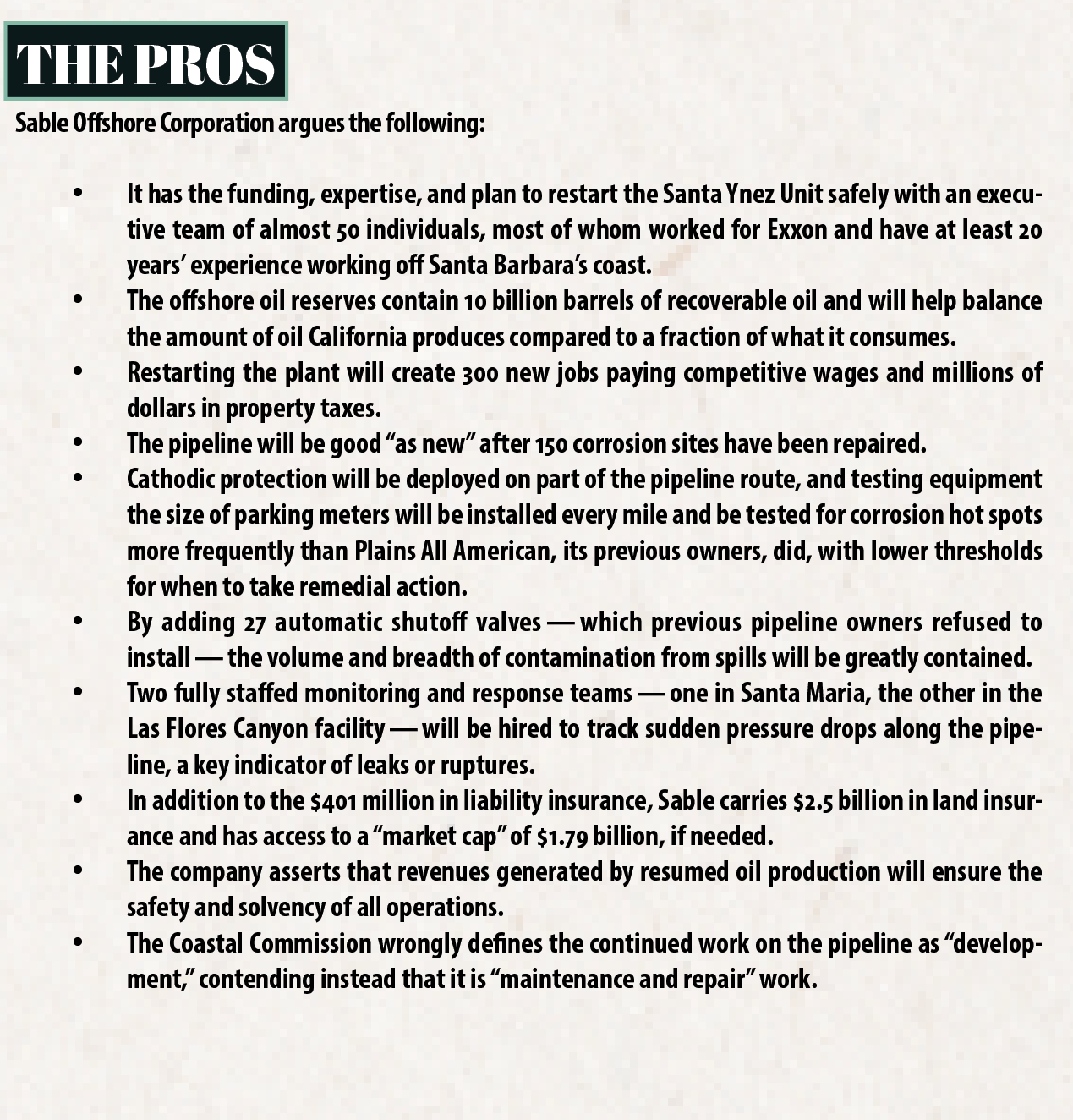
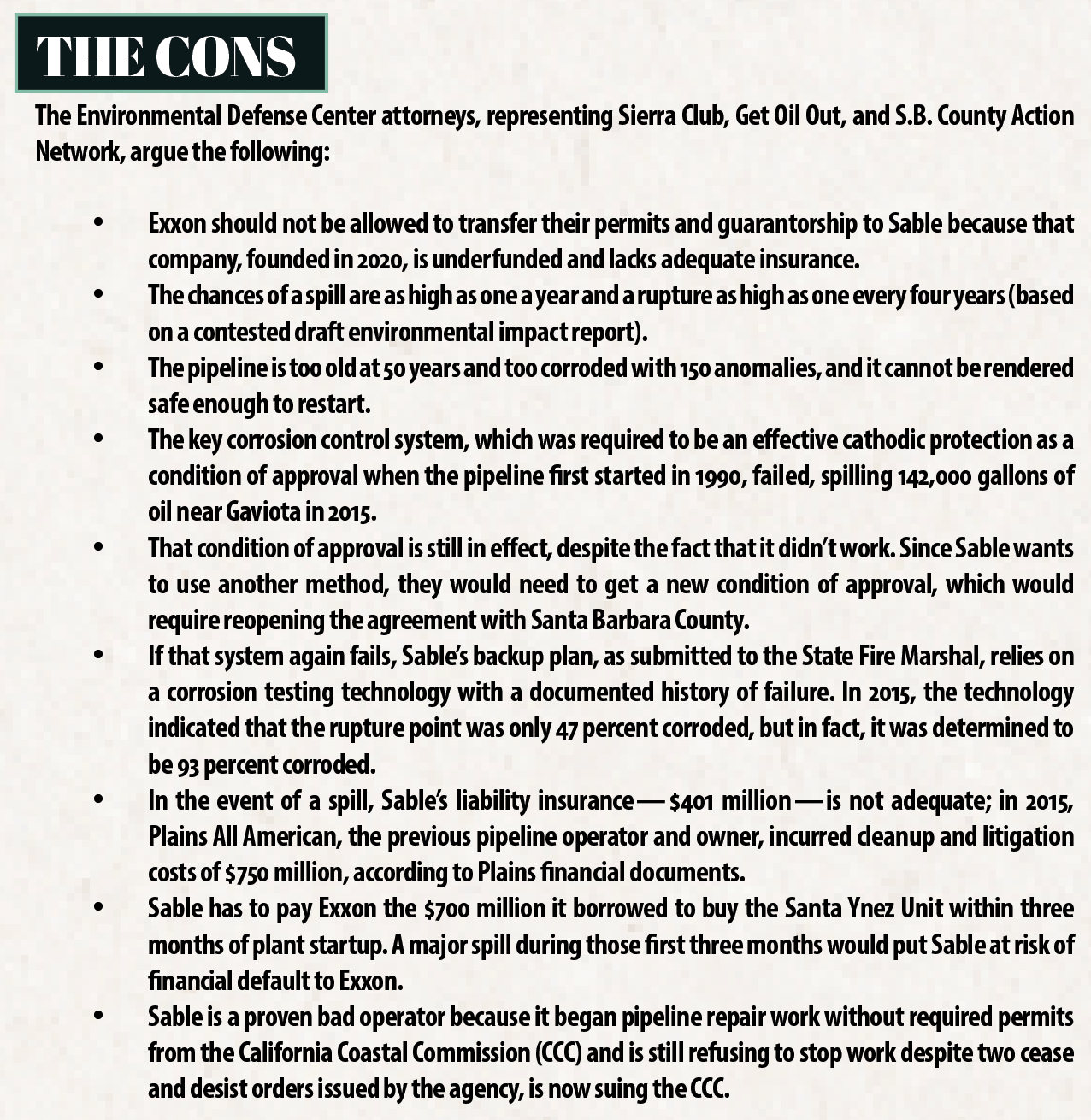
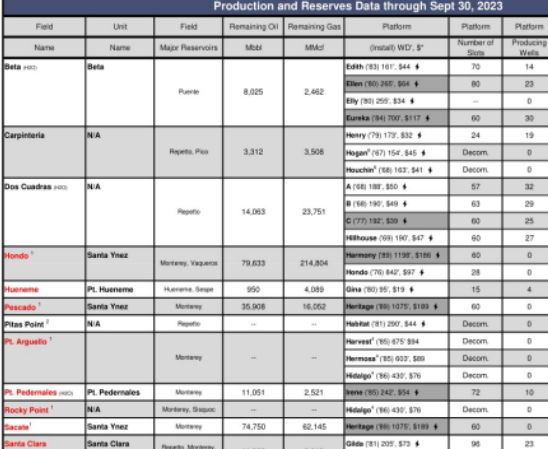
Below are the pros and cons of the SYU restart as cited by the Independent. (Clarification: The 10 billion bbl oil reserves number (“pros” slide) is at least an order of magnitude too high and is perhaps a typographical error. BSEE’s June 2023 data sheet (excerpt pasted at the end of this post) indicates remaining oil reserves of 190 million bbls for the 3 SYU fields. Adding the gas reserves ups the total to 243 million bbls of oil equivalent (boe). Additional reserves could likely be confirmed with new extended reach wells, but anything more than 1 billion bbls would be highly unlikely. Sable’s investor presentation (p.5) indicates 646 million bbl of Remaining Total Net Estimated Contingent Resources.)
John Smith forwarded Sable’s court filing (attached) and highlighted important text.
The Coastal Commission has asserted that anomaly repair work on Sable’s onshore pipeline, which was required by the California Fire Marshall and approved by Santa Barbara County, constitutes a violation of the Coastal Act.
Santa Barbara County had confirmed in writing that Sable’s repair work is authorized by the pipeline’s existing coastal development permits and, consistent with the County’s past practices, no new or separate Coastal Act authorization is required.
John and I believe Sable has a strong case, but you can be the judge. For the Commission and County to have such divergent opinions is rather surprising.
Among other assertions, Sable argues (par. 115) that the Coastal Commission violated the takings clause of the Fifth Amendment to the U.S. Constitution, as incorporated by the Fourteenth Amendment, which prohibits the temporary or permanent taking of private property for public use without prior, just compensation. This could lead to significant liability costs for the State.
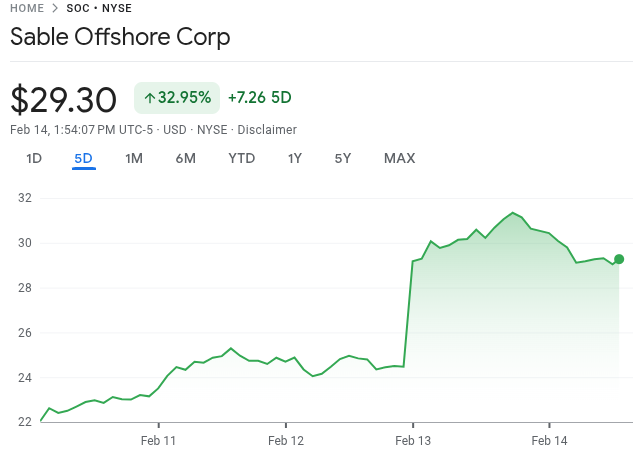
Sable’s stock soared on Thursday following a favorable Santa Barbara County decision (letter pasted below).
Sable’s path is still rocky. Decommissioning specialist John Smith notes that “Sable faces a number of permitting obstacles not to mention litigation by the Environmental Defense Center and others who are committed to trying to stop the SYU restart. The next hurdle will be a Feb 25 Santa Barbara County hearing on an appeal of the ownership transfer from XOM to Sable. And we should not overlook the OCS related litigation on ownership transfer, SYU Development and Production Plan updates, and Court ordered prohibition on fracking absent a Fracking EIS and consultation.”
The County’s letter is pasted below. Note the diverse responsibilities of this SBC division: Energy, Minerals, Compliance & Cannabis 😀
The Santa Barbara County Planning Commission has approved the transfer of the onshore pipeline from Exxon to Sable Offshore. Although the Environmental Defense Center (EDC) is appealing that decision to the Board of Supervisors, the Board’s vote will likely be a 2-2 tie. Supervisor Hartmann’s property is close to the pipeline and she has recused herself from votes on the matter. A 2-2 vote would be a win for Sable, because a tie vote means the planning commission decision stands.
As an investment, Sable is a “pure California permitting play,” which means the risks are high. The company’s chances for success are almost entirely dependent on receiving the necessary approvals from State and local agencies.
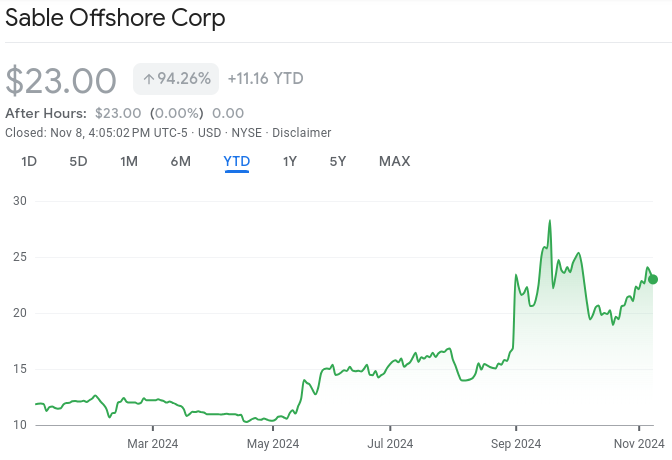
Sable’s share price soared to $23.43 on 9/3 after the company reached agreement with Santa Barbara on the installation of required pipeline valves. The price bounced further to $28.30 on 9/19 before falling sharply to $19.43 on 10/9 after being cited for failing to get California Coastal Commission approval to install the required valves. The price rebounded to $24 following the County Planning Commission’s approval of the transfer from Exxon to Sable before settling at $23 on Friday, the date of the EDC appeal.
Expect the financial and psychological roller coaster ride to continue.




 Bud's Offshore Energy (BOE)