Posts Tagged ‘relief well’
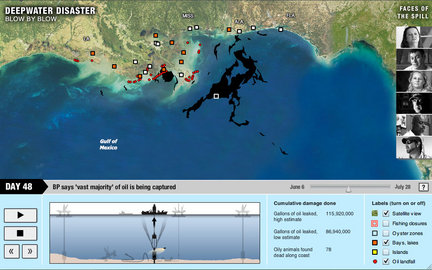
Excellent Times Picayune Animation of Macondo Slick Movement and Well Control Activities
Posted in accidents, well control incidents, tagged accidents, blowouts, Deepwater Horizon, drilling, Gulf of Mexico, macondo, oil spill, relief well, safety, well control on September 13, 2010| Leave a Comment »
Relief well intercept – necessary operation, science project, moral imperative, or face-saving gesture?
Posted in accidents, well control incidents, tagged accidents, blowouts, BOE, bp, Deepwater Horizon, Gulf of Mexico, macondo, relief well, top kill, unified command, well control on September 12, 2010| Leave a Comment »
BOE has previously commented that completion of the Macondo relief well appeared to be unnecessary, and and that the intercept adds additional risk to the plugging and abandonment operation. Pasted below are disconcerting Unified Command and BP statements about the intercept followed by BOE comments:
I have stated over and over again, let me be perfectly clear. I am the National Incident Commander. I issue the orders. This will not be done until we complete the bottom kill. Admiral Allen, 5 August 2010
Comment: While I believe Admiral Allen has performed well in the difficult and thankless job of incident commander (as did Admiral Landry before him) and wanted to make it clear that the government was in charge of this operation, this strong statement appears to have painted the Unified Command into a corner.
… in response to BP’s request to consider foregoing the relief well, the government scientific technical team has determined that the benefits of the bottom kill procedure outweighs the risks. (14 August letter from Admiral Allen to BP)
Comment: Reading between the lines, we assume that at least some BP engineers favored foregoing the relief well intercept, and wanted to proceed with a conventional plugging and abandonment operation. Was their proposal given serious consideration? How could it have been given the Admiral’s prior statements about completing the relief well?
We are currently working with BP engineers and our science team to look at test results and do investigations to lead us to the best way to mitigate any risk of intercepting the annulus and increasing the pressure in the annulus. Admiral Allen, 16 August
Comment: Much attention continues to be focused on mitigating the risks of an operation that appears to be unnecessary.
There are several reasons for the relief well to be completed, including demonstrating that the difficult procedure can be done, providing more scientific data about the leak and giving closure to an oil-weary public. BP CEO Bob Dudley, 29 August
Comments: This BP statement seems to contradict their prior request to forgo completion of the relief well. With regard to Mr. Dudley’s rationale for completing the relief well, I’ll offer the following:
- If BP believes they need to demonstrate relief well intercept capability (not necessary in my view), they should drill into one of the thousands of depleted wells in the Gulf, not Macondo.
- This is not a risk-free science project. Are the risks and delays justified?
- The “oil-weary public” needs an offshore industry that is committed to safety and pollution prevention, not symbolic gestures.
And in order to speed the process up, but also ensure that we had the right pressure controls on the well, I’ve signed a directive out to BP earlier this morning, directing them to take a series of measurements on the well head that would allow us to ascertain whether or not the seal in the ring – in the casing hanger were in place and had not lifted and, if that was the case, then to be able to put what we call a sleeve over the top of it that would basically walk that down to the point where it could withstand over one million pounds of pressure and would obviate the need to be able to cement the annulus at the top.
And subject to BP providing me the plans and the results of those tests, that would allow us to go ahead and proceed more quickly without having to cement the top of the annulus. And based on a revised schedule from BP, we might be able to accelerate going ahead and finishing out the relief well. Admiral Allen, 10 September
Comment: Let me get this straight. They are going to put off the cementing of the annulus, which will have to be done anyway and would provide a barrier should something go wrong with the intercept, so they can conduct tests (that would be unnecessary if they first cemented the annulus) for the purpose of expediting completion of the long-delayed relief well? Huh?
BP Issues Report on Macondo Response
Posted in accidents, well control incidents, tagged accidents, blowouts, bp, Coast Guard, Deepwater Horizon, drilling, Gulf of Mexico, macondo, offshore oil, oil spill, relief well, safety, unified command, well control on September 3, 2010| Leave a Comment »
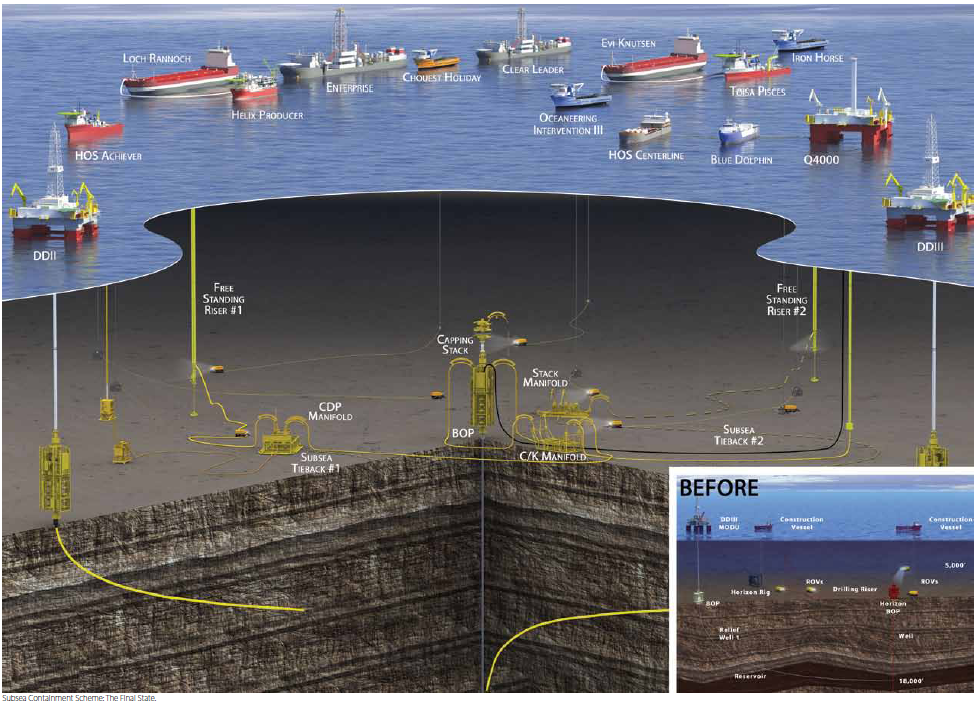
BP has issued a report on the response capabilities and innovative new technology and procedures demonstrated following the Macondo blowout. While the report is somewhat promotional (understandably), the information is summarized and compiled in a useful manner and underscores the magnitude of the response. Although most close observers probably have issues with certain actions taken by BP or the Unified Command, one cannot deny the unprecedented size and complexity of the response. We can only imagine how chaotic this response could have been if the operator did not have the resources and the will to mount such an enormous effort.
I hope BP will be similarly forthcoming with the results of their internal review of the blowout’s causes. When will that very important report be released?
At some point, BP’s candid observations on the functioning and effectiveness of the Unified Command system would also be helpful. The more we can learn about the differences of opinion and problems that arose during the response, the better we can prepare for future incidents. Will any of the official investigations be looking into these aspects of the response? At BOE, we are particularly interested in the well intervention, capping, containment, and relief well decisions.
Macondo End Game Confusion – Part 4
Posted in accidents, well control incidents, tagged accidents, blowouts, Deepwater Horizon, drilling, Gulf of Mexico, macondo, offshore oil, oil spill, relief well, safety, well control on August 19, 2010| Leave a Comment »
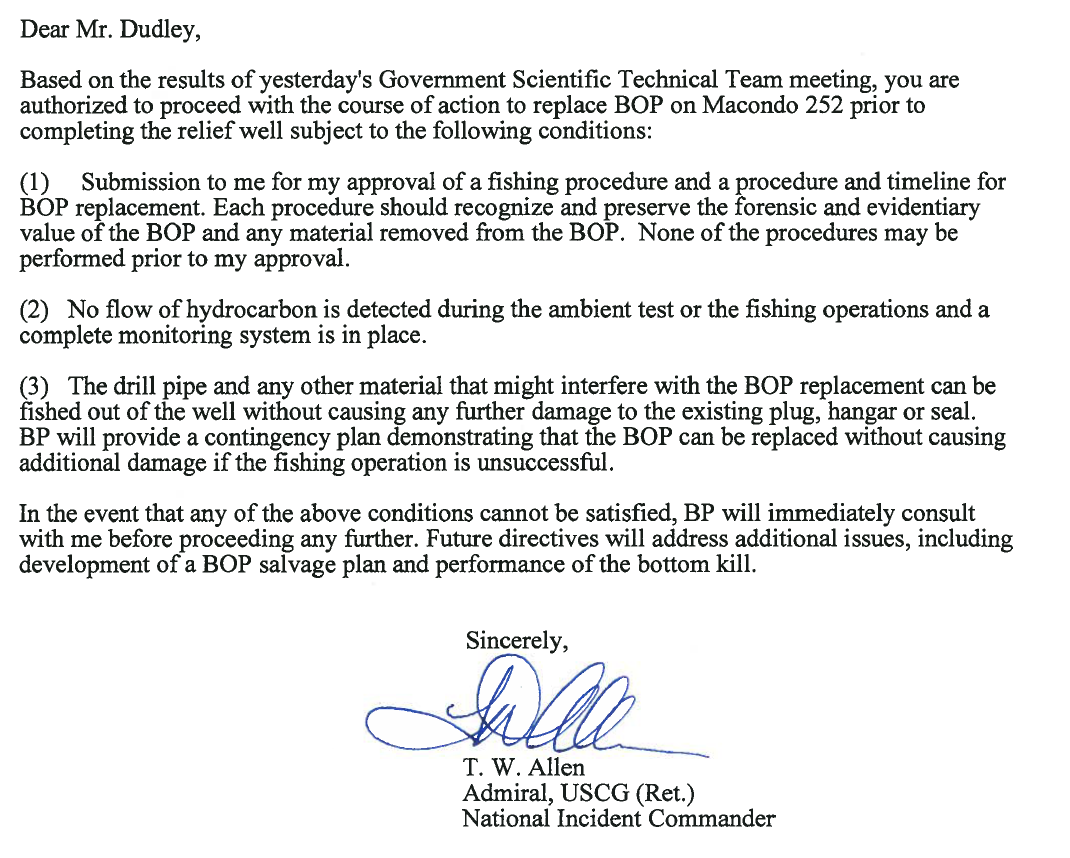
Aug. 19, 2010 letter, click to enlarge
With the new BOP in place, and the capability to enter the well from the top, squeeze cement into the annulus, and set and test plugs, the relief well intercept appears to add nothing but risk. Is the relief well being finished because of the repeated “read my lips” statements about its necessity or is there a valid reason that we are missing?
Also, with the well killed, should the Incident Commander be directing and approving operations that seem to fall under the plugging and abandonment category? Those operations are under the purview of the Bureau of Offshore Energy Management, Regulation, and Enforcement (BOEMRE) in the Department of the Interior. (Actually, according to the applicable MOU, (see section 10), BOEMRE should have had the lead on well control and flow abatement since the well blew out on April 20.)
Macondo End Game Confusion – Part 3
Posted in accidents, well control incidents, tagged accidents, blowouts, Deepwater Horizon, drilling, Gulf of Mexico, macondo, offshore oil, oil spill, relief well, safety, well control on August 17, 2010| Leave a Comment »
We are currently working with BP engineers and our science team to look at test results and do investigations to lead us to the best way to mitigate any risk of intercepting the annulus and increasing the pressure in the annulus. Admiral Allen
This insistence on drilling into a “killed well” reminds me of the Unified Command’s plan to end to end the “well integrity test” and vent the well after it had been successfully capped on July 15. Fortunately, the Command showed good judgement and reversed that decision. Perhaps they should do the same with the relief well intercept, which no longer appears to be necessary and may be hazardous.
The obvious next step is to re-enter the well from the top, perforate the production casing and squeeze cement into the annulus, and proceed with the plugging and abandonment operation. If the Command has reasons why this would not be the best approach, we’d like to hear what they are.
Despite the repeated “my way is the relief well” pronouncements, I trust that the Command will choose the option that accomplishes the objectives with the fewest risks to safety and the environment.
Macondo End Game Confusion – Part 2
Posted in accidents, well control incidents, tagged accidents, blowouts, Deepwater Horizon, drilling, Gulf of Mexico, macondo, offshore oil, relief well, safety, well control on August 14, 2010| 1 Comment »
Letter from Admiral Allen to BP:
… in response to BP’s request to consider foregoing the relief well, the government scientific technical team has determined that the benefits of the bottom kill procedure outweighs the risks.
- Did BP really ask to forgo the relief well or was this just a point of discussion? If so, it would be nice to hear BP’s side of this.
- Is BP confident the annulus is plugged? If so, what is the basis for their confidence?
- If the annulus is plugged, what is the objective for the relief well? To confirm that cement is in place? Inject additional cement? Is there sufficient information to properly assess the risks associated with such an injection procedure?
- If not unprecedented, it is certainly unusual to drill a relief well into a well that has been killed. Could measures taken during the abandonment operation (e.g. cut the production casing and set a plug over the production casing stub) assure the Unified Command that the annulus is sealed?
Macondo’s Heroes
Posted in accidents, well control incidents, tagged accidents, blowouts, Deepwater Horizon, drilling, Gulf of Mexico, Louisiana, macondo, offshore oil, ohmsett, oil spill, relief well, safety, well control on August 10, 2010| 3 Comments »
We have heard plenty about Macondo’s real, imagined, and convenient villains, but very little about the heroes. Let’s pay tribute to them:
- First and foremost the eleven men who lost their lives exploring for energy for our economy and security. Sadly, were it not for the massive spill, their sacrifice would have received little public attention.
- The rescue crews who brought the other 115 workers safely to shore.
- The responders who worked under difficult conditions to minimize the environmental effects of the spilled oil.
- The relief well crews who demonstrated how complex drilling operations should be conducted.
- The ROV and well intervention teams. The performance of the ROVs and subsea tools is perhaps the biggest Macondo success story. Their pioneering work will be studied in developing the well intervention, capping, and collection plans that will be a part of future drilling programs.
- The people of Louisiana, who despite their personal adversity continue to believe that energy, fishing, and other offshore interests can and must co-exist.
- The MMS oil spill research program. In the lean years following the Valdez oil spill research surge, MMS continued to conduct important burning, dispersant, remote sensing, and mechanical cleanup studies, while upgrading and expanding the use of the nation’s major oil spill response test facility – Ohmsett.
- The Unified Command scientists who are providing comprehensive scientific data about the effects of the spill, and refuse to be swayed by sensational media reports.
- Oil consuming bacteria!
- Others?
Two requests for the Unified Command
Posted in accidents, well control incidents, tagged accidents, blowouts, Deepwater Horizon, drilling, Gulf of Mexico, macondo, offshore oil, oil spill, relief well, safety, well control on August 6, 2010| Leave a Comment »
- Now that the Unified Command has had a couple of days to review the static kill data (which were certainly considered in planning the cementing operation that was concluded yesterday), please provide an update on the latest thinking with regard to the well’s flow path.
- Please post a cross section schematic (best estimate) of the well after the completion of yesterday’s cementing operation.
Deep Water is Not the Problem
Posted in accidents, well control incidents, tagged accidents, Australia, blowouts, BOE, Deepwater Horizon, drilling, Gulf of Mexico, macondo, Montara, offshore oil, oil spill, relief well, safety, well control, well integrity test on July 27, 2010| 1 Comment »
In the Gulf of Mexico, deepwater drilling is more risky because that is where the high-rate wells are, not because the water is deep.
- Water depth had little to do with the well integrity problems at Macondo. Similar errors in planning and execution would have yielded similar results in any water depth or on land. Has Montara already been forgotten?
- Subsea BOP stacks have a much better performance record than the surface stacks used in shallow water drilling (more on this later in the week).
- Historical data indicate that blowouts occur less frequently in deep water, not more frequently (more to follow).
- Obviously, blowouts involving high-rate wells are likely to do more damage. This applies regardless of the water depth. You can reduce the spill risk by prohibiting drilling in the areas with the highest production potential, but that wouldn’t be very sound energy policy and you won’t find many buyers for the leases.
- It is safer to conduct intervention and capping operations on subsea wells. Regulators would not even allow surface capping to be considered at Montara because of the high risk to workers. The subsurface ROV work is perhaps the biggest Macondo success story.
- If the Macondo well was in shallow water (with the wellhead above the water surface), and well integrity concerns precluded a risky surface capping operation, how would the flow have been contained and collected?
- Other things being equal, the environmental risk is less at deepwater locations which tend to be farther from shore.
Water depth is just one well planning consideration. Abnormal pressures and temperatures, shallow gas, hydrogen sulfide, ice, permafrost, storms, currents, extended reach targets, and horizontal completions are some of the others. To prevent another Macondo, in the US or anywhere else in the world, we need to focus our attention on the 3 categories of issues listed below. These issues are important in all water depths and in all environments.
- Well integrity including design, construction, barriers, verification, and monitoring.
- BOPE performance and reliability under all conditions.
- Capping, containing, and collecting oil in the event of a blowout.
Interesting WSJ Article
Posted in accidents, well control incidents, tagged accidents, blowouts, Deepwater Horizon, drilling, Gulf of Mexico, macondo, offshore oil, oil spill, relief well, safety, well control on July 21, 2010| Leave a Comment »
Most recently, tensions flared as BP made plans to lower its newly designed cap onto the gushing well. Last Thursday, when the cap appeared to stop the oil, all weren’t happy at the Houston crisis center. Instead, a squabble broke out between government scientists and BP engineers.
Which of the official investigations will look at the important interactions among Unified Command participants and the effectiveness of the decisionmaking procedures?
 Bud's Offshore Energy (BOE)