Feeds:
Posts
Comments

Posts Tagged ‘relief well’

Australian Department of Resources, Energy, and Tourism

The Independent Review concluded that the Montara Action Plan effectively responds to the issues identified by the Montara Commission of Inquiry and sets PTTEP Australasia on the path to achieving industry best practice standards for both good oil field practice and good governance.

Comments:

  1. Perhaps the results of the “Independent Review” should have been released before PTTEP announced that it was moving ahead with development of the Montara field.
  2. Macondo was a model operation compared to Montara which was suspended for months with only a flawed casing shoe and a corrosion cap as barriers. When well activities resumed after the suspension, and the corrosion cap was removed, they could have tied back the 13 3/8″ casing and installed the BOP stack, but instead moved to another well so they could optimize efficiency. When the well began to flow, there was no means of even attempting to shut it in or install a surface cap.
  3. PTTEP has not been fined or penalized in any way by the Australian government. I wonder how Commissioner Borthwick and the folks who participated in the Montara Inquiry, which did an admirable job and was very critical of PTTEP, feel about that.

Read Full Post »

A little bit of information on the BOP “forensic” testing from the Louisiana Record:

Justice Department attorney Michael Underhill said that a forensic report on the failed blowout preventor (BOP) which led to the Deepwater Horizon explosion and subsequent Gulf of Mexico oil spill should be finished in March.  Underhill spoke at a status conference for the BP multidistrict litigation in Judge Carl Barbier’s chambers at U.S. District Court for the Eastern District of Louisiana.

Barbier expressed concern over reports that the testing for the BOP and the cement used in drilling the Deepwater Horizon was falling behind. Underhill stated that the testing on the BOP should be done by the first week of March, but that’s “not a promise.” Underhill stated that the BOP investigation has already cost millions of dollars and has involved laser scanning all the equipment removed from the device. He also said that the forensic report on the BOP should be done by the end of March.

Read Full Post »

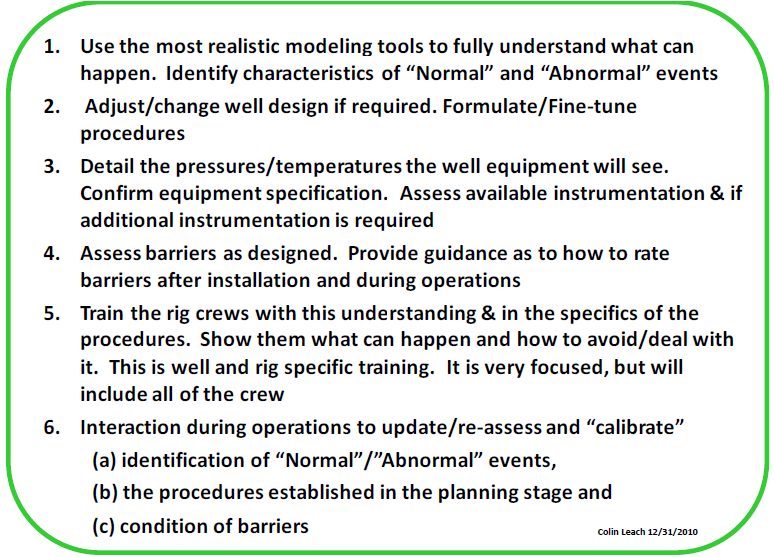
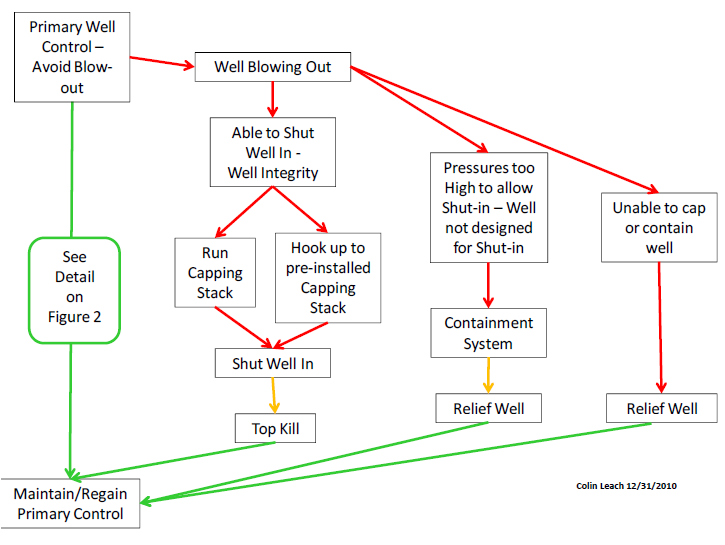
Colin Leach has provided a nice overview of the loss of well control scenarios for a deepwater well (Figure 1), and a concise, but comprehensive, summary of the critical elements of a well control program (Figure 2).   Click on either figure to enlarge.

We appreciate Colin’s continued leadership and initiative on well control issues.

Figure 1: Well Control Activities in Deep Water

Figure 2: Activities Focused on Maintaining Primary Well Control

Read Full Post »

Montara Blowout

According to the Australian Government’s report:

The draft Government response proposes accepting 92 recommendations, noting 10, and not accepting three. The three recommendations that are proposed not to be accepted relate to actions which are technically inappropriate.

While these numbers imply nearly complete Government concurrence with the Commission’s recommendations, the recommendation and response tables (beginning on page 17) tell a somewhat different story. A few examples follow:

  • For some of the recommendations, the Government’s acceptance seems to have little significance.   For example, recommendation 11 calls for a Memorandum of Agreement (MOA) among operators to provide emergency assistance in the event of a blowout.  The Government “accepts” this recommendation by commenting that such an MOA is an industry matter. Since the Commission recommended that operators enter into a MOA, they clearly understood that this was an industry matter.  That’s not the point.  The Commission would no doubt like the Government to exercise its influence and authority to ensure that the MOA was prepared and executed in a timely manner. The Government made no such commitment in its response.  When the Montara well blew out, every operator and drilling contractor in the region should have been prepared to suspend operations immediately and move their rig to the site. For reasons that remain unclear, that does not appear to have been the case.
  • Other recommendations are accepted/dismissed by saying that the recommended action is “accepted industry practice.”  While that may be true, the Commission is reminding us that there are problems and inconsistencies in the way industry interprets and applies these practices.  How will the Government ensure that these challenges are addressed?
  • Recommendation 19 calls for operators “to inform regulators of the proposed removal of a barrier, even if they consider that well integrity is not thereby compromised.”  The recommendation specifically states that the “the information should be presented by way of a special report.” The Government’s “acceptance in part” reads like “rejection in full,” since the Government comments that existing rules cover this and that the providing this information in the daily drilling report is sufficient.
  • Very good well control recommendations (57-62) are seemingly dismissed (although the text says they are accepted) by saying that “this is primarily an industry operational matter” and “the Government notes that operators already have well control and operating standards in place.”  How is that “accepting” the recommendation?  Yes, this is an industry matter, but improvements are needed in the standards and training, and it’s the Government’s responsibility to make sure that industry makes these improvements.
  • Recommendation 65 pertains to safety culture issues that apply to well control.  The Government dismisses the recommendation (“accepted in principle”) as an industry matter.  Can the Government can do nothing to promote safety culture? Norway has had a safety culture regulation since 2002 and Dr. Mark Fleming, a leading researcher on the topic, made it quite clear in his Vancouver presentation that the Government can and must influence safety culture.

In accepting the Commission’s recommendations, the Government has an obligation to be make sure they are implemented, regardless of which party has primary responsibility for the action.

Read Full Post »

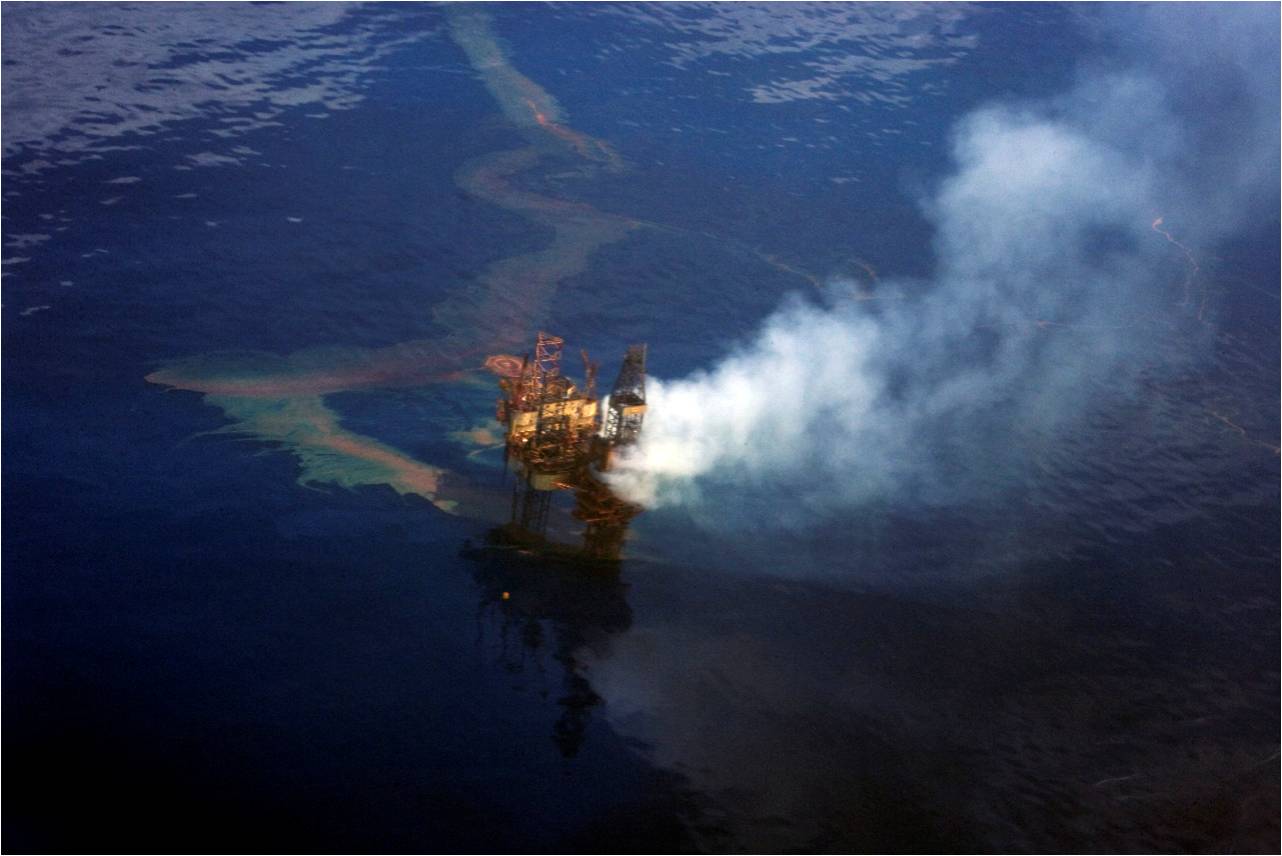
West Atlas Jackup and Montara Wellhead Platform

While there has been much post-Macondo discussion about the complexity of subsea containment and capping operations for deepwater wells, Macondo was ultimately capped and killed before being intersected by the relief well. The same cannot be said for the shallow water Montara well, which was killed by a relief well after flowing for 74 days.

Capping a flowing well is never routine, regardless of the water depth. However, the safety risks are greater for surface wells.  Those risks combined with the low probability of success are why a capping operation was not even attempted at Montara.  These were the concerns:

  1. The risk of a fatality was estimated at an alarming 25-30%.
  2. The risk of ignition while retracting the cantilever of the West Atlas jackup, a necessary step in the capping operation, was high.
  3. Only the 20-inch casing was tied-back to the wellhead platform. The 13 3/8″ casing was suspended just above the water surface. (According to testimony during the inquiry, the 13 3/8″ casing was not cemented back inside the 20″ casing.)
  4. Unless they were going to tie-back the 13 3/8″ casing while the well was flowing (probably not feasible and not mentioned as a possibility in the Inquiry report), they would have had to install a specially made BOP on the 20.”  If they were able to install this BOP and shut-in the well, flow would have undoubtedly broached the casing at the 20″ inch shoe.  One possible alternative may have been to install a diverter under the BOP and attempt a dynamic kill operation (i.e. direct the flow downwind and away from the rig while pumping mud down the well).  This too would have been complex and risky.

Given the very high safety risk and the low probability of success, I believe the regulator and operator made the correct decision in forgoing a capping attempt. The experiences at Macondo and Montara indicate that capping considerations must be taken into account during well planning activities for both subsea and surface wells, and that they latter pose greater safety risks.  Given the fire potential, having the wellhead at the surface is not an advantage when it comes to capping a flowing well.  It’s better to have the wellhead on the seafloor where the robotic equipment is doing the work.

Read Full Post »

Montara Blowout - Timor Sea

Our virtual vigil is over.  I awoke to messages from Odd, Anthea, and Kevin that the day had finally arrived – the Montara Report has been released. Not only do we have the Inquiry report, but also the government’s response and PTTEP’s action plan.  We’ll be digesting this over the next few days (along with a turkey dinner), but below are a few key items (direct quotes from the government’s response) that are likely to be of interest to BOE readers:

  • To create a single national regulator the Government will expand the functions of the existing National Offshore Petroleum Safety Authority (NOPSA) to include regulation of structural integrity, environment plans and day-to-day operations associated with petroleum activities in Commonwealth waters. There is a fundamental connection between the integrity of structures, the safety of people, and protection of the environment. The expanded authority – to be named the National Offshore Petroleum Safety and Environmental Management Authority (NOPSEMA) – will also regulate safety, integrity and environment plans for minerals extraction and greenhouse gas storage activities in Commonwealth waters.
  • In recognition of the global nature of the offshore petroleum industry, and Australia’s increasingly important role, the Government intends to host an international conference for governments, regulators and the offshore petroleum industry to share the lessons from Montara and to learn from the experience of other nations. The conference will beheld in Australia during 2011.
  • An important feature of objective-based regulation is that it encourages continuous improvement rather than acompliance mentality. It is essential that a regulatory system encourage the creator of the risk to move beyond minimum standards in a continuous effort for improvement, and not just accept the minimum standard. The risk of specific standards is that they can shift the burden of responsibility from the operator to the government and stifleinnovation. The Australian objective-based regime retains the focus clearly on the operator to evaluate risk andachieve fit for purpose design in order to reduce risk to ‘as low as reasonably practicable’.

Read Full Post »

This well-written draft report is fascinating reading for those who closely followed the various attempts to contain and kill the Macondo well.

A couple of concerns:

  1. The report relies heavily on anecdotes and qualitative judgments attributed to unnamed individuals. For example, twelve sources are cited in the footnotes on page 6, but only one is mentioned by name.  No information is provided about the qualifications or responsibilities of the unnamed sources, so it is difficult to assess the significance of their comments.
  2. The narrative ends rather abruptly without any discussion about the decision to continue with the relief well after the successful static kill operation.  The report simply states that BP proceeded with the relief well to finally kill Macondo.  As indicated previously on BOE, this is not entirely accurate. Macondo was already killed, and the well could have been secured through conventional plugging and abandonment procedures.  The relief well was presumably continued to verify that the annulus was sealed and provide information that might be useful as part of the investigation.  However, the relief well did not kill the well and the intercept was not necessary for that purpose.

Read Full Post »

Now that Admrial Allen has officially confirmed that the dead Macondo well is in fact dead, what is the legacy of the relief well?

  1. The relief well was Macondo’s opposite – a technological marvel that was flawlessly planned and precisely drilled without incident.
  2. The relief well verified new sensing and ranging tools for locating a well.
  3. The relief well contributed to the “burial” of Macondo by further cementing and pressure testing the annulus
  4. Perhaps most importantly, the relief well provided further confirmation that Macondo flowed inside the production casing and not in the annulus surrounding that casing.  Was this an unstated BP objective in supporting the decision to complete the intercept operation? Remember that after the top kill cementing operation killed the well, BP requested that the Unified Command “consider foregoing the relief well.”  This was an appropriate request since the annulus could have been secured through conventional plugging and abandonment practices. Whether or not BP changed positions on the intercept, the completion of that operation seems to have helped the BP legal defense.  Misinterpreting negative pressure tests, missing signs of flow, and mis-routing that flow would seem to be more defensible than improperly designing the well, ignoring centralizer recommendations, and foregoing the cement bond log.

Read Full Post »

Admiral Allen’s statement:

I have received extensive briefings over the last 24 hours regarding the final effort to intercept the Macondo well.  Through a combination of sensors embedded in the drilling equipment and sophisticated instrumentation that is capable of sensing distance to the well casing, BP engineers and the federal science team have concluded that the Development Driller III relief well has intersected the Macondo well.  This determination was made based on a loss of drilling fluids that indicated communication had been established beyond the relief well, the pressure exerted against the drill bit as it came in contact with the well casing and, finally, an increase in pressure in the choke line of the Macondo well blow out preventer.  While each of these indicators taken separately would not necessarily be conclusive, the aggregate data available supports the conclusion that the two wells are joined.  It is also important to note that none of the measurements supported a scenario where the annulus of the well is in communication with the reservoir.  Accordingly, we intend to proceed with preparation to cement the annulus and complete the bottom kill of the well.  Further information will be provided as cementing procedures are completed.

Observations:

  1. The relief well engineering team and crew performed exceptionally despite the many distractions and interruptions. Outstanding work.
  2. The new ranging and sensing equipment, combined with real-time measurement-while-drilling technology, made this complex operation seem routine.
  3. The above report seems to confirm that the annulus had been sealed with cement above the producing reservoir.  This was accomplished either when the production casing was cemented prior to the blowout or during the top-kill operation, presumably the former.
  4. There was no report of oil in the mud returns or other evidence of of oil in the annulus surrounding the production casing.  If no oil was encountered in the annulus, this would seem to confirm BP’s conclusion that the well flowed inside the production casing.
  5. Flow was stopped by the capping stack on July 15, and the Macondo well was killed when mud and cement were injected during the top-kill operation.  Since the well was already dead, the cementing of the annulus that will follow is actually part of the plugging and abandonment operation.  While the annulus could have been secured through more conventional plugging procedures, this does not detract from the relief well team’s extraordinary achievement.

Read Full Post »

“Can’t happen again” was the mantra of the OCS oil and gas program for 40 years after the Santa Barbara blowout.  “Can’t happen here” was the short-lived message of government and industry after last year’s Montara blowout in the Timor Sea.   Surprisingly, new versions of the “can’t happen” message have been heard since Macondo.  Companies have boasted that “it couldn’t happen to us,” and some government representatives have claimed that their regulatory regimes would have prevented the blowout.  The beat goes on.

Macondo will not be the blowout that ends all blowouts, and Macondo will not be the last major offshore accident.  We need to focus on reducing the risks of another disaster during drilling, production, or transportation, in deep or shallow water, arctic ice, and every other environment where operations are conducted. The new mantra, no matter where you operate or regulate, should be “CAN HAPPEN AGAIN.”  That is the attitude we need if we are to prevent future accidents.  We should preach the “CAN HAPPEN AGAIN” message loudly and clearly, no matter how many years (hopefully decades) elapse before the next major accident.

We’ve heard a lot of details about the shortcomings of the well design, the companies involved, and one of the regulators.  However, consistent with the CAN HAPPEN AGAIN message, we need to also look at the high-level management, leadership, and regulatory issues. How do we sustain outstanding performance and minimize the risks of major accidents?  Here are four suggestions that have received little attention since the blowout:

  1. Challenge industry.  One lesson I have learned from the Norwegians is to make industry take ownership for their problems. Instead of halting deepwater drilling for six months while the government attempts to fix the problems (real and perceived), we should have given offshore operators six months to develop a plan for not only preventing another Macondo, but reducing the risks of any major drilling, production, and pipeline accidents.  If the government wasn’t satisfied with the industry plan, operations could be curtailed until a good plan was developed.
  2. Improve management systems and cooperative industry programs.  US operators and contractors are understandably in a reactive mode with a goal of lifting the moratorium. However, the next disaster will not duplicate this one.  The offshore industry must provide the leadership needed to improve management systems and develop cooperative programs that will monitor performance, evaluate technology and procedures, and asses risks.
  3. Truly reorganize the OCS regulatory program by consolidating safety and pollution prevention functions into a single authority. Wells, platforms, and pipelines are integrated systems.  You can’t divide the components among regulators and expect the regime to function effectively and efficiently. That’s not possible. A few examples (there are may more): separate agencies should not regulate connecting OCS pipelines; separate agencies should not regulate offshore cranes based on the type of facility; and multiple agencies should not regulate the integrity of floating structures.  Because of the complexity of the OCS regime, regulatory and industry personnel spend too much time resolving and coordinating administrative and procedural matters.  This time would be better spent focusing on mission critical safety issues.   A single agency should be responsible and accountable for safety and pollution prevention at offshore facilities, including the review of plans, permit applications, and management systems, and the conduct of inspections and audits needed to assess performance and verify compliance.
  4. Request assistance from international regulatory partners. While numerous US entities have questioned regulators in Norway, the UK, Australia, Canada, and elsewhere, no one has actually asked these organizations for assistance.  In lieu of one or more of the official US inquiries, international regulators should have been called on to review the accident and the regulatory regime. Who has spent more time assessing regulatory options than other regulators?  Who knows more about establishing and achieving safety performance objectives? Who else is knowledgeable and objective, yet insulated from US political influences?

Read Full Post »
Older Posts »