Feeds:
Posts
Comments

Posts Tagged ‘pipeline spill’

As we have been suggesting for several days, the initial spill estimate was too conservative (high) and assumed near total losses from the pipeline. The Coast Guard has now established a “minimum” estimate which is identical to the spill volume cited in footnote 2 of the PHMSA Order. This estimate was presumably determined after a review of meter data.

Coast Guard Capt. Rebecca Ore said at a media briefing that officials “have assessed and verified pipeline data, and made a determination that the minimum amount of crude oil released from that pipeline is 588 barrels of oil,” which equals about 24,696 gallons.

OC Register

The Coast Guard is not backing off the original estimate entirely hedging that “it’s still possible the leak is of roughly the size that’s been reported.” Meanwhile, the mayor of Huntington Beach has expressed some optimism:

Asked whether the lower estimate of oil released could mean beaches reopen sooner, Huntington Beach Mayor Kim Carr said she was “cautiously optimistic that it will be sooner than later.”

OC Register

Read Full Post »

This is a very good article with thoughtful, well informed input:.

“My experience suggests this would be a darned hard leak to remotely determine quickly,” said Richard Kuprewicz, a private pipeline accident investigator and consultant. “An opening of this type, on a 17-mile-long (27-kilometer) underwater pipe is very hard to spot by remote indications. These crack-type releases are lower rate and can go for quite a while.”

Jonathan Stewart, a professor of civil and environmental engineering at the University of California, Los Angeles, said he was surprised the damage wasn’t more severe given how far the pipe was moved.

“My first reaction when I heard that it is displaced so far was that it’s remarkable that it’s even intact at all,” Stewart said.

The type of crack seen in the Coast Guard video is big enough to allow some oil to escape to potentially trigger the low pressure alarm, Kuprewicz said. But because the pipeline was operating under relatively low pressure, the control room operator may have simply dismissed the alarm because the pressure was not very high to begin, he said.

Read Full Post »

BSEE data indicate that the operator of the Beta Unit facilities (Platforms Ellen, Elly, and Eureka, and the associated pipelines) had a good compliance and safety record.

  • Since 1/1/2015 Beta facilities were inspected 262 times and 49 Incidents of Non-Compliance (INCs) were issued.
  • The ratio of 0.19 INCs/inspection was better than the average for the Pacific Region (0.29 INCs/inspection).
  • No facility shut-in orders were issued during that period.
  • BSEE assesses civil penalties for violations that constitute a serious threat to safety or the environment. Since 1/1/2015, Beta has not been assessed any civil penalties.
  • BSEE incident data are badly out-of-date (no data posted for 2020 or 2021), but the most recent incidents at the Beta Unit facilities were 2 minor injuries (no lost time) in 2019, a small dryer fire in 2018, a minor injury (no lost time) in 2017, and a lost time injury (fall) in 2016.
  • BSEE’s oil spill data are even more out-of-date (no data posted since 2013) so it is difficult to assess Beta’s performance in that category.

With regard to the Huntington Beach pipeline spill, the evidence to date seems to confirm that the pipeline damage was caused by anchor dragging. Beta’s response to the PHMSA preliminary finding on their delayed response to the low pressure alarm (see previous post) will be of great interest. Alarm issues are not always straightforward. PHMSA’s 12-page order was issued on Monday (10/4), only 2 days after the spill was reported. The investigation will no doubt carefully consider the pressure and alarm history for the pipeline, data for 10/1 and 10/2, and input from those working in the control room.

Read Full Post »

Per PHMSA:

  • At approximately 02:30 PDT (05:30 Eastern Daylight Time (EDT)) on October 2, 2021, Beta Offshore’s control room personnel received a low-pressure alarm on the San Pedro Bay Pipeline, indicating a possible failure.
  • Beta Offshore reported the San Pedro Bay Pipeline was shut down at approximately 06:01 PDT (09:01 EDT) on October 2, 2021—over three hours later.

Comment: Very interesting finding. Good to learn that the pipeline pressures were being monitored. Need to see the pressure history for the pipeline and hear from the crew before reaching any conclusions regarding the conduct of the operator.

Also note that PHMSA is estimating that the spill volume was 700 barrels, far less than the 3000+ bbl maximum estimate. Further, a footnote in the PHMSA letter reports an updated company estimate of 588 barrels. I’m assuming that the refined estimate was based on meter differentials. These lower estimates are more in line with the oil recover data that have been provided and the visual images of the slick.

Read Full Post »

The evidence to date indicates that the leak was detected by visual observation of the oil slick. There are some reports that the slick and associated smell were evident on Friday night (10/1). The pipeline operator Amplify issued a statement advising that they first observed an oil sheen on Saturday morning (10/2), which is when the response was initiated. Nothing in Amplify’s statement suggests that a drop in pipeline pressure or a reduction in the flow rate at the onshore terminal was observed.

So, what do the regulations require with regard to leak detection? It depends whether the pipeline is regulated by the Department of Transportation (DOT) or the Department of the Interior (DOI/BSEE). This is how DOI authority is delineated:

DOI pipelines include:
(1) Producer-operated pipelines extending upstream (generally seaward) from each point on the OCS at which operating responsibility transfers from a producing operator to a transporting operator;
(2) Producer-operated pipelines extending upstream (generally seaward) of the last valve (including associated safety equipment) on the last production facility on the OCS that do not connect to a transporter-operated pipeline on the OCS before crossing into State waters;
(3) Producer-operated pipelines connecting production facilities on the OCS;
(4) Transporter-operated pipelines that DOI and DOT have agreed are to be regulated as DOI pipelines; and
(5) All OCS pipelines not subject to regulation under 49 CFR parts 192 and 195.

Unless provision (4) applies, the Elly to shore pipeline is either a producer or transporter-operated pipeline (depending on how the Amplify’s San Pedro Bay Pipeline Co. is classified) that falls under DOT jurisdiction. DOT leak detection requirements (49 CFR 195.134) are new as of 10/1/2019 and do not take effect until 10/1/2024. Unless DOI or similar leak detection requirements are being applied (by agreement, condition of approval, or some other administrative means), there are no such requirements for this pipeline.

Assuming the protection specified below for DOI pipelines is being required, why wasn’t the leak detected and production shut-in. This will be determined during the investigation, but the most probable explanation is that the pressure sensor was set too low, perhaps because the pipeline’s operating range is broad. With regard to a volumetric comparison system (250.1004 (5)), I don’t get the sense that such a capability was in place. If it was, the operator should be able to provide a good estimate of the amount of oil that was spilled (i.e. Elly output – onshore input – any oil recovered from the line after the leak was detected).

§ 250.1004 Safety equipment requirements for DOI pipelines.

(3) Departing pipelines receiving production from production facilities shall be protected by high- and low-pressure sensors (PSHL) to directly or indirectly shut in all production facilities. The PSHL shall be set not to exceed 15 percent above and below the normal operating pressure range. However, high pilots shall not be set above the pipeline’s MAOP.

(5) The Regional Supervisor may require that oil pipelines be equipped with a metering system to provide a continuous volumetric comparison between the input to the line at the structure(s) and the deliveries onshore. The system shall include an alarm system and shall be of adequate sensitivity to detect variations between input and discharge volumes. In lieu of the foregoing, a system capable of detecting leaks in the pipeline may be substituted with the approval of the Regional Supervisor.

One would hope that this major spill will lead to an independent review of the regulatory regime for offshore pipelines. Consideration should be given to designating a single regulator that is responsible and accountable for offshore pipeline safety (a joint authority approach might also merit consideration) and developing a single set of clear and consistent regulations.

Read Full Post »

Read Full Post »

Per the latest update from the Unified Command, a total of only 75 barrels of oil have been recovered (up from 29 bbls reported on Sunday). The 75 bbls no doubt includes some water. It’s unclear as to why so little oil has been recovered (unfavorable offshore conditions? response focused on the shoreline?). Perhaps the volume of oil spilled was less than the 3000 barrel estimate. A few hundred barrels of oil can generate a very large slick.

As BOE and others have suggested, the most likely cause of the spill was a ship’s anchor. SkyTruth’s review of satellite data points to that possibility.

SkyTruth image

The Orange County District attorney seems unhappy with the possibility that (1) the pipeline was struck by an anchor and (2) the leak was in Federal waters:

The Orange County district attorney, Todd Spitzer, said he has investigators looking into whether he can bring state charges for the spill. Spitzer said his jurisdiction ends 3 miles offshore.

Spitzer also said Amplify’s divers should not be allowed near the pipeline without an independent authority alongside them.

AP article

The DA’s insistence that independent divers accompany the company’s divers may be a first in the history of the US offshore program. Isn’t video documentation sufficient? Diving is not risk free.

Read Full Post »

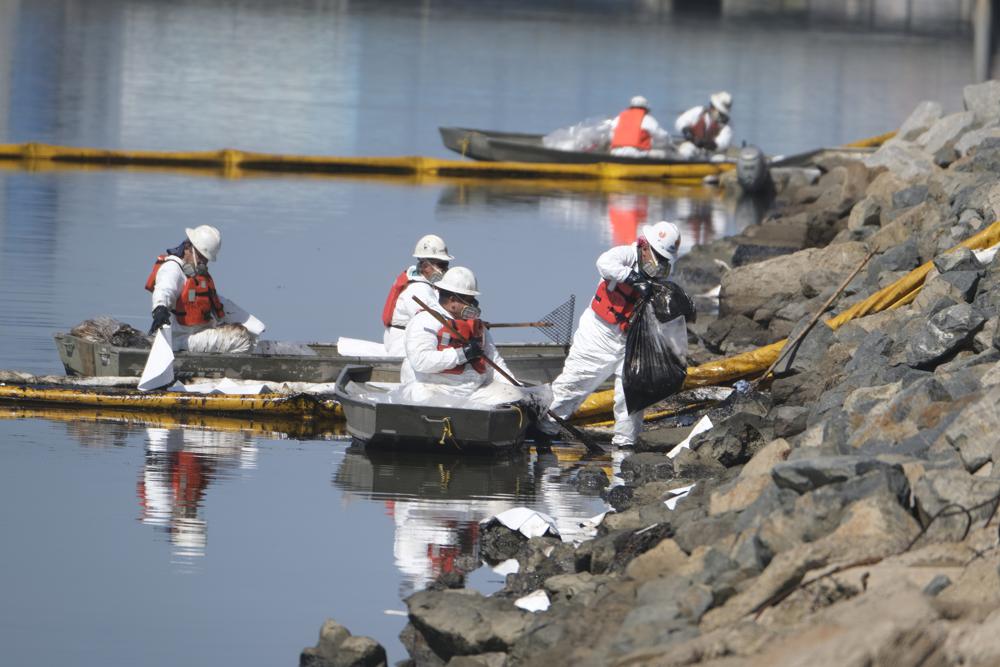
Cleanup contractors unload collected oil in plastic bags trying to stop further oil crude incursion into the Wetlands Talbert Marsh in Huntington Beach, Calif., Sunday, Oct. 3, 2021. One of the largest oil spills in recent Southern California history fouled popular beaches and killed wildlife while crews scrambled Sunday to contain the crude before it spread further into protected wetlands. (AP Photo/Ringo H.W. Chiu)
AP Photo/Ringo H.W. Chiu
  • Large, sudden pipeline spills are usually caused by external impacts (e.g. anchor dragging). If that was not the case, the spill was presumably caused by significant, undetected corrosion.
  • The internal (smart pig) and external inspection history of the pipeline will be an important part of the investigation.
  • Another important consideration is the extent to which pressure and volumetric monitoring systems were in place and functioning. Early reports imply that the leak was not discovered until the slick was observed on the water surface.
  • An excellent 2008 case study details the challenges that were experienced in internally inspecting this pipeline. This presentation provides good background information on the pipeline and the initial internal inspection efforts.
  • Why isn’t BSEE, the Federal bureau that inspects the Beta Unit facilities and approves the spill response plan, part of the Unified Command? BSEE is also a leader in spill response research.
  • Per the Unified Command, 1218 gallons of oil-water mix were recovered as of Sunday. This is pretty minimal – only 29 barrels (including water) and <1% of the estimated spill volume, but is not atypical for mechanical spill response operations. It may also be that the 3000 bbl spill estimate was overly conservative (i.e. high).
  • Also per the Unified Command: “One oiled Ruddy duck has been collected and is receiving veterinary care. Other reports of oiled wildlife are being investigated.” If this was the extent of wildlife impacts as of Sunday, some of the reporting on this spill has been hyperbolic.
  • A comprehensive review of the balkanized regulatory regime for offshore pipelines is long overdue, as is an update to Federal pipeline regulations.
  • This spill, Hurricane Ida, and offshore COVID issues have further demonstrated the importance of BSEE. Why has the Administration still not appointed a BSEE Director? Keep in mind that this appointment does not require Senate confirmation.

Read Full Post »

No photo description available.
Platforms Ellen and Elly
  • Pipeline carries oil from Platform Elly in Federal (OCS) waters to onshore processing facility in Long Beach
  • Operator: Beta Operating Co.
  • Platform complex is 8.6 miles from shore
  • Estimated spill volume: 3,000 bbls
  • Slick first evident on Saturday (10/2) about 3 miles from shore
  • Oil has reached shoreline at Huntington Beach
  • Production has been shut-in; unclear as to whether the leak has been sealed
  • No information on the cause of the leak

Read Full Post »

Divers identify broken pipeline as source of Gulf oil spill
satellite image provided by Maxar Techologies shows Port Fourchon and slicks on 9/2/2021
  • 12″ pipeline displaced by Ida
  • Approximately 2 miles south of Port Fourchon which took a direct hit from Ida. (Appears that the pipeline is in Louisiana State waters).
  • Water depth = 34′
  • Talos funding spill response, although the company said it was not their pipeline
  • Leak has slowed significantly; apparently production is not entering the line and the spill is limited to pipeline inventory
  • This type of incident is not surprising given the magnitude and track of Ida and the pipeline infrastructure that was exposed to major hurricane conditions

Read Full Post »

« Newer Posts