if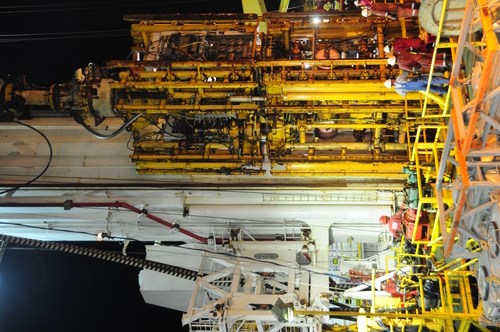
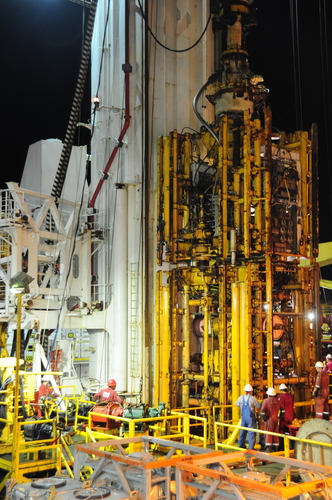
Deepwater Horizon BOP Stack
Posted in accidents, well control incidents, tagged accidents, blowouts, BOP, Deepwater Horizon, drilling, Gulf of Mexico, macondo, oil spill, safety, well control on September 5, 2010| Leave a Comment »
Deepwater Horizon BOP Stack
Posted in accidents, well control incidents, tagged accidents, blowouts, Deepwater Horizon, drilling, Gulf of Mexico, macondo, Montara, offshore oil, oil spill, safety, well control on September 5, 2010| Leave a Comment »

This article is nicely done, but like most commentary on the factors contributing to the Macondo blowout, it assumes that the well flowed in the annulus outside the production casing. Steps 1-3 would be irrelevant if the well flowed up through the shoe track and inside the production casing (ala Montara).
Posted in accidents, well control incidents, tagged accidents, blowouts, bp, Coast Guard, Deepwater Horizon, drilling, Gulf of Mexico, macondo, offshore oil, oil spill, relief well, safety, unified command, well control on September 3, 2010| Leave a Comment »
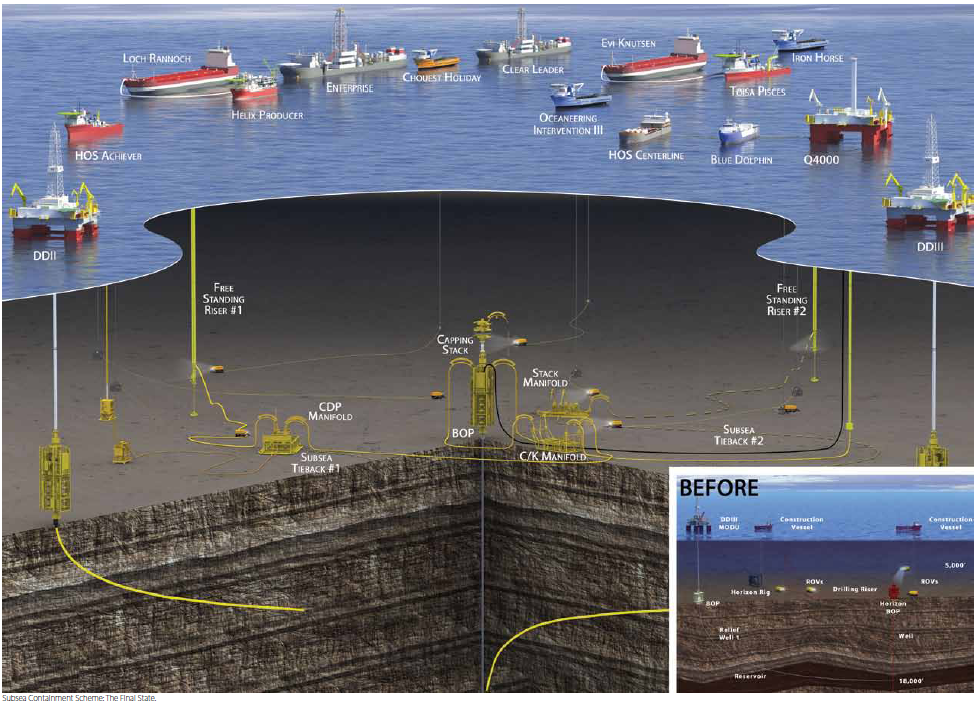
BP has issued a report on the response capabilities and innovative new technology and procedures demonstrated following the Macondo blowout. While the report is somewhat promotional (understandably), the information is summarized and compiled in a useful manner and underscores the magnitude of the response. Although most close observers probably have issues with certain actions taken by BP or the Unified Command, one cannot deny the unprecedented size and complexity of the response. We can only imagine how chaotic this response could have been if the operator did not have the resources and the will to mount such an enormous effort.
I hope BP will be similarly forthcoming with the results of their internal review of the blowout’s causes. When will that very important report be released?
At some point, BP’s candid observations on the functioning and effectiveness of the Unified Command system would also be helpful. The more we can learn about the differences of opinion and problems that arose during the response, the better we can prepare for future incidents. Will any of the official investigations be looking into these aspects of the response? At BOE, we are particularly interested in the well intervention, capping, containment, and relief well decisions.
Posted in accidents, well control incidents, tagged Australia, blowouts, damage claims, Indonesia, macondo, Montara, oil spill on September 2, 2010| Leave a Comment »
While BP has established a $20 billion damage fund that is being administered by the Federal government, PTTEP, the party responsible for the Montara blowout in the Timor Sea, is taking a different approach. PTTEP has denied all claims from the Indonesian government arguing that oil spill damages were limited to the immediate vicinity of the Montara field. However, information presented at the Montara hearings indicates that the slick extended into Indonesian waters.
PTTEP Australia (PTTEP AA), a subsidiary of the Thai-listed PTT Exploration and Production Public Company Limited today (2 September 2010) confirmed the Government of Indonesia that it has not accepted any claims for compensation relating to the claimed impacts of oil released from the company’s Montara field in the Timor Sea last year.
What if PTTEP was the operator at Macondo?
Posted in accidents, well control incidents, tagged accidents, blowouts, BOE, Deepwater Horizon, drilling, Gulf of Mexico, macondo, Montara, offshore oil, oil spill, safety, well control on September 2, 2010| 1 Comment »
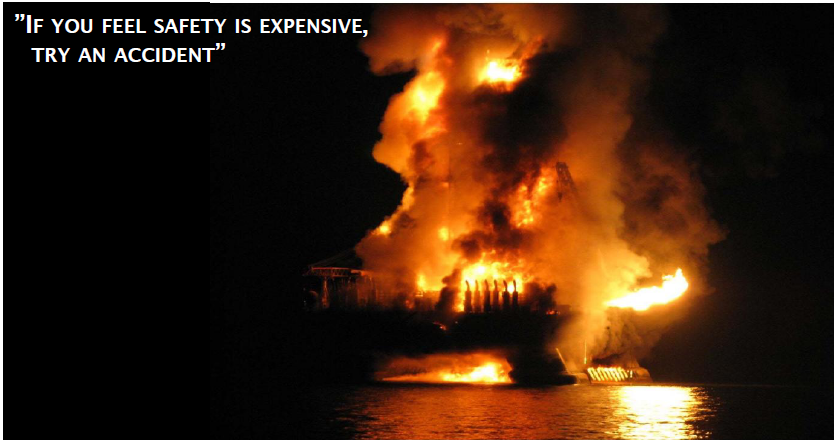
While there are no new details on the causes of the blowout, available information on the possible contributing factors is nicely summarized. The presentation also includes a very good summary of risk management considerations.
Barriers against accidents are not only technical and operational and “physical” but are also non-physical built around strategic and organizational measures and decisions
During the Montara hearings and later in Macondo discussions, we raised concerns about the timing of the production casing pressure test. This issue has not received enough attention in our view, possibly because most of the Macondo focus has been on annulus flow and barriers. It was good to see this comment in the presentation:
Pressure tested well far too early – could have blown out cement of shoe track
Posted in Uncategorized, tagged accidents, Canada, drilling, macondo, moratorium, offshore oil, oil spill, safety, well control on August 19, 2010| Leave a Comment »
 The Canadian Senate has decided that the facts do not justify banning Canada’s offshore drilling operations. The full report is linked.
The Senate also showed support for the International Regulators’ Forum. Canada will be hosting a major international conference in Vancouver in October.
The committee heard sufficient evidence to make it comfortable with Canada’s (federal and provincial) approach to striking this risk/reward balance andwith its new judgment-based and goal-oriented regulatory approach. Canada is a leading participantin the International Regulators Forum, a group of offshore industry regulators from the most activeoffshore drilling nations, including Norway, the United Kingdom, the United States, Australia, NewZealand, the Netherlands and Brazil. Interestingly, none of these nations have called for or imposedbans on current offshore drilling operations within their jurisdictions following the BP incident.
Posted in accidents, well control incidents, tagged accidents, blowouts, Deepwater Horizon, drilling, Gulf of Mexico, macondo, offshore oil, oil spill, relief well, safety, well control on August 19, 2010| Leave a Comment »
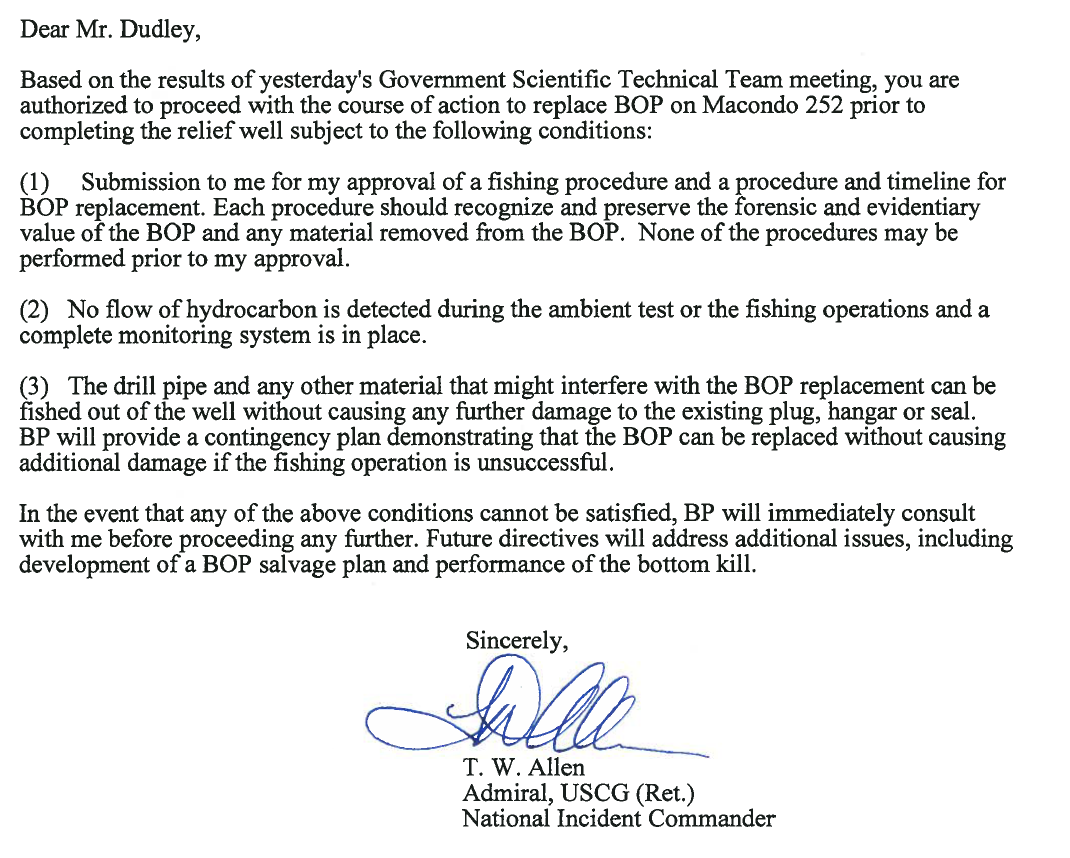
Aug. 19, 2010 letter, click to enlarge
With the new BOP in place, and the capability to enter the well from the top, squeeze cement into the annulus, and set and test plugs, the relief well intercept appears to add nothing but risk. Is the relief well being finished because of the repeated “read my lips” statements about its necessity or is there a valid reason that we are missing?
Also, with the well killed, should the Incident Commander be directing and approving operations that seem to fall under the plugging and abandonment category? Those operations are under the purview of the Bureau of Offshore Energy Management, Regulation, and Enforcement (BOEMRE) in the Department of the Interior. (Actually, according to the applicable MOU, (see section 10), BOEMRE should have had the lead on well control and flow abatement since the well blew out on April 20.)
Posted in accidents, tagged accidents, blowouts, Gulf of Mexico, LSU, macondo, NOAA, offshore oil, oil spill, Overton on August 18, 2010| Leave a Comment »
Not surprisingly, the television networks embraced the “Georgia Study,” which estimates that up to 79% of the Macondo spillage remains in the Gulf. Correspondents, bobbing from boats, rushed to report the news. Does this mean that the networks will resume their courageous Key West oil-watch? How about those damage projections for East Coast beaches?
Anyone who thinks that 79% of the oil remains hasn’t spent much time observing oil spills. NOAA’s peer reviewed numbers are more credible.
The major newspapers, to their credit, seem to be providing balanced coverage of the new report. The New York Times has a good article and this comment from Ed Overton seems to be pretty much on target:
Other marine scientists involved in evaluating the impact of the spill defended the government’s findings. “I generally agreed with the results,” said Edward Overton, a biologist at Louisiana State University who was one of several scientists who reviewed the federal study prior to its release. “I think it’s close to being on the mark.”
Posted in accidents, well control incidents, tagged accidents, blowouts, Deepwater Horizon, drilling, Gulf of Mexico, macondo, offshore oil, oil spill, relief well, safety, well control on August 17, 2010| Leave a Comment »
We are currently working with BP engineers and our science team to look at test results and do investigations to lead us to the best way to mitigate any risk of intercepting the annulus and increasing the pressure in the annulus. Admiral Allen
This insistence on drilling into a “killed well” reminds me of the Unified Command’s plan to end to end the “well integrity test” and vent the well after it had been successfully capped on July 15. Fortunately, the Command showed good judgement and reversed that decision. Perhaps they should do the same with the relief well intercept, which no longer appears to be necessary and may be hazardous.
The obvious next step is to re-enter the well from the top, perforate the production casing and squeeze cement into the annulus, and proceed with the plugging and abandonment operation. If the Command has reasons why this would not be the best approach, we’d like to hear what they are.
Despite the repeated “my way is the relief well” pronouncements, I trust that the Command will choose the option that accomplishes the objectives with the fewest risks to safety and the environment.
Posted in Uncategorized, tagged claims, Kenneth Feinberg, macondo, oil spill on August 16, 2010| Leave a Comment »
The filing of claims from far away “gives you some idea of the creativity of the claimant population.” Kenneth Feinberg, Administrator of BP Spill Fund
Hopefully, Feinberg will be able to weed out most of the scammers. Sadly, some of the people who are most deserving will be too proud to submit a claim.

 Bud's Offshore Energy (BOE)