Feeds:
Posts
Comments

Posts Tagged ‘offshore oil’

The following are significant accidents (based on the consequences or potential for consequences) that have been discussed on BOE, but for which no official company or governmental report has been released.  These accidents happened from 8 months to 3 years ago. I’m sure there are many others that we didn’t hear about or discuss. How do you effectively prevent accidents when reports are either not prepared, not released, or not completed in a timely manner?

The following accidents are are too recent (6 were just last month) to expect reports. BOE will publish links to the reports as soon as they become available.

If you are aware of other accidents that you think should be added to these lists, please let me know.


Read Full Post »

…. and gleeful. 

“Is there likely to be litigation over new drilling permits? You bet there is,” said David Petit, a senior attorney with the Natural Resources Defense Council.

“We’ll definitely litigate it,” Kieran Suckling, executive director of the Center for Biological Diversity, said of the federal approval of Shell’s plan. “It’s patently illegal.”

Environmental Suits Threaten Gulf Drilling- Wall Street Journal

Read Full Post »

From Platt’s Oilgram News: 

Canadian Prime Minister Stephen Harper turned two minority election victories since 2006 into a clear-cut majority win May 2, giving him the freedom to govern unchallenged for four years and, if he chooses, open the door to Canada’s first offshore oil and natural gas exports, climate change legislation, a national energy strategy and increased resource sector takeovers by foreign state owned companies.

Harper wasted no time telling reporters May 3 that Western Canada, whose economies rely heavily on oil, natural gas and mineral resources, can “breathe a lot easier.” He said NDP and Liberal policies calling for a ban on crude oil and LNG tankers off the northern British Columbia coast and a cap-and-trade emissions-reduction plan “were pretty seriously threatening” to Western Canada. “It’s a great thing those policies won’t be coming to fruition,” Harper promised.

Read Full Post »

oil-eating bacteria

scientists led by Terry Hazen, a microbiologist at Lawrence Berkeley National Laboratory, discovered that cold-loving microbes were making quick work of the oil (Greenwire, Aug. 24, 2010). These bugs were, in effect, oil-seeking missiles. They were highly mobile, armed with swimming flagella and protein sensors that could guide them to their oily prey, according to additional work so far unpublished by Hazen’s group.  New York Times

Read Full Post »

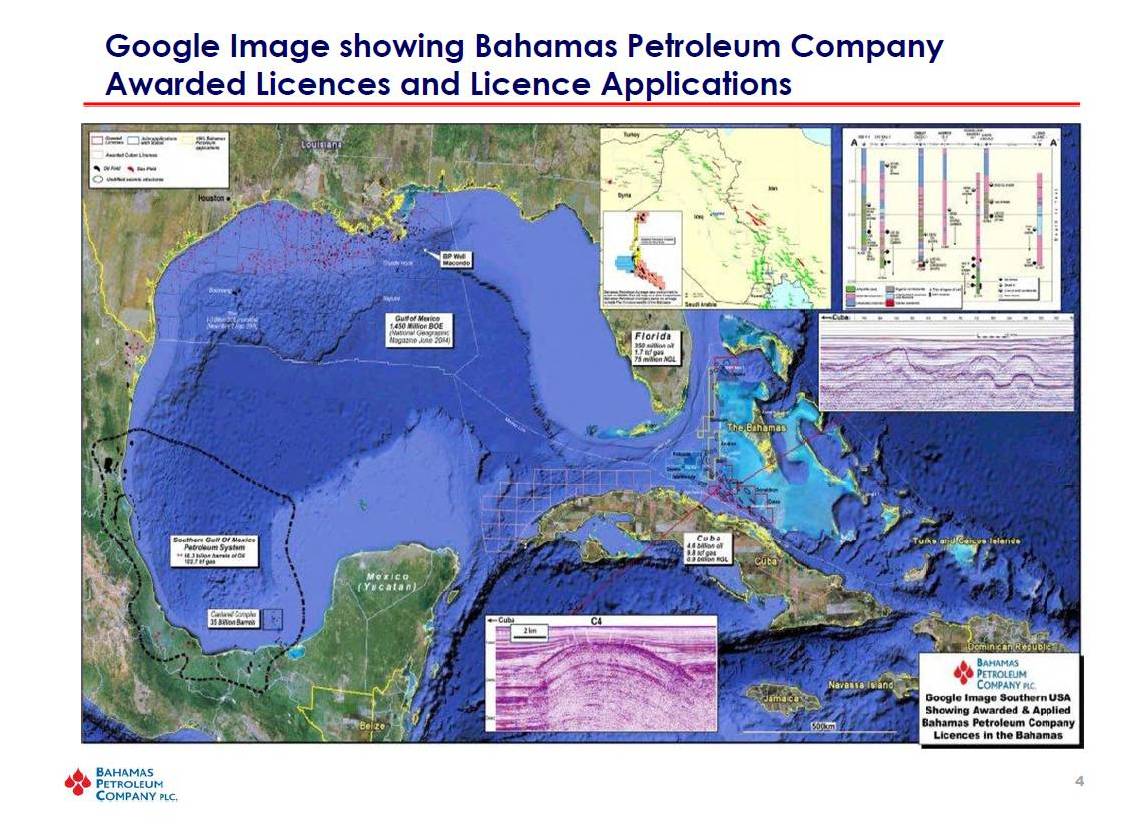
click on image to enlarge

from the Bahamas Tribune:

“We hope that in the second quarter of next year we will be able to be in a position where we can go forward and drill a well. We’ve just raised $75 million on the London market last month to apply towards our exploration purposes,” Dr Crevello said during a meeting of the Rotary Club of Nassau yesterday.

It is doubtful that this timeline will be met as Government has said it will not lift its moratorium on drilling any time soon.

“Well it’s nigh impossible for this (the passing of legislation relating to oil drilling) to be accommodated within this Parliament,” Environment Minister Earl Deveaux told The Tribune last month.

Read Full Post »

This makes sense

“One of the goals potentially of the MWCC group is to see how we can work together with the Helix group to try to accommodate solutions for all of the Gulf of Mexico,” Dupree (BP) said.

Read Full Post »

AP report:

“The Deepwater Horizon BOP was unreasonably dangerous, and has caused and continues to cause harm, loss, injuries, and damages to BP (and others) stemming from the blowout of Macondo well, the resulting explosion and fire onboard the Deepwater Horizon, the efforts to regain control of the Macondo well, and the oil spill that ensued before control of the Macondo well could be regained,” BP said in the suit.

Read Full Post »

CNN Poll

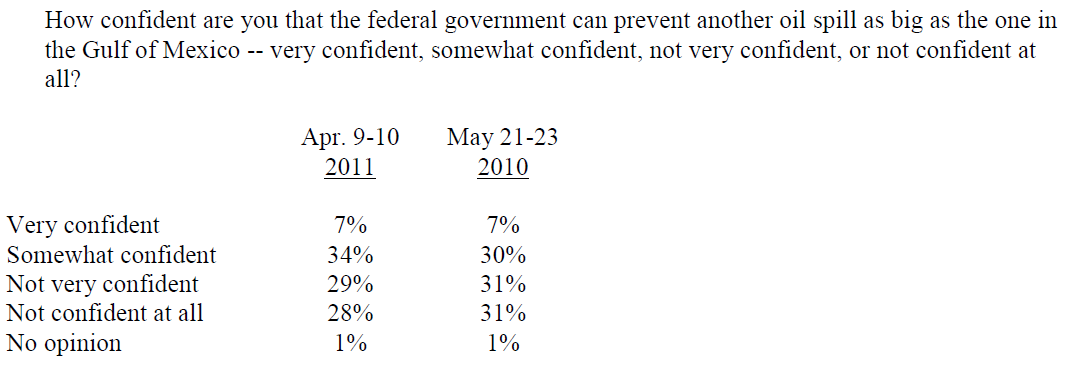
A CNN/Opinion Research Corporation survey released Tuesday indicates that 69 percent of Americans favor increased offshore drilling, with just over three in ten opposed. That 69 percent is up 20 points from last June, while the oil spill was still in progress, and is back to the level of support seen in the summer of 2008.

Confidence in government has shown a less significant increase.

Read Full Post »

Jupiter Flotel

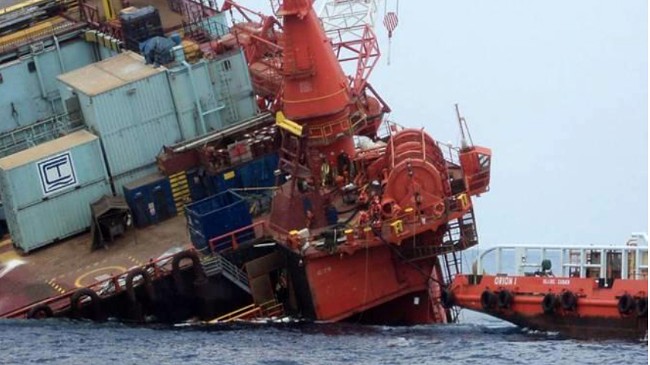
….interest in offshore accidents quickly diminishes.  The Pemex Jupiter semisubmersible quarters facility sank last week with 713 workers aboard (fortunately all were safely evacuated). This stunning near-disaster received minimal coverage. Follow-up reports are non-existent.  As our friend JL Daeschler asked, how does a flotel capsize in calm conditions and shallow water? What went wrong and why? Let’s hope that a comprehensive investigation is conducted and that the findings are shared worldwide (unlike Venezuela’s handling of the Aban Pearl sinking).

As we have noted before, Macondo would have disappeared from the news within a week if the deadly fire and explosion had not been followed by a sustained oil spill. The only investigation would have been by Coast Guard and the Minerals Management Service (which would likely still exist). There would have been no National Commission, National Academy, Chemical Safety Board, or congressional investigations, and prosecution by the Justice Department would have been unlikely.

In the US, offshore spills are media events; other accidents are not. How much attention did the horrific fire and explosion that killed seven workers on the South Pass 60 B Platform receive in 1989? Virtually none. How about the lives lost in helicopter crashes? While the crash that killed 17 off Newfoundland in 2009 has been well studied and reported, offshore helicopter crashes in the US receive almost no attention. Ditto for crane accidents. If we want to build a proper safety culture, we need to pay as much attention to the low-profile accidents as we do the pollution spectaculars, and everyone needs to participate.

Read Full Post »

  • Require that a Central Gulf of Mexico (GoM) oil and gas lease sale be held within 4 months of enactment, and that a second sale for that area be held within 12 months.
  • Require that a Western GoM sale be held within 8 months of enactment.
  • Stipulate that prior environmental reviews would satisfy NEPA requirements for the GoM sales.
  • Require that a Virginia offshore sale be conducted within 1 year of enactment. [Comment: While I support a sale offshore Virginia, I do not believe this can be accomplished in one year.]

HR 1231 would:

  • Require that specified volumes of oil and gas (per estimates made by MMS in 2006) be made available for leasing.
  • Set offshore production goals.
  • Give credits (for use in paying lease bonuses) to companies for costs associated with pre-sale seismic surveys.   [Comment:  If the legislation provides reasonable assurance that lease sales will be held, why are the seismic survey credits needed? The seismic data will have a high commercial value. Collection of these data should not have to be subsidized by the Federal government.]

HR 1229 would:

  • Require that DOI act on drilling applications within 60 days.
  • Extend the term leases where the approval of drilling applications was delayed following the Macondo blowout.
  • Make the 5th Circuit Court the venue for any civil actions involving GoM energy projects.
  • [Comment: The important question is not the number of days that the regulator should be given to review applications, but whether a complex permit review and approval process is the optimal regulatory approach. A lesson learned from virtually every major accident, from Santa Barbara through the Ocean Ranger, Alexander Kielland, Piper Alpha, and Macondo, is that command and control regulation is not in the best interest of offshore safety. Industry should not rely on government to manage its operations and government should focus on safety achievement, not directing the day-to-day activities of offshore companies. Over the long-term, the US would be better served if regulatory resources were dedicated to risk assessment, data analysis, assessment of operator and contractor management systems, targeted inspections and audits, participation in standards development and research, and safety leadership.]

Read Full Post »

« Newer Posts - Older Posts »