Feeds:
Posts
Comments

Posts Tagged ‘offshore oil’

I have been too busy to do much blogging, but thought I would share some thoughts from the past week:

Media vacates Margaritaville

Margarita consumption declines on Key West: Now that Federal scientists have determined that the Key West tar is NOT related to the Macondo blowout, the TV networks  have ended their brave beach monitoring vigil on the island.  I have volunteered to man the vacated outpost pictured to the left. Tough duty, but somebody has to do it!  Cheers!

Heard on the local news in Norfolk, VA: The slick has entered the Loop Current superhighway and Virginia Beach is in imminent danger. (I am not making this up!)  By the way, when will we hear again from the “experts” who predicted that oil would arrive on Florida East Coast beaches 3 weeks ago?

A Tale of Two Spills:  Listen to the concerned but rational speakers at the daily Unified Command briefings; then tune-in to the evening news.  You would think they were talking about entirely different events.  Excellent work by the Unified Command, but we could do without the spam-like emails that track every move of the agency chiefs.

How many times can you throw 1700 people under the bus? May we suggest a temporary moratorium on the MMS bashing?  Does it make sense to at least find out what happened and why before demonizing a Federal agency and everyone who works for it?  It’s amazing how much so many people suddenly know about oil and gas operations and how they should be regulated.  We could have used their help for the past 30-years when the cameras were directed elsewhere.

Back to the Future: James Watt, perhaps the most controversial Secretary of the Interior in history, was best known for his attempts to accelerate resource development on Federal lands and for banning the Beach Boys (too vulgar :)) from Independence Day concerts on the National Mall.  The Beach Boys decision was reversed after Nancy Reagan intervened, and the aggressive land use policies backfired in a big way.  Watt’s personality and policies galvanized environmental opposition and led to 25 years of moratoria on most OCS exploration and development.

Less well known is Secretary Watt’s 1982 decision to form the MMS in response to concerns about royalty collection practices.  Prior to the creation of MMS, the OCS regulatory functions were in the Conservation Division of the US Geological Survey (USGS) and the leasing program was in the Bureau of Land Management.  The decision to once again split these functions, which I have long supported, recognizes the importance of function-based management and independent regulators.  Rest in Peace MMS.  The realignment will be better for the OCS program, the employees, the public, and the regulated industry.

Macondo well flow rate exceeds national consumption: When this well is finally brought under control, there will be no need for oil imports.  While I am of course exaggerating, the spill-rate speculation is as out-of-control as the well.  Fortunately, Admiral Allen has promised an official estimate from the Unified Command.  Hopefully, this estimate will include a list of assumptions and an uncertainty range.

-Lastly, beware of speakers who start by saying, “I’ll be brief.” 🙂
Read Full Post »

I haven’t posted recently for a variety of reasons, but I see that folks are still visiting the blog.  Thanks for checking-in.  For those who are formulating their own views about what really happened and why, the documents at the House Energy and Commerce Committee site are mandatory reading.

Also, many thanks to those who have asked about my testimony before the Senate Committee on Energy and Natural Resources.  My statement is here. Kudos to Chairman Bingaman and the very capable committee staff for their thoughtful and professional approach to these hearings.

Read Full Post »

"Macondome" Pollution Containment Chamber

Assuming well intervention efforts continue to be unsuccessful, the next big milestone will be the installation of the subsea containment dome and the floating production system that will support it.  We should know a lot more in one to two weeks.  Schematics of the subsea, riser, and surface arrangements would be useful for those of us watching at home.

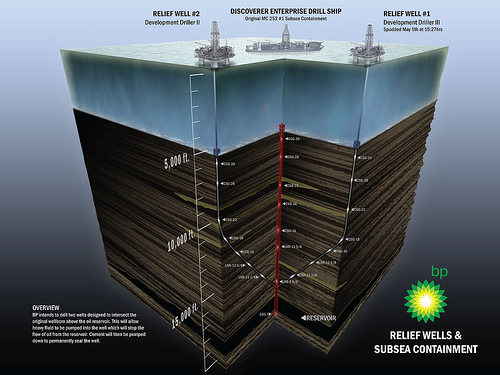
Relief Wells

From the BP relief well schematic, it appears that both wells will have the same target, so the 2-well program is solely for the purpose of killing the well as soon as possible.  No information has been provided as to whether the flow is thought to be originating at the production casing shoe or in the annulus surrounding the casing.

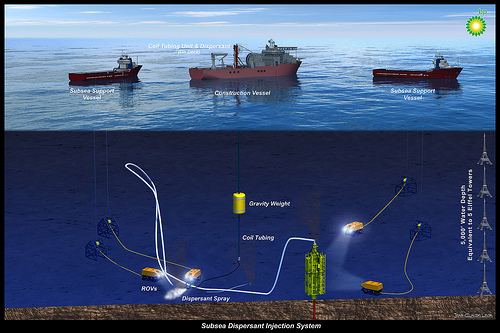
Subsea Dispersant Injection System

BP is reporting good results with the seafloor dispersant system.

Read Full Post »

Based on careful examination, NOAA scientists do not believe that these sea turtle strandings are related to the oil spill. NOAA and its partners have conducted 10 necropsies so far – none of ten turtles showed evidence of oil, externally or internally. ~Barbara Schroeder, NOAA national sea turtle coordinator.

link

Read Full Post »

On June 3, 1979, a rig drilling off Mexico on a prospect called Ixtoc experienced a severe blowout. Oil was soon washing up on south Texas beaches. Brown and Root, the offshore drilling and supply company, improvised a device they called the sombrero. It was a funnel, or hat-shaped device, which was lowered over the runaway well. The floating oil would enter at the bottom and be funneled up the device to the surface where it was pumped into a floating tanker. The idea was good but apparently the design was not quite right. It did not capture all the oil.

Having heard about BP’s seafloor collection system, which Upstream has dubbed Macondome I :), long-time friend and leading marine scientist Gene Shinn sent me this excerpt from his memoirs.  Gene talks about Dr. Jerry Milgram’s research in the wake of the Ixtoc blowout.  Check it out here.  Gene’s comment about Dr. Milgram’s mad genius is spot-on.  Dr. Milgram was also a designer of America’s Cup boats. Hopefully the Mocondome designers contacted Jerry for his wisdom.

At first Gerry seemed to be a stereotype of the absent-minded egghead professor from a prestigious university. I really wondered if any of this would work. Boy was I surprised! That man could handle a welding torch one minute and operate a sophisticated spectrometer the next. At the same time, he was making complex calculations in his head. I was greatly impressed.

Read Full Post »

-The responders have successfully installed a valve on one of 3 leak points – the drill pipe protruding from the riser.

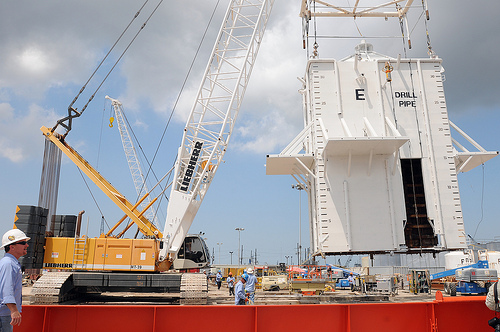
Installation of the first pollution dome will begin today.  This is really a production system and more information on the design will presumably be forthcoming.

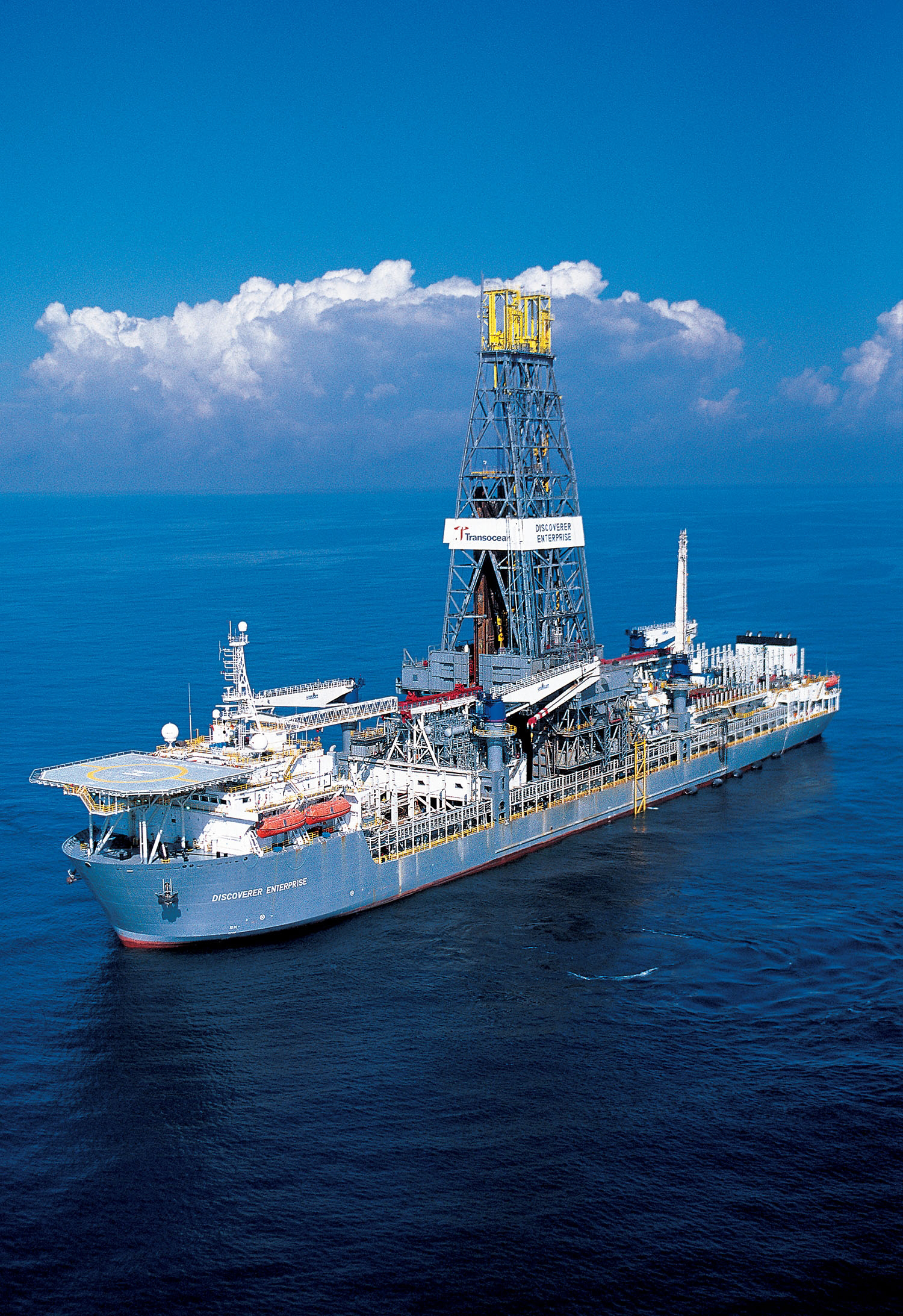
Discoverer Enterprise

I assume there will be some type of pipeline riser connecting the dome to the Enterprise  through the moon pool, that the rig’s tensioning system will be used to keep the riser taut, that the oil and gas will be processed on the enterprise, that the gas will be flared,  and that the oil will be stored on the rig and offloaded to a shuttle tanker.  In essence, the Enterprise will serve as a temporary FPSO.

Read Full Post »

The tragic events on the Deepwater Horizon rig in the Gulf of Mexico have attracted great international attention, and have also promoted a flood of questions to the Petroleum Safety Authority Norway (PSA).

The PSA Norway has issued a statement on the Horizon incident, and has appropriately avoided responding to the “can it happen here?” question.  Their interest and support are greatly appreciated.

Read Full Post »

The Deepwater Driller III (pictured) has spudded the first relief well.

Discoverer Enterprise will support seafloor contaiment system.

While BOE’s eager but poorly managed staff struggles to keep pace, Upstream is providing excellent coverage of the well intervention, relief well, and seafloor containment system stories.  This is the news of greatest interest to our small, but highly sophisticated readership.  (For extensive coverage of news celebrities standing near the shore or bravely venturing into streamers of oil, turn your attention to the network news.)

Anyway, lots of new developments: the relief well was spudded, another rig is on the way to drill a second relief well, the seafloor containment system is ready to be transported to the site, and plans to install a second BOP stack (on top of the first) proceed.   But perhaps of greatest interest to BOE readers is the report that BP had closed the rams but did not stem the flow.  The BP spokesman suggested that the rubber portions of the rams may have been eroded and were thus unable to seal the well.   This makes sense for the pipe rams and annular preventers (although some flow reduction would still be expected), but what about the shear ram?  Was it closed?  Was it unable to cut pipe that was inside the stack?  What happened when the crew attempted to shut-in the well prior to evacuation?  When can we expect a statement from Cameron, the BOP manufacturer?

Read Full Post »

This blowout is a national tragedy with 11 fatalities, 3 critical injuries, many lives disrupted, and a major ongoing oil spill.  Nonetheless, as with every disaster, there are some positives.  A  few come to mind:

  1. 115 workers were rescued following the initial explosion.
  2. The first ever deepwater oil containment and collection system is being built.  Should the responders not be able to soon stop flow from the well, this system will be deployed and evaluated.
  3. An innovative and unprecedented attempt may be made to install and operate a second BOP (above the failed stack).
  4. New spill cleanup options such as underwater dispersants are being studied.  The resulting data will be very useful to oil spill researchers.
  5. Lessons from Macondo are likely to trigger improvements in BOP systems and well integrity assurance procedures.

Read Full Post »

Let me be clear: BP is responsible for the leak; BP will be paying the bill. President Obama

While this is clearly the case for “removal costs,” damage costs are a different matter.  The Oil Pollution Act of 1990 establishes liability limits as follows:

for an offshore facility except a deepwater port, the total of all removal costs plus $75,000,000;

With regard to maximum liability, a MODU like the Horizon would be treated the same as an offshore facility.  Removal costs are “costs to prevent, minimize, or mitigate oil pollution,” not economic costs to affected parties.

The liability limits do not apply in the event of  “(A) gross negligence or willful misconduct of, or (B) the violation of an applicable Federal safety, construction,or operating regulation by,the responsible party, an agent or employee of the responsible party, or a person acting pursuant to a contractual relationship with the responsible party.”

The legal battles have already begun and will last for at least a decade.

Read Full Post »

« Newer Posts - Older Posts »