Feeds:
Posts
Comments

Posts Tagged ‘offshore’

Cheryl Anderson took oil spill data analysis to a level worthy of a world class offshore program. In my opinion, Cheryl was the top analyst in the history of the OCS program, a true Hall of Famer. Regardless of the politics of the day, she always stuck to the facts and resisted “spin,” and that was a trait her colleagues greatly admired.

Cheryl retired at the end of 2010 and her final update, with assistance from 2 other OCS program icons, Melinda Mayes and Bob LaBelle, was published in June 2012. That update is attached.

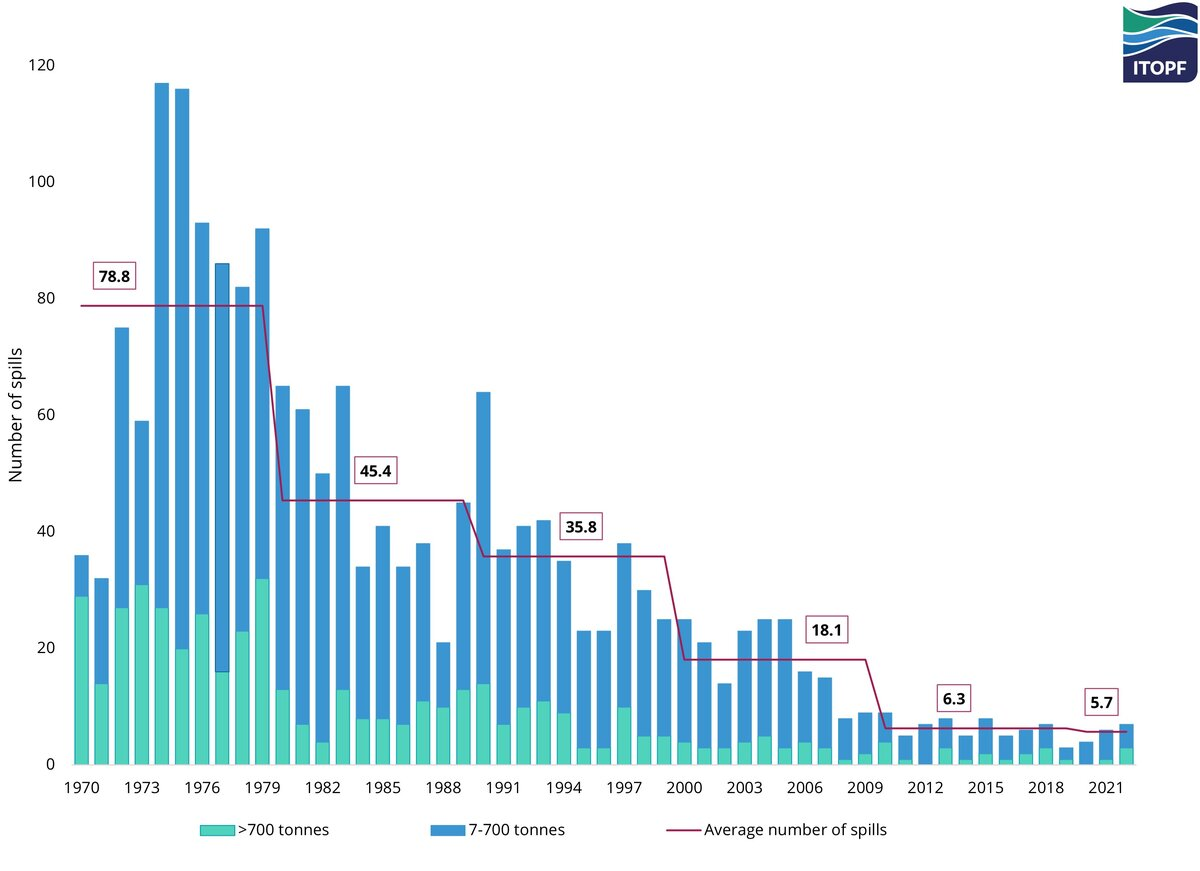
ITOPF also deserves mention for their comprehensive tanker spill data. A recent chart is pasted below. ITOPF’s data are nicely presented on their website. No such data are available for international offshore production.

Read Full Post »

Encouraging report from Steve Walker and his HSE colleagues.

Figures from the Health and Safety Executive (HSE) show that there were 73 major or significant hydrocarbon releases associated with offshore installations in 2010/11, compared with 85 the previous year. There were 61 recorded in 2008/09 – the lowest since HSE began regulating the industry. Overall, there continues to be a downward trend in the total of all reported hydrocarbon releases offshore.

For the fourth year running, no workers were killed during offshore activities regulated by HSE and 2010/11 also saw a fall in the number of major injuries. There were 42 reported compared with 50 the previous year, bringing the total in line with the average of the previous five years.

Read Full Post »

If someone had asked me a few years ago what the highest risk offshore system was, I certainly would not have said a fully cased well in the process of being suspended. Yet that was the scenario for both of the recent mega-incidents, Montara and Macondo.

I would have instead suggested that dynamic production risers were the highest risk offshore system. The combination of relatively new technology, movement,  fatigue potential, exposure in the splash zone, and continuous hydrocarbon flow poses risks that must be carefully managed.  That is why investigations of incidents like the Visund gas leak are so important. In that regard, PSA does an excellent job and prominently posts all of their reports so that we all may benefit. I recommend that you take a look at this one.

In connection with the planned shutdown on Visund on 9 April 2011, a hydrocarbon leak occurred from well A21’s 6” flexible riser UK-18-0009. The Petroleum Safety Authority Norway (PSA) has carried out an investigation of certain aspects of the incident.

 We have identified three nonconformities within the areas of establishment and follow-up of preconditions for safe operation of dynamic risers, training and expertise and governing documentation.

Read Full Post »

A month ago, BOE posted a list of major accidents for which no official company or government reports had been released.  Below is the latest update on these accidents. If you have updated information, or if there are other events that should be added to the list, please let us know.

The following recent accidents are on our “watch list.”  Accidents are added to the “missing report list” when six months have elapsed since the accident.

Read Full Post »

Congratulations to the many dedicated professionals who contribute to the success of this important conference.   OTC-logo-blue-black---clear.gif

Attendance at the 2011 Offshore Technology Conference (OTC) reached a 29-year high of 78,150, up 8% from last year, as offshore energy industry experts from around the world came together at the world’s largest event for offshore resources development. OTC was held 2-5 May at Reliant Park in Houston.

Read Full Post »

Surprisingly, the post-Macondo discussion about regulatory approaches has been largely devoid of value and cost-benefit assessments. While PSA has been praised for Norway’s outstanding offshore safety record, little attention has been paid to their relatively low regulatory costs.

According to data in the 2010 Annual Report, PSA has 161 employees, and had total operating expenses of NOK 202,762,689  ($US 38.1 million) for 2010. These modest cost and staffing numbers are particularly impressive when the magnitude and complexity of Norwegian offshore operations are considered. In March 2011, Norwegian oil production averaged 2.017 million barrels per day (no. 2 offshore oil producer slightly behind Brazil) and gas production averaged 11.6 billion cubic feet per day (world offshore leader). PSA is also responsible for onshore processing facilities.

PSA’s costs are relatively modest for the same reason that their regulatory program is successful. They hold companies responsible for managing their operations and conducting inspections. They don’t approve every detail of every operation, but focus on ensuring that the company management systems are effectively implemented.  They identify risks and insist that industry address them. As Magne Ognedal said in his interview with BOE: 

Our regulatory philosophy is indeed firmly based on the legislated expectation that those who conduct petroleum activities are responsible for complying with the requirements of our acts and regulations. Furthermore, our regulations require that they employ a management system that systematically probes and ensures such compliance at any time.  The approach to achieving this should be risk-based.  So, ensuring compliance with rules and regulations is the operator’s job – not ours.

Read Full Post »

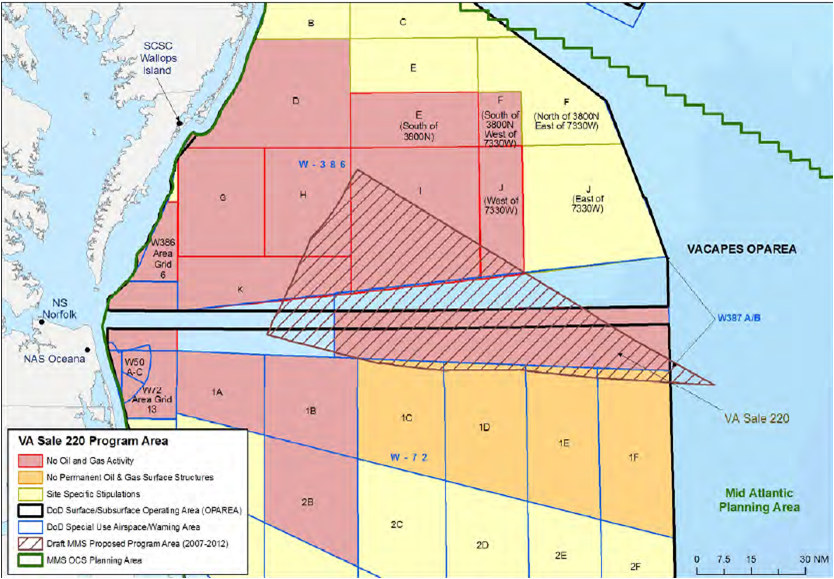
…but the only Atlantic area included in the present 5-year oil and gas leasing program  is the cross-hatched wedge in the map below.  This area was to have been considered for leasing  in Sale 220, but the sale was cancelled following the blowout. The House Natural Resources Committee has passed legislation that would require that sale to be held.

No matter what happens, Sale 220 isn’t much to get excited about, especially if the Department of Defense has its way. In light of world events and the fuel demands of our military, one would assume that DOD would be a leading advocate for offshore energy exploration and development. However, rightly or wrongly, preventing disruptions to military training and operations has always been a higher DOD priority than domestic energy production.

With regard to Sale 220, DOD wants 72% of this already small area (magenta) removed from consideration. So even if this lease sale is held, the maximum offering would likely be the cross-hatched blue micro-sliver. That would be the extent of Atlantic leasing for the foreseeable future.

Oil is where you find it, not where you wish it was, where it is most convenient, or where you legislate it to be. Ditto for natural gas. We need an offshore oil and gas program that identifies the most prospective targets, provides for exploratory drilling to evaluate these targets, facilitates production, and effectively manages the safety and environmental risks. We can’t just explore the small slivers that remain after political and administrative reviews have eliminated the rest.

Like it or not, our Outer Continental Shelf lands belong to the entire nation. We need to manage these lands and the associated resources in a manner that is in the best interest of all Americans.
Read Full Post »
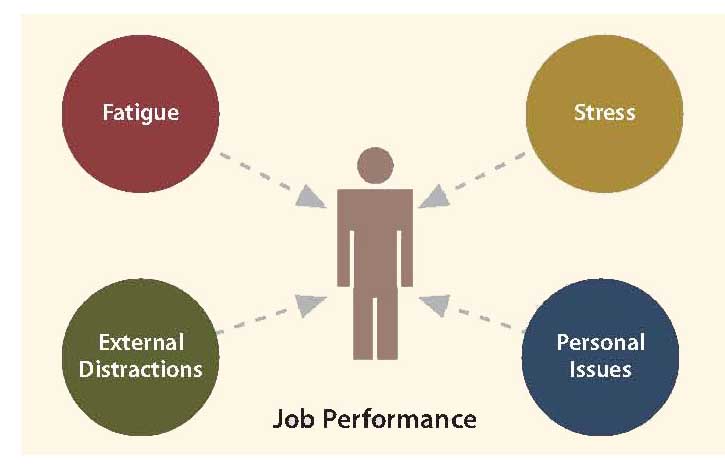
Step Change in Safety, a UK partnership committed to offshore safety achievement, has published an interesting human factors report.  The report, which was brought to my attention by Melinda Mayes, includes 12 one-page case studies of offshore incidents with commentary on how human factors played a role.

I suspect that many of you can relate to “Case Study 3,” which begins as follow:

After going through a difficult downsizing a company decided to restrict recruitment and personnel moves, in an attempt to avoid painful redundancies in the future.

At the time there was great demand for personnel in the oil and gas market. One installation lost a number of its operational leadership to another company. For a while the installation managed. It was able to maintain its minimum manning levels, and less experienced personnel were asked to step-up into leadership positions. The Offshore Installation Manager (OIM) and offshore engineer began micro-managing work on the installation.

After reading the report, you may want to take a look at the comments posted at the Step Change site. These comments illustrate another human factor – differences in opinion!

Read Full Post »

Bloomberg report on East Cameron 278 “B”gas leak (90 miles offshore, 170′ water depth):

Apache workers have boarded the platform to seek to contain the source of the gas leak, the U.S. bureau said in an e-mailed statement today. The government said a remotely operated vehicle will monitor conditions to make sure work can occur safely.

The bureau said today that, in accordance with its direction, Apache is continuing preparations for drilling a relief well to stop the leak in the event the platform procedures don’t succeed.

Read Full Post »

Shell has agreed to transport its used drilling fluids from Beaufort Sea exploration drilling out of the Arctic if the company finally gets government permission to drill a well next summer. Alaska Journal of Commerce

I assume this includes all drilling fluids and drilled solids (cuttings) except for the spud mud and cuttings generated prior to installing the riser?  If so, I believe this will be a first for an exploratory well drilled from a floating rig in US offshore waters.

Read Full Post »

Older Posts »