“The Deepwater Horizon BOP was unreasonably dangerous, and has caused and continues to cause harm, loss, injuries, and damages to BP (and others) stemming from the blowout of Macondo well, the resulting explosion and fire onboard the Deepwater Horizon, the efforts to regain control of the Macondo well, and the oil spill that ensued before control of the Macondo well could be regained,” BP said in the suit.
Posts Tagged ‘macondo’
BP vs. Cameron
Posted in accidents, well control incidents, tagged accidents, blowouts, BOP, Deepwater Horizon, drilling, Gulf of Mexico, macondo, offshore oil, oil spill, safety, well control on April 20, 2011| 6 Comments »
Absent a sustained oil spill…..
Posted in accidents, tagged Flotel, Jupiter, macondo, offshore oil, oil spill, Pemex, safety, sinking on April 19, 2011| 2 Comments »
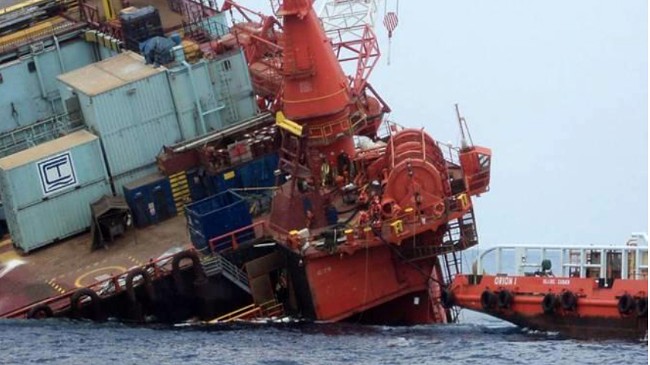
Jupiter Flotel
….interest in offshore accidents quickly diminishes. The Pemex Jupiter semisubmersible quarters facility sank last week with 713 workers aboard (fortunately all were safely evacuated). This stunning near-disaster received minimal coverage. Follow-up reports are non-existent. As our friend JL Daeschler asked, how does a flotel capsize in calm conditions and shallow water? What went wrong and why? Let’s hope that a comprehensive investigation is conducted and that the findings are shared worldwide (unlike Venezuela’s handling of the Aban Pearl sinking).
As we have noted before, Macondo would have disappeared from the news within a week if the deadly fire and explosion had not been followed by a sustained oil spill. The only investigation would have been by Coast Guard and the Minerals Management Service (which would likely still exist). There would have been no National Commission, National Academy, Chemical Safety Board, or congressional investigations, and prosecution by the Justice Department would have been unlikely.
In the US, offshore spills are media events; other accidents are not. How much attention did the horrific fire and explosion that killed seven workers on the South Pass 60 B Platform receive in 1989? Virtually none. How about the lives lost in helicopter crashes? While the crash that killed 17 off Newfoundland in 2009 has been well studied and reported, offshore helicopter crashes in the US receive almost no attention. Ditto for crane accidents. If we want to build a proper safety culture, we need to pay as much attention to the low-profile accidents as we do the pollution spectaculars, and everyone needs to participate.
Three offshore oil and gas bills clear House Natural Resources Committee
Posted in Uncategorized, tagged drilling, House Natural Resources Committee, leasing, macondo, offshore drilling, offshore oil, permitting, Regulation, safety on April 18, 2011| Leave a Comment »

- Require that a Central Gulf of Mexico (GoM) oil and gas lease sale be held within 4 months of enactment, and that a second sale for that area be held within 12 months.
- Require that a Western GoM sale be held within 8 months of enactment.
- Stipulate that prior environmental reviews would satisfy NEPA requirements for the GoM sales.
- Require that a Virginia offshore sale be conducted within 1 year of enactment. [Comment: While I support a sale offshore Virginia, I do not believe this can be accomplished in one year.]
- Require that specified volumes of oil and gas (per estimates made by MMS in 2006) be made available for leasing.
- Set offshore production goals.
- Give credits (for use in paying lease bonuses) to companies for costs associated with pre-sale seismic surveys. [Comment: If the legislation provides reasonable assurance that lease sales will be held, why are the seismic survey credits needed? The seismic data will have a high commercial value. Collection of these data should not have to be subsidized by the Federal government.]
- Require that DOI act on drilling applications within 60 days.
- Extend the term leases where the approval of drilling applications was delayed following the Macondo blowout.
- Make the 5th Circuit Court the venue for any civil actions involving GoM energy projects.
- [Comment: The important question is not the number of days that the regulator should be given to review applications, but whether a complex permit review and approval process is the optimal regulatory approach. A lesson learned from virtually every major accident, from Santa Barbara through the Ocean Ranger, Alexander Kielland, Piper Alpha, and Macondo, is that command and control regulation is not in the best interest of offshore safety. Industry should not rely on government to manage its operations and government should focus on safety achievement, not directing the day-to-day activities of offshore companies. Over the long-term, the US would be better served if regulatory resources were dedicated to risk assessment, data analysis, assessment of operator and contractor management systems, targeted inspections and audits, participation in standards development and research, and safety leadership.]
Coast Guard Incident Specific Preparedness Review (Macondo)
Posted in accidents, well control incidents, tagged accidents, blowouts, Coast Guard, Deepwater Horizon, drilling, Gulf of Mexico, macondo, offshore oil, oil spill on April 10, 2011| Leave a Comment »
Good report; worth reading. Some of the positive points are unlikely to get much attention, so we’ll mention them here:
- The National Incident Management System/Incident Command System worked as intended
- Personnel provided by the Responsible Party (RP) and Coast Guard personnel worked effectively together, and there was “unity of effort” throughout the response organization.
- The team found no evidence of collusion between the Coast Guard and RP.
- The response generally benefited from the ability of the Government and the private sector to rapidly assess and adapt to new or unusual contingencies and develop innovative solutions for problems not previously experienced.
- The knowledge acquired and capabilities learned from this experience are unprecedented, and should become a basis for significant improvements in planning, preparedness, and response for industry, Government, and the response community.
More on the Deepwater Horizon BOP failure
Posted in accidents, well control incidents, tagged accidents, blowouts, Deepwater Horizon, drilling, Gulf of Mexico, macondo, offshore drilling, oil spill, safety, well control on March 30, 2011| 2 Comments »
 In a previous post, we discussed JL Daeschler’s comments suggesting that the emergency disconnect sequence (EDS) may have actuated the shear ram, but that the sequence aborted when the ram did not close fully. Another knowledgeable commenter, while requesting not to be named, noted that:
Whether the EDS-functions terminated before the sequence was completed is clearly a relevant question.
I agree and believe this possibility may have been dismissed without being fully considered. The DNV report claims that the EDS sequence never actually initiated, probably because of a loss of communication with the stack after the initial explosion. As evidence, the report offers the following:
There is an account of lights flashing, indicating that the EDS function had initiated. There are no accounts of any specific lights going steady, which would have indicated a function had been completed and confirmed by the subsea control pods.
Comment: Perhaps no light stopped flashing because the first step in the sequence, BSR actuation, was not concluded (i.e. the BSR never fully closed).
Reviewed ROV video indicated no evidence that the sequence had initiated; the LMRP remained latched to the BOP, the Blue and Yellow Control Pod stingers were not retracted.
Comment: This only tells us that the sequence terminated prior to unlatching he LMRP and retracting the pod stingers. It says nothing about the timing of the BSR closure.
Note that pages 166-167 of the DNV report indicate that the EDS was manually functioned (at the test facility) via surface control and that it functioned as intended.
The report also confirms that the accumulators were functional:
HP Shear Close, EDS, AMF/Deadman and Autoshear have a common reliance on the accumulator bottles (8 x 80 gallon) located on the BOP. Testing of these accumulators determined that they functioned as intended in the as-received condition.
The report goes on to say:
This is further indication the BSR’s were activated either by the Authoshear or possibly the AMF/Deadman functions. No further failure cause analysis was performed.
Comment: So why was the EDS ruled out as the trigger for the BSR activation? Also, if the shear ram was activated by the AMF, why did that sequence terminate after the ram closed (partly)?
Comment on the riser disconnect: While closure of the BSR is a critical first step in the EDS or AMF sequence, riser disconnect, which has received very little attention, is equally important. To prevent flow, you want the well sealed before you disconnect the riser and the column of drilling fluid contained within. However when an EDS is activated, there is a good chance that the well may already have started to flow. Under those circumstances, you need to quickly disconnect the riser so the workers can be removed from the threat. In the case of the Deepwater Horizon, the failure of the riser to disconnect is as significant as the failure of the BSR to seal the well. Although the EDS may have been activated too late to save the workers who lost their lives, they would likely have been safe if the rig had been disconnected from the well prior to the initial surge.
Manslaughter charges?
Posted in accidents, well control incidents, tagged accidents, blowouts, bp, Deepwater Horizon, drilling, Gulf of Mexico, macondo, offshore oil, oil spill, safety, well control on March 29, 2011| Leave a Comment »
Fair or harsh? You be the judge.
Federal prosecutors are considering whether to pursue manslaughter charges against BP Plc (BP/) managers for decisions made before the Gulf of Mexico oil well explosion last year that killed 11 workers and caused the biggest offshore spill in U.S. history, according to three people familiar with the matter. Bloomberg
Deepwater Horizon BOP Question
Posted in accidents, well control incidents, tagged accidents, blowouts, BOP, C-SPAN, Deepwater Horizon, drilling, Gulf of Mexico, macondo, offshore oil, safety, well control on March 29, 2011| Leave a Comment »
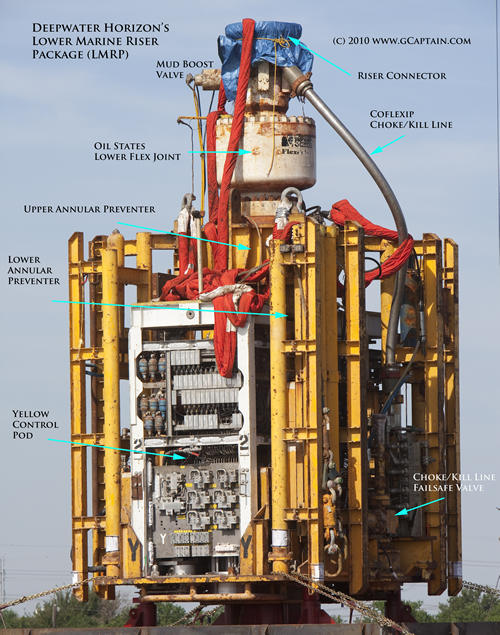 The following question is based on an interesting email message that I received from JL Daeschler, a pioneering subsea engineer:
One of the final acts on the Deepwater Horizon crew appears to have been the activation of the emergency disconnect sequence (EDS). The DNV report concludes that this emergency sequence was triggered, but never actually initiated, probably because of a loss of communication to the BOP stack after the initial explosion. Is it possible that the EDS sequence actually was initiated, but that the incomplete closure of the shear ram terminated that sequence?
Looking forward to next week’s hearings. Hopefully C-SPAN will televise the proceedings, because there is not indication that the Joint Investigation has arranged for live streaming.
Judge Barbier Orders Additional DWH BOP Testing
Posted in accidents, well control incidents, tagged accidents, blowouts, BOP, Deepwater Horizon, drilling, Gulf of Mexico, macondo, safety, well control on March 25, 2011| Leave a Comment »
Here is the court order. It doesn’t say that the upcoming BOP hearings will be delayed, so they will presumably begin on April 4th as scheduled.
What’s Next for BOPs?
Posted in accidents, well control incidents, tagged accidents, blowouts, Deepwater Horizon, DNV, drilling, macondo, offshore drilling, offshore oil, safety, well control on March 25, 2011| 1 Comment »
Everyone agrees that a series of failures and mistakes leading to the use of containment systems is totally unacceptable. Capping stacks and containment devices, while necessary and important, should never have to be used in the post-Macondo offshore world.
The same cannot be said for blowout preventers. BOPs will be used and will have to work when needed. No matter how carefully drilling programs are planned and executed, there will be hydrocarbon influxes into well bores. While most of these influxes will be “routine kicks,” the equipment must work and the personnel must be trained to use it properly and to function effectively as a team.
The DNV report on the Deepwater Horizon BOP failure included some unexpected findings. These findings will be discussed at the Joint Investigation hearings which begin on 4 April, and will hopefully be televised or streamed live. While attention will focus on specific components, BOPs must be evaluated as complete systems. What new risks have been identified? What are the options for addressing these risks? What risks are posed by the solutions? What other risks, related and unrelated, need to be addressed?
I doubt that there will be any argument with the DNV recommendations. These include studies on elastic buckling, shear blade surfaces, the effectiveness of ROV intervention, and well control procedures (including the sequencing of annular preventer and pipe ram closures); revised testing procedures for backup control systems; improved capabilities for monitoring of the status of BOP functions; and requirements for backup control system performance.
BOP stacks with redundant blind shear rams are becoming more common, and would generally seem to be appropriate for subsea wells. However, attention must be paid to the entire stack with the goal of optimizing overall performance and most effectively managing risks for the type of well that is being drilled and the site-specific conditions.
April BOP Hearings Should be Streamed Live
Posted in accidents, well control incidents, tagged accidents, Australia, blowouts, BOP, Coast Guard, CSB, Deepwater Horizon, DOI, drilling, Gulf of Mexico, hearings, macondo, Montara, National Commission, oil spill, safety, well control on March 24, 2011| Leave a Comment »
While C-SPAN has broadcast some of the proceedings, the Deepwater Horizon Joint Investigation hearings have inexplicably not been streamed live by the Coast Guard (USCG) and Department of the Interior (DOI). The National Commission and Chemical Safety Board streamed their hearings live, but the USCG and DOI have not done so. Why? This is perhaps the most significant accident in the history of the US offshore oil and gas program, and the most notable worldwide offshore disaster since Piper Alpha in 1988. Eleven men died on the Deepwater Horizon. Economic costs will total in the tens of $billions. Major regulatory changes, some of which don’t appear to address identified risks, are being imposed.
The upcoming hearings are particularly important because the BOP issues that will be discussed have enormous international significance. In this era, the world shouldn’t have to travel to New Orleans to observe the hearings, rely on sketchy press reports, or wait months for transcripts to be released. (And how is it that the Montara Inquiry Commission in Australia was able to post transcripts within hours after the conclusion of each day’s hearing?)
Accident prevention is dependent on complete and timely information. Had more people paid attention to Montara, Macondo may have been prevented. The upcoming Deepwater Horizon BOP hearings are of critical importance, and should be streamed so that all interested parties can follow the proceedings.
 Bud's Offshore Energy (BOE)