Feeds:
Posts
Comments

Posts Tagged ‘macondo’

Quote from a Financial Post article:

The voracious Dutch vessels, for example, continuously suck up vast quantities of oily water, extract most of the oil and then spit overboard vast quantities of nearly oil-free water. Nearly oil-free isn’t good enough for the U.S. regulators, who have a standard of 15 parts per million — if water isn’t at least 99.9985% pure, it may not be returned to the Gulf of Mexico.

Is (was?) this EPA discharge standard being applied to water that is collected during the oil spill response operation?  If so, the author’s harsh criticism is justified.  Why haul mixtures that are 90% water to shore when you can separate the oil and discharge relatively clean water?  Why make all those trips to shore delivering cargoes that are mostly water?  A lot of the reporting on the spill has been inaccurate, so we don’t want to jump to conclusions.  Can anyone confirm or refute the author’s charge?
Read Full Post »

Interesting comments from Jane Cutler, CEO of Australia’s National Offshore Safety Petroleum Safety Authority, in NOPSA’s excellent newsletter:

The incidents in the Gulf of Mexico (Deepwater Horizon) and at the Montara wellhead platform are different in many respects, particularly in technical matters. However, they share some common factors prompting regulatory action.

I agree entirely with Ms. Cutler.  International regulators and operators must work in concert to address and resolve these issues.

Read Full Post »

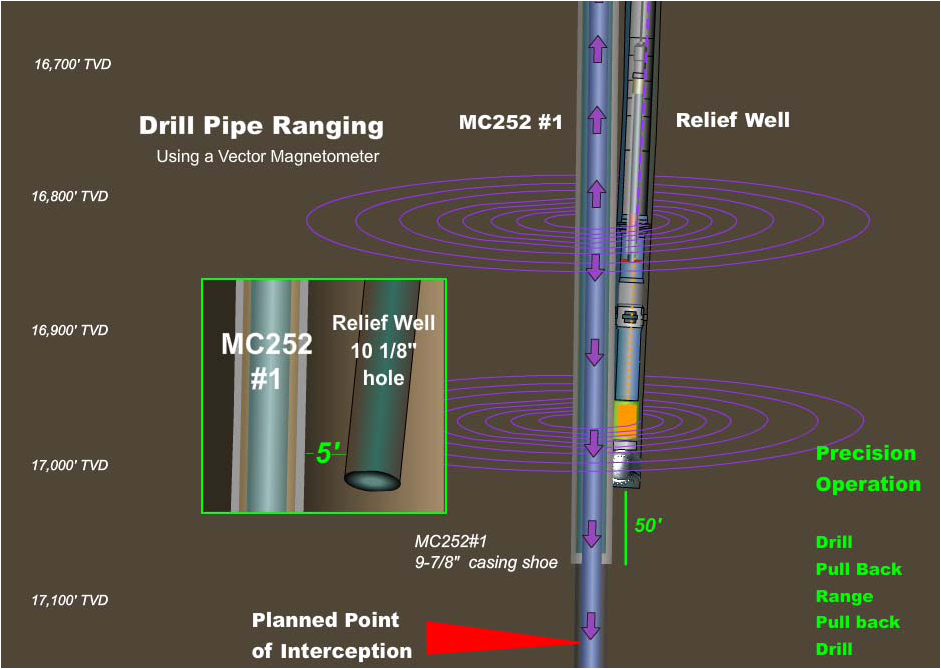
BP has released a slide presentation and animation on the relief wells showing the intercept point below the 9 7/8″ casing shoe.   The exact sequence of operations once they reach the intercept point will be interesting to observe. They should encounter flow when they reach the 7″ casing annulus (assuming that is a flow path; there still seems to be some uncertainty in that regard).  Will they attempt to kill the flow in the annulus before milling into the 7″ casing?  Is there flow inside the 7″ casing via channels in the casing shoe? Is there drill pipe inside the casing?

Read Full Post »

-The duration of the Montara blowout was 75 Days. Ironically, Day 76 of the Macondo blowout will be the 4th of July.

-Eleven days have elapsed since the Montara Report was presented to Minister Ferguson, who has apparently retained his cabinet position in the new government.  Now that the cabinet has been settled, perhaps there will be more public clamor for the report?

-Cap Summit in DC? – According to Admiral Allen, government and industry experts will convene on Wednesday to decide whether to change the collection cap.  Other designs would provide a better seal and facilitate higher recovery rates via free-standing risers, but the well would flow unabated during the changeover.

-More Macondo irony:  Since the oil spilled is “avoidably lost,” royalties will presumably be due on both the oil spilled and the oil “produced” at Macondo.  However, for fields in water depths greater than 800m, the Deepwater Royalty Relief Act  of 1995 exempts the first 87.5 million barrels of oil equivalent from Federal royalties.  Court interpretations of this poorly written legislation have determined that this relief must be applied on a lease (not field) basis, making the royalty exemption much more generous.  Ironically, Kerr McGee (now part of Macondo partner Anadarko) filed the law suit that resulted in this favorable decision for industry.  MMS, which has been repeatedly (and incorrectly) denounced for being “too cozy with industry,” fought hard for the less generous interpretation.

Read Full Post »

The House Energy and Commerce Committee has posted a discussion draft of the Blowout Prevention Act of 2010.   A hearing is scheduled for 30 June.

Read Full Post »

Hurricane Juan - "Sudden Storm" killed 9 offshore workers in 1985

The offshore industry has an outstanding hurricane evacuation record, but the Macondo blowout adds a significant new dimension to the decision making process.  Disconnect the production risers and 35,000 to 60,000 bopd flow directly into the Gulf.  Suspend the relief wells and the final Macondo solution gets moved that much farther into the future.

There will be pressure to minimize the downtime and that would be a mistake.  Days, not hours, will be needed to prepare for the evacuations.  Decisions will have to be made well in advance of a storm’s arrival and will be based on less reliable long-term weather forecasts.  If a shutdown decision is made too soon, hundreds of thousands of additional barrels of oil pour into the Gulf.  If the decision is delayed, lives are threatened.

The most frightening scenarios are associated with “sudden storms” which can form in or near the Gulf and explode into hurricanes in hours, not days.  The rapid formation and development of these storms precludes an orderly shutdown and evacuation process, and poses a major safety threat to workers.  In 1985, nine offshore workers were killed when Hurricane Juan formed suddenly in the Gulf and personnel could not be safely evacuated.

Let’s hope that the well is brought under control before any hurricanes enter or form in the Gulf.  If not, decision makers need to exercise extreme caution and shutdown operations before lives are threatened.

Read Full Post »

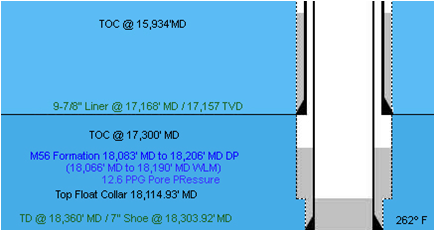
I believe they’re going to try and intercept somewhere around between 16,700 and 17,000 feet. We will confirm that for you and put out a statement tomorrow.

Comment: I pasted that portion of the well cross-section above.  It looks like the plan is to drill into the 7″ x 9 7/8″ annulus (the most likely flow path) and secure that annulus.  Based on the float and casing shoe issues that have been reported, the flow could also be inside the 7″ production casing or both inside the casing and in the annulus. (Also, sealing the annulus could force flow through possible shoe channels inside the production casing).  They will presumably have to drill through the 7″ casing (after the annulus has been secured?) and set a cement plug inside the casing.

They decided not to use the blowout preventer because of the uncertainty regarding the status of the wellbore and what pressure might do going down. That’s the reason they abandoned the Top Kill and the capping exercise at that point.

Comment: Admiral Allen confirms reports that the second BOP option was dropped because of downhole issues.  Poor well integrity sure makes things difficult.  Concerns have been raised about the strength of the 16″ casing, and possible fracture paths outside casing.   If the ROV had been able to actuate the BOP and seal the well, would casing failure and formation fracturing have occurred; or are subsequent events (erosion?) the primary reason for these well integrity concerns?

Secretary Salazar and Secretary Chu had a meeting last week in Washington with other industry representatives beyond BP, other oil-producing companies that are out there, and we’ve actually identified a couple of platforms that are in the area that might be capable of taking the product coming out of the wellbore through pipelines and either producing it or putting it back down into the reservoir. We’re exploring that over the next couple of days.

Comment: Yikes!

Read Full Post »

Click here for the judge’s full decision.

Click here for the judge’s order.

Read Full Post »

OMNI-MAX Anchor

Pasted below is a note from Evan Zimmerman that I am posting with his approval.  As many of you know, MODU station-keeping has historically been a major problem during hurricanes.  For the past 5 years, industry and government leaders have worked hard to improve hurricane and deepwater mooring capabilities.  Evan has been a key participant in this effort.  His company developed advanced anchors (see above picture) and mooring lines, and new risk assessment tools for assessing mooring system failure probabilities and their consequences.   The Gulf of Mexico will not be a safer place if deepwater technology leaders like Delmar are forced to close or move their equipment and personnel overseas.

The moratorium on drilling has put more than 70% of all that risk reducing mooring equipment on its way to the beach without contracts.  For a company like Delmar that derives more than 95% of its income from deepwater OCS drilling activity, its clear that we will have to immediately start shipping equipment outside of the US to find work.  Its my expert opinion that without a doubt, the offshore station keeping safety options will be reduced once drilling activities resume.  Its also clear the longer the moratorium continues, the fewer moored rigs will be left to drill not only the intermediate water depth areas the DP rigs cannot, but also the ultra deepwater wells they have been so busy drilling safely.  The longer this moratorium continues, the higher the station keeping risks for both DP and moored rigs the MMS will have to approve to keep the few rigs left in the Gulf working.  It’s the single biggest disappointment in my career to see all the hard work that MMS, Delmar and industry have done to increase station keeping safety quickly slip between our fingers here domestically.  I leave overseas again week after next to try to secure work for half (two sets) of OMNI-Max anchors as well as most of our other risk reducing equipment that now is no longer on contract due to the moratorium.

We are the last US owned deepwater anchor handling company that has brought the safest and most technically advantageous equipment to the mooring industry, and it looks like we will have to drastically change inclusive of cutting jobs domestically and moving outside of the US.

Read Full Post »

We know about the Macondo victims, most notably the 11 men who died and their families, but who stand to benefit from the blowout?

  1. OPEC – Will OPEC’s market share grow as the US and others prevent or delay production?
  2. West Africa and Brazil – Better rates and availability for deepwater rigs?
  3. PTTEP (Montara) – Not receiving much attention as BP draws all the flack
  4. Shale gas – Can the huge promise be realized?  Will natural gas gain an increased share of the transportation market?
  5. Alternative Energy – Are these industries ready to step up?
  6. Spill response research – Government and industry oil spill research funding always jumps after major spills.
  7. Nuclear industry – Perhaps, but Macondo may remind people that “the unthinkable” can happen.
  8. Lawyers – The only sure winners.  The litigation spectacular has already begun.

Read Full Post »

« Newer Posts - Older Posts »