Feeds:
Posts
Comments

Posts Tagged ‘Gulf of Mexico’

In a previous post, we discussed JL Daeschler’s comments suggesting that the emergency disconnect sequence (EDS) may have actuated the shear ram, but that the sequence aborted when the ram did not close fully. Another knowledgeable commenter, while requesting not to be named, noted that:

Whether the EDS-functions terminated before the sequence was completed is clearly a relevant question.

I agree and believe this possibility may have been dismissed without being fully considered. The DNV report claims that the EDS sequence never actually initiated, probably because of a loss of communication with the stack after the initial explosion.  As evidence, the report offers the following:

There is an account of lights flashing, indicating that the EDS function had initiated. There are no accounts of any specific lights going steady, which would have indicated a function had been completed and confirmed by the subsea control pods.

Comment: Perhaps no light stopped flashing because the first step in the sequence, BSR actuation, was not concluded (i.e. the BSR never fully closed).

Reviewed ROV video indicated no evidence that the sequence had initiated; the LMRP remained latched to the BOP, the Blue and Yellow Control Pod stingers were not retracted.

Comment: This only tells us that the sequence terminated prior to unlatching he LMRP and retracting the pod stingers.  It says nothing about the timing of the BSR closure.

Note that pages 166-167 of the DNV report indicate that the EDS was manually functioned (at the test facility) via surface control and that it functioned as intended.

The report also confirms that the accumulators were functional:

HP Shear Close, EDS, AMF/Deadman and Autoshear have a common reliance on the accumulator bottles (8 x 80 gallon) located on the BOP. Testing of these accumulators determined that they functioned as intended in the as-received condition.

The report goes on to say:

This is further indication the BSR’s were activated either by the Authoshear or possibly the AMF/Deadman functions. No further failure cause analysis was performed.

Comment: So why was the EDS ruled out as the trigger for the BSR activation? Also, if the shear ram was activated by the AMF, why did that sequence terminate after the ram closed (partly)?

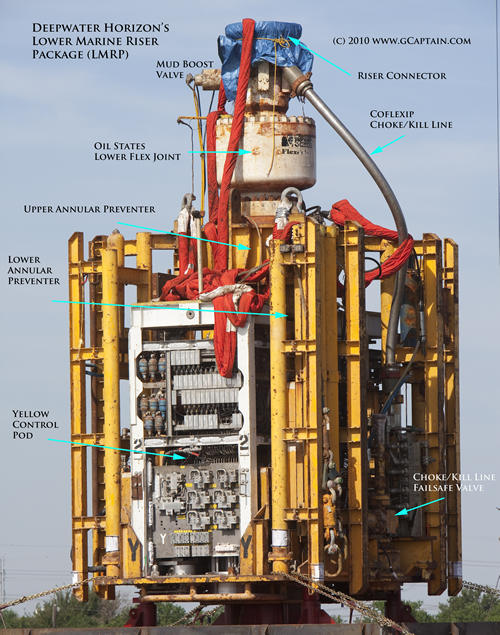
Comment on the riser disconnect: While closure of the BSR is a critical first step in the EDS or AMF sequence, riser disconnect, which has received very little attention, is equally important. To prevent flow, you want the well sealed before you disconnect the riser and the column of drilling fluid contained within. However when an EDS is activated, there is a good chance that the well may already have started to flow. Under those circumstances, you need to quickly disconnect the riser so the workers can be removed from the threat. In the case of the Deepwater Horizon, the failure of the riser to disconnect is as significant as the  failure of the BSR to seal the well. Although the EDS may have been activated too late to save the workers who lost their lives, they would likely have been safe if the rig had been disconnected from the well prior to the initial surge.
Read Full Post »

Fair or harsh? You be the judge.

Federal prosecutors are considering whether to pursue manslaughter charges against BP Plc (BP/) managers for decisions made before the Gulf of Mexico oil well explosion last year that killed 11 workers and caused the biggest offshore spill in U.S. history, according to three people familiar with the matter. Bloomberg

Read Full Post »

The following question is based on an interesting email message that I received from JL Daeschler, a pioneering subsea engineer:

One of the final acts on the Deepwater Horizon crew appears to have been the activation of the emergency disconnect sequence (EDS). The DNV report concludes that this emergency sequence was triggered, but never actually initiated, probably because of a loss of communication to the BOP stack after the initial explosion. Is it possible that the EDS sequence actually was initiated, but that the incomplete closure of the shear ram terminated that sequence?

Looking forward to next week’s hearings. Hopefully C-SPAN will televise the proceedings, because there is not indication that the Joint Investigation has arranged for live streaming.

Read Full Post »

Here is the court order. It doesn’t say that the upcoming BOP hearings will be delayed, so they will presumably begin on April 4th as scheduled.

Read Full Post »

From Cheryl Anderson based on Coast Guard information:

  • Anglo-Suisse WD 117 well samples match samples from the beach
  • Anglo-Suisse responsible for paying cleanup costs
  • USCG & BOEMRE investigating cause of spill
  • No new oil on shore since Monday
  • Substantial resources still on water: 8,400 feet boom. 2 MARCO skimmers, 4 drum skimmers, and 5 barge boats.


Read Full Post »

While C-SPAN has broadcast some of the proceedings, the Deepwater Horizon Joint Investigation hearings have inexplicably not been streamed live by the Coast Guard (USCG) and Department of the Interior (DOI).  The National Commission and Chemical Safety Board streamed their hearings live, but the USCG and DOI have not done so.  Why? This is perhaps the most significant accident in the history of the US offshore oil and gas program, and the most notable worldwide offshore disaster since Piper Alpha in 1988. Eleven men died on the Deepwater Horizon.  Economic costs will total in the tens of $billions. Major regulatory changes, some of which don’t appear to address identified risks, are being imposed.

The upcoming hearings are particularly important because the BOP issues that will be discussed have enormous international significance. In this era, the world shouldn’t have to travel to New Orleans to observe the hearings, rely on sketchy press reports, or wait months for transcripts to be released. (And how is it that the Montara Inquiry Commission in Australia was able to post transcripts within hours after the conclusion of each day’s hearing?)

Accident prevention is dependent on complete and timely information.  Had more people paid attention to Montara, Macondo may have been prevented. The upcoming Deepwater Horizon BOP hearings are of critical importance, and should be streamed so that all interested parties can follow the proceedings.

Read Full Post »

Just released.

The DNV report will be discussed in the upcoming hearings:

The Bureau of Ocean Energy Management, Regulation and Enforcement (BOEMRE)/U.S. Coast Guard (USCG) Joint Investigation Team, which is examining the Deepwater Horizon explosion and resulting oil spill, today announced that it will hold a seventh session of public hearings the week of April 4, 2011. The hearings, which will focus specifically on the forensic examination of the Deepwater Horizon blowout preventer (BOP), are scheduled to take place at the Holiday Inn Metairie, New Orleans Airport, 2261 North Causeway Blvd., Metairie, La.

Read Full Post »

Our oil spill expert, Cheryl Anderson, has been monitoring the Gulf of Mexico slick reports, and has provided the following update:

Excerpt from a NOLA.com article below published 4-5 hours after yesterday’s Coast Guard media briefing regarding the source of the latest slick in Louisiana state waters :

A state official, speaking on condition of anonymity because of a continuing Coast Guard investigation, said the Department of Wildlife and Fisheries traced the emulsified oil on the west side of the river to its apparent source at West Delta Block 117. He said tests by a state-contracted lab confirmed that was the source of the oil.

Wildlife and Fisheries officials found the source of the oil Monday evening and encountered workers in a boat trying to restore a cap on the well using a remotely operated submarine.

There was a USCG Media Briefing at 2 pm local time Monday [4-5 hours before the NOLA.com article was published]. The briefing confirmed that the 100-mile sheen on Saturday was not petroleum, just sediments from water disturbances.

With regard to the most recent slick, the Coast Guard said:

–no source had been identified,

–no active spill incidents had been identified,

–spill had been Federalized,

–testing showed that it was Louisiana crude, and

–LSU was still working on the tests to see if the oil matched the Macondo well or any recorded previous spill incident.

Read Full Post »

Kudos to:

  1. The US Coast Guard for promptly analyzing the Gulf of Mexico sheen that was reported over the weekend and determining that it was not associated with offshore oil and gas production.
  2. The many news organizations and journalists who ignored the irresponsible speculation, and waited for the Coast Guard to complete its investigation.

Read Full Post »

Wall Street Journal:

What was reported as a miles-long oil slick in the Gulf of Mexico is likely a plume of silt emanating from a dredging operation on the Mississippi River, a U.S. Coast Guard spokesman said Sunday.

So much for the hysterical post-Macondo rush to judgement by a few reporters.

Read Full Post »

« Newer Posts - Older Posts »