
Posts Tagged ‘Gulf of Mexico’
Gulf of Mexico rig count unchanged
Posted in drilling, Gulf of Mexico, Offshore Energy - General, tagged Baker Hughes rig count, Gulf of Mexico on June 24, 2022| Leave a Comment »
EIA short term production forecast for the Gulf of Mexico looks about right
Posted in energy policy, Gulf of Mexico, Offshore Energy - General, tagged EIA short term forecast, gas production, Gulf of Mexico, longer term concerns, oil production on June 23, 2022| Leave a Comment »
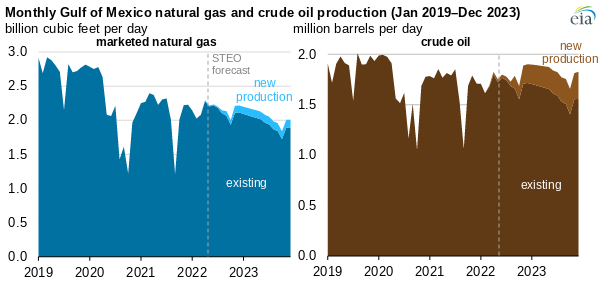
The EIA forecast looks about right. Production from new projects should offset existing field declines and maintain relatively stable volumes over the next 2-3 years. In the intermediate and longer terms we have problems given the dearth of exploratory drilling and new discoveries, and the complete absence of leasing.
Will the proposed 5 Year Leasing Program (US offshore) be released by June 30? How many regions will have sales? Total number of sales?
Posted in Alaska, energy policy, Gulf of Mexico, Offshore Energy - General, tagged 5 year leasing plan, Alaska, DOI, Gulf of Mexico, Secretary Haaland on June 22, 2022| Leave a Comment »
- Secretary of the Interior Haaland committed to releasing the Proposed Program by June 30, 2022. Will that deadline be met? BOE’s guess is that the deadline will be met. However, the White House Climate Policy Office, which seems to control energy policy, may have other ideas.
- Number of regions in which lease sales will be proposed: BOE thinks 2, the Gulf of Mexico and Alaska. There is no chance of >2. A GoM only proposed program is possible, but we doubt that Alaska will be eliminated at this early stage.
- Number of lease sales proposed: BOE guesses a total of 7 sales, 5 in the GoM and 2 in Alaska. The “under” is probably a better bet than the “over,” unless they eschew area-wide GoM sales and propose an increased number of more targeted sales.
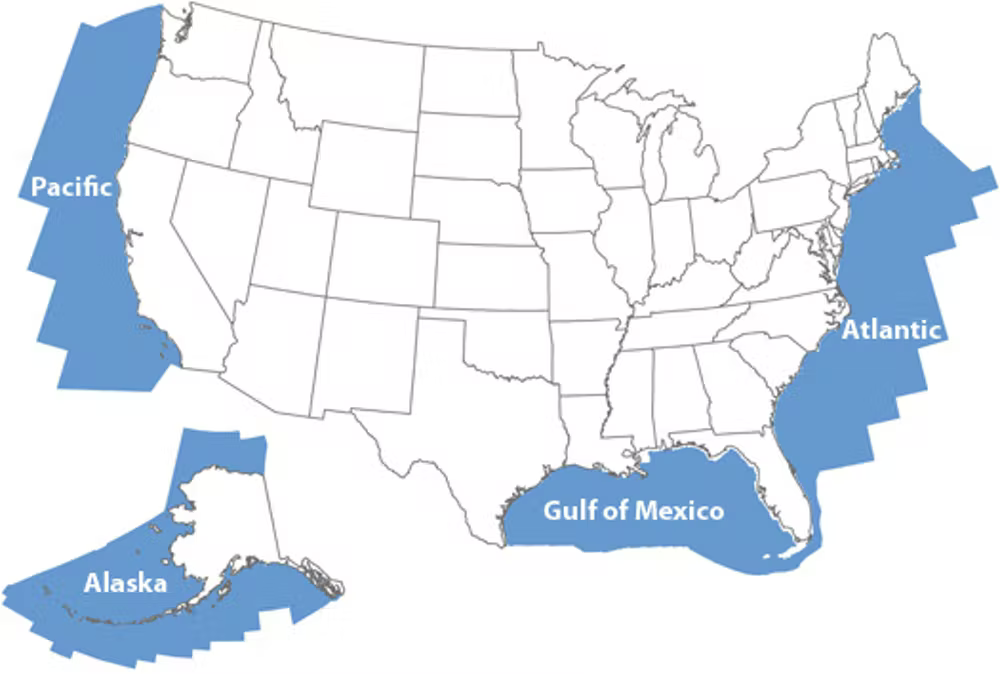
For comparison, the previous six 5-Year Programs have included 10-12 GoM sales (11.3 average), 1-8 Alaska sales (4.3 ave.), 0-1 Atlantic sales (0.3 ave.), and no Pacific sales.
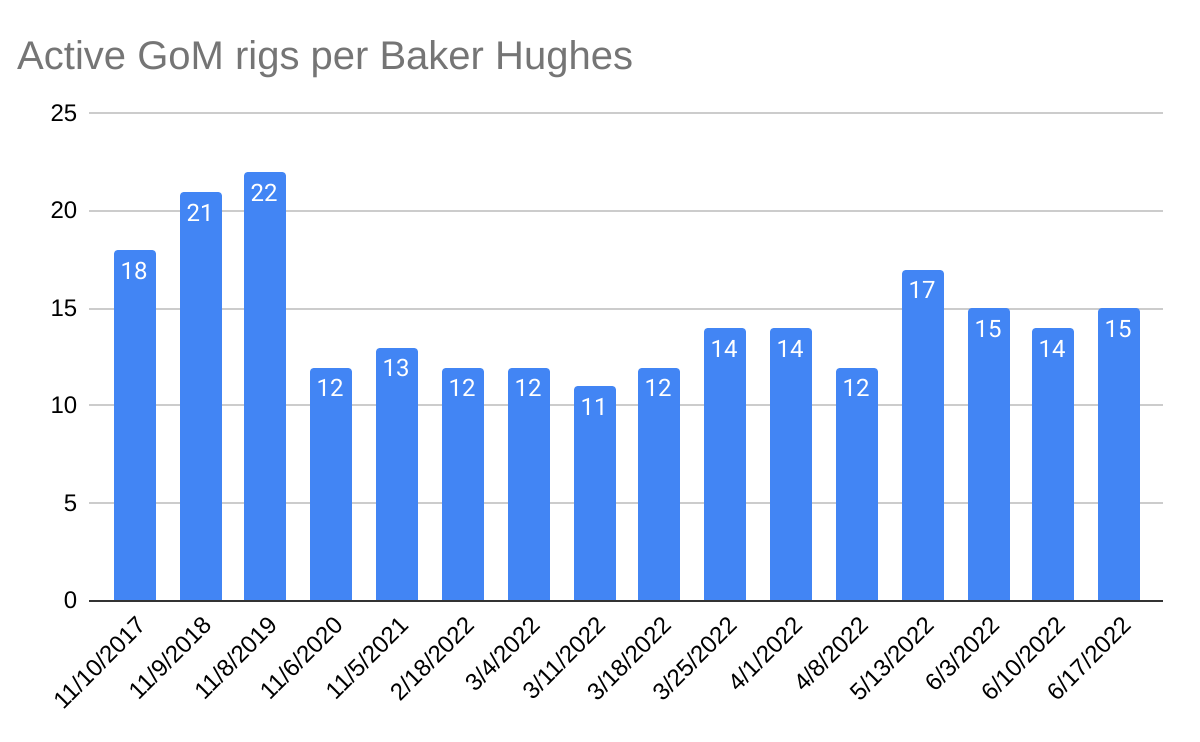
Gulf of Mexico rig count back up to 15
Posted in drilling, Gulf of Mexico, Offshore Energy - General, tagged Baker Hughes rig count, Gulf of Mexico on June 17, 2022| Leave a Comment »
Inspector General reports on Gulf of Mexico flaring violator
Posted in energy policy, Gulf of Mexico, Offshore Energy - General, Regulation, tagged flaring, flaring data, Gulf of Mexico, OIG report, reporting on June 16, 2022| Leave a Comment »
We determined that over approximately 5 years, the energy company’s venting and flaring activities exceeded regulatory limits without the required approvals, resulting in a loss of Federal mineral royalties and resources. More specifically, we identified approximately 229,066 MCF of vented and flared natural gas as suspicious or exceeding the allowable amount across four platforms in the Gulf of Mexico between January 2014 and April 2020. We presented our findings to ONRR, which assisted us in analyzing the energy company’s venting and flaring activities and determining the amount of lost Federal mineral royalties. Based on this analysis, ONRR submitted and secured a proof of claim in the amount of $712,857.82 for unpaid mineral royalties during the energy company’s bankruptcy proceeding.
OIG report 6/13/2022
Comments:
- The report doesn’t name the company, but one can make an educated guess based on some of the information provided (e.g. number of platforms the company operated, bankruptcy proceedings, etc.)
- The regulator usually finds out about false or misleading recordkeeping. Reports from employees, anonymous or otherwise, are a common source of such charges, as was the case here. (In my District in California, a toolpusher informed us that BOP pressure test records were being falsified. This led to multiple felony convictions.)
- The IG’s recommendations to BSEE and ONRR are reasonable and appropriate:
- Examine venting and flaring reports for patterns that may reflect violations or amounts that exceed permissible limits.
- Develop a process to ensure that royalties are being paid for improperly flared or vented gas.
- As BOE has previously reported, available public flaring data do not match. These data inconsistencies should be addressed.
- BSEE/ONRR should make more detailed flaring/venting data publicly available so differences between facilities and sectors (e.g. deepwater vs. shelf) can be assessed. Efforts should also be made to post these data in a more timely manner. Data for 2021 are still not available.
Excellent update on Gulf of Mexico incident trends
Posted in accidents, Gulf of Mexico, well control incidents, tagged BSEE, Gulf of Mexico, incident trends, Jason Mathews, safety alerts, violations on June 13, 2022| Leave a Comment »
Kudos to BSEE’s Gulf of Mexico Region for their timely safety alerts and comprehensive updates on offshore incidents, trends, and compliance issues. Their most recent update is linked below.
For the past 50 years. my main goal for US offshore operations has been a zero fatality year. Sadly, that goal has never been achieved and will not be achieved this year (see slide 15).
Many casualties are associated with activities that are not perceived to be of high risk. The message on slide 22 of Jason’s presentation is thus very important:
Perceived low risk activities can still result in impactful injuries. Continually risk assess the work being undertaken, no matter if it permitted or nonpermitted work.
Know your personal limits and stop before you reach your limit. Pause and ask for help before you are at your limit.
Jason Mathews, BSEE, 6/7/2022
Gulf of Mexico rig count down another tick
Posted in drilling, Gulf of Mexico, Offshore Energy - General, tagged Baker Hughes rig count, Gulf of Mexico, offshore drilling on June 10, 2022| Leave a Comment »
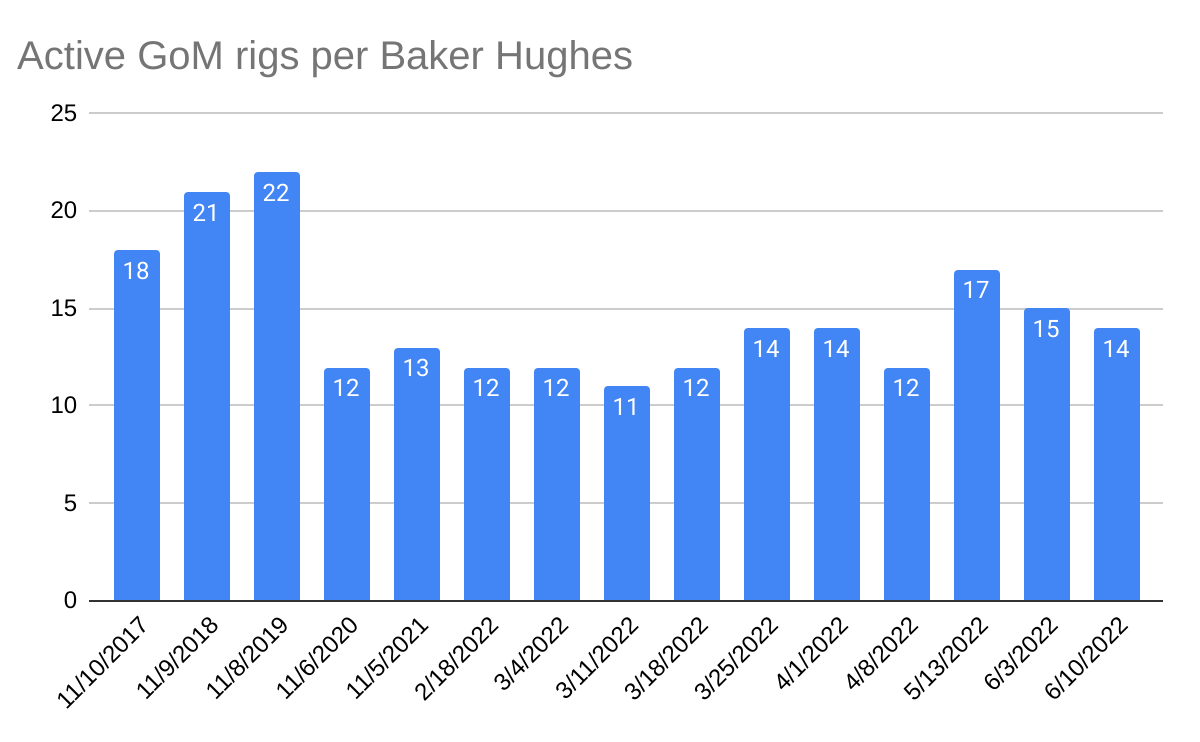
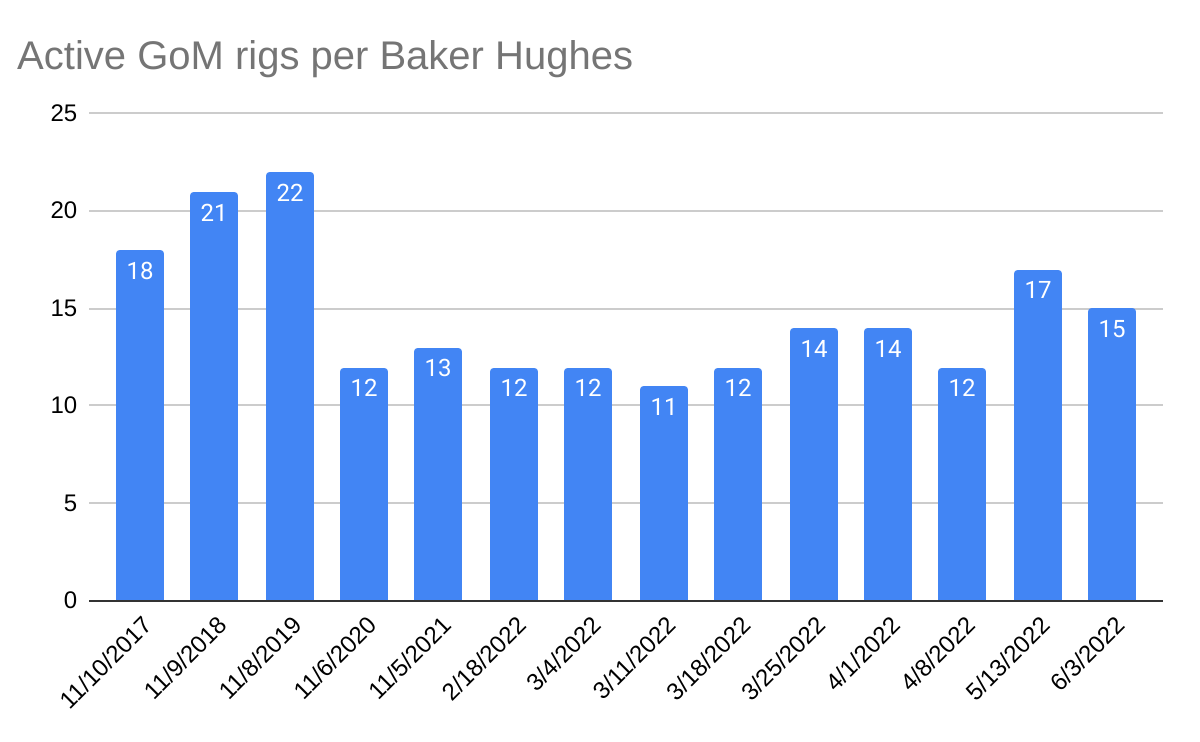
Gulf of Mexico rig count back down to 15
Posted in drilling, Gulf of Mexico, Offshore Energy - General, tagged drilling, Gulf of Mexico, rig counts on June 4, 2022| Leave a Comment »
Aquaculture resurfaces
Posted in energy policy, Gulf of Mexico, Offshore Energy - General, rigs-to-reefs, tagged aquaculture, Gulf of Mexico, NAOA, Rigs-to-Range, Rigs-to-Redfish/Rockfish, rigs-to-roe on June 3, 2022| Leave a Comment »

As is the case every 5 years or so, there is another aquaculture push within the Federal government. It looks like this will be a very process-rich endeavor (check out the list of “Scoping Information Needs“), so don’t expect much soon.
NOAA Fisheries is conducting public scoping for a programmatic environmental impact statement to consider identifying one or more AOAs in federal waters of the Gulf of Mexico. The programmatic environmental impact statement will evaluate the impacts and benefits associated with siting aquaculture in those locations, which could occur through future proposals and project level review. Public scoping is an opportunity for the public to provide input on the range of issues to be addressed in the programmatic environmental impact statement. This is a planning effort and no specific aquaculture-related activities or individual aquaculture projects are being proposed at this time.
NOAA FIsheries
Gulf of Mexico LNG: the future is now!
Posted in energy policy, Gulf of Mexico, hurricanes, natural gas, Offshore Energy - General, tagged Gulf of Mexico, jackup rigs, LNG, New Fortress Energy on June 1, 2022| Leave a Comment »
In the past the thought was that we would be importing LNG, i.e. “Rigs-to-Regasification.” Now that we are exporting LNG, we are adding “Rigs-to-Refrigeration” to the alternative use list.
Per our previous post on this topic, New Fortress Energy is moving forward with fast-track LNG projects in the Gulf. Three converted jack-up rigs purchased from Maersk will make up the first “Fast LNG” liquefaction train.
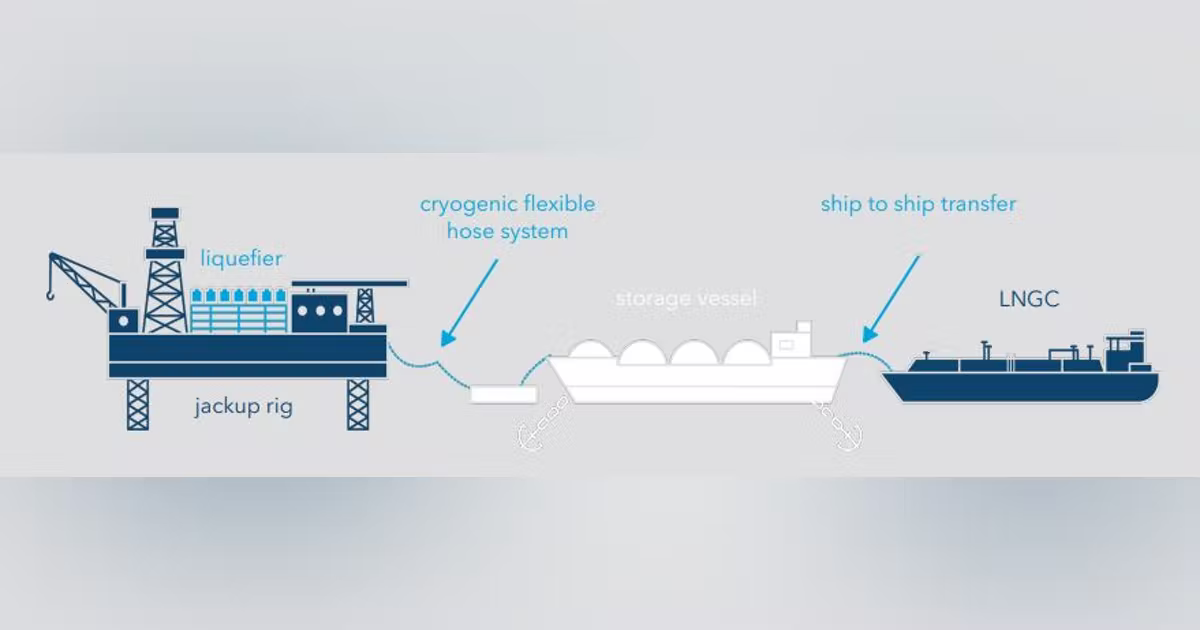
New Fortress is planning to install its first two “Fast LNG” units in West Delta Lease Block 38, located about 16 nm off Grand Isle, Louisiana. The two independent liquefaction trains at this deepwater “port” would export about 1.4 million tonnes per annum (mtpa) of LNG each. Though small by shoreside standards, the plant design would offer a number of advantages, like low cost and speed to market – a critical factor at a time of high demand for LNG. The company says that it should be able to produce each facility on an 18-20 month timescale, from engineering through construction and commissioning.
Maritime Executive
Given the challenges posed by tropical storms, particularly for jackup units, the design criteria for these “permanent” jack-up liquefaction facilities and the role of classification societies are of particular interest.
 Bud's Offshore Energy (BOE)