Posted in accidents, well control incidents, tagged accidents, Australia, blowouts, drilling, macondo, Montara, offshore oil, well control on February 17, 2011|
Leave a Comment »
Anthea Pitt, Executive Editor of the Petroleum Economist and a native Australian, recently wrote about her country and its historical dependence on natural resources:
Australia is well aware it relies on primary industries for its wealth. In the 19th century, the country proudly “rode on the sheep’s back”. More recently, iron ore, coal, bauxite and gold helped keep the worst of the sub-prime crisis at bay. Soon, a slew of large hydrocarbon developments off the country’s remote northwest coast will come on line, another rich seam flowing into Australia’s resources revenue stream.
The blowout at Montara was well-earned, and Australian and PTTEP were lucky even during a massive disaster. No one was injured, the well was at a remote location, and international attention was soon diverted to the spectacle of Macondo.
Evidence given to the inquiry showed exactly how fortunate Australia had been. It emerged that wells drilled at Montara failed to meet PTTEP AA’s internal well-construction standards, let alone satisfy regulatory requirements. The H-1 well, which had been suspended as a future producer during batch drilling operations, was open to surface for around a week before it blew out. Its downhole cementing job was flawed; there were no mechanical barriers in place. The rig’s blowout preventer was over another well at the time of the incident.
Although PTTEP has been given a pass by Australian Resources Minister Ferguson, the lessons of Montara must not be ignored. Deepwater drilling is not the problem; Montara was in 80m of water. Poor planning and execution are the problem, whether the well is in the Timor Sea, the Gulf of Mexico, the arctic, the North Sea or anywhere else in the world.
Read Full Post »
 Few Cabinet Secretaries are scientists or engineers, and none has been a Nobel Prize winner. We expect Secretary Chu to be different and yesterday’s meeting with DOE’s Ultra-Deepwater Advisory Committee was not your typical Washington “hit and run” performance. Rather than making a quick speech and running along to his next appointment, Secretary Chu engaged in technical dialogue with our committee for a full hour, offering insights and responding to questions. Among the topics discussed were BOP instrumentation and monitoring, well integrity, ROV/AUV issues, and Macondo findings.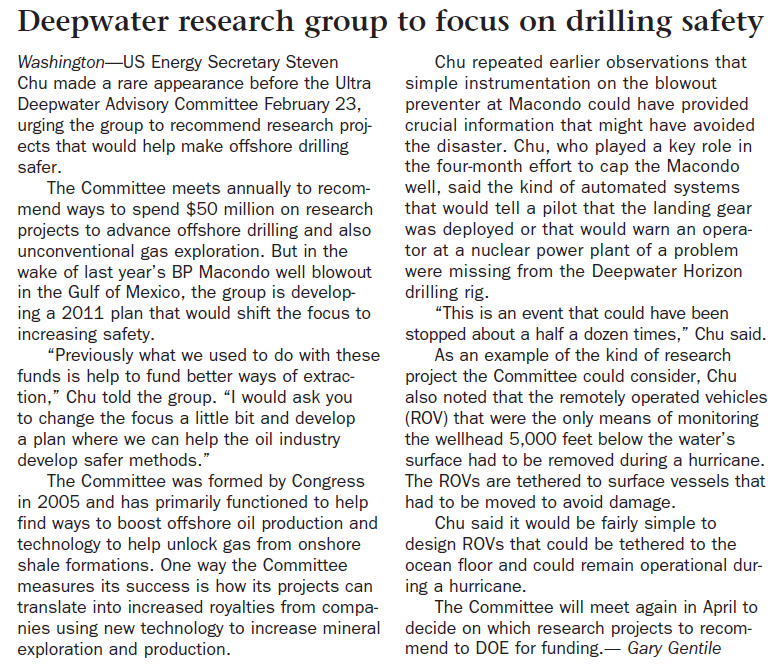




 Bud's Offshore Energy (BOE)
