Feeds:
Posts
Comments

Posts Tagged ‘drilling’

From the Houston Chronicle:

“I didn’t have a lot of set ideas about how things should work in the energy industry,” Jahnke said. “So I thought ‘Why can’t we try a curved blade?’ like the curved hook on a Swiss Army Knife can opener.”

Since January, T-3 has been testing Jahnke’s design, slicing through just about every size of drill pipe and casing used in the Gulf.

National Oilwell Varco is showing customers its new shear rams — a pair of trident-like blades that puncture a drill pipe before cutting it to shreds. The ShearMax Low Force Casing Shear Rams are aimed at cutting through tool joints – the thickest section of a drill pipe where it screws into another section of pipe.

GE Oil & Gas’ Hydril line of blowout preventers include a hardware and software system that allows an operator to know exactly how far shear rams close within the blowout preventer.

Another new Hydril product captures the natural pressure thousands of feet underwater to help activate a shear ram.

Weatherford International has touted its new “closed-loop” drilling system, which allows for better monitoring for gas as mud comes back from a well during drilling.

Read Full Post »

From Platts Oilgram News:

The US has given permission for a Cuban delegation to attend a conference sponsored by the International Association of Drilling Contractors in Trinidad next month to discuss Cuba’s deepwater drilling plans, the IADC said April 29.

If the Cuban delegation, which includes a top drilling regulator, attends, it will be the first time the Cubans have discussed their deepwater drilling plans in an international forum.

The IADC had applied to the US Treasury Department for a license to allow Cubans to attend the conference and was told on April 29 the license had been granted, Brian Petty, IADC senior vice president of government affairs, said.

The session on Cuba should be quite interesting.

Read Full Post »

oil-eating bacteria

scientists led by Terry Hazen, a microbiologist at Lawrence Berkeley National Laboratory, discovered that cold-loving microbes were making quick work of the oil (Greenwire, Aug. 24, 2010). These bugs were, in effect, oil-seeking missiles. They were highly mobile, armed with swimming flagella and protein sensors that could guide them to their oily prey, according to additional work so far unpublished by Hazen’s group.  New York Times

Read Full Post »

click on image to enlarge

from the Bahamas Tribune:

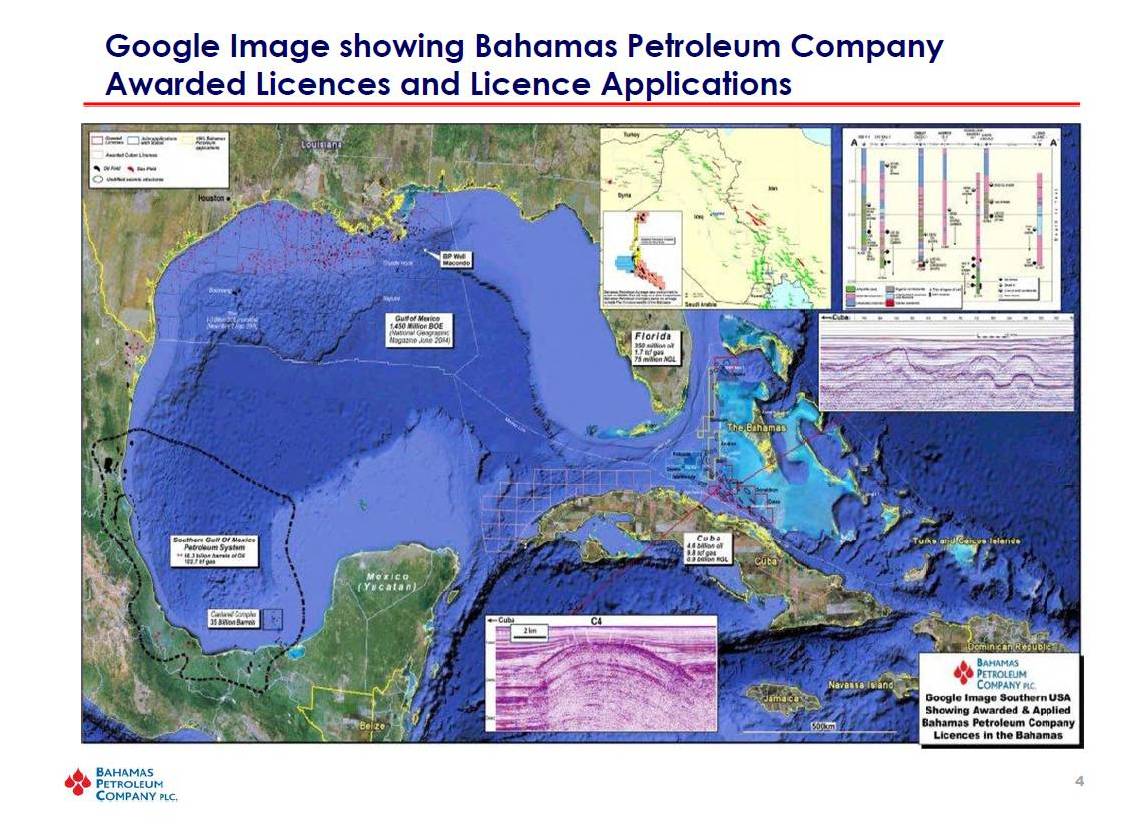
“We hope that in the second quarter of next year we will be able to be in a position where we can go forward and drill a well. We’ve just raised $75 million on the London market last month to apply towards our exploration purposes,” Dr Crevello said during a meeting of the Rotary Club of Nassau yesterday.

It is doubtful that this timeline will be met as Government has said it will not lift its moratorium on drilling any time soon.

“Well it’s nigh impossible for this (the passing of legislation relating to oil drilling) to be accommodated within this Parliament,” Environment Minister Earl Deveaux told The Tribune last month.

Read Full Post »

AP report:

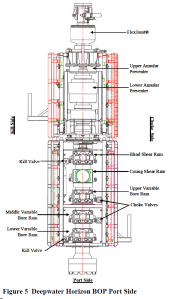
“The Deepwater Horizon BOP was unreasonably dangerous, and has caused and continues to cause harm, loss, injuries, and damages to BP (and others) stemming from the blowout of Macondo well, the resulting explosion and fire onboard the Deepwater Horizon, the efforts to regain control of the Macondo well, and the oil spill that ensued before control of the Macondo well could be regained,” BP said in the suit.

Read Full Post »

CNN Poll

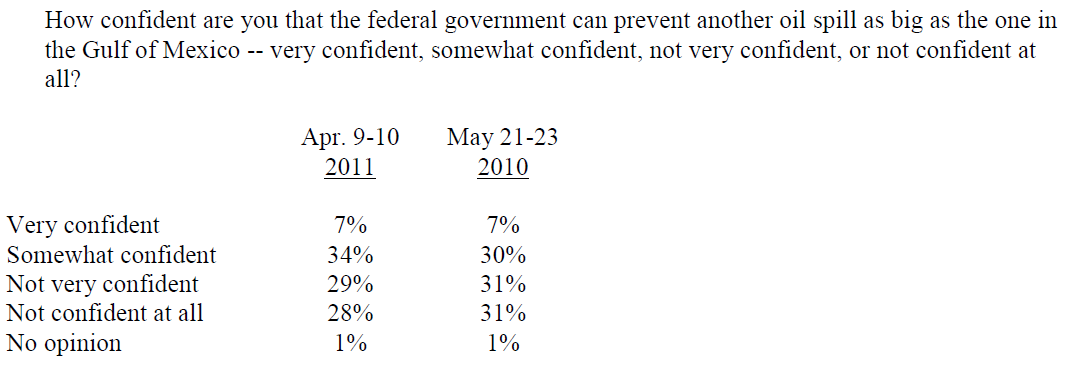
A CNN/Opinion Research Corporation survey released Tuesday indicates that 69 percent of Americans favor increased offshore drilling, with just over three in ten opposed. That 69 percent is up 20 points from last June, while the oil spill was still in progress, and is back to the level of support seen in the summer of 2008.

Confidence in government has shown a less significant increase.

Read Full Post »

  • Require that a Central Gulf of Mexico (GoM) oil and gas lease sale be held within 4 months of enactment, and that a second sale for that area be held within 12 months.
  • Require that a Western GoM sale be held within 8 months of enactment.
  • Stipulate that prior environmental reviews would satisfy NEPA requirements for the GoM sales.
  • Require that a Virginia offshore sale be conducted within 1 year of enactment. [Comment: While I support a sale offshore Virginia, I do not believe this can be accomplished in one year.]

HR 1231 would:

  • Require that specified volumes of oil and gas (per estimates made by MMS in 2006) be made available for leasing.
  • Set offshore production goals.
  • Give credits (for use in paying lease bonuses) to companies for costs associated with pre-sale seismic surveys.   [Comment:  If the legislation provides reasonable assurance that lease sales will be held, why are the seismic survey credits needed? The seismic data will have a high commercial value. Collection of these data should not have to be subsidized by the Federal government.]

HR 1229 would:

  • Require that DOI act on drilling applications within 60 days.
  • Extend the term leases where the approval of drilling applications was delayed following the Macondo blowout.
  • Make the 5th Circuit Court the venue for any civil actions involving GoM energy projects.
  • [Comment: The important question is not the number of days that the regulator should be given to review applications, but whether a complex permit review and approval process is the optimal regulatory approach. A lesson learned from virtually every major accident, from Santa Barbara through the Ocean Ranger, Alexander Kielland, Piper Alpha, and Macondo, is that command and control regulation is not in the best interest of offshore safety. Industry should not rely on government to manage its operations and government should focus on safety achievement, not directing the day-to-day activities of offshore companies. Over the long-term, the US would be better served if regulatory resources were dedicated to risk assessment, data analysis, assessment of operator and contractor management systems, targeted inspections and audits, participation in standards development and research, and safety leadership.]

Read Full Post »

Good report; worth reading.  Some of the positive points are unlikely to get much attention, so we’ll mention them here:

  1. The National Incident Management System/Incident Command System worked as intended
  2. Personnel provided by the Responsible Party (RP) and Coast Guard personnel worked effectively together, and there was “unity of effort” throughout the response organization.
  3. The team found no evidence of collusion between the Coast Guard and RP.
  4. The response generally benefited from the ability of the Government and the private sector to rapidly assess and adapt to new or unusual contingencies and develop innovative solutions for problems not previously experienced.
  5. The knowledge acquired and capabilities learned from this experience are unprecedented, and should become a basis for significant improvements in planning, preparedness, and response for industry, Government, and the response community.

The “Political Demands” section beginning on page 75 includes relatively candid observations on the challenges associated with the management of such a high profile response.

Read Full Post »

In a previous post, we discussed JL Daeschler’s comments suggesting that the emergency disconnect sequence (EDS) may have actuated the shear ram, but that the sequence aborted when the ram did not close fully. Another knowledgeable commenter, while requesting not to be named, noted that:

Whether the EDS-functions terminated before the sequence was completed is clearly a relevant question.

I agree and believe this possibility may have been dismissed without being fully considered. The DNV report claims that the EDS sequence never actually initiated, probably because of a loss of communication with the stack after the initial explosion.  As evidence, the report offers the following:

There is an account of lights flashing, indicating that the EDS function had initiated. There are no accounts of any specific lights going steady, which would have indicated a function had been completed and confirmed by the subsea control pods.

Comment: Perhaps no light stopped flashing because the first step in the sequence, BSR actuation, was not concluded (i.e. the BSR never fully closed).

Reviewed ROV video indicated no evidence that the sequence had initiated; the LMRP remained latched to the BOP, the Blue and Yellow Control Pod stingers were not retracted.

Comment: This only tells us that the sequence terminated prior to unlatching he LMRP and retracting the pod stingers.  It says nothing about the timing of the BSR closure.

Note that pages 166-167 of the DNV report indicate that the EDS was manually functioned (at the test facility) via surface control and that it functioned as intended.

The report also confirms that the accumulators were functional:

HP Shear Close, EDS, AMF/Deadman and Autoshear have a common reliance on the accumulator bottles (8 x 80 gallon) located on the BOP. Testing of these accumulators determined that they functioned as intended in the as-received condition.

The report goes on to say:

This is further indication the BSR’s were activated either by the Authoshear or possibly the AMF/Deadman functions. No further failure cause analysis was performed.

Comment: So why was the EDS ruled out as the trigger for the BSR activation? Also, if the shear ram was activated by the AMF, why did that sequence terminate after the ram closed (partly)?

Comment on the riser disconnect: While closure of the BSR is a critical first step in the EDS or AMF sequence, riser disconnect, which has received very little attention, is equally important. To prevent flow, you want the well sealed before you disconnect the riser and the column of drilling fluid contained within. However when an EDS is activated, there is a good chance that the well may already have started to flow. Under those circumstances, you need to quickly disconnect the riser so the workers can be removed from the threat. In the case of the Deepwater Horizon, the failure of the riser to disconnect is as significant as the  failure of the BSR to seal the well. Although the EDS may have been activated too late to save the workers who lost their lives, they would likely have been safe if the rig had been disconnected from the well prior to the initial surge.

Read Full Post »

Fair or harsh? You be the judge.

Federal prosecutors are considering whether to pursue manslaughter charges against BP Plc (BP/) managers for decisions made before the Gulf of Mexico oil well explosion last year that killed 11 workers and caused the biggest offshore spill in U.S. history, according to three people familiar with the matter. Bloomberg

Read Full Post »

« Newer Posts - Older Posts »