Posts Tagged ‘drilling’
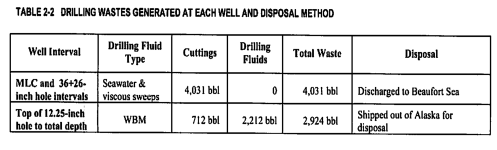
More on Shell’s “Zero Discharge” plans for the Beaufort
Posted in Alaska, tagged Alaska, Beaufort, cuttings, drilling, muds, offshore drilling, Shell, zero discharge on December 12, 2010| Leave a Comment »
Swiss court blocks Transocean dividend payment
Posted in accidents, well control incidents, tagged accidents, Andarko, blowouts, bp, Cameron, Deepwater Horizon, drilling, Gulf of Mexico, macondo, Mitsui, offshore oil, safety, Switzerland, transocean, well control on December 11, 2010| Leave a Comment »
Transocean Ltd. (RIG, RIGN.VX) said Thursday that a Swiss administrative court ruled that the company cannot pay out about $1 billion to shareholders because of the numerous Deepwater Horizon-related lawsuits pending against the rig owner in the U.S. Wall Street Journal
The $40 billion question: How much will Macondo ultimately cost Transocean? Halliburton? Anadarko? Mitusi? Cameron?
Helix organizing alternative well containment capability
Posted in accidents, well control incidents, tagged accidents, blowouts, drilling, Gulf of Mexico, Helix, macondo, offshore oil, oil spill, safety on December 10, 2010| Leave a Comment »
Helix’s system, a competitor to a project led by Exxon Mobil Corp that is still in the planning stages, is built from equipment that was used to siphon oil from the sea floor after BP Plc’s Macondo well ruptured on April 20. Reuters article
Interesting. We don’t know the details, but this would seem to be a cost-effective approach that could be quickly implemented.
Good Wall Street Journal Article
Posted in accidents, well control incidents, tagged accidents, Australia, blowouts, Deepwater Horizon, drilling, Gulf of Mexico, macondo, Montara, offshore oil, oil spill, safety, well control on December 9, 2010| Leave a Comment »
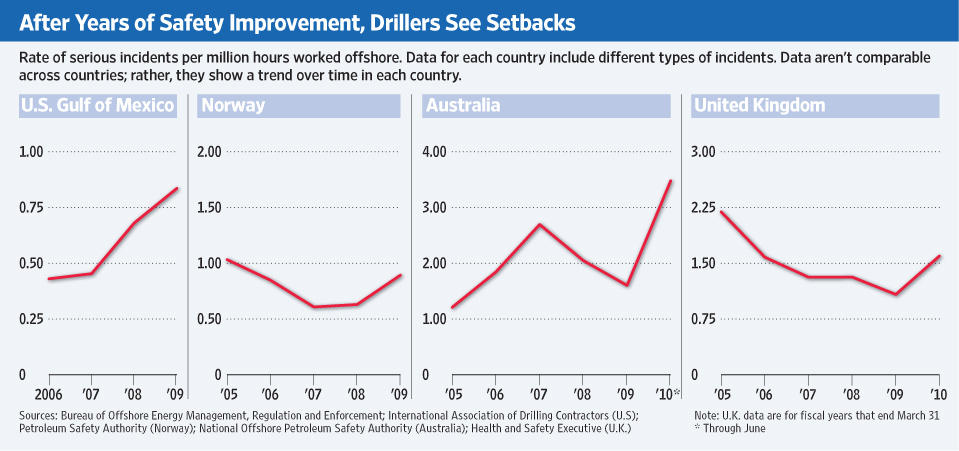
While the significance of these charts is debatable, the occurrence of two historic blowouts – Montara and Macondo – within an eight month period is a clear signal that we have problems. The disturbing similarities in these two blowouts tell us that well construction, monitoring, barrier verification, and personnel training practices are not where they should be.
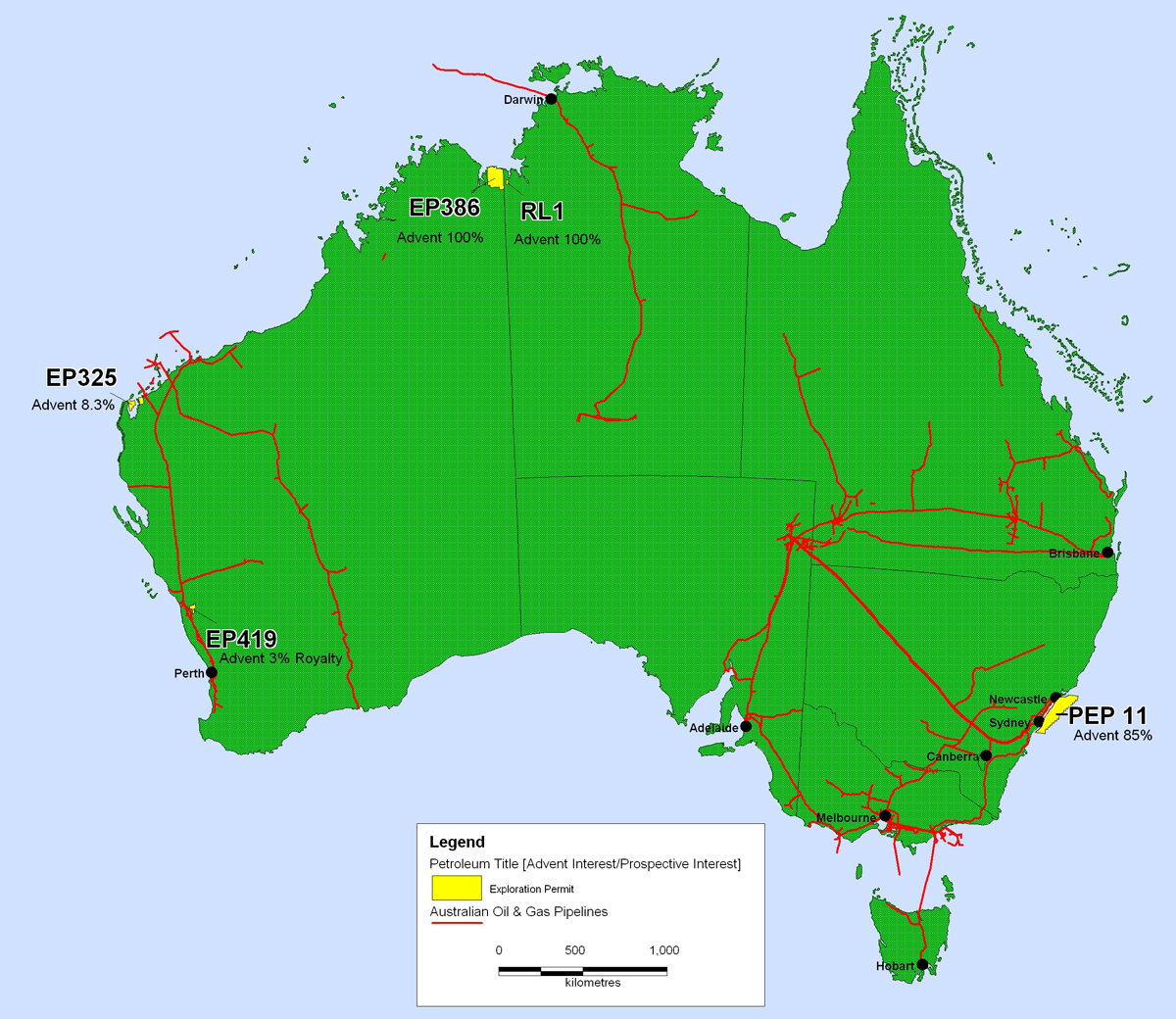
First Well to Be Drilled Off New South Wales (Australia) Coast
Posted in drilling, Offshore Energy - General, tagged Australia, drilling, Montara, offshore on December 8, 2010| Leave a Comment »
It looks like Montara has not affected frontier exploratory drilling offshore Australia. Per Upstream:
New Seaclem-1 will be the first well to be drilled off the New South Wales coast and will target an estimated 6 trillion cubic feet of gas in the Great White & Marlin prospects.
Posted in accidents, well control incidents, tagged accidents, blowouts, Canada, CBC, Deepwater Horizon, drilling, Gulf of Mexico, macondo, offshore oil, oil spill, safety, well control on December 8, 2010| Leave a Comment »
Blowout: Is Canada Next?
Thursday, December 9, 2010 at 9 pm on CBC-TV
If the title and announcement for this CBC documentary are indicators, this won’t be a scholarly review of the risks associated with Canadian offshore exploration and development. Nonetheless, those of you who can view CBC programming may want to tune in and see what they have to say.
Well Capping Operations: Montara vs. Macondo
Posted in accidents, well control incidents, tagged accidents, Australia, blowouts, drilling, Gulf of Mexico, macondo, Montara, offshore oil, relief well, safety, well control on November 30, 2010| Leave a Comment »
While there has been much post-Macondo discussion about the complexity of subsea containment and capping operations for deepwater wells, Macondo was ultimately capped and killed before being intersected by the relief well. The same cannot be said for the shallow water Montara well, which was killed by a relief well after flowing for 74 days.
Capping a flowing well is never routine, regardless of the water depth. However, the safety risks are greater for surface wells. Those risks combined with the low probability of success are why a capping operation was not even attempted at Montara. These were the concerns:
- The risk of a fatality was estimated at an alarming 25-30%.
- The risk of ignition while retracting the cantilever of the West Atlas jackup, a necessary step in the capping operation, was high.
- Only the 20-inch casing was tied-back to the wellhead platform. The 13 3/8″ casing was suspended just above the water surface. (According to testimony during the inquiry, the 13 3/8″ casing was not cemented back inside the 20″ casing.)
- Unless they were going to tie-back the 13 3/8″ casing while the well was flowing (probably not feasible and not mentioned as a possibility in the Inquiry report), they would have had to install a specially made BOP on the 20.” If they were able to install this BOP and shut-in the well, flow would have undoubtedly broached the casing at the 20″ inch shoe. One possible alternative may have been to install a diverter under the BOP and attempt a dynamic kill operation (i.e. direct the flow downwind and away from the rig while pumping mud down the well). This too would have been complex and risky.
Given the very high safety risk and the low probability of success, I believe the regulator and operator made the correct decision in forgoing a capping attempt. The experiences at Macondo and Montara indicate that capping considerations must be taken into account during well planning activities for both subsea and surface wells, and that they latter pose greater safety risks. Given the fire potential, having the wellhead at the surface is not an advantage when it comes to capping a flowing well. It’s better to have the wellhead on the seafloor where the robotic equipment is doing the work.
Halliburton cementing study referenced in Montara Report
Posted in accidents, well control incidents, tagged accidents, Australia, blowouts, cementing, drilling, Gulf of Mexico, Halliburton, macondo, Montara, safety, SPE, well control, well integrity on November 29, 2010| Leave a Comment »
I was unaware of the Halliburton study referenced in the Montara Inquiry Report:
A 2001 Halliburton study of USA Gulf of Mexico cementing failures in 4000 wells showed that (i) approximately one in six casing shoes required remedial work after primary cementing (by way of a so‐called ‘squeeze job’); and (ii) intermediate casing shoes failed shoe tests 70 per cent more often than shallower casings because they were more likely to be over‐displaced.
This paper was presented at an SPE conference in New Orleans. Click here to purchase the paper or read a good abstract.
Questions:
- Have other analyses and reports been prepared using these data?
- Would Halliburton make the data base available for the common good if they receive legal protection?
- In light of the worldwide interest in better understanding well integrity risks, would Halliburton and others expand the data base to include other regions?
- Surely, there must be other private data bases that would be useful for assessing operational risks and developing mitigations. Are the owners willing to identify these data bases? Can they be protected from liability risks if they agree to make the information accessible?
National Commission Draft Working Paper on the Macondo Well Kill Operations
Posted in accidents, tagged accidents, blowouts, Deepwater Horizon, drilling, Gulf of Mexico, macondo, National Commission, offshore oil, relief well, well control on November 23, 2010| Leave a Comment »
A couple of concerns:
- The report relies heavily on anecdotes and qualitative judgments attributed to unnamed individuals. For example, twelve sources are cited in the footnotes on page 6, but only one is mentioned by name. No information is provided about the qualifications or responsibilities of the unnamed sources, so it is difficult to assess the significance of their comments.
- The narrative ends rather abruptly without any discussion about the decision to continue with the relief well after the successful static kill operation. The report simply states that BP proceeded with the relief well to finally kill Macondo. As indicated previously on BOE, this is not entirely accurate. Macondo was already killed, and the well could have been secured through conventional plugging and abandonment procedures. The relief well was presumably continued to verify that the annulus was sealed and provide information that might be useful as part of the investigation. However, the relief well did not kill the well and the intercept was not necessary for that purpose.
Long Overdue: Failure Reporting System for BOPE
Posted in drilling, Uncategorized, tagged BOP, BOPE, Deepwater Horizon, drilling, failure reporting, macondo, Malcolm Sharples, offshore oil, safety, well control on November 23, 2010| Leave a Comment »
In my 11 May 2010 testimony before the Senate Energy and Natural Resources Committee, I made ten recommendations. While many of the issues raised in that testimony are being addressed, one of the more important recommendations (no. 4) has received little or no attention. This recommendation calls for a public or private system for collecting and assessing failure date for blowout prevention equipment. To the best of my knowledge, the only publicly available performance data for BOPE were collected by MMS and SINTEF and pertain to failures during BOP pressure testing, not failures during other operations. How can we have a credible safety system without comprehensive failure data for such critical well control equipment?
Dr. Malcolm Sharples, an important BOE contributor, identified a number of BOP performance issues since Macondo. Here are a few examples:
- During routine tests on the device, the locking system of one of the rams jammed in a locked position. Sevan is working with Petrobras and the supplier, Cameron, to find a solution.
- Reliance suspended all drilling work in the block after the Transocean rig Deepwater Expedition developed technical problems in its BOP. Reliance was drilling the KGV-D3-W1 well in the contract area since April 2010.
- The rig was offshore Australia for Shell early last month when newly installed BOP components failed during operations. Following several unsuccessful attempts to rectify the problems in the field, the failing BOP component is currently undergoing repairs in Singapore.
How is this information not important to every operator, regulator, and drilling contractor? A comprehensive BOP failure reporting system should be a high and immediate priority for the offshore industry. The information should be verified and published so that all may learn and future performance improved. Requirements for providing such information should be included in contracts and, if necessary, regulations.
An other major void that I have been talking about for years, without much success, is the absence of a comprehensive and verified international incident reporting system. I assumed this would be universally recognized immediate necessity, and a critical element of the offshore industry’s initiatives agenda. Apparently that is not the case. More on this to follow.