Feeds:
Posts
Comments

Posts Tagged ‘drilling’

The Center for Offshore Safety (COS) was established in response to a recommendation by the National Commission on the BP Deepwater Horizon Oil Spill and Offshore Drilling for improved self-regulation by the offshore industry. The Commission supported the creation of a non-profit, industry-funded organization similar to the Institute of Nuclear Power Operations, to promote the highest levels of safety and operational excellence. 

The COS has been effective in strengthening corporate Safety and Environmental Management Systems, influencing the industry’s safety culture, and sharing best practices and lessons learned. These are important accomplishments.

The COS has fallen short in gathering the data needed to assess the offshore industry’s safety performance. As is the case with most voluntary reporting programs, data completeness and accuracy issues limit the significance of COS performance reviews.

Observations regarding the most recent COS Offshore Safety Performance Report follow:

  • The COS uses accepted performance indicators and a logical classification scheme.
  • COS reports that their members accounted for 78% of OCS oil and gas activity in 2024. This is accurate when cross-checked with BSEE hours worked data. However, the % of hours worked is not a good measure of the % of incidents reported in any category.
  • Companies not participating included important operators like LLOG, Cantium, Walter, and W&T, a host of smaller Gulf independents, the 2024 violations leader (by a wide margin) Cox, and troubled Fieldwood. (See Fieldwood’s 2021 and 2022 performance.)
  • Only two drilling contractors – Helmerich & Payne and Valaris – are members. Major contractors like Noble, Transocean, and Seadrill are not members. Their incidents will thus not be reported if they are not working for a COS member.
  • No production contractors are COS members. These companies conduct most of the platform operations on the shelf, where many of the lease operators are not COS members.
  • Pacific and Alaska Region operators do not participate.
  • Looking only at fatalities (table below), the most important and easily verified incident category, there are troubling omissions:
    • COS reports no 2024 fatalities when in fact there was a fatality during an operation for a COS member.
    • COS reports no 2022 fatalities when there were actually five. A workover incident took the life of one worker, and four died in a helideck crash on an OCS platform. In both cases, the facility operator was a non-member company.
    • COS records one 2021 fatality, but fails to include a 2021 Fieldwood fatality. There were also 6 “non-occupational” fatalities on OCS facilities in 2021, as classified by BSEE. Given the importance of worker health (the H in HSE), such a high number of non-occupational fatalities should be of interest industry-wide.
    • The COS report includes only two of the six 2020 fatalities, 2 of which were classified by BSEE as non-occupational.
    • The bottom line is that COS accounted for only 3 of 12 (25%) occupational fatalities during the 2020-24 period. There were at least 20 fatalities if you include the non-occupational incidents.
fatalities per COSoccupational
fatalities (from BSEE data)
non-occupational
fatalities (from BSEE data)
202401?
202300?
202205?
2021126
2020242

The offshore industry is only as good as its worst performer, so complete participation is essential. Voluntary reporting is seldom complete reporting, because some companies are more concerned about confidentiality than completeness and information sharing.

For industry reporting programs to be comprehensive and credible:

  • The entity receiving the reports and managing the data must be independent and not affiliated with an industry advocacy organization.
  • All operating companies must participate and complete reporting must be required. This can be accomplished contractually. If necessary, the regulator can require participation (either as a separate regulation or as a SEMS element).
  • Company incident submittals should be audited by the independent entity.
  • Fees should be solely for the purpose of supporting the independent reporting system.
  • For SP1 and SP2 incidents (per the COS classification scheme), the names of the responsible companies should be included in the performance reports. The current COS system prioritizes confidentiality over accountabiity and information sharing.
Read Full Post »

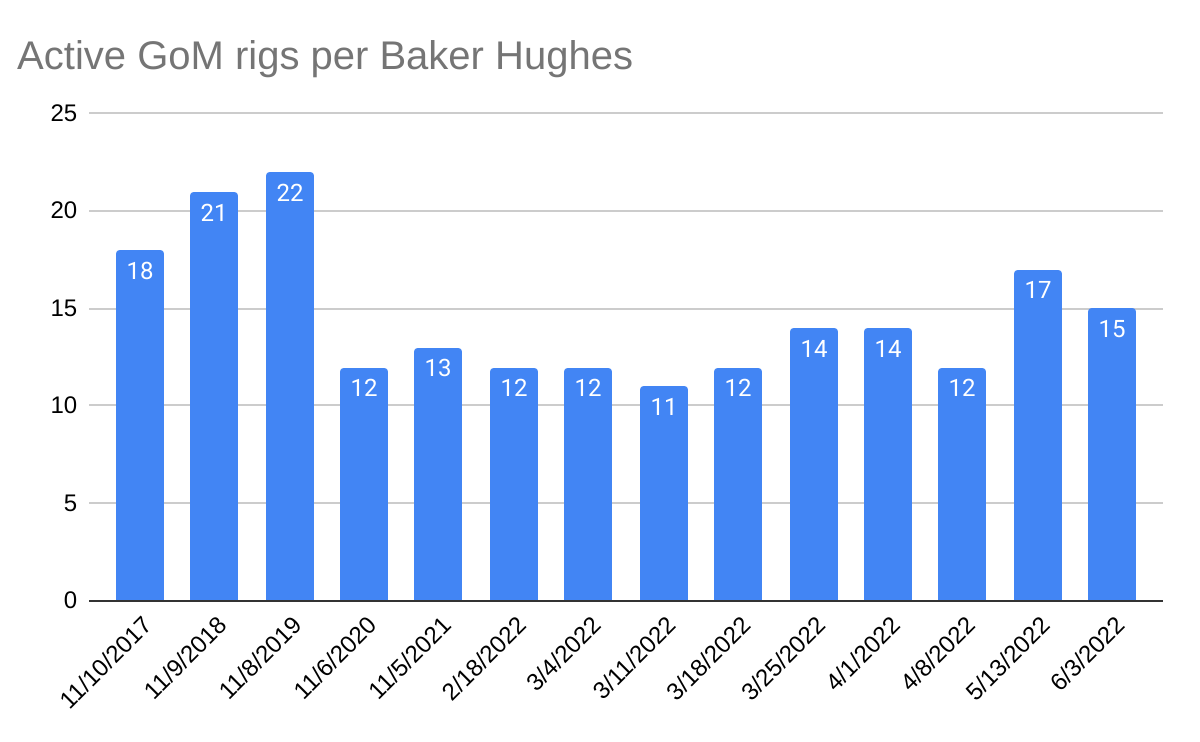
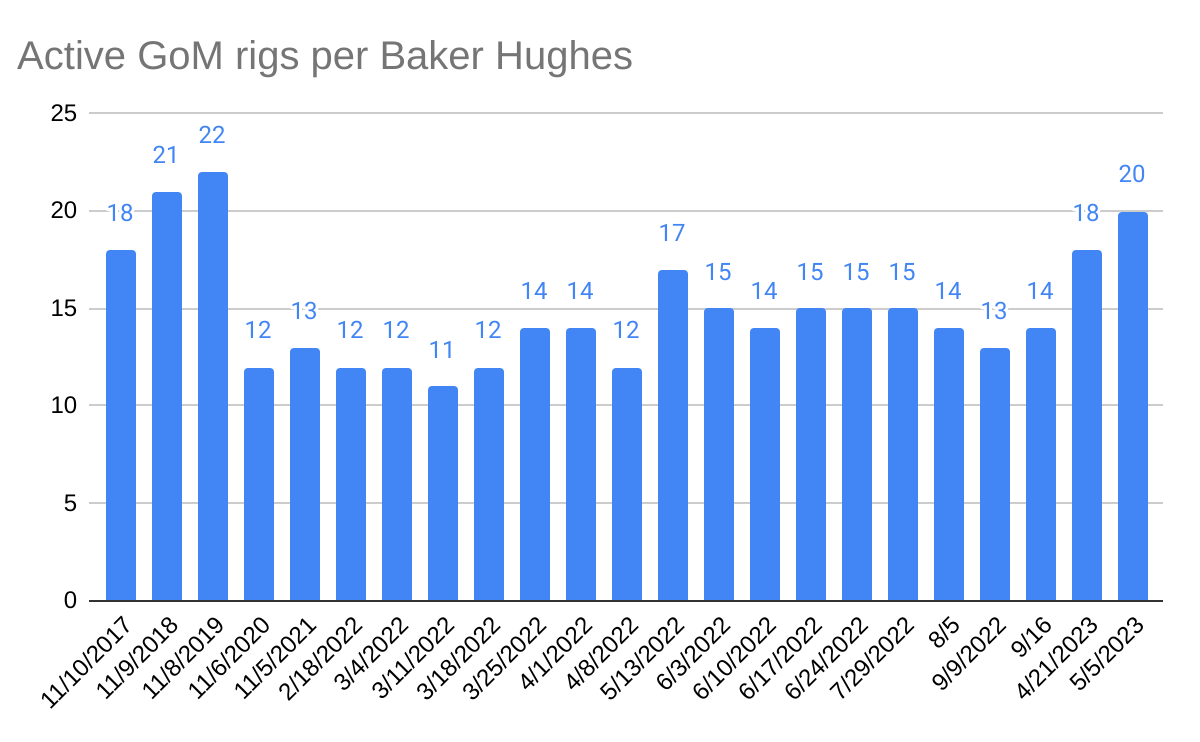
The Gulf rig count is up to 20, the highest since 2019, as the total US rig count falls by 7 to 748.

Read Full Post »

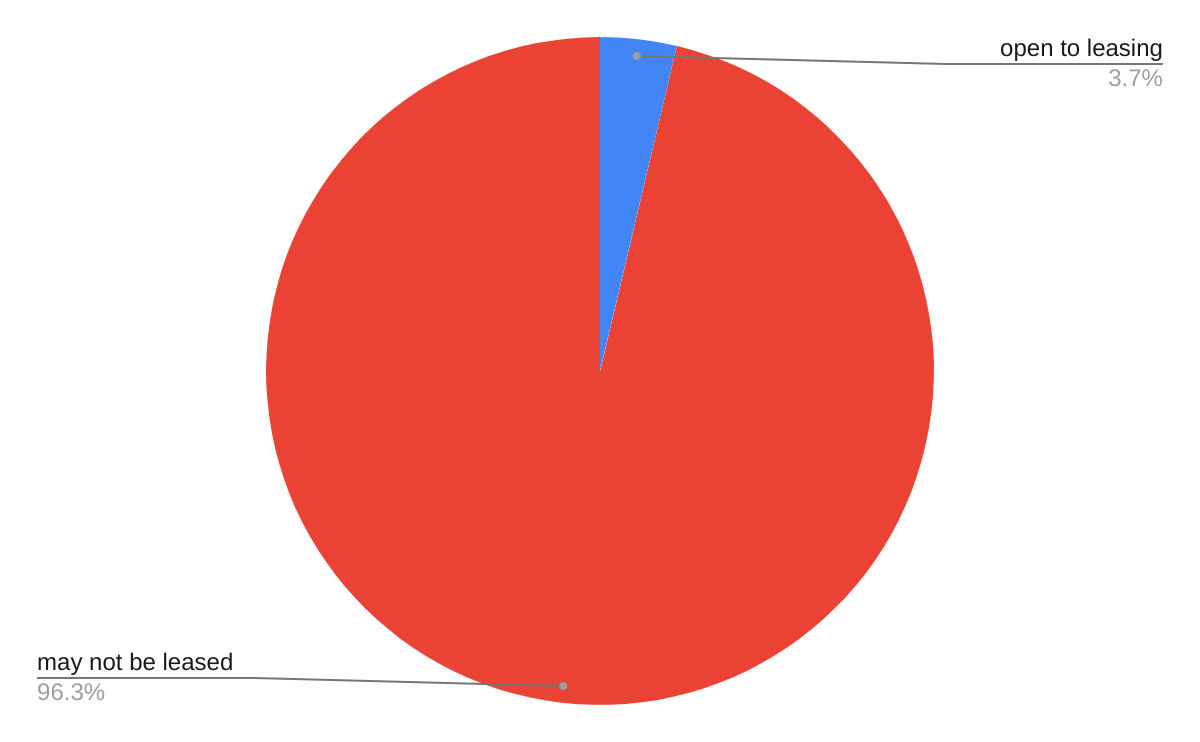
Of the 1.7 billion acres of Federal land on the US Outer Continental Shelf, only about 73 million acres in the Gulf of Mexico and 1 million acres in the Cook Inlet may be offered for oil and gas leasing. Official or de facto exclusions prohibit leasing in the entire US Atlantic, the entire US Pacific, all Alaska areas except the Cook Inlet, and most of the Eastern Gulf of Mexico. No other coastal nation has restricted access to oil and gas resources to this extent.

As demonstrated in recent sales, many of the tracts being offered have little or no production potential. Only 308 tracts (1.7 million acres) received bids in GoM Sale 257. 94 of the high bids were for sequestration purposes and were arguably invalid. Sale 258 in the Cook Inlet only received a single bid.

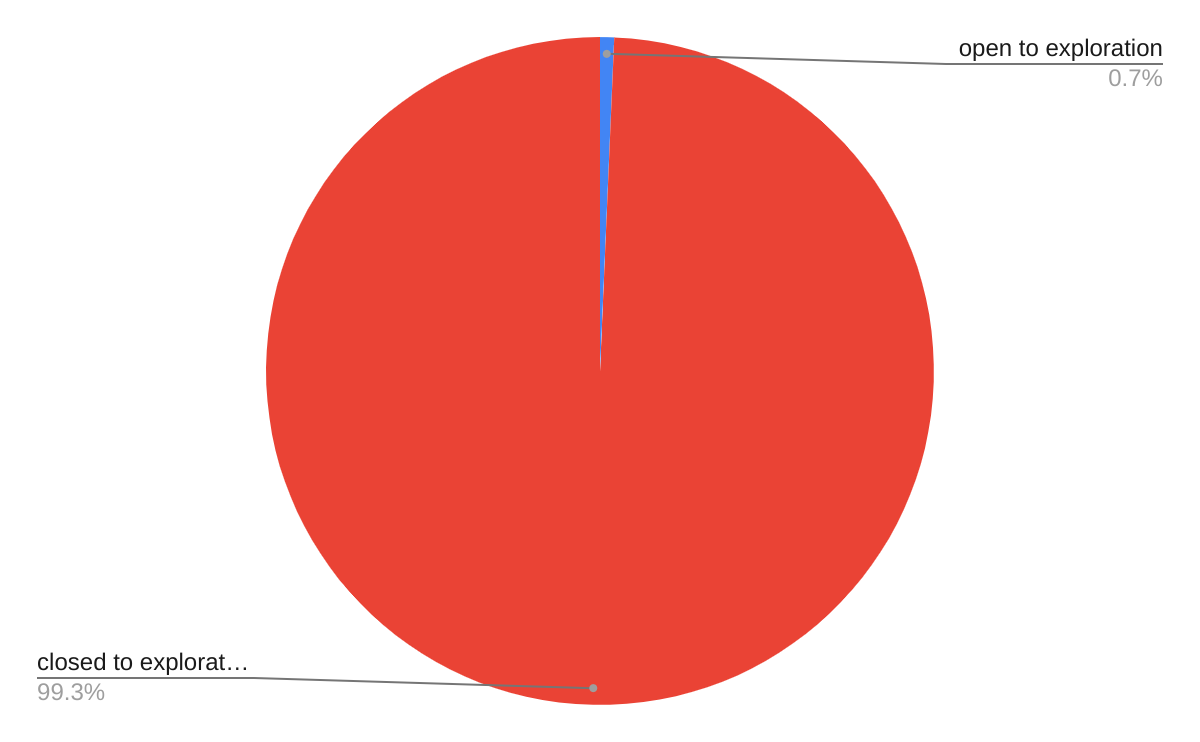
The number of active leases, currently 2153, has been at a historically low level for the past 2 years. Only 0.7% of our OCS is leased and thus open to exploration. 26% (552) of these leases are already producing, leaving a historically low number of nonproducing leases.

Oil is where you find it, not where you wish it was or want it to be. Denying access to all but a small portion of the OCS limits exploration strategies and prevents publicly owned resources from supporting our economy in the manner intended by the OCS Lands Act.

Read Full Post »

Per our post on the first Gulf of Mexico OCS production, here is what has happened since:

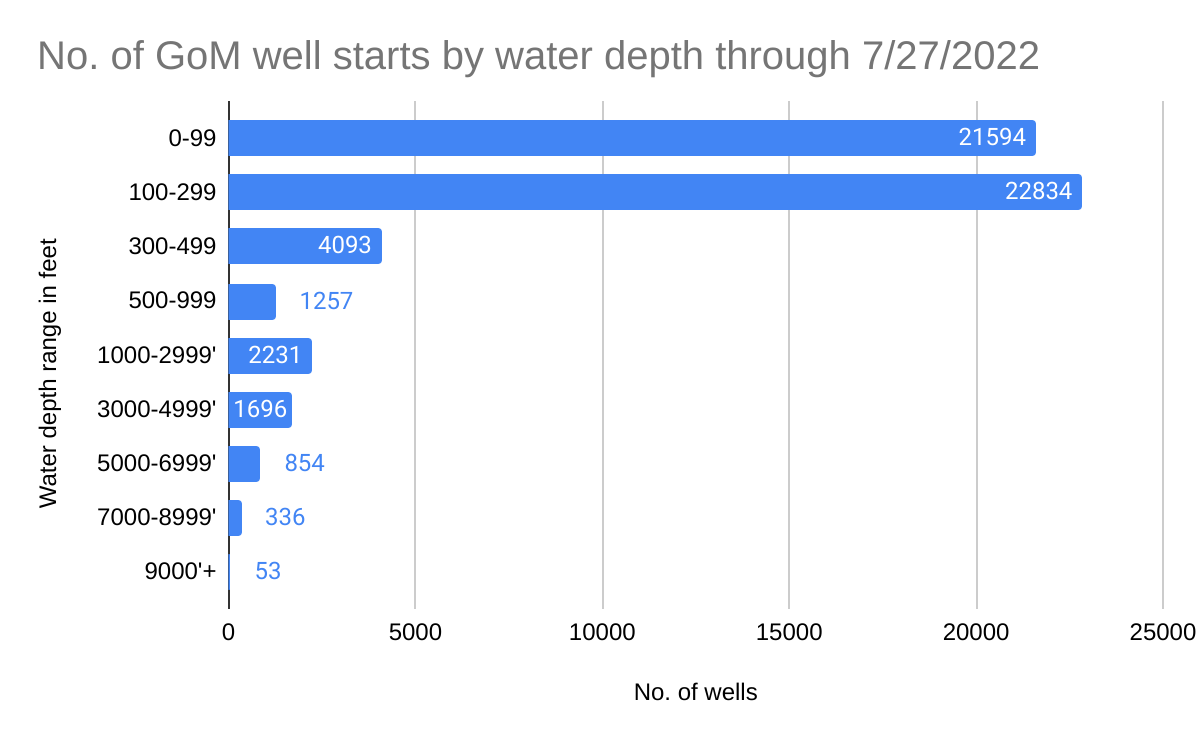
  • 54,948 wells drilled
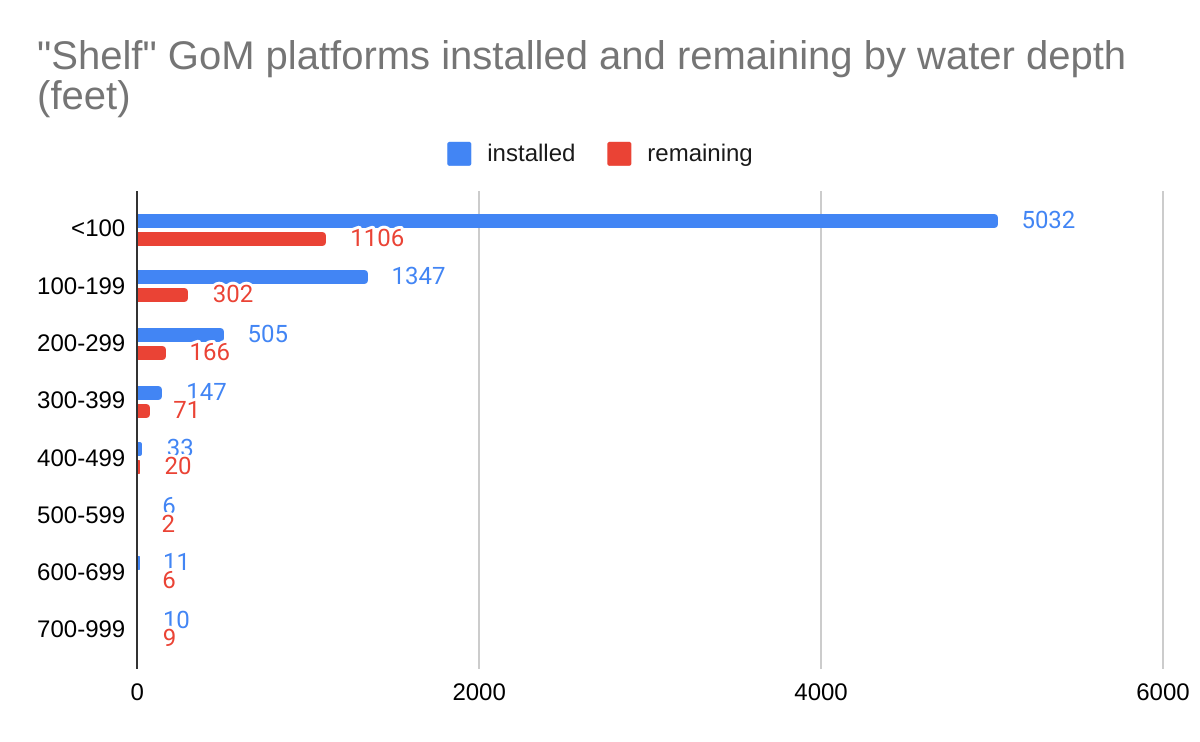
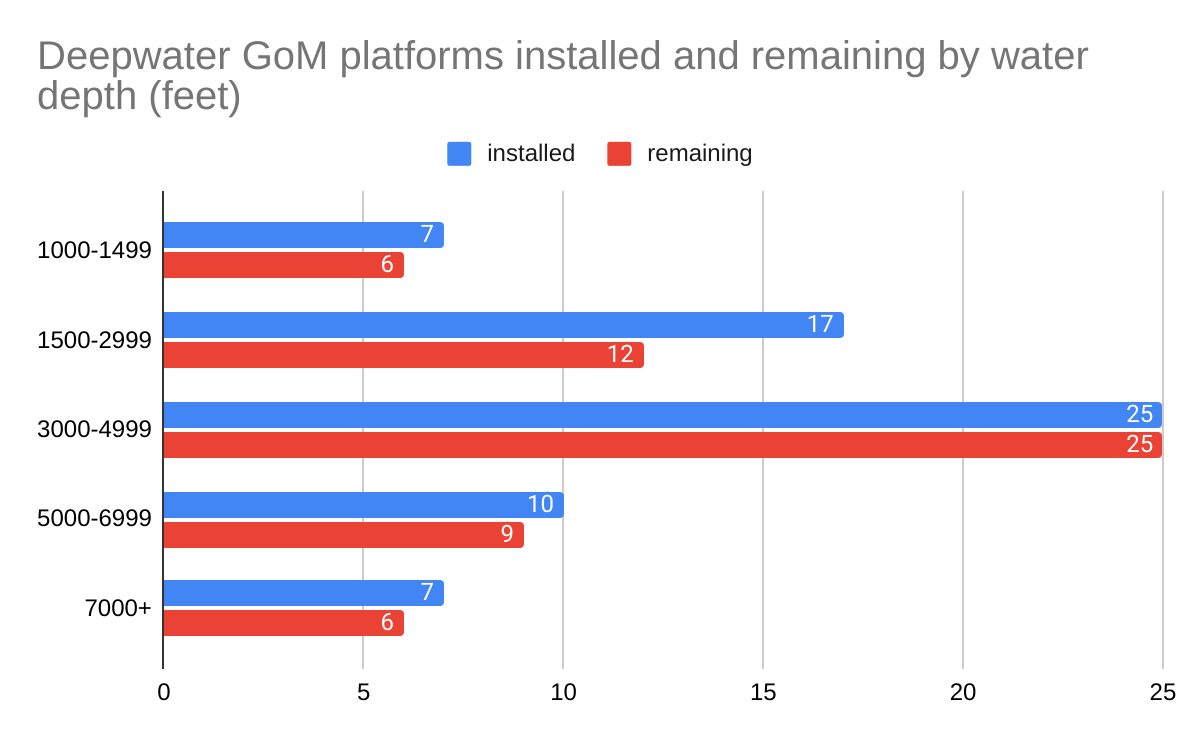
  • 7159 platforms installed; 1743 remain in place
  • 40,000 miles of pipeline installed (per GAO)
  • Deepest water depth well: 10141 feet, Murphy (2008)
  • Deepest water depth platform: 9560 feet, Stones (Turritella) FPSO, Shell
  • Total oil production: 1947-2022 YTD = 23.6 billion bbls
  • Total gas production: 1947-2022 YD = 190.1 trillion cubic feet
  • Max. annual oil production: 693 million bbls (2019)
  • Max. annual gas production: 5.15 trillion cu ft (1997)
  • 131 lease sales
  • 28,482 tracts leased

Except for the GAO pipeline estimate, all numbers are from BSEE and BOEM online data centers.

Read Full Post »

Read Full Post »

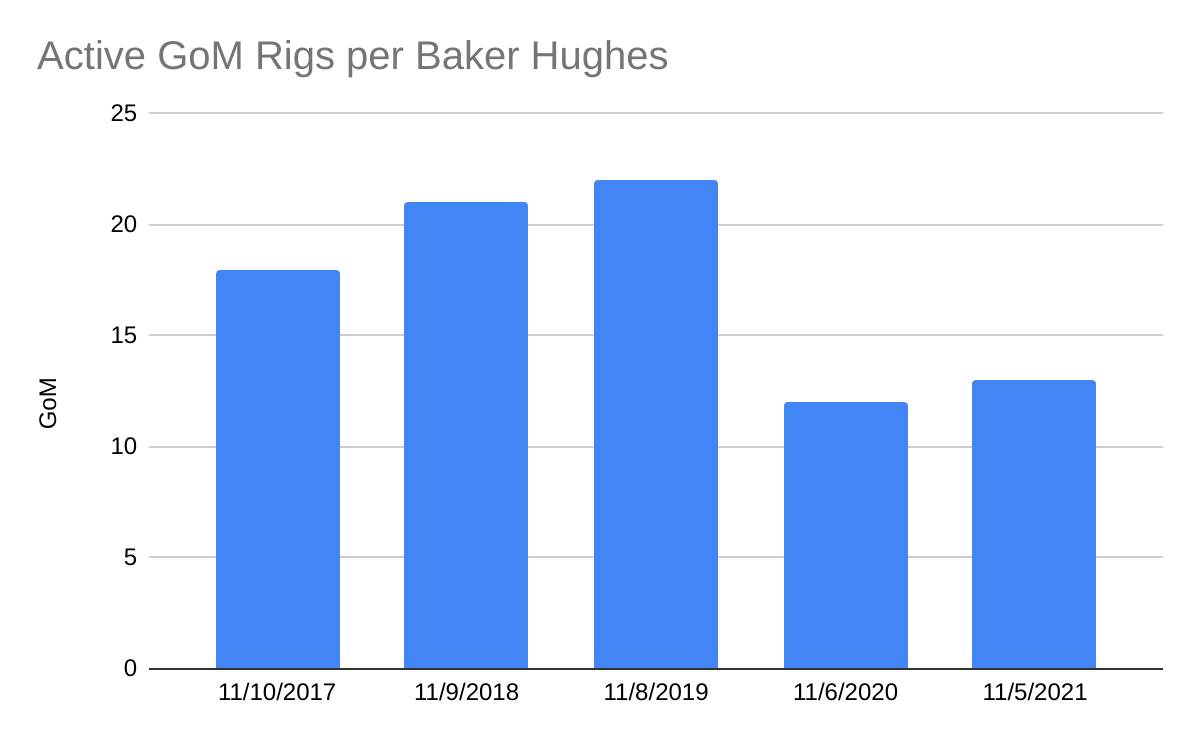
  • Chart 1: Gulf of Mexico rig count remains low
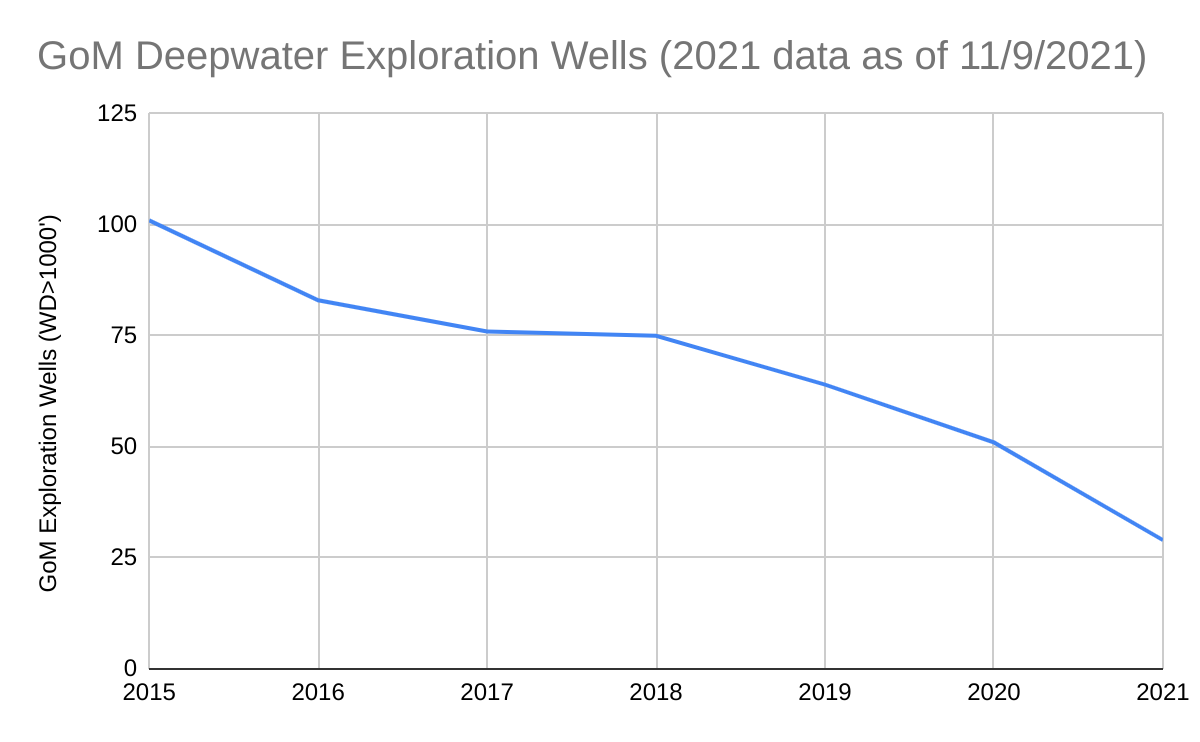
  • Chart 2: Exploratory drilling continues to decline and may be insufficient to replace reserves
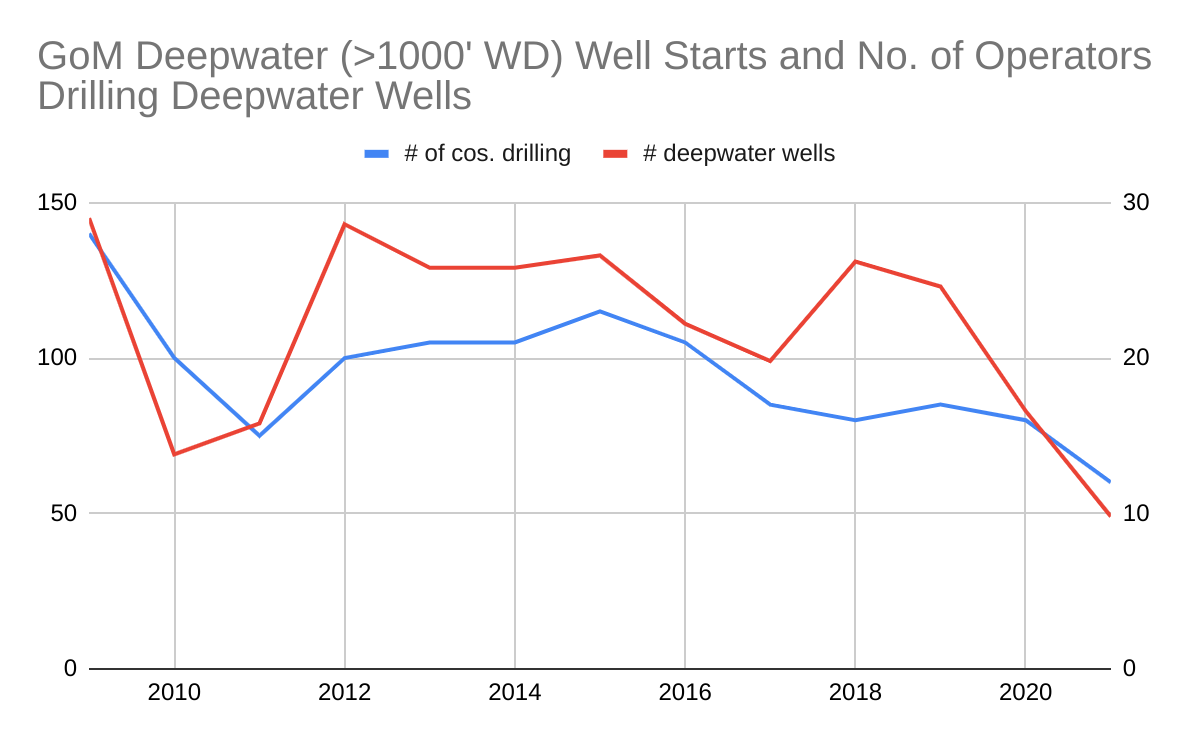
  • Chart 3: Well starts and number of operators drilling remain at historic low levels
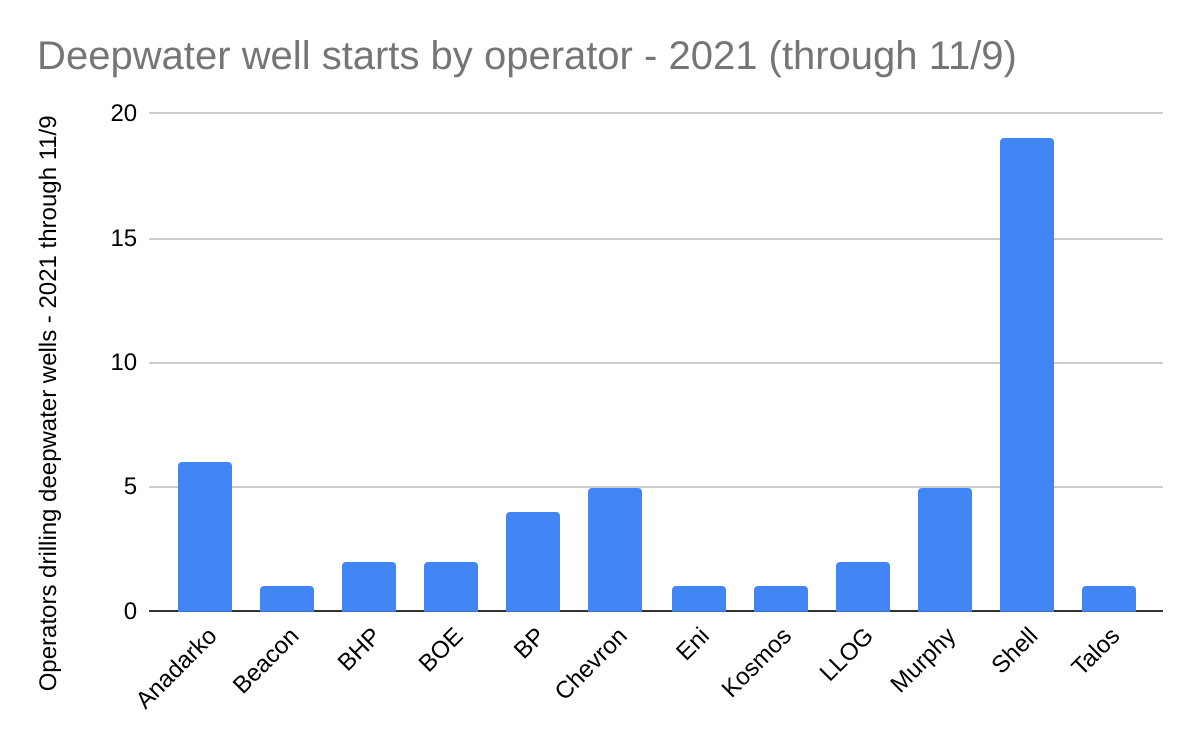
  • Chart 4: (1) One company (Shell) accounted for 39% of the 2021 YTD deepwater well starts in the GoM. (2) Five companies (Shell, Oxy/Anadarko, Chevron, Murphy, and BP) accounted for 80% of the deepwater well starts.

More certainty regarding lease sales would help. Prospective participants need assurances that they will have opportunities to apply findings and test exploration and development strategies. Will Lease Sale 257 be held on schedule next week?

Read Full Post »

Phil Rae piece in Fuel Fix

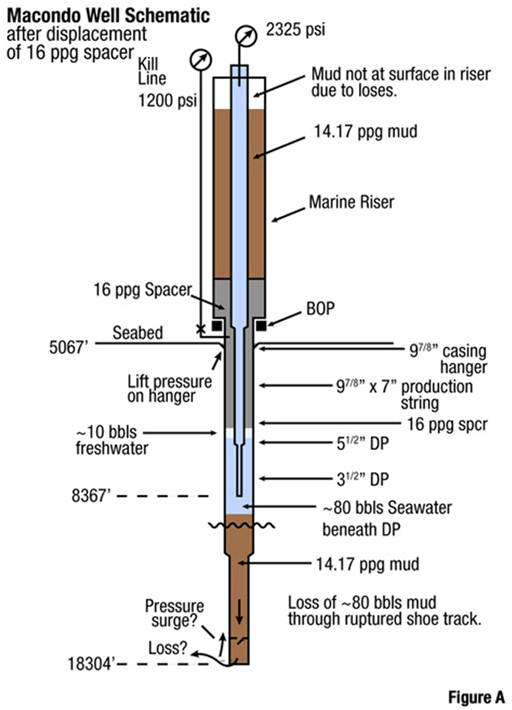
  1. The well clearly had losses through the shoe during the initial displacement of the heavy spacer with seawater, immediately prior to the negative test.
  2. Allowing for, and accepting, losses of ~80 bbls during spacer displacement, explains ALL pressure and flow anomalies without the need to create or invoke undocumented and unsubstantiated valve closures or manipulations that contradict witness testimony of events. It also eliminates the need to adopt unrealistically-low pump efficiencies for the rig pumps, hypothetical washed-out tubing and ridiculously high viscosities for the drilling mud, in an effort to fit questionable computer models.
  3. Despite extensive examination by investigators and the publication of several reports, the fact that the well experienced losses, making it even more severely underbalanced than was planned, has been given little credence or has received little or no attention, despite several clear indications that this was the case. While this statement regarding losses may be self-evident, its significance on the outcome at Macondo merits closer examination since it explains many previous, apparently-contradictory aspects of the disaster.
  4. Under-displacement of heavyweight spacer, as a result of losses during displacement, caused U-tubing and partial evacuation of the kill line, the lower end of which was later refilled with heavyweight spacer, driven by pressure and flow from the formation. The vacuum, initially, and subsequent invasion of heavy fluid rendered the kill line useless for monitoring the well since the line was effectively blind to pressure changes in the well.
  5. While initial flow into the well was through the shoe, pressure above the casing hanger seal during the negative test was reduced to levels that could have allowed the casing to lift, compromising the seal and possibly also allowing flow from the external annulus.
  6. The well encountered further losses during the second displacement (to displace the riser), after completion of the negative test. These losses, which were perhaps as much as 200 bbls, effectively replaced heavy mud with sea water in the casing below the drill pipe. This further underbalanced the well to the point that it was being kept under control only by pumping friction pressure. As the pump rate was reduced prior to shut down for the sheen test, effectively reducing system backpressure, the now severely underbalanced well began to flow.

Read Full Post »

from Platts Oilgram News:

Representatives Ed Markey of Massachusetts and Rush Holt of New Jersey introduced the so-called No Free Inspections for Oil Companies Act (H.R. 2566) July 15, in reaction to House Republicans’ proposal for funding the Bureau of Ocean Energy Management, Regulation and Enforcement. About $35 million short of the Obama administration’s request, the GOP’s $154 million budget rejected new and more expensive fees on offshore operators. The administration wanted to ratchet up industry fees to $65 million a year, from $10 million, to pay for a tougher inspections regime.

The annual inspection fees debate, a budget season ritual for 20+ years, has picked up intensity and financial significance in the post-Macondo spotlight. However, discussions about regulatory philosophy and the fundamental program decisions that dictate inspection strategy are still absent. Safety and pollution prevention are the goals, not inspections. While inspections are an essential part of any safety regime, they are just one component of a comprehensive regulatory program. More inspections would not have prevented Macondo. Better standards, training, technology, and attention to prior incidents (most notably Montara) may have.

Read Full Post »

You be the judge.

Read Full Post »

This information is unconfirmed but the source is highly reputable:

We just received word this morning that the Transocean Marianas rig  has developed a large crack in one of the pontoons on the #5/#6 anchor chain locker while they were picking up anchors, and is currently taking on water and listing.  The bilge pumps are keeping up (barely), but there’s certainly concern that it might sink on location. So far, 68 people have been evacuated from location.

According to RigZone, the Marianas was working offshore Nigeria. [Per one of our readers, (see comment below) Petrodata shows the rig operating offshore Ghana.]

More:  The Marianas, spudded the Macondo in October, 2009, but was damaged by Hurricane Ida and towed to shore.  The Deepwater Horizon was the rig that replaced the Marianas.

Read Full Post »

Older Posts »