This picture was posted on the “Rig Pigs” Facebook page by Huston Funk. Per Huston: “First crew photo from the Deepwater Horizon. Taken in the Indian Ocean after we had left Singapore.”
Commenters identified 3 Macondo victims in the photo: Jason Anderson, Don Clark, and Stephen Curtis 🙏
Seconds matter – training, equipment maintenance, and effective leadership are critical!
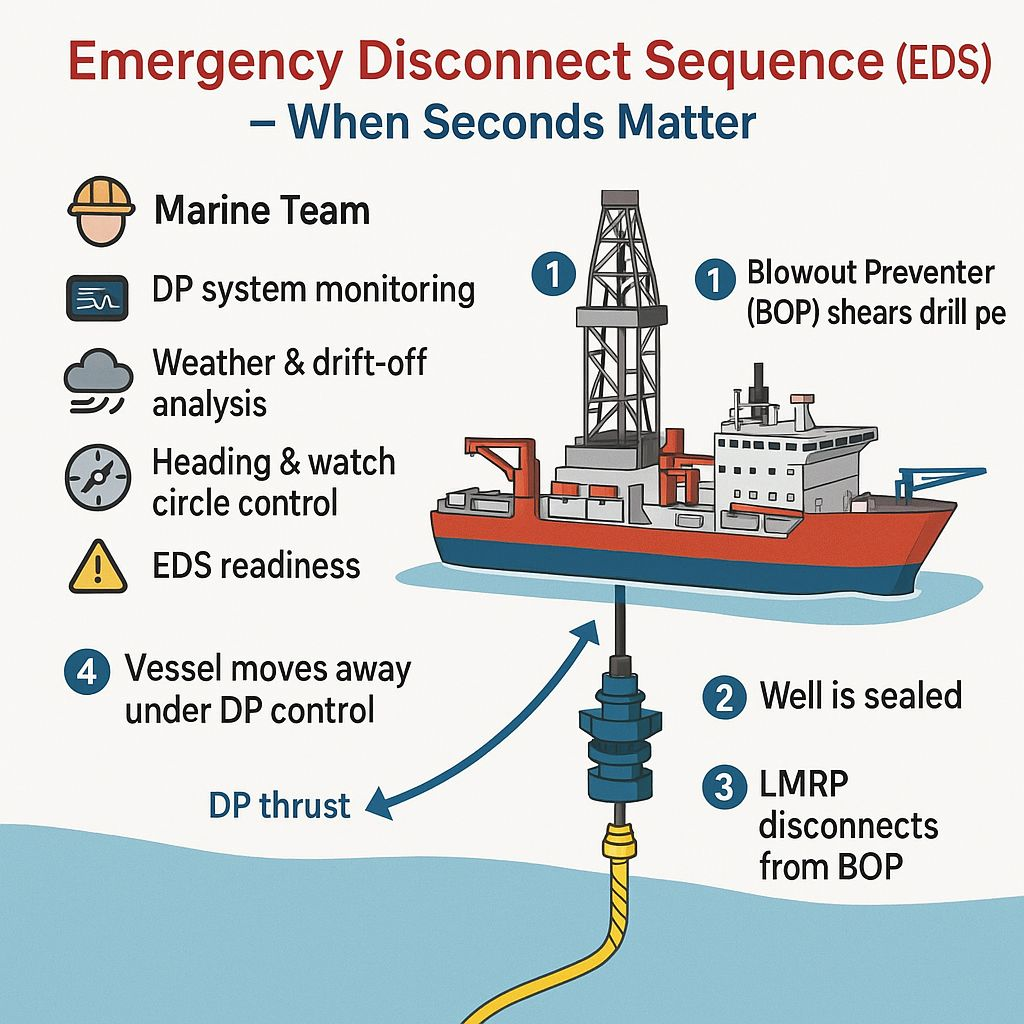
Several BSEE Safety Alerts have just been released. Of particular importance to those interested in deepwater drilling is the attached alert describing two separate Emergency Disconnect Sequence (EDS) incidents.
The EDS (see the diagram above) is a critically important safety protocol that ensures that a well is sealed and the riser and rig are disconnected from the blowout preventer in the event of a well control emergency, unforeseen weather/ocean conditions, loss of power, or positioning system malfunction. Note that the Macondo blowout could have been prevented if the Deepwater Horizon crew had activated the EDS in a timely manner.
The two EDS events cited in the Safety Alert were presumably the March 28, 2025 and March 5, 2024 incidents investigated by BSEE district offices. The drillships were the Stanley Lafosse and the Deepwater Poseidon The investigation reports provide detailed information on these incidents.
Unintended riser disconnects not associated with EDS activations are a related safety and pollution concern that necessitated the issuance of a 2000 Notices to Lessees that was subsequently updated:
The COS has been effective in strengthening corporate Safety and Environmental Management Systems, influencing the industry’s safety culture, and sharing best practices and lessons learned. These are important accomplishments.
The COS has fallen short in gathering the data needed to assess the offshore industry’s safety performance. As is the case with most voluntary reporting programs, data completeness and accuracy issues limit the significance of COS performance reviews.
The COS uses accepted performance indicators and a logical classification scheme.
COS reports that their members accounted for 78% of OCS oil and gas activity in 2024. This is accurate when cross-checked with BSEE hours worked data. However, the % of hours worked is not a good measure of the % of incidents reported in any category.
Only two drilling contractors – Helmerich & Payne and Valaris – are members. Major contractors like Noble, Transocean, and Seadrill are not members. Their incidents will thus not be reported if they are not working for a COS member.
No production contractors are COS members. These companies conduct most of the platform operations on the shelf, where many of the lease operators are not COS members.
Pacific and Alaska Region operators do not participate.
Looking only at fatalities (table below), the most important and easily verified incident category, there are troubling omissions:
COS reports no 2024 fatalities when in fact there was a fatality during an operation for a COS member.
COS reports no 2022 fatalities when there were actually five. A workover incident took the life of one worker, and four died in a helideck crash on an OCS platform. In both cases, the facility operator was a non-member company.
COS records one 2021 fatality, but fails to include a 2021 Fieldwood fatality. There were also6 “non-occupational” fatalities on OCS facilities in 2021, as classified by BSEE. Given the importance of worker health (the H in HSE), such a high number of non-occupational fatalities should be of interest industry-wide.
The COS report includes only two of the six 2020 fatalities, 2 of which were classified by BSEE as non-occupational.
The bottom line is that COS accounted for only 3 of 12 (25%) occupational fatalities during the 2020-24 period. There were at least 20 fatalities if you include the non-occupational incidents.
fatalities per COS
occupational fatalities (from BSEE data)
non-occupational fatalities (from BSEE data)
2024
0
1
?
2023
0
0
?
2022
0
5
?
2021
1
2
6
2020
2
4
2
The offshore industry is only as good as its worst performer, so complete participation is essential. Voluntary reporting is seldom complete reporting, because some companies are more concerned about confidentiality than completeness and information sharing.
For industry reporting programs to be comprehensive and credible:
The entity receiving the reports and managing the data must be independent and not affiliated with an industry advocacy organization.
All operating companies must participate and complete reporting must be required. This can be accomplished contractually. If necessary, the regulator can require participation (either as a separate regulation or as a SEMS element).
Company incident submittals should be audited by the independent entity.
Fees should be solely for the purpose of supporting the independent reporting system.
For SP1 and SP2 incidents (per the COS classification scheme), the names of the responsible companies should be included in the performance reports. The current COS system prioritizes confidentiality over accountabiity and information sharing.
The following message is from Jason Mathews – petroleum engineer, football coach, proud father, and outstanding offshore safety leader.
Happy Easter – BSEE Family and Friends
The explosion on the Deepwater Horizon oil rig occurred on April 20, 2010, at approximately 9:45 p.m. CDT. Shortly after the initial explosion, a series of further explosions and a firestorm engulfed the platform that forever changed our industry and eleven families.
This past week, I was in Orlando with my family attending an International Cheer event – All Star World Championship. As I was sitting there, I noticed a young athlete with a date written on her shoes, and she touched the date as she walked back with her team. My assumption was it was something to inspire her.
It quickly reminded me of a young man by the name of Shane Roshto. At only 22 years young, he was a victim of the Deepwater Horizon explosion, and he had written the date of his wedding and his son’s birthday on the inside of his hard hat. Those dates served as reminders of the important people and events in his life while working on the rig miles away from those who meant the most to him.
On Wednesday evening, they brought the top ten teams at the cheer competition onto the stage and called out each finalist on the stage until there were three left, and my daughter’s team was still remaining. While those girls were on stage, I thought back on the countless hours her coaches pushed her and always requested more from them because they had a collective goal to win Nationals and Worlds, and then they called the third-place finisher. It seemed like forever before they called the second-place finisher, but when they did, I got to witness athletes, coaches and families reach something they had put everything into since they began cheer. A date LA Spirit – Fame will never forget – April 16th, and only four days from a day we will never forget – April 20th.
At the conclusion of the day after taking everything in and calming down, I sent this message to the coaches of my daughter’s team – “Coaches thanks for “living your legacy” with our girls at LA Spirit. Every one of your goals, expectations, and coaching styles foster a meaningful life well beyond cheer that leaves a positive impact on our girls. All too often, our girls are told what they can and can’t do with their schedules, their abilities, or their choices. Y’all showed them they can do whatever they set their mind to if they want it bad enough and are willing to make sacrifices for it. As a parent, thank you for making positive memories and experiences that have a ripple effect and continue to inspire our girls for years to come.”
Although the two events have nothing in common (one being a tragedy and one being a highlight), they both drive individuals to live their legacies. At BSEE, all of us (not just inspectors and engineers) have an awesome responsibility to live our legacy in the oil and gas industry by actively shaping our life’s story and influence by focusing on our values, actions, and contributions to those around us (and those who work offshore).
Whether you have days like April 20th or April 16th, always “Live Your Legacy.”
I am again sharing this touching tribute to the 11 men who lost their lives on the Deepwater Horizon on April 20, 2010. The video is introduced by country singer Trace Atkins, a former Gulf of Mexico rig worker. The video and Trace’s song serve as a memorial to the 11 Deepwater Horizon workers and others who have died exploring for and producing oil and gas around the world. Please take a moment to watch.
I had the pleasure of working with Jason Mathews when he was a young MMS engineer. He truly cared about our safety mission and has taken that commitment to the next level at BSEE. Jason shared this important, heartfelt message on the anniversary of the Macondo blowout.
One of the greatest gifts I ever received in life is having a little girl and having the opportunity to go home every evening and spending time with her at cheer, softball, doing homework, etc. I have a great deal of respect for the men and women who work offshore and put their lives on hold for 14-28 days to deliver much needed OCS production to meet US demand. Undoubtedly, they are better / tougher people than me.
Over the last year, my team has seen multiple incidents that had a high potential severity that could have led to a fatal / serious injury or major incident in the GOM. Although we can sit and debate the causal factors for hours, one that jumps to the top of the discussion is the Human Factor – Complacency. Of all the things a leader should fear, complacency heads the list. There is no doubt success breeds complacency, and complacency breeds failure.
To this day, I am still shook by the mindset and complacency of many onboard the Deepwater Horizon prior to the incident. During testimony in the public hearings, John Guide, the BP well team leader for the Horizon, believed that the rig crew had become “too comfortable” because of its good track record for drilling difficult wells. Ross Skidmore, a BP contractor on the rig on April 20, testified that the crew became complacent after completing drilling because “when you get to that point, everybody goes to the mindset that weʹre through, this job is done.” To me, the complacency on the Deepwater Horizon could be attributable to the crew not having access to all of the well data (OptiCem reports – cement job risk) available to BP personnel onshore and the well site leaders on the rig. Our investigation concluded, the overall complacency of the Deepwater Horizon crew was a possible contributing cause of the kick detection failure.
As regulators, we have special roles in the GOM as it relates to safety:
Driving the avoidance of complacency and risk-free mindsets of the offshore employees
Understanding we can’t be selfish – Our success is not our individual personal growth / gains, but it is being unwavering in your promotion of offshore safety to ensure all offshore employees return home to their families safely
Holding each other (internally) and industry (externally) accountable when necessary
In order to achieve greatness offshore, we ,as a regulator, have to believe we can, and never sit still until we achieve it.
Everyone on this email has a very critical function and role. Never underestimate the value of what you do, have the proper mindset, and avoid complacency.
Do whatever it takes to ensure the people offshore are gifted the same gift we receive every day – going home to our families.
All In –
Jason P. Mathews, Petroleum Engineer, Field Operations – OSM
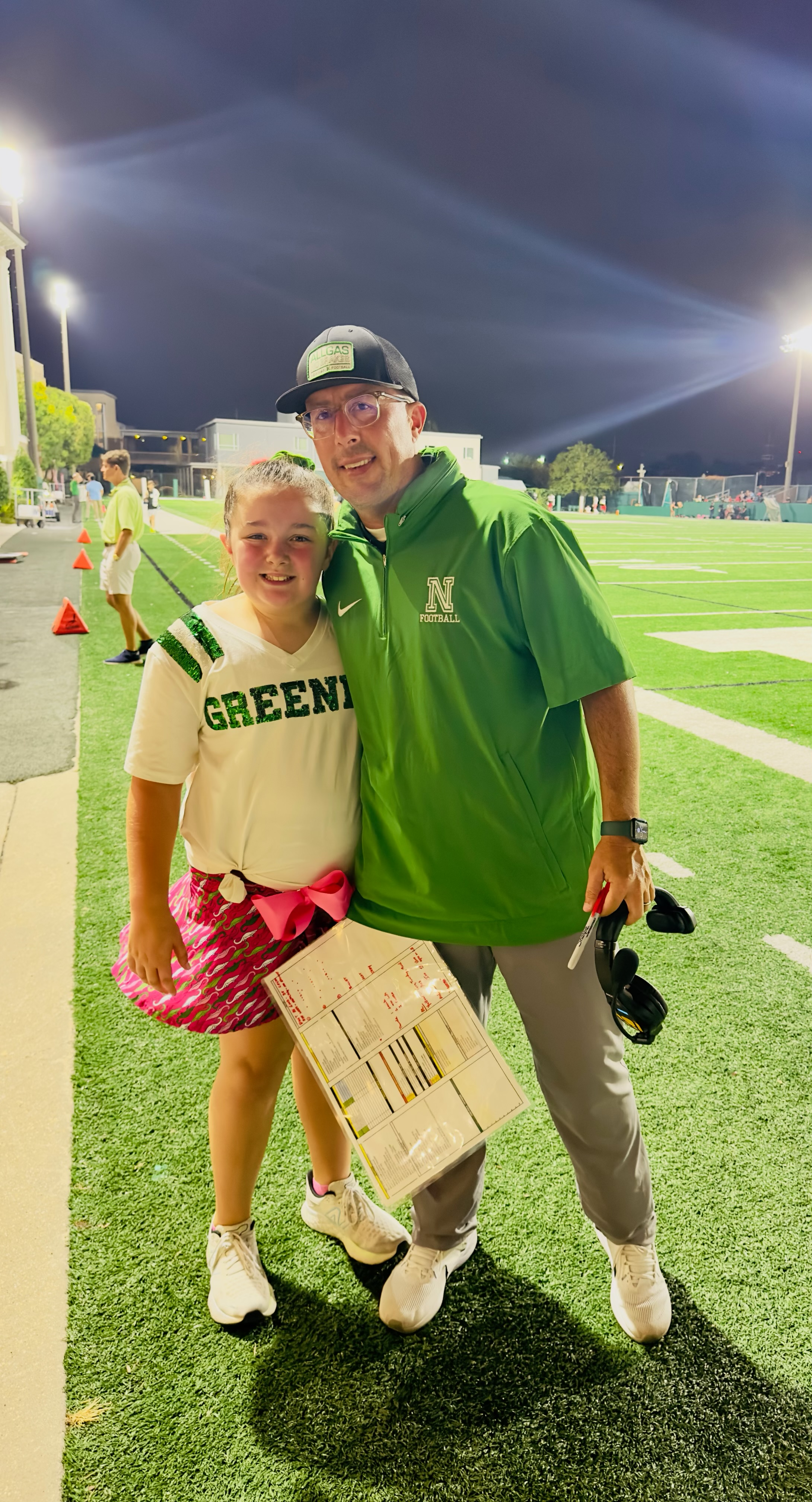
Friday Night LIghts: Coach Mathews and his daughter
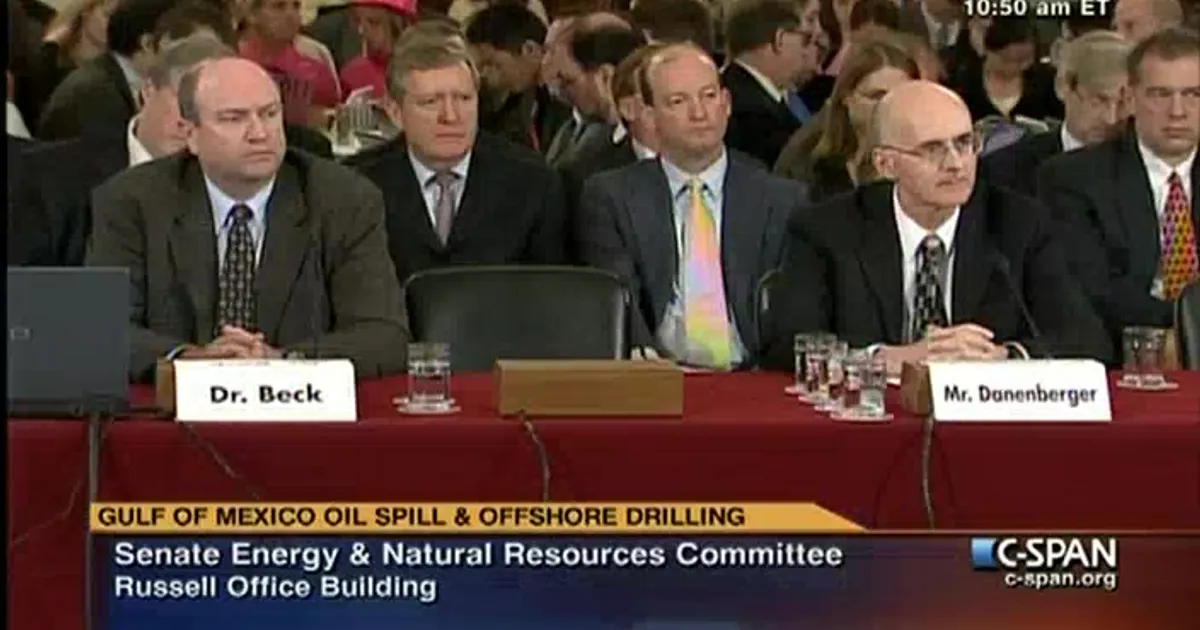
I was on the first panel to appear before a Senate committee during the Macondo blowout. All of the senators were respectful and professional with two exceptions, one of whom was Bob Menendez. Perhaps Senator Menendez’s penchant for political grandstanding was an indication of more significant character flaws.
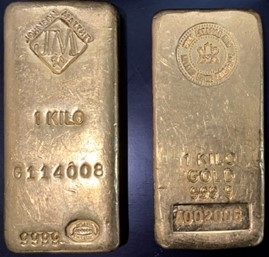
Robert Menendez Allegedly Agreed to Use His Official Position to Benefit Wael Hana, Jose Uribe, Fred Daibes, and the Government of Egypt in Exchange for Hundreds of Thousands of Dollars of Bribes to Menendez and His Wife Nadine Menendez, Which Included Gold Bars, Cash, and a Luxury Convertible
Last week, Sen. Menendez was cited for additional charges accusing him of accepting bribes from a foreign government and conspiring to act as a foreign agent.
Sharing this touching tribute to the 11 men who died on the Deepwater Horizon on April 20, 2010. These American heroes gave their lives exploring for energy to power our economy. The video is introduced by singer Trace Atkins, a former Gulf of Mexico rig worker. Please take a moment to watch.
[Disclosure: I assisted the legal team that defended Bob Kaluza. That said, I completely disagreed with the charges against him and Don Vidrine before my involvement in the case.]
Bob Kaluza (L) and Don Vidrine
Unsurprisingly, there was a lot of tough guy talk in Washington DC after the blowout:
“Our job is basically to keep the boot on the neck of British Petroleum”
It was therefore predictable that the Department of Justice (DOJ) would choose to prosecute BP employees individually. There were BP managers who would have been good candidates, but instead DOJ chose to criminally prosecute the working stiffs – the two BP well site leaders on the rig. They were the lowest ranking BP employees associated with the incident. This was apparently acceptable to BP, since their plea agreement blamed Kaluza and Vidrine’s for their role in overseeing the negative pressure test (#blametheworker). Never mind that:
BP management was responsible for the well planning and shortcuts that were the root causes of the blowout (see the previous posts in this Macondo series).
the extent to which the negative pressure test was misconducted and misinterpreted was and remains a topic of dispute.
there were no regulations or standards requiring this test or explaining how it should be conducted, and BP’s internal guidance was woefully inadequate.
Bob Kaluza was a temporary replacement for the regular well site leader, had worked primarily onshore, and had never conducted or witnessed a negative pressure test.
Kaluza and Vidrine were themselves victims and were fortunate to have survived the incident.
Despite all of this, DOJ still chose to prosecute the two well site leaders. However, the weaknesses in the DOJ case became more obvious over time, and DOJ dropped all but a misdemeanor water pollution charge. Vidrine, who had health issues that were exacerbated by the case, accepted a plea deal. Kaluza was confident of his innocence and chose to make his case in court. His defense team was very strong, and the trial was essentially a walkover. After less than 2 hours of deliberation, the jury fully acquitted Bob Kaluza (2/25/2016). Sadly, Don Vidrine passed away the following year.
While the previously discussed planning, cementing, and well suspension issues allowed the well to flow, there were many other equipment, operational, and management deficiencies that elevated the incident to a disaster. Below are those that bother me the most:
Blowout Preventers
The Deepwater Horizon BOP stack had a single blind shear ram. Regardless of what the regulations allowed, you don’t drill a complex well like this without redundant shearing capability (and at the time of the blowout most deepwater drillers were using rigs with dual shear rams). All well control emergencies requiring the emergency disconnect sequence, deadman, and autoshear functions are dependent on effective shearing capability. You can have redundancy in every other BOP element, but without dual shear rams, you don’t have a redundant BOP system. Further, for full redundancy both shear rams should be capable of sealing the well bore after shearing. In that regard, the present regulations and the applicable standard (API S 53) require only one shear ram capable of sealing. They are thus deficient and should be updated.
The DWH BOP system did not have full bore shearing capability (available at the time) which may have sheared the deflected drill pipe.
The DWH BOP system was not properly maintained and recertified as required by regulation.
Transocean’s “condition based maintenance” was a euphenism for “fix it when it fails.” Perhaps worse, BP authorized the continuation of operations knowing that an annular preventer was leaking.
The initial flow from the well was directed to the mud-gas separator instead of being routed overboard via the diverter. Routing the flow to the diverter would have provided additional time for the crew to safely evacuate.
Gas detectors
Not all gas detectors were fully operational. As justification, Transocean’s report expressed concerns about alarm fatigue, a weak excuse. Alarm issues can be effectively managed without disabling the devices.
The gas detectors did not automatically shutdown the generators, the source of the initial explosion. This is somewhat understandable on a dynamically positioned rig that is dependent on power to maintain position. However, someone should have shut down the generators as soon as gas was detected.
Engine overspeed devices didn’t work, and apparently weren’t tested regularly. Had they worked, the engine room explosion may have been prevented.
The crew had time to activate the Emergency Disconnect Sequence, but did not.




 Bud's Offshore Energy (BOE)