Feeds:
Posts
Comments

Posts Tagged ‘Colin Leach’

A recent Colin Leach comment (below) merits a separate post.  Keep in mind that formation gas is highly soluble in oil-based fluids. Under bottomhole temperature/pressure conditions, the gas may be completely dissolved in the drilling fluid, complicating kick detection.

Problem: A small amount of gas is in the riser above the BOP.  This gas has been recognized, the BOP has been shut, and the well below the BOP has been killed and circulated.

What to do next? There may be 2000 bbl of mud in the riser.  Overboard?  In any case if this is done, it may get quite exciting when the (small) gas pocket reaches surface.  Do we always send this mud overboard?  Whenever there is a doubt?

The alternative of circulating through a “riser gas handler” (if the rig is equipped with one) is quite safe as long as some back-pressure  (perhaps 200 psi as a minimum) is held on a choke in order to prevent what was termed “explosive unloading” from happening.  Without this back-pressure, the events that follow are disastrous.

Follow-up: It is time to take a step back and re-look at this whole situation.  To do so does require the realistic modeling software….OLGA, Drillbench etc.. Simple gas calculations (P1V1=P2V2…..or even allowing for Z) don’t include the dynamic effects that you will see and simply must not be used.  The gas rates that come from these simple calculations are misleadingly low.

Certainly this is an area where the industry needs some focused effort.


Read Full Post »

The folks at WordPress.com sent us a blog health report and it looks like we are doing surprisingly well:

Healthy blog!

The Blog-Health-o-Meter™ reads Wow!

WordPress.com added:

The Louvre Museum has 8.5 million visitors per year. This blog was viewed about 71,000 times in 2010. If it were an exhibit at The Louvre Museum, it would take 3 days for that many people to see it.

In 2010, there were 470 new posts, not bad for the first year! There were 412 pictures uploaded, taking up a total of 97mb. That’s about 1 pictures per day.

We did okay for an obscure blog that accepts no sponsorships, advertisements, or donations, and focuses on niche safety and regulatory issues.  Thanks for your support.

Among the many BOE contributors, special thanks go to Odd Finnestad, Colin Leach, and Malcolm Sharples. These internationally recognized experts have voluntarily provided suggestions, data, and and informed analyses. It’s a pleasure working with them and the others who have contributed, some of whom prefer to remain anonymous.

Over the past year, I have heard from many dedicated energy professionals and safety leaders.  Because of their commitment and enthusiasm, I am optimistic that we will resolve our issues and move forward in a manner that benefits the offshore industry and society.

Read Full Post »

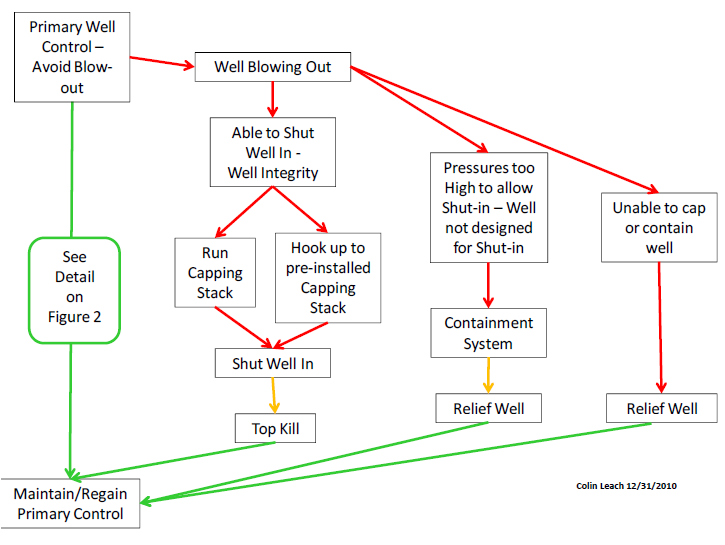
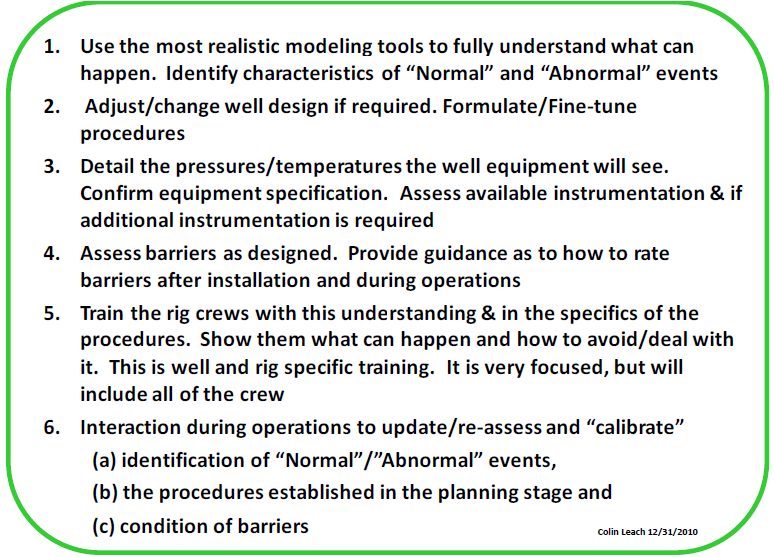
Colin Leach has provided a nice overview of the loss of well control scenarios for a deepwater well (Figure 1), and a concise, but comprehensive, summary of the critical elements of a well control program (Figure 2).   Click on either figure to enlarge.

We appreciate Colin’s continued leadership and initiative on well control issues.

Figure 1: Well Control Activities in Deep Water

Figure 2: Activities Focused on Maintaining Primary Well Control

Read Full Post »

We have commented frequently about the similarities between the Montara and Macondo blowouts, particularly the root cause casing shoe issues. In this post, Colin Leach draws attention to the float shoe and collar issues that permitted oil and gas to enter both wells. Click here to view the full post.

The Bly report (page 70) noted some significant “inconsistencies” in the operation of the float shoe/float collar (see full post). This is so similar in nature to the “inconsistencies” in the 9 5/8″ cement job on the Montara well to be scary. The bottom line is that both disasters could have been prevented if these “inconsistencies” had been recognized and additional barriers placed above the float collar. In fact even if there are no “inconsistencies”, the placing of an additional barrier or so seems like an exceptionally prudent step, which would not take that much time or effort.

Read Full Post »

While we wait for the Bly Report (BP), Colin Leach (without the benefit of staff and access) has issued his concise and credible report on Macondo. I recommend that you take a few minutes to read it. Many thanks to Colin for his continued leadership on offshore safety issues.

Read Full Post »

Kent Well’s response to a reporter’s question and Colin Leach’s comment on BOE seem to give credence to our suspicion that the flow path for the Macondo well was inside the production casing!  If true, this is enormously significant for the following reasons:

  1. The root cause of Macondo is eerily similar to that at Montara in that oil and gas entered the well via compromised cement in the casing shoe and a failed float.  Did the BP engineers and TO crew even know about Montara?  This shows why accident information must be promptly circulated and brought to the attention of key personnel everywhere in the world. It also demonstrates why the Montara report needs to be released without further delay.
  2. Presumed contributing factors that would be irrelevant or less significant: the long string vs. liner/tieback decision, and the failure to run a Cement Bond Log, additional centralizers, or a lockdown sleeve on the casing seal.
  3. Contributing factors that would have even greater importance: selection of the casing point (integrity at the base of the well), waiting on cement time, timing of the positive and negative pressure tests (this is a topic that warrants much more scrutiny and discussion), and failure to set a cement plug before displacing the mud with sea water.

Read Full Post »

BOE friend and internationally recognized well control expert Colin Leach has submitted an excellent paper suggesting new procedures that will improve well design and intervention.  Click here to read Colin’s paper.

The goal is to eliminate the possibility of what actually could happen not being recognized (at the time of the design). This is achieved by having a core of knowledge against which individual operating companies and outside assessors can assess designs and approaches. Communication between the operator and the “knowledge core”would be confidential as long as a well control incident did not occur. The format of this “knowledge core” is such that it eliminates the “committee think” within an operating company where a dissenting individual (who is actually knowledgeable) can be overruled by a committee vote.

Read Full Post »

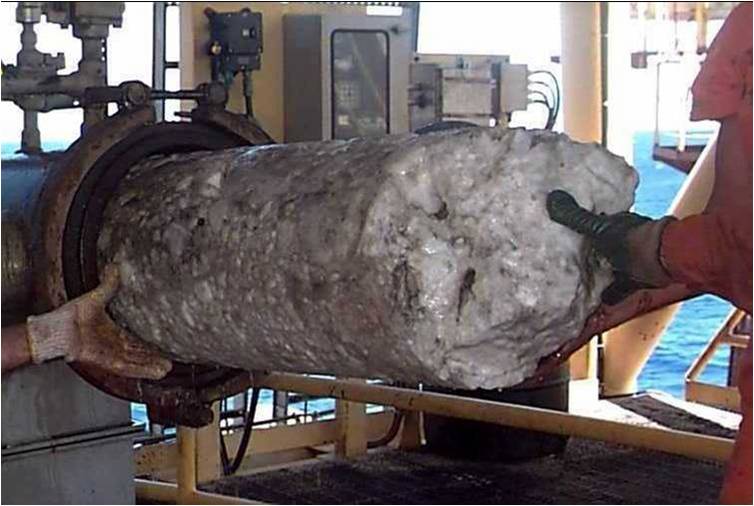
hydrate plug removed from pipeline

In a recent conversation, Colin Leach suggested an interesting plugging option for the Macondo well – hydrates.   Why not take advantage of nature and induce hydrate formation to plug the well?  We know that hydrates are difficult to prevent when methane mixes with water under the pressure conditions at Macondo.  Why not pump cold water down the choke line where it will mix with methane in the stack to form hydrates and plug the well?  To optimize the hydrate formation, methane could be injected down the kill line.

Hydrates would definitely form.  Chances are good that natural forces would form a solid hydrate plug that would prevent further flow from the well.  The only risk would be that the hydrates would form too slowly (unlikely given the experience with the seafloor containment chamber) or that they wouldn’t completely plug the well.    The presence of a hydrate plug would also require additional caution when the well is finally re-entered (after the relief well has secured the downhole flowpaths).   The best time to attempt the hydrate option would seem to be right now, after the more conventional BOP intervention attempts and before cutting the riser to install the cap.

Read Full Post »

Given the complicated situations that can occur, I think that the key is in understanding what can happen on a particular well, given the well geometry and rig specifics, such that communications with the crew are simple and focused.  The key is playing the “what if” games before a real incident occurs. ~ Colin Leach

In light of BOE’s interest in drilling safety, we thought we would ask a few questions to Colin Leach, a well control expert and a partner in Argonauta Energy Services.   Colin has over 26 years of upstream experience with an emphasis on deepwater drilling, and is internationally recognized for the depth and breadth of his understanding of drilling systems.  Read Colin’s insightful comments here.

Read Full Post »