
Julia Gillard
Martin Ferguson is likely to retain his post as Minister for Resources and Energy. We trust that he will now release the Montara Inquiry Report as promised. When has a politician ever broken a promise? Never happens in this country 🙂
Posted in Uncategorized, tagged Australia, Montara, offshore oil, oil spill, safety on September 7, 2010| Leave a Comment »
Julia Gillard
Martin Ferguson is likely to retain his post as Minister for Resources and Energy. We trust that he will now release the Montara Inquiry Report as promised. When has a politician ever broken a promise? Never happens in this country 🙂
Posted in accidents, well control incidents, tagged Australia, blowouts, damage claims, Indonesia, macondo, Montara, oil spill on September 2, 2010| Leave a Comment »
While BP has established a $20 billion damage fund that is being administered by the Federal government, PTTEP, the party responsible for the Montara blowout in the Timor Sea, is taking a different approach. PTTEP has denied all claims from the Indonesian government arguing that oil spill damages were limited to the immediate vicinity of the Montara field. However, information presented at the Montara hearings indicates that the slick extended into Indonesian waters.
PTTEP Australia (PTTEP AA), a subsidiary of the Thai-listed PTT Exploration and Production Public Company Limited today (2 September 2010) confirmed the Government of Indonesia that it has not accepted any claims for compensation relating to the claimed impacts of oil released from the company’s Montara field in the Timor Sea last year.
What if PTTEP was the operator at Macondo?
Posted in accidents, well control incidents, tagged accidents, Australia, blowouts, Montara, offshore oil, safety, well control on August 29, 2010| Leave a Comment »
Since it’s already Monday morning in Oz, our Australian bureau has returned to work and is eager to pass on some news:
We received this comment from an oil industry manager in Australia:
The Montara report damns the regulatory agency and there are many that think that is not appropriate. That is the reason for the holdup.
Comment: I assume the report’s criticism is primarily directed at the Northern Territory regulator. In defense of the regulators, the current division of responsibilities between the Federal government and the States is unworkable. You can’t have one agency responsible for well integrity and another responsible for rig and facility safety. The US has similar issues with the division of safety authority among the Departments of Interior and Transportation (pipelines), and the Coast Guard. If the regulatory responsibilities of the former MMS are not retained in a single bureau, but divided between the two new Interior bureaus, these problems could be exacerbated. Most of the recommendations in my 11 May testimony before the Senate Committee on Energy and Natural Resources have received at least some attention. One very important recommendation (no. 1) calling for a streamlined OCS regulatory regime, has not been addressed.
Posted in accidents, tagged accidents, Australia, blowouts, Deepwater Horizon, drilling, Gulf of Mexico, macondo, Magne Ognedal, Montara, Norway, offshore oil, ONS, well control on August 28, 2010| Leave a Comment »
BOE does not officially resume posting until 30 August, but we wanted to make sure you were aware of Magne Ognedal’s recent remarks to Upstream
“It is very frustrating,” Ognedal said. “We do not have the information we need to finish the job. We know from the transcripts of the inquiry that the Macondo and Montara blowouts appear to have very similar causes. However we cannot draw any conclusions until we have access to the report.”
I also suggest that you read the text of Magne’s excellent speech during the Safety Luncheon at ONS in Stavanger.
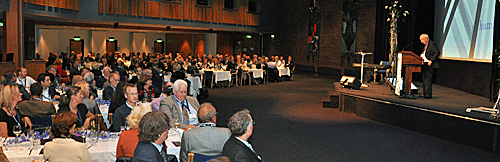
Magne Ognedal Addresses ONS Safety Luncheon
Posted in Uncategorized, tagged Australia, Gillard on August 21, 2010| Leave a Comment »
Gillard quotes Bill Clinton: “The people have spoken but it is going to take a little while to determine exactly what they have said.”
From the rather narrow BOE perspective, post-election uncertainty will likely delay the release of the Montara report even more. Not good.
Posted in accidents, well control incidents, tagged accidents, Australia, blowouts, croc, Deepwater Horizon, Gillard, Gulf of Mexico, macondo, Montara, offshore oil, safety, well control on August 19, 2010| Leave a Comment »
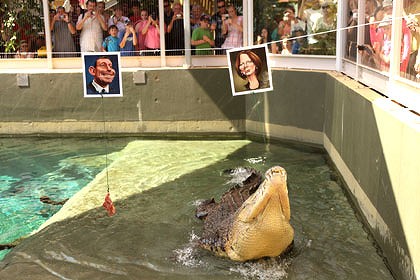
Like all swinging voters, Dirty Harry – a saltwater crocodile admired for his prediction prowess – took his time sniffing out the candidates in his enclosure at Crocosaurus Cove in Darwin today. Refusing to make a snap decision, Harry – reluctantly it seemed – chose the chicken carcass that was attached to a caricature of Prime Minister Julia Gillard.
Should the croc be correct, BOE friend Martin Ferguson will presumably retain his cabinet position and release the Montara report as promised. Why is the release of this report so important?
Posted in accidents, well control incidents, tagged accidents, Australia, blowouts, Montara, offshore oil, oil spill, regulator, safety, well control on August 11, 2010| Leave a Comment »
It may be winter in Australia, but the offshore debate is heating up. I awoke to a stream of emails from Odd Finnestad who follows the Australian news very closely. Odd noted that the Australian Petroleum Production and Exploration Association (APPEA) Safety Conference opened with a presentation on the industry response to Montara. Further from Odd:
Then, Martin Ferguson, who was apparently also present, gave an address. Quotes of his speech appear in numerous articles, and the cat is now out of the bag: The Montara report will NOT be released before the election! And, should the Gillard Labour Party win the battle, Martin says there will be a shift to a national regulator in Australia from January 1, 2012.
See this article for a good summary of Minister Ferguson’s remarks.
Creating a new all-powerful national regulator for the offshore oil and gas industry would be a top priority of a re-elected Gillard Labor government, federal resources minister Martin Ferguson said today.
While the other states appear to be on board, the West Australia government is not happy.
The most colorful quote is from APPEA CEO Belinda Robinson:
Knee-jerk reactions such as calls for moratoriums on offshore exploration were not the answer and it was important not to “overdo the self-flagellation”, she said.
BOE comment: We’re not looking for “self-flagellation,” but a little humility would be nice. Ms. Robinson and industry leaders in Australia, the US, and elsewhere need to take a close look at the safety culture of the industry they represent. The reactive studies that are necessary to satisfy government authorities are not enough. The goal should be participation by all offshore operators in organized programs that assess across-the-board risks and address problem areas before major accidents occur.
Posted in accidents, well control incidents, tagged Australia, blowouts, macondo, Montara, offshore oil, safety, well control on August 6, 2010| Leave a Comment »

G’Day Australia. There are now only 2 weeks until the Federal election. Ironically, the election, which may have delayed the release of the Montara Inquiry report, will be held on the first anniversary of that blowout.
This report will play an important role in keeping our workers safe, protecting our environment and safeguarding our energy security. Minister Martin Ferguson
BOE fully agrees with Minister Ferguson’s statement about the importance of the Montara Inquiry report and hopes that he or his successor promptly releases the report after the election. The lessons learned at Montara will not only prevent accidents in Australia, but elsewhere in the world. In light of the disturbing similarities between the two blowouts, it is possible that closer international attention to Montara might even have prevented the Macondo blowout.
Posted in accidents, well control incidents, tagged accidents, Australia, blowouts, Colin Leach, Deepwater Horizon, Gulf of Mexico, macondo, Montara, offshore oil, oil spill, safety, well control on August 5, 2010| 2 Comments »
Kent Well’s response to a reporter’s question and Colin Leach’s comment on BOE seem to give credence to our suspicion that the flow path for the Macondo well was inside the production casing! If true, this is enormously significant for the following reasons:
Posted in accidents, well control incidents, tagged accidents, Australia, blowouts, dispersants, Gulf of Mexico, macondo, offshore, offshore oil, oil spill, safety, well control on August 2, 2010| Leave a Comment »
End game mysteries?: As BP prepares for the static kill operation, the well’s flow path is still not clear. While the consensus seems to be that the flow originates in the annulus outside the production casing, irregularities during the cementing and testing of that casing suggest the possibility of flow inside the casing. The condition of the well bore and casing strings is also uncertain. Perhaps of greatest importance will be the inspection of the BOPE after the well is plugged and the stack is pulled. This inspection process should be closely supervised by the regulators.
Press conference etiquette?: After admitting that they joined yesterday’s Unified Command press briefing late, two reporters asked questions that had been answered earlier. Perhaps they think their time is more important than Admiral Allen’s, or that of the other attendees, viewers, and listeners. One of these questioners asked when the static kill operation would begin. Admiral Allen, who answered the question politely and patiently, should have asked when it would be most convenient for the reporter. Surely, the Unified Command would want to accommodate the reporter’s busy schedule. 😉
Dispersants: As has been demonstrated at oil spill workshops and conferences for the past 30 years, you can always stir up passions by questioning the use of dispersants. Dispersants, unlike burning and skimmers, don’t remove oil from the water (at least not directly). The On-Scene Commander (OSC) must consider the tradeoffs and make the decisions that he or she thinks will minimize the net impact of the spill. Given the magnitude of location of the Macondo spill, I think the OSCs made the correct calls. Dispersants were also used (not without controversy of course) in responding to last year’s Montara blowout in the Timor Sea.
 Bud's Offshore Energy (BOE)