The Transportation Safety Board of Canada (TSB) will hold a news conference on Wednesday, February 9, 2011 to make public the final TSB investigation report (A09A0016) into the crash of a Cougar Helicopters Sikorsky S-92A off the coast of Newfoundland on March 12, 2009.
Posts Tagged ‘accidents’
Report on Newfoundland helicopter crash to be released on 9 February
Posted in accidents, tagged accidents, Canada, helicopter crash, Newfoundland, offshore oil, Robert Wells, safety on January 22, 2011| Leave a Comment »
American Ingenuity!
Posted in Uncategorized, tagged accidents, blowouts, Deepwater Horizon, drilling, Gulf of Mexico, huckster, oil spill, well control on January 21, 2011| Leave a Comment »
A Detroit Lakes, Minn., man who fabricated a story last summer that he had invented the cap that fixed the Deepwater Horizon oil spill is facing three unrelated felony theft charges.
You may recall the parade of snake oil salesmen and other hucksters who appeared on TV during the blowout. Apparently, this guy was one of them.
In July, several local news outlets, including KARE-TV and KSTP-TV, reported that Mastin had invented the cap that eventually plugged the oil spill in the Gulf of Mexico. But the Pioneer Press found that BP had not bought the device from Mastin.
Thursday Morning Items
Posted in accidents, cuba, well control incidents, tagged accidents, Apache, blowouts, cuba, gas leak, Gulf of Mexico, National Commission, safety, well control, William Reilly on January 20, 2011| Leave a Comment »
1. This is a surprise. Does anyone know more about this conference?
U.S. experts will participate in a conference on oil safety in Cuba this April, Reuters reported. The conference comes as the BP disaster on the U.S. side of the Gulf of Mexico is raising concern over the start of offshore drilling in Cuban waters this year. The arrival of an exploratory drilling platform in Cuban waters that had been expected for early this year was reportedly postponed to summer.
National oil spill commission co-chairman William Reilly called on the Obama administration to think about negotiating a treaty with Mexico and possibly Cuba that would lay out uniform safety standards for offshore drilling in the Gulf of Mexico.
3. Nothing new is being reported on the blowout/uncontrolled flow/gas leak beneath the East Cameron block 278 B platform that Apache is calling a “water disturbance.” Spin doctors never sleep.
Based on the limited information that is available, well integrity issues loom large and there appear to be some disturbing similarities with the Main Pass 91 blowout in 2007.
Platts Reports Gas Leak at Apache Platform in Gulf of Mexico
Posted in accidents, tagged accidents, Gulf of Mexico, offshore oil, safety on January 18, 2011| Leave a Comment »
Apache said a hydrocarbon sheen was discovered in the water near its production platform in East Cameron Block 278 as the company was permanently plugging and abandoning nearby by non-producing wells. Apache said its workers saw bubbling in the water Sunday, followed by the sheen on Monday.
Good Financial Times Article
Posted in accidents, well control incidents, tagged accidents, blowouts, Deepwater Horizon, drilling, macondo, offshore oil, safety, well control on January 17, 2011| 1 Comment »
One of the better paragraphs I have read since Macondo:
The Deepwater story shows the fight against complacency is a continuous struggle, not a single battle. An executive at another oil major told me the default setting for safety managers should be “chronic unease”. That’s easy to see if you’re a prison governor or lighthouse-keeper. But it should be part of any executive’s attitude. Constant vigilance against, say, new competition, supply chain disruption, or unforeseen technological change is a must for modern managers.
Washington Post Editorial
Posted in accidents, well control incidents, tagged accidents, blowouts, Deepwater Horizon, drilling, Gulf of Mexico, macondo, offshore oil, safety, well control on January 7, 2011| Leave a Comment »
No government regulatory structure alone can guarantee safety in an industry that must constantly adapt new technology to natural variations in drilling sites and unexpected natural phenomena. Oversight must improve, as the Obama administration has made clear, but also every company involved in oil drilling – not just BP – must individually and in concert with others evaluate industry standards and safety research programs. And none should assume that BP’s mistakes could not occur elsewhere. Washington Post
Well said!
Exxon CEO disputes claims of systemic problems in the industry
Posted in accidents, well control incidents, tagged accidents, blowouts, Deepwater Horizon, drilling, Gulf of Mexico, macondo, offshore oil, oil spill, safety, well control on January 6, 2011| 2 Comments »
The explosion aboard the Deepwater Horizon rig, resulting in the massive oil spill in the Gulf of Mexico, was caused by its operators’ decisions and not by general problems in the oil industry, Exxon Mobil Corp. Chief Executive Rex Tillerson said Thursday.
But then seems to contradict that statement:
“It’s really up to the industry” to make sure regulation is strong and disasters like these don’t happen again, he said.
So, isn’t the second quote acknowledging a systemic problem?
Macondo Penalties Speculation, Litigation Update, and Comments from BP, TO, and Halliburton
Posted in accidents, well control incidents, tagged accidents, blowouts, Deepwater Horizon, Gulf of Mexico, macondo, National Commission, offshore oil, oil spill, safety, well control on January 6, 2011| Leave a Comment »
The conclusions of the presidential commission’s inquiry into the causes of the Deepwater Horizon accident published Thursday make it increasingly likely that BP will not be found grossly negligent and will avoid the harshest financial penalties for the Gulf of Mexico oil spill.
Siding with arguments by the Plaintiffs, Judge Barbier concluded that the depositions should go forward in New Orleans, rather than in Houston as preferred by BP.
BP vs. TO vs. Halliburton (quotes from New York Times article)
In a statement on Wednesday, BP noted that the commission had found fault with a number of companies, not only BP, the main owner of the well.
Halliburton said in a statement that it had acted at BP’s direction in preparing and injecting cement into the well. It said tests the panel identified as indicating problems with its cement formula were preliminary and did not contribute to the disaster. Halliburton also criticized the commission for what it called selective omissions of exculpatory material it gave to the panel’s staff.
A spokesman for Transocean said that BP, not Transocean, made the major decisions in the hours before the blowout. “Based on the limited information made available to them, the Transocean crew took appropriate actions to gain control of the well,” the spokesman said. “They were well trained and considered to be among the best in the business.”
UK Parliamentary Report Link and Comment
Posted in accidents, UK, well control incidents, tagged accidents, blowouts, Deepwater Horizon, drilling, Energy and Climate Change Committee, Gulf of Mexico, macondo, parliament, safety, UK, well control on January 6, 2011| 1 Comment »
What?
The blowout in the Gulf of Mexico could have been prevented if the last-line of defence—the blind shear ram on the blowout preventer, located at the well head on the ocean floor—had activated and crushed the drill pipe. Given the importance of this equipment, and the evident dangers of relying on a single device, we urge the HSE to consider prescribing specifically that blowout preventers on the UK Continental Shelf should have two blind shear rams.
Comments:
- The UK government should NOT be commenting on the BOP failure until the US government has completed its forensic testing and investigation.
- The Committee has apparently not paid any attention to the testimony on the BOP issues or the other BOP information that has surfaced. Have they not seen the comments from BP and Transocean or the videos shot on the Q4000?
- Would it have been appropriate for the US government to publish a report on Piper Alpha before Lord Cullen had completed his review?
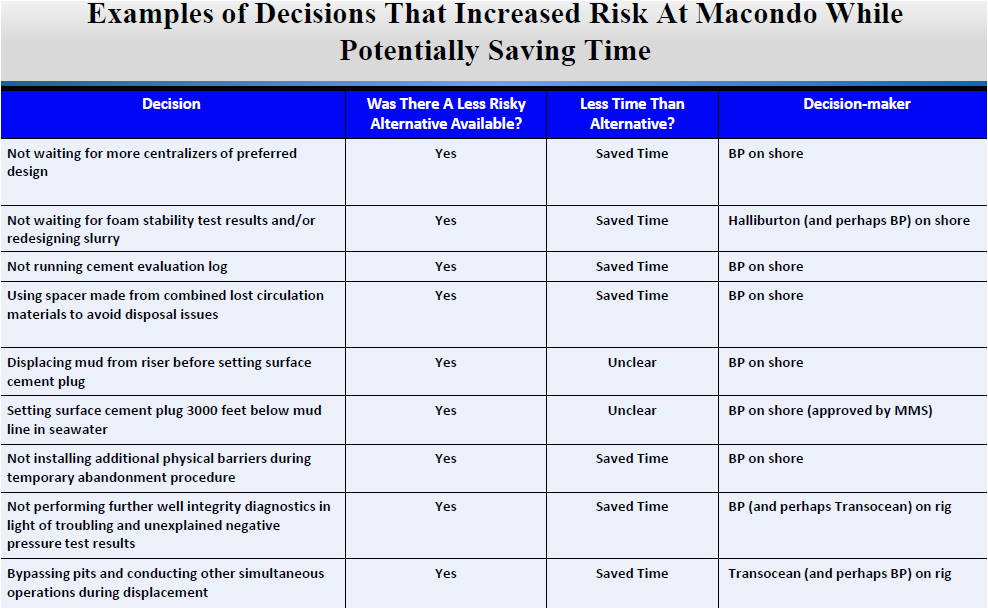
National Commission releases chapter on the causes of the Macondo blowout
Posted in accidents, well control incidents, tagged accidents, blowouts, Deepwater Horizon, drilling, Gulf of Mexico, macondo, National Commission, offshore oil, safety, well control on January 5, 2011| Leave a Comment »
 Bud's Offshore Energy (BOE)