Feeds:
Posts
Comments

Posts Tagged ‘accidents’

From the Houston Chronicle:

“I didn’t have a lot of set ideas about how things should work in the energy industry,” Jahnke said. “So I thought ‘Why can’t we try a curved blade?’ like the curved hook on a Swiss Army Knife can opener.”

Since January, T-3 has been testing Jahnke’s design, slicing through just about every size of drill pipe and casing used in the Gulf.

National Oilwell Varco is showing customers its new shear rams — a pair of trident-like blades that puncture a drill pipe before cutting it to shreds. The ShearMax Low Force Casing Shear Rams are aimed at cutting through tool joints – the thickest section of a drill pipe where it screws into another section of pipe.

GE Oil & Gas’ Hydril line of blowout preventers include a hardware and software system that allows an operator to know exactly how far shear rams close within the blowout preventer.

Another new Hydril product captures the natural pressure thousands of feet underwater to help activate a shear ram.

Weatherford International has touted its new “closed-loop” drilling system, which allows for better monitoring for gas as mud comes back from a well during drilling.

Read Full Post »

Chapter 6

Good Woods Hole Oceanographic Institute videos about their participation in the Deepwater Horizon scientific effort. 

Read Full Post »

oil-eating bacteria

scientists led by Terry Hazen, a microbiologist at Lawrence Berkeley National Laboratory, discovered that cold-loving microbes were making quick work of the oil (Greenwire, Aug. 24, 2010). These bugs were, in effect, oil-seeking missiles. They were highly mobile, armed with swimming flagella and protein sensors that could guide them to their oily prey, according to additional work so far unpublished by Hazen’s group.  New York Times

Read Full Post »

AP report:

“The Deepwater Horizon BOP was unreasonably dangerous, and has caused and continues to cause harm, loss, injuries, and damages to BP (and others) stemming from the blowout of Macondo well, the resulting explosion and fire onboard the Deepwater Horizon, the efforts to regain control of the Macondo well, and the oil spill that ensued before control of the Macondo well could be regained,” BP said in the suit.

Read Full Post »

Per the Citizens Voice, no injuries were reported

The Atgas 2H well operated by Chesapeake Energy in Leroy Township blew out at around 2 a.m., according to Bradford County Emergency Management Agency Deputy Director Skip Roupp.

The well was in the process of being hydraulically fractured and Roupp characterized the spilled fluid as “mostly water … with some contaminants” but he did not know the exact composition of the fluid.

Evidently the crack is in the top part of the well below the blowout preventer,” he said, referring to a device used in emergency situations to choke off flow from a well. “They don’t really know what happened yet because they don’t have it controlled yet.”

Read Full Post »


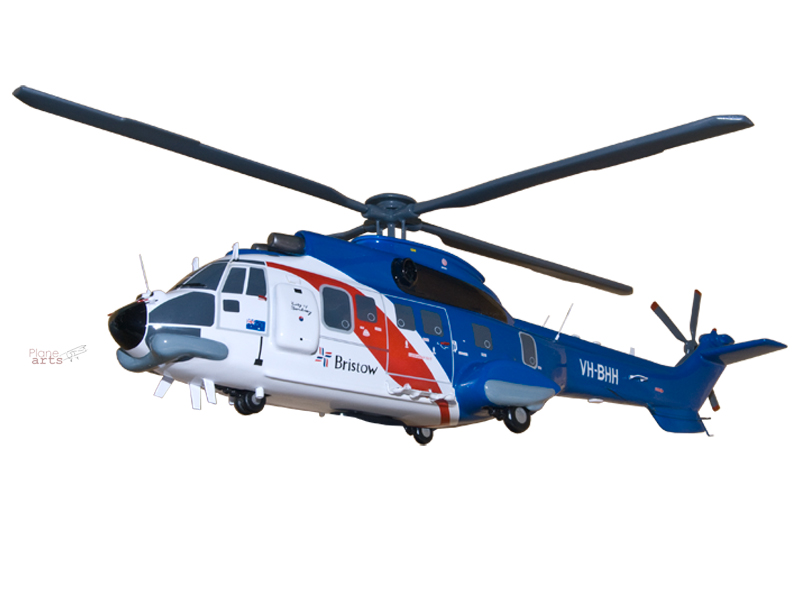
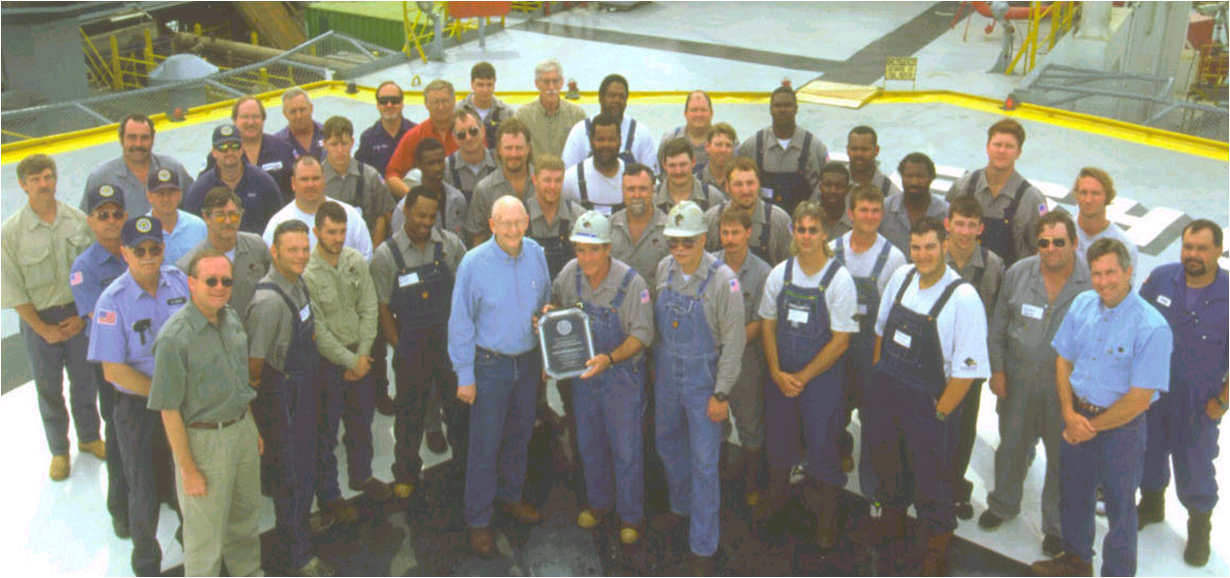
Congratulations to Bristow for winning the 2011 National Ocean Industries Association (NOIA) Safety-in-Seas Award. Bristow, a helicopter company, was recognized for its “Target Zero” program.

I was honored to serve as one of the judges, and Bristow is a most deserving recipient of this prestigious award. To the best of my knowledge, the Safety-in-Seas program, which began in 1978, is the oldest safety award program for offshore oil and gas operations.

I would also like to congratulate the other Safety-in-Seas nominees. All of the nominations were outstanding. While we must learn from accidents and failures, we can also learn from successes. The achievements of outstanding companies and safety leaders deserve attention and recognition.

KATC.com provides more information on Bristow’s selection:

“Target Zero” is a comprehensive cultural and training system that seeks to achieve zero accidents, zero harm to people and zero harm to the environment across Bristow’s operations. Building on statistical data that indicated human error contributed to 4 out of 5 accidents or incidents, Bristow’s “Target Zero” has reduced the rate of air accidents in for example the Gulf of Mexico from 2 reportable air accidents and one air incident in 2007 to zero accidents or incidents, with similar results in subsequent years. Bristow has achieved a 47% improvement year on year in Lost Work-time Cases, with overall improvement from 2007 – 2009 of 88%. When it comes to the environment, Bristow’s “Target Zero has maintained a record of zero environmental incidents and has stepped up pro-active efforts to ensure this stays constant. 

Read Full Post »

Proposal: Let’s make April 20th International Offshore Safety Day to honor those who have been killed or injured, to recognize the many workers who provide energy for our economies and way of life, and to encourage safety leadership by all offshore operators, contractors, and service companies.

Discussion: April 20th is, of course, the anniversary of the Macondo tragedy in the Gulf of Mexico. Eleven men died on the Deepwater Horizon that day. Many other offshore workers have died or been injured exploring for and producing offshore energy.  167 workers were killed when Piper Alpha exploded in 1988, 84 died when the Ocean Ranger sank in 1982, 123 perished when the Alexander Kielland capsized in 1980, 17 died in a helicopter crash off Newfoundland in 2009, 11 died when the Petrobras 36 sank in the Roncador field in 2001, and many others have been killed working offshore. Some of these accidents, like last summer’s fatality on the Jack Ryan offshore Nigeria, receive no public notice. Others like the fall in the Gulf on Monday or the recent diver fatality in the North Sea receive just a brief mention.

In addition to honoring those killed or injured, Offshore Safety Day would draw attention to the importance of offshore workers, their dedication and commitment, progress that is being made in addressing offshore safety risks, and the outstanding safety management efforts of leading companies around the world.  It’s time for a day to honor offshore workers!

Read Full Post »

An employee on a non-producing offshore natural gas platform died after falling through a deck opening on Monday, the U.S. offshore drilling regulator said.

The employee of Alliance Oilfield Services was working on a Hilcorp Energy platform in 375 feet of water about 129 miles off the Louisiana coast in the Gulf of Mexico, the Bureau of Ocean Energy Management, Regulation and Enforcement said in a statement. Hilcorp and Alliance are both privately-held companies. Reuters  

Read Full Post »

Good report; worth reading.  Some of the positive points are unlikely to get much attention, so we’ll mention them here:

  1. The National Incident Management System/Incident Command System worked as intended
  2. Personnel provided by the Responsible Party (RP) and Coast Guard personnel worked effectively together, and there was “unity of effort” throughout the response organization.
  3. The team found no evidence of collusion between the Coast Guard and RP.
  4. The response generally benefited from the ability of the Government and the private sector to rapidly assess and adapt to new or unusual contingencies and develop innovative solutions for problems not previously experienced.
  5. The knowledge acquired and capabilities learned from this experience are unprecedented, and should become a basis for significant improvements in planning, preparedness, and response for industry, Government, and the response community.

The “Political Demands” section beginning on page 75 includes relatively candid observations on the challenges associated with the management of such a high profile response.

Read Full Post »

In a previous post, we discussed JL Daeschler’s comments suggesting that the emergency disconnect sequence (EDS) may have actuated the shear ram, but that the sequence aborted when the ram did not close fully. Another knowledgeable commenter, while requesting not to be named, noted that:

Whether the EDS-functions terminated before the sequence was completed is clearly a relevant question.

I agree and believe this possibility may have been dismissed without being fully considered. The DNV report claims that the EDS sequence never actually initiated, probably because of a loss of communication with the stack after the initial explosion.  As evidence, the report offers the following:

There is an account of lights flashing, indicating that the EDS function had initiated. There are no accounts of any specific lights going steady, which would have indicated a function had been completed and confirmed by the subsea control pods.

Comment: Perhaps no light stopped flashing because the first step in the sequence, BSR actuation, was not concluded (i.e. the BSR never fully closed).

Reviewed ROV video indicated no evidence that the sequence had initiated; the LMRP remained latched to the BOP, the Blue and Yellow Control Pod stingers were not retracted.

Comment: This only tells us that the sequence terminated prior to unlatching he LMRP and retracting the pod stingers.  It says nothing about the timing of the BSR closure.

Note that pages 166-167 of the DNV report indicate that the EDS was manually functioned (at the test facility) via surface control and that it functioned as intended.

The report also confirms that the accumulators were functional:

HP Shear Close, EDS, AMF/Deadman and Autoshear have a common reliance on the accumulator bottles (8 x 80 gallon) located on the BOP. Testing of these accumulators determined that they functioned as intended in the as-received condition.

The report goes on to say:

This is further indication the BSR’s were activated either by the Authoshear or possibly the AMF/Deadman functions. No further failure cause analysis was performed.

Comment: So why was the EDS ruled out as the trigger for the BSR activation? Also, if the shear ram was activated by the AMF, why did that sequence terminate after the ram closed (partly)?

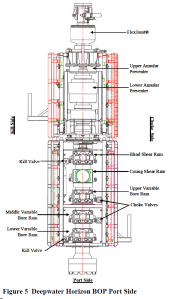
Comment on the riser disconnect: While closure of the BSR is a critical first step in the EDS or AMF sequence, riser disconnect, which has received very little attention, is equally important. To prevent flow, you want the well sealed before you disconnect the riser and the column of drilling fluid contained within. However when an EDS is activated, there is a good chance that the well may already have started to flow. Under those circumstances, you need to quickly disconnect the riser so the workers can be removed from the threat. In the case of the Deepwater Horizon, the failure of the riser to disconnect is as significant as the  failure of the BSR to seal the well. Although the EDS may have been activated too late to save the workers who lost their lives, they would likely have been safe if the rig had been disconnected from the well prior to the initial surge.

Read Full Post »

« Newer Posts - Older Posts »