Odd Finnestad dug up this information on the Aban Pearl sinking.
Venezuela appointed a high level commission to investigate the causes of the sinking of Aban Pearl rig, which exploited gas offshore, according to executives of that program on Friday.
Posted in accidents, well control incidents, tagged aban pearl, accidents, venezuela on May 15, 2010| 1 Comment »
Odd Finnestad dug up this information on the Aban Pearl sinking.
Venezuela appointed a high level commission to investigate the causes of the sinking of Aban Pearl rig, which exploited gas offshore, according to executives of that program on Friday.
Posted in accidents, tagged aban pearl, accidents, offshore, venezuela on May 14, 2010| Leave a Comment »
There is nothing about the sinking on the Aban Offshore website, and very little new information elsewhere. The way the incident was announced – a tweet from Hugo Chavez – seems to be the big story to date.
Posted in accidents, well control incidents, tagged accidents, Bulford Dolphin, offshore, venezuela on May 13, 2010| Leave a Comment »

Aban Pearl
From BOE Europe Chief Odd Finnestad: All 95 workers are safe, says President Hugo Chávez. The rig was previously named named Bulford Dolphin and owned by Fred. Olsen (Norwegian rig owner) who sold it in 2007 when it was 30 years old. The rig started to take in water and capsized during the night. The workers were evacuated and two navy crafts are now patrolling the area.
Odd has done more research and has provided the following additional information:
The rig is currently owned by Aban Singapore Pte. Ltd. Aban Singapore (ASPL) is a wholly owned subsidiary of Aban Offshore Ltd, an Indian company. The rig’s previous names were Bulford Dolphin (Fred Olsen Energy) and Treasure Seeker (Wilh. Whilhelmsen). In 1975, Treasure Hunter, the first oil drilling rig was delivered to WW, followed by Treasure Seeker and Treasure Finder in the next two years. After a difficult start, the drilling rigs were secured on profitable long-term contracts with the oil companies, paving the way for the ordering, chartering and acquisition of still larger and more advanced rigs, culminating with Polar Pioneer from 1985 – one of the world’s most advanced rig for drilling in inhospitable waters. The WW offshore activities, however, were gradually phased out towards the end of the decade.
Posted in Uncategorized, tagged accidents, blowouts, Deepwater Horizon, drilling, Gulf of Mexico, House Energy and Commerce, macondo, offshore oil, ohmsett, oil spill, safety, Senate Energy and Natural Resources, well control on May 12, 2010| 5 Comments »
I haven’t posted recently for a variety of reasons, but I see that folks are still visiting the blog. Thanks for checking-in. For those who are formulating their own views about what really happened and why, the documents at the House Energy and Commerce Committee site are mandatory reading.
Also, many thanks to those who have asked about my testimony before the Senate Committee on Energy and Natural Resources. My statement is here. Kudos to Chairman Bingaman and the very capable committee staff for their thoughtful and professional approach to these hearings.
Posted in accidents, well control incidents, tagged accidents, blowouts, Deepwater Horizon, Gulf of Mexico, macondo, Macondome, offshore oil, oil spill, safety, well control on May 6, 2010| Leave a Comment »
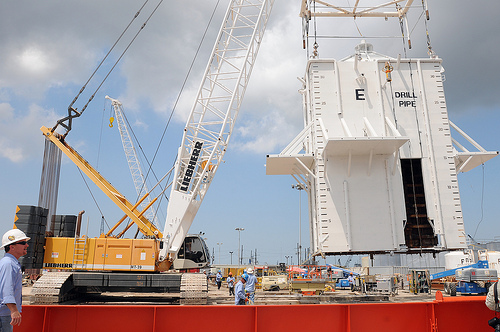
"Macondome" Pollution Containment Chamber
Assuming well intervention efforts continue to be unsuccessful, the next big milestone will be the installation of the subsea containment dome and the floating production system that will support it. We should know a lot more in one to two weeks. Schematics of the subsea, riser, and surface arrangements would be useful for those of us watching at home.
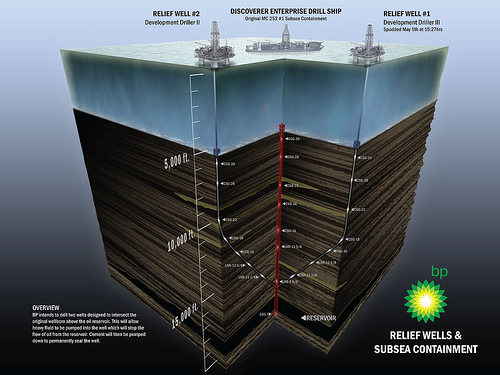
Relief Wells
From the BP relief well schematic, it appears that both wells will have the same target, so the 2-well program is solely for the purpose of killing the well as soon as possible. No information has been provided as to whether the flow is thought to be originating at the production casing shoe or in the annulus surrounding the casing.
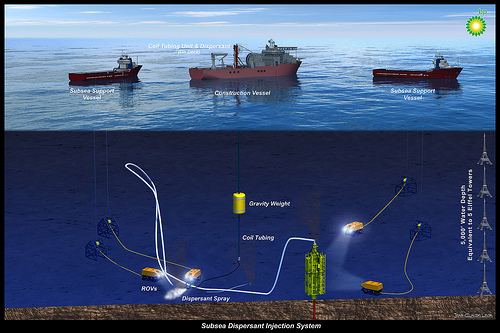
Subsea Dispersant Injection System
BP is reporting good results with the seafloor dispersant system.
Posted in accidents, well control incidents, tagged accidents, blowouts, Deepwater Horizon, drilling, Gulf of Mexico, macondo, offshore oil, oil spill, turtles, well control on May 5, 2010| Leave a Comment »
Based on careful examination, NOAA scientists do not believe that these sea turtle strandings are related to the oil spill. NOAA and its partners have conducted 10 necropsies so far – none of ten turtles showed evidence of oil, externally or internally. ~Barbara Schroeder, NOAA national sea turtle coordinator.
Posted in accidents, well control incidents, tagged accidents, blowouts, Deepwater Horizon, drilling, Gulf of Mexico, macondo, offshore oil, oil spill, safety, well control on May 5, 2010| Leave a Comment »

-The responders have successfully installed a valve on one of 3 leak points – the drill pipe protruding from the riser.
–Installation of the first pollution dome will begin today. This is really a production system and more information on the design will presumably be forthcoming.
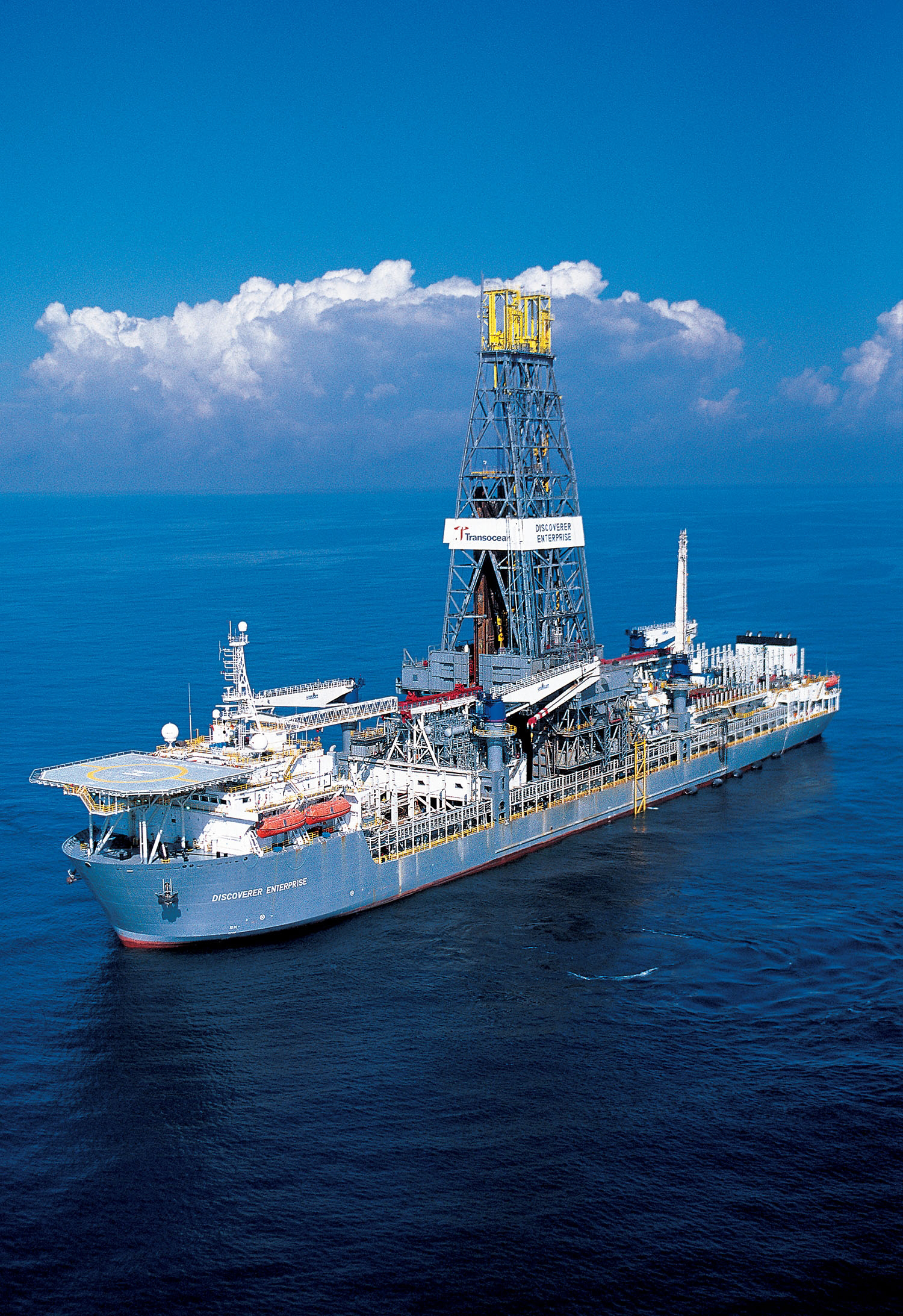
Discoverer Enterprise
I assume there will be some type of pipeline riser connecting the dome to the Enterprise through the moon pool, that the rig’s tensioning system will be used to keep the riser taut, that the oil and gas will be processed on the enterprise, that the gas will be flared, and that the oil will be stored on the rig and offloaded to a shuttle tanker. In essence, the Enterprise will serve as a temporary FPSO.
Posted in accidents, Norway, well control incidents, tagged accidents, blowouts, Deepwater Horizon, drilling, Gulf of Mexico, macondo, offshore oil, oil spill, PSA on May 4, 2010| 4 Comments »
The tragic events on the Deepwater Horizon rig in the Gulf of Mexico have attracted great international attention, and have also promoted a flood of questions to the Petroleum Safety Authority Norway (PSA).
The PSA Norway has issued a statement on the Horizon incident, and has appropriately avoided responding to the “can it happen here?” question. Their interest and support are greatly appreciated.
Posted in accidents, well control incidents, tagged accidents, blowouts, Deepwater Horizon, drilling, Gulf of Mexico, macondo, offshore oil, oil spill, safety, well control on May 4, 2010| Leave a Comment »

The Deepwater Driller III (pictured) has spudded the first relief well.
Discoverer Enterprise will support seafloor contaiment system.
While BOE’s eager but poorly managed staff struggles to keep pace, Upstream is providing excellent coverage of the well intervention, relief well, and seafloor containment system stories. This is the news of greatest interest to our small, but highly sophisticated readership. (For extensive coverage of news celebrities standing near the shore or bravely venturing into streamers of oil, turn your attention to the network news.)
Anyway, lots of new developments: the relief well was spudded, another rig is on the way to drill a second relief well, the seafloor containment system is ready to be transported to the site, and plans to install a second BOP stack (on top of the first) proceed. But perhaps of greatest interest to BOE readers is the report that BP had closed the rams but did not stem the flow. The BP spokesman suggested that the rubber portions of the rams may have been eroded and were thus unable to seal the well. This makes sense for the pipe rams and annular preventers (although some flow reduction would still be expected), but what about the shear ram? Was it closed? Was it unable to cut pipe that was inside the stack? What happened when the crew attempted to shut-in the well prior to evacuation? When can we expect a statement from Cameron, the BOP manufacturer?
Posted in accidents, well control incidents, tagged accidents, blowouts, Deepwater Horizon, drilling, Gulf of Mexico, macondo, offshore oil, oil spill, safety, well control on May 3, 2010| Leave a Comment »
This blowout is a national tragedy with 11 fatalities, 3 critical injuries, many lives disrupted, and a major ongoing oil spill. Nonetheless, as with every disaster, there are some positives. A few come to mind:
 Bud's Offshore Energy (BOE)