Feeds:
Posts
Comments

Posts Tagged ‘5 year leasing plan’

DUBAI, June 13 (Reuters) – OPEC does not see a peak in oil demand in its long-term forecast and expects demand to grow to 116 million barrels a day by 2045, and may be higher, the secretary general said on Thursday.

The International Energy Agency said in a report on Wednesday it sees oil demand peaking by 2029, levelling off at around 106 million barrels per day (bpd) towards the end of the decade.

Hathaim Al Ghais, writing in Energy Aspects, called the IEA report “dangerous commentary, especially for consumers, and will only lead to energy volatility on a potentially unprecedented scale”.

IEA’s credibility has been questioned in recent years, while OPEC’s forecast have been reasonably accurate.

Perhaps the most likely path to oil demand peaking by 2029 is a worldwide recession that the energy policies encouraged by IEA could precipitate. Energy policy in the US and elsewhere suffers from the illusion that a transition to an economy based on intermittent energy sources is imminent. Remarkably, the authors of our 5 year offshore leasing plan were concerned that offshore production would continue for too long. That line of thought led to a 5 year plan no lease sales except for 3 that are a prerequisite to issuing new wind leases.

Read Full Post »

  • Zero oil production
  • Zero gas production
  • Zero well starts in the past 8 years
  • Zero participation in recent lease sales

CP’s acquisition of Marathon is an endorsement of shale production, most of which is from private lands. Sadly, these historically important OCS operators no longer have an interest in the Federal offshore sector.

Given the potential for long-term, high-rate, and cost-effective production from deepwater wells, it may not be prudent for a US super-major to put all of the corporate eggs in the shale basket and ignore the OCS. However, contrary to the direction provided by the OCS Lands Act, Federal policies seem to encourage industry rejection.

The 5 year plan boasts about offering only 3 mandated lease sales, and punitive executive branch decisions are a continuous threat. Presidential withdrawals and other actions have eliminated 96.3% of the OCS from even being considered for leasing. Production from private onshore lands in supportive States like Texas and North Dakota is very attractive by comparison.

Read Full Post »

After the announcement of further restrictions on resource development in the National Petroleum Reserve of Alaska (NPR-A), Senator Sullivan (AK) called on the administration to stop sanctioning Alaska and to instead restore sanctions on Iran. 

The US OCS is being similarly sanctioned by its own government. The 5 year OCS “leasing plan” not only excludes all areas except the Gulf of Mexico, but authorizes a maximum of only 3 sales, the fewest ever for a 5 year program. The number of sales may well have been zero were it not for the requirement to hold an oil and gas sale during the year prior to the issuance of a lease for wind development.

2024–2029 Proposed Final Program Lease Sale Schedule
CountSale NumberSale YearOCS Region and Program Area
12622025Gulf of Mexico:  GOM Program Area
22632027Gulf of Mexico:  GOM Program Area
32642029Gulf of Mexico:  GOM Program Area
Most limited 5 year leasing program in history

Read Full Post »

Given the current guidance for implementing the OCS Lands Act’s “fair market value” mandate, all 12 of BOEM’s Sale 261 bid rejections (table below) were warranted:

  • All but one of the rejections was on a single bid tract.
  • BOEM’s Mean of the Range-of-Value (MROV) estimates were 2.6 to 18.7 times the rejected bonus bids.
  • The Adjusted Delayed Value (ADV), which takes into account the effects of delaying bonuses and future royalty payments, ranged from 1.3 to 9.2 times the high bids.
  • Perhaps the closest calls were Chevron’s two Walker Ridge bids which had ADV to bid ratios of only 1.3 to 1.4.

The main concern going forward is the absence of a consistent, predictable leasing schedule for the 3.7% of the OCS that may be considered for leasing. BOEM’s new methodology, which will be applied at the next lease sale (whenever that might be), does not require the bureau to estimate the delay period between the sale being evaluated and the projected next lease sale. Given that the new 5 year plan calls for a maximum of 3 lease sales, the gap between sales has become a much more significant factor just as the new guidance is being implemented.

The new 5 year “leasing plan” is intended to restrain OCS production in deference to “net zero” pathways. This strategy discourages interest from exploration and production companies. US offshore leases, which are by far the world’s smallest, are even less attractive when you don’t know if and when you will be able to acquire the nearby tracts that may be needed for economical deepwater development. This is not the way to obtain fair market value for public resources.

BlockNo. of bidsHigh Bid ($)MROV($)
ADV($)
High BidderMROV/bid
ADV/bid
MC 7111584,7006,600,000
2,400,000
bp11.3
4.1
MC 8961641,6286,100,000
1,600,000
Shell9.5
2.5
GC 1821800,0853,900,000
2,600,000
Anadarko4.9
3.2
GC 1831800,0859,100,000
6,000,000
Anadarko11.4
7.5
GC 2261800,0852,100,000
1,600,000
Anadarko2.6
2.0
GC 2272974,62813,000,000
9,000,000
Shell13.3
9.2
GC 34511,095,61513,000,000
5,300,000
Murphy11.9
4.8
GC 3461845,8155,100,000
2,000,000
Murphy6.4
2.4
GC 5491800,08515,000,000
6,900,000
Anadarko18.7
8.6
AT 2371909,8998,300,000
3,000,000
Equinor9.1
3.3
WR 2851859,8376,200,000
1,200,000
Chevron7.2
1.4
WR 3291595,8374,400,000
770,000
Chevron5.7
1.3
MROV=Mean of the Range-of-Value
ADV=Adjusted Delayed Value, which takes into account delaying bonuses and royalties

Read Full Post »

14 of the high bids at Gulf of Mexico Lease Sale 259 were rejected. Did those tracts receive bids at sale 261? What was the net gain or loss of revenue? See the summary bullets and table below

  • 6 of the 14 tracts received no bids whatsoever
  • 5 of the 14 tracts received higher bids that were accepted.
  • 2 tracts received substantially higher bids that were again rejected
  • 1 tract received a lower bid that was accepted
  • net bonus revenue gain to the govt from the bid rejections (pending re-offering at future sales): $1,032,877
  • net bonus revenue gain = 0.27% of the total high bids at sale 261
  • net loss in future rental and royalty payments: ????

For a net bonus revenue gain to date of only 1/4 of one per cent, 8 of the 14 sale 259 tracts with rejected high bids remain closed to exploration. The timing of any future sales is very much in doubt given the minimalist 5 year leasing plan and the associated legal challenges.

Current bid evaluation practices only make sense if regular lease sales are held on a predictable schedule, as has historically been the case.

Meanwhile, 100% of the improper CCS bids (199/199) were accepted at the last 3 oil and gas lease sales.

area and blockSale 259 rejected high bid – companySale 261 high bidbid acceptedgovt gain (loss*)
DC 6222,101,836 – Shell615,628 – Shellyes(1,486,208)
GC 173307,107 – Woodsideno bidNA(307,107)
GC 5471,783,498 – Chevronno bidNA(1,783,498)
GC 5911,291,993 – Chevronno bidNA(1,291,993)
GC 642605,505 – Anadarkono bidNA(605,505)
GC 777583,103 – bpno bidNA(583,103)
AT 51,551,130 – Anadarko5,215,628 – Shellyes3,664,498
AT 133607,107 – Woodsideno bidNA(607,107)
KC 745707,777 – Beacon2,422,222 – Beaconno(2,422,222)
KC 789707,777 – Beacon2,143,299 – Beaconno(2,143,299)
WR 794724,744 – Beacon1,487,624 – Beaconyes762,880
WR 795774,242 – Beacon5,301,107 – Woodsideyes4,526,865
WR 796774,242 – Beacon3,310,107 – Woodsideyes2,535,865
WR 750724,744 – Beacon1,498,555 – Beaconyes773,811
total govt. gain1,032,877
*Loss based on rejected sale 261 high bid. If no sale 261 bid, loss based on sale 259 high bid. These tracts could receive bids at a future sale.

Read Full Post »

(2) the Secretary may not issue a lease for offshore wind development under section 8(p)(1)(C) of the Outer Continental Shelf Lands Act (43 U.S.C.1337(p)(1)(C)) unless—
(A) an offshore lease sale has been held during the 1-year period ending on the date of the issuance of the lease for offshore wind development; and (B) the sum total of acres offered for lease in offshore lease sales during the 1-year period ending on the date of the issuance of the lease for offshore wind development is not less than 60,000,000 acres.

‘‘Inflation Reduction Act of 2022,” p. 646

Lease Sale 261 was held on 12/20/23. Absent legislative action, no wind leases may be issued after 12/20/24 unless another oil and gas lease sale is held prior to that date. Given that the minimalist 5 year oil and gas leasing plan, which is being challenged, does not propose a sale until 2025, wind lease issuance will likely be suspended at the end of the year. (Note: I wonder if the legislative restriction also applies to lease assignments from existing owners to new owners? Probably not, but that would be very significant given the current state of the offshore wind industry.)

The legislative restriction may be a partial explanation for the apparent rush to issue wind leases. 16 new wind leases were issued in 2022 and 2023, bringing the total number of active leases to 36. The philosophy seems to be this: issue as many leases as you can, as fast as you can, wherever you can (ala James Watt’s failed strategy for the oil and gas program.) Coastal residents are not entirely thrilled.

Perhaps the wind program should be required to develop 5 year leasing plans, as is the case for the oil and gas program. This might facilitate a more holistic approach to wind energy development and ease concerns about cumulative impacts.

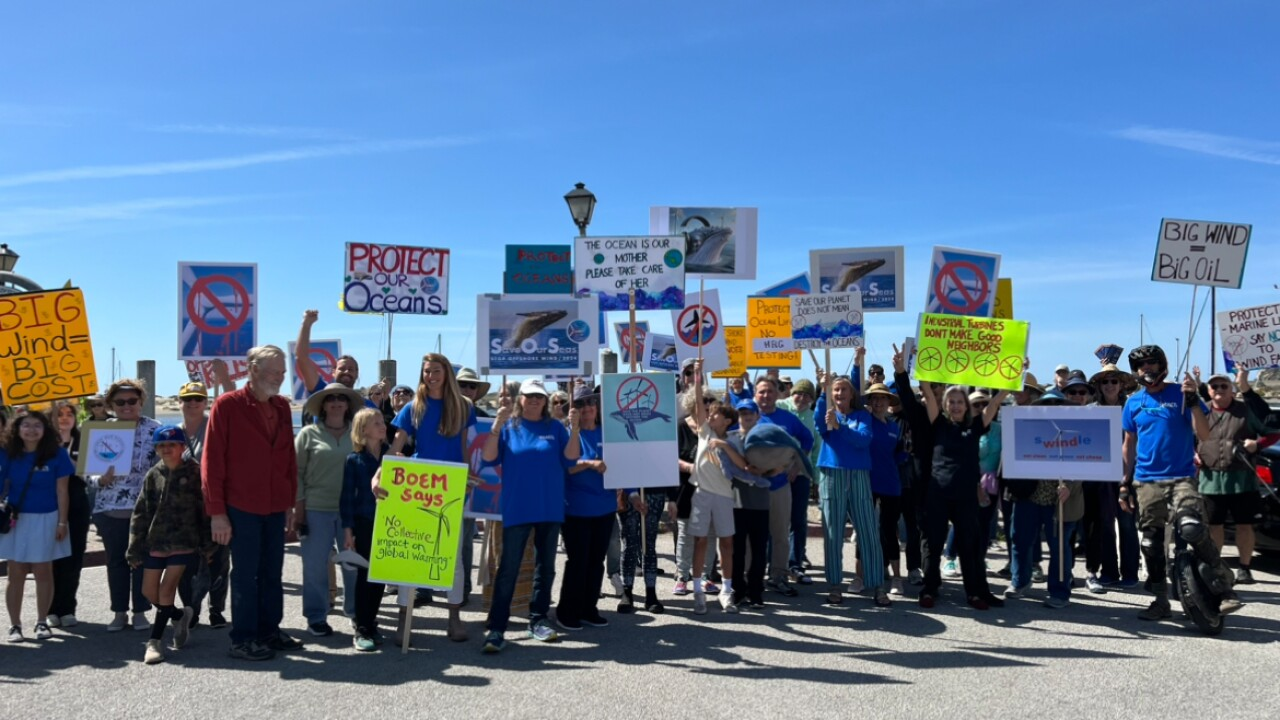
Morro Bay protest

Read Full Post »

Expected appeals by API (first attachment) and Earth Justice et al (second attachment) were filed on 12 Feb, 60 days after Secretary Haaland approved the 5 year plan and thus the first day appeals could be filed pursuant to 43 U.S. Code § 1349.

The statute (language below) requires that leasing program appeals be filed in the DC Court of Appeals. API would have undoubtedly rather filed in Louisiana while Earth Justice is likely content with the DC venue.

43 U.S. Code § 1349 (c)(1) Any action of the Secretary to approve a leasing program pursuant to section 1344 of this title shall be subject to judicial review only in the United States Court of Appeal for the District of Columbia.

The filings don’t include any arguments except for API’s general assertion that “the Record of Decision and Approval is arbitrary, capricious, and not in accordance with law.”

Earth Justice presumably filed for defensive reasons given that the 5 year plan has the fewest lease sales in history and would seem to be favorable to their point of view.

API will likely contend that the plan is not balanced as require by the statue:

43 U.S. Code § 1344 (a)(3)The Secretary shall select the timing and location of leasing, to the maximum extent practicable, so as to obtain a proper balance between the potential for environmental damage, the potential for the discovery of oil and gas, and the potential for adverse impact on the coastal zone.

We’ll see how this plays out.

Read Full Post »

Energy experts like Dan Yergin have a different, and far more credible view. Yergin explains that energy transitions don’t happen on command, noting that the world uses almost three times as much coal today as in the 1960’s when oil finally surpassed coal as the world’s primary energy source.

Oxy CEO Vicki Hollub’s recent remarks should serve as a reality check for the 5 Year Plan authors and their counterparts elsewhere in western governments. More oil and gas exploration and production are needed, not less. Leading Oxy investor Warren Buffet agrees.

Crude reserves are being found and developed at a much slower pace than they’ve been in the past. Specifically, she said the world has only newly identified less than half the amount of crude it’s consumed over the course of the past 10 years. Given the current trends, this means demand will exceed supply before the end of 2025.

Oxy CEO Vicki Hollub per the Motley Fool

Recent trends in the Gulf of Mexico, where Hollub’s Anadarko unit is one of the more active and successful operators, reflect Hollub’s concern. Note below the sharp decline in discoveries, as determined by BOEM, over the past 20 years. Effective development of older discoveries and improved resource recovery practices are sustaining GoM production, but declines are inevitable without consistent leasing and increased exploration.

Read Full Post »

Foreground (L to R) Lucy Querques Denett, Carolita Kallaur (RIP), Carole Hartgen, Vicki Agnew (RIP); Rear (L ro R) David Sutfin, Willie Taylor; photo credit: Keith Good

As we await Lease Sale 261, Carol Hartgen, my long-time colleague and founder of the 5 year OCS leasing program, voiced astonishment that the new 5 year plan was only for the purpose of scheduling 3 lease sales required by Congress as prerequisites to offshore wind lease auctions.  Carol provides some historical context:

I couldn’t believe the release of the final Five Year Program as just a necessity to hold offshore wind sales.  Back in 1969, Carolita Kallaur, Joan Davenport and I worked on a 5-year schedule based on the supply and demand needs of the nation. That approach, which developed into the elaborate process in the OCS Lands Act and the passage of the National Environmental Policy Act, is a thing of the past. Over.those 50 plus years, politics from both sides of the aisle always drove the changes

Related: How NOT to manage our oil and gas leasing program

Read Full Post »

The announcement boasts about “the fewest oil and gas lease sales in history” while seemingly apologizing for holding any sales at all.

Consistent with the requirements of the Inflation Reduction Act (IRA) concerning offshore conventional and renewable energy leasing, the Department of the Interior today published the final 2024–2029 National Outer Continental Shelf Oil and Gas Leasing Program (Program) with the fewest oil and gas lease sales in history.

These three lease sales are the minimum number that will enable the Interior Department’s offshore wind energy program to continue issuing leases in a way that will ensure continued progress towards the Administration’s goal of 30 gigawatts of offshore wind by 2030.  

DOI

Read Full Post »

« Newer Posts - Older Posts »