Feeds:
Posts
Comments

link

Conceptually, these projects have great promise. To date, the main challenges have been durability, mooring system integrity, and space preemption. As noted in the Post article:

The idea is simple; execution less so. As these devices — and their computers, turbines and hydraulics — must survive in some of the harshest conditions on Earth.

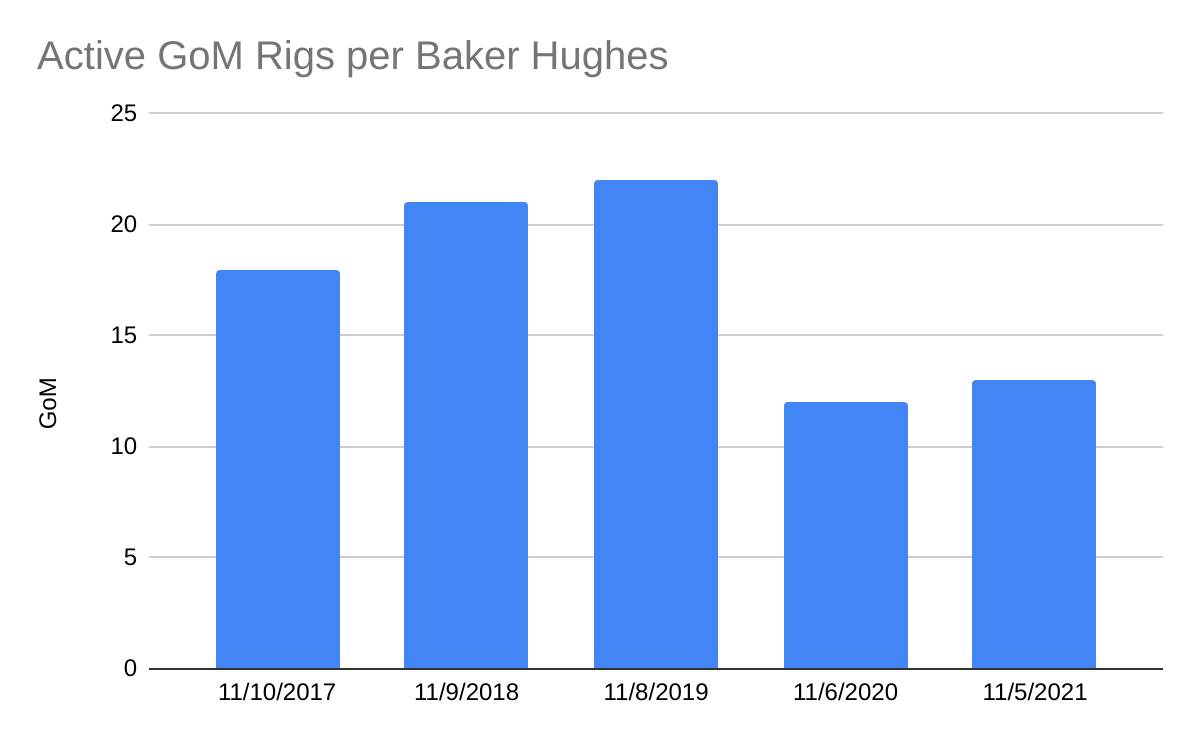
  • Chart 1: Gulf of Mexico rig count remains low
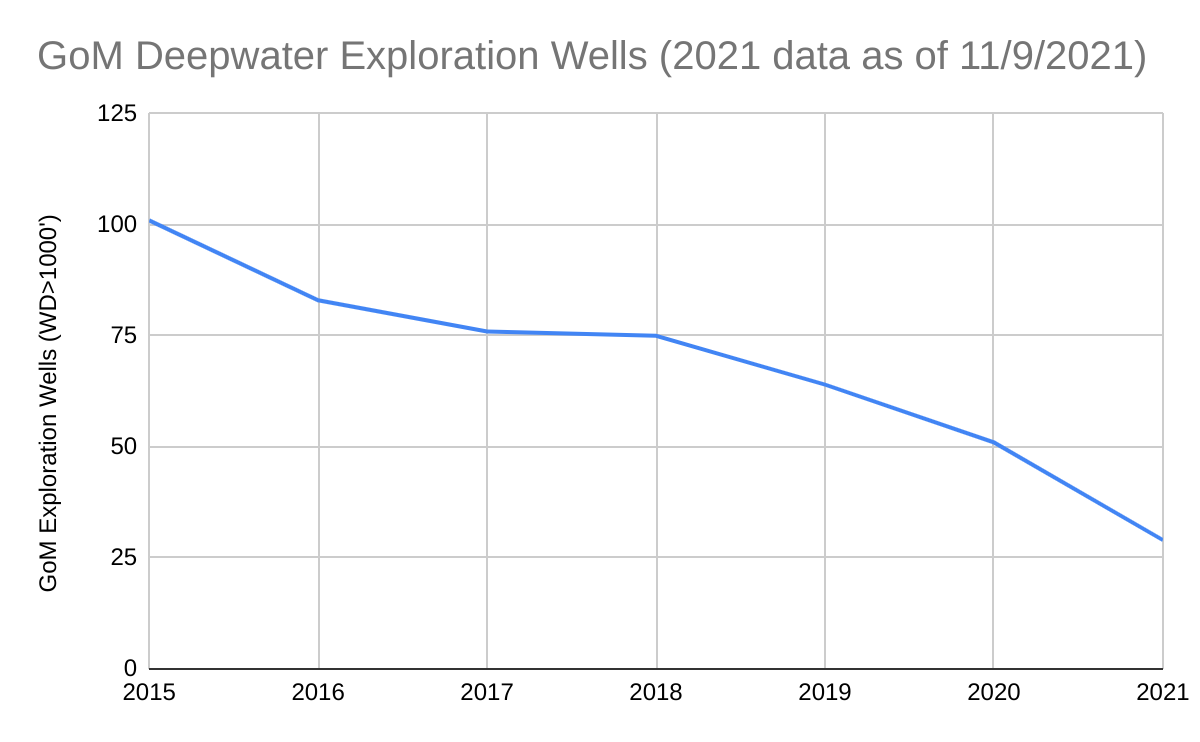
  • Chart 2: Exploratory drilling continues to decline and may be insufficient to replace reserves
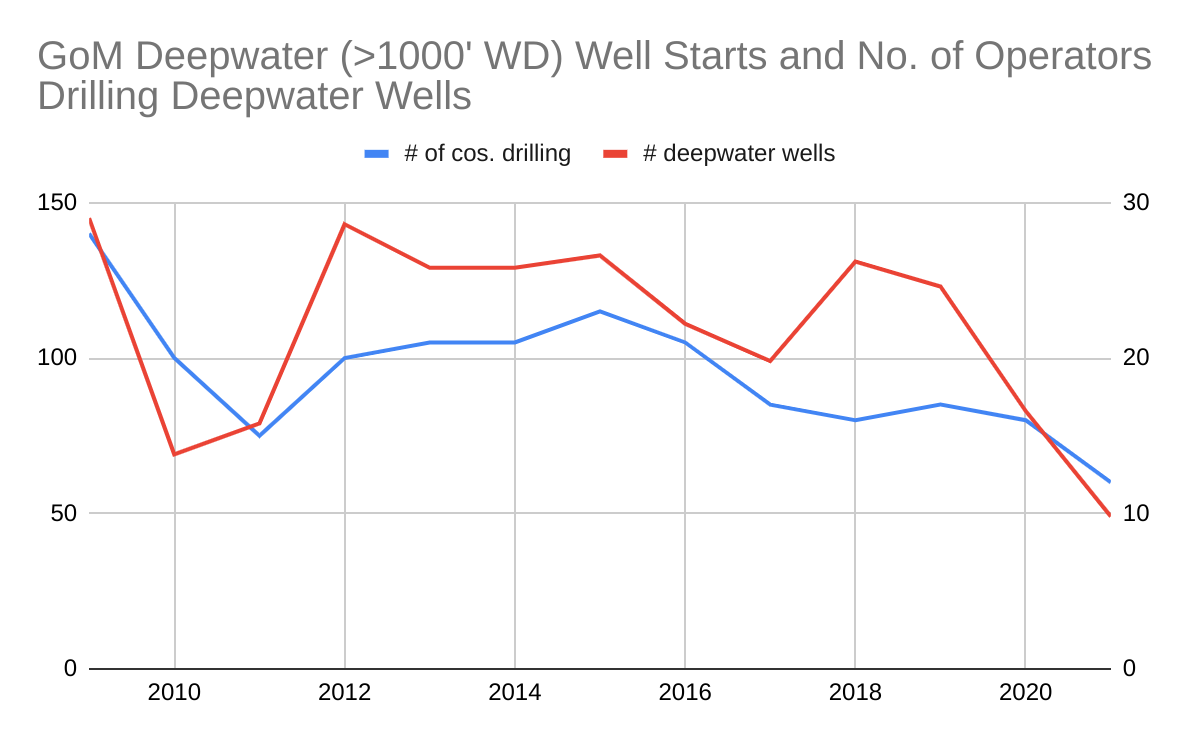
  • Chart 3: Well starts and number of operators drilling remain at historic low levels
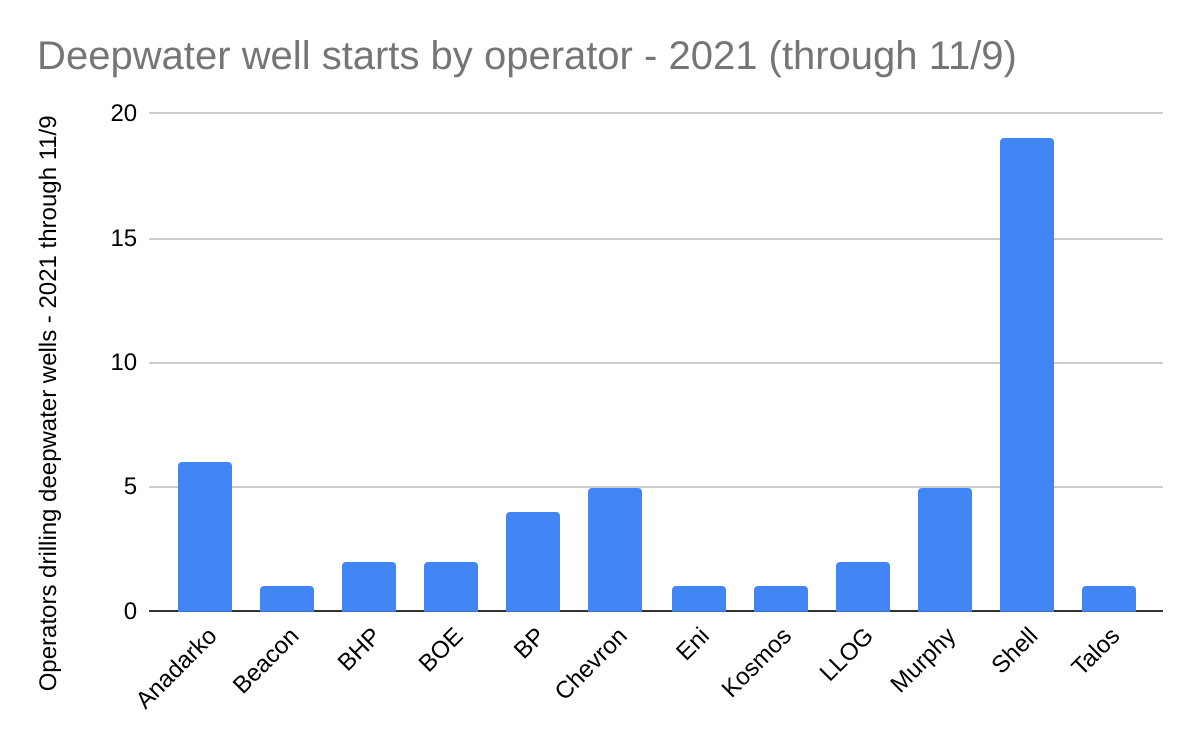
  • Chart 4: (1) One company (Shell) accounted for 39% of the 2021 YTD deepwater well starts in the GoM. (2) Five companies (Shell, Oxy/Anadarko, Chevron, Murphy, and BP) accounted for 80% of the deepwater well starts.

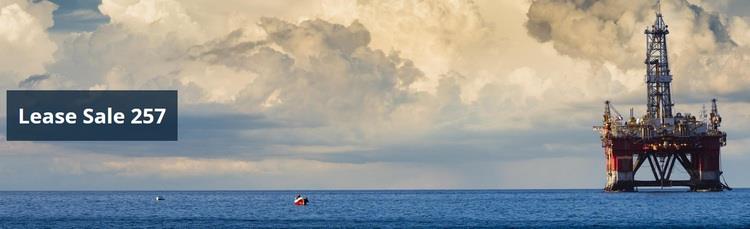
More certainty regarding lease sales would help. Prospective participants need assurances that they will have opportunities to apply findings and test exploration and development strategies. Will Lease Sale 257 be held on schedule next week?

No photo description available.
Photo by Clint Young

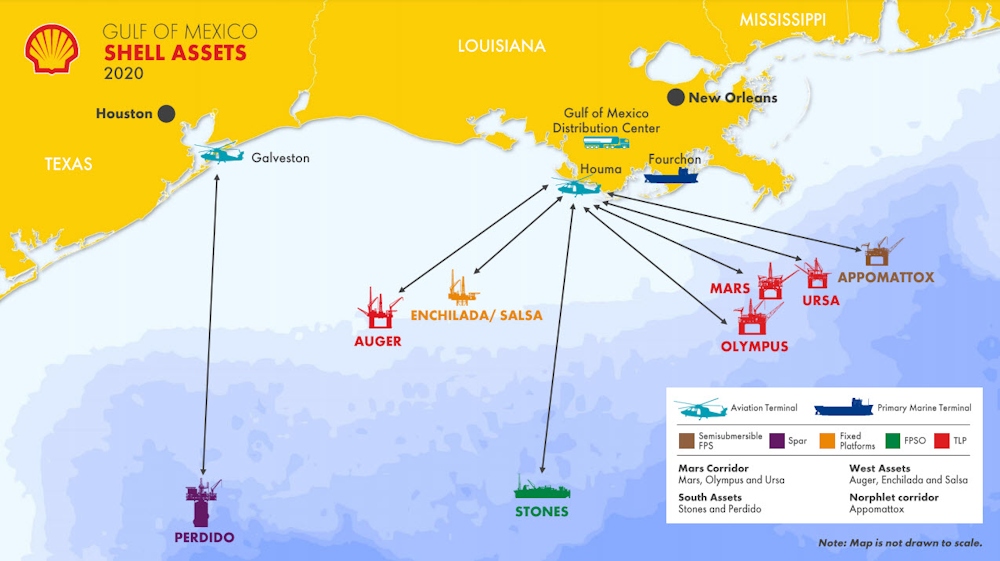
Per Shell, production at Mars and Ursa has restarted. Olympus was restarted on 10/1. The December production figures should give us a pretty good indication of stabilized GoM production post Ida.

210902 Shell Go M Asset Map

She is, of course, correct in asserting that markets determine energy prices, as they should. She is wrong in implying that OPEC alone controls oil prices. (Is she aware that the country she serves is a major oil producer?). She earns the Not My Job Award for implying she is powerless to influence energy prices and laughing about it (an added bit of chutzpah that greatly impressed the NMJA selection panel).

GoM: BOEM proposes first Gulf oil and gas lease sale for 2021 - Lease Sale  257

Opponents have filed suit in DC Federal Court to block the sale. Given that DOI seems to side with the parties that are suing them (no irony there, this is Washington), how vigorous will their defense be? Meanwhile, OPEC continues to reject White House appeals for increased production.

Per Forbes:

“If we prematurely discourage investment in fossil fuels — and then our dependence doesn’t decline as rapidly as the Biden Administration envisions — that is a recipe for shortages, higher prices, and greater dependence on foreign nations for our energy.”

Forbes

The 5th U.S. Circuit Court of Appeals granted an emergency stay of the requirement by the federal Occupational Safety and Health Administration that those workers be vaccinated by Jan. 4 or face mask requirements and weekly tests.

NPR

This court action was completely predictable from the outset. OSHA no doubt knew this but had no option but to dedicate substantial resources to the task. In all likelihood, the ETS/regulation will never be finalized.

Many (probably most) proposed regulations are never completed. Others never get beyond the concept stage. Establishing an OSHA rule takes an average of 7 years. That is not at all atypical for Federal regulators. There are much better ways to accomplish the regulatory objectives as was demonstrated after Hurricanes Katrina and Rita in 2005. Unfortunately our political system frowns on collaborative approaches so we do things the hard way – accomplishing much less in much more time and at a far greater cost.

  • Executive Branch fiats don’t work in this country (and we can be thankful for that), but those in power sometimes don’t get that (or don’t care). Fortunately, we (MMS) weren’t tasked with many political rules, largely to the credit of our leadership.
  • OSHA had done a good job of reinventing itself and improving its reputation and image. Now this.
  • OSHA has a no-win assignment: issue a complex rule disguised as an Emergency Temporary Standard (a convenient regulatory hook that is being challenged legally).
  • This is a very labor intensive exercise for OSHA. The 490 page rule standard that was issued today is just the beginning.
  • Well managed companies should have already developed a policy that best serves their business interest and fully considers the needs of customers and employees.
  • The OSHA directive takes the lagging companies off the hook. Rather than actually managing, corporate execs can simply point to the government directive.
  • It looks like enforcement falls on the companies which “must maintain a record and a roster of each employee’s vaccination status.”
  • OSHA is a bit late to the party. BSEE has been collaboratively working COVID issues with the offshore industry for nearly 2 years. Will they now be asked to inspect facility COVID records and enforce the OSHA mandate?
  • For the record, 100% of BOE’s employees are thrice vaccinated for COVID (initial Pfizer doses plus the booster).😃

The legal challenges are already in motion, and the arguments are compelling:

“The order is unconscionable. OSHA does not know how to run our companies. We do,” said Steve Fettig, Secretary and Treasurer of Tankcraft and Plasticraft. “OSHA does not know how to keep our employees safe. We do. And we have done so successfully since the start of the pandemic without the interference of a federal bureaucracy. We respect our employees’ fundamental right to make their own private, difficult medical choices.”

Milwaukee Journal

Among other provisions, EPA’s proposed rule, issued on 11/2/2021, specifies that associated gas be handled as follows:

Route associated gas to a sales line. If access to a sales line is not available, the gas can be used as an onsite fuel source, used for another useful purpose that a purchased fuel or raw material would serve, or routed to a flare or other control device that achieves at least 95 percent reduction in methane and VOC emissions.

Because the Dept. of the Interior has jurisdiction over air emissions on most of the Gulf of Mexico OCS, I assume this proposed rule does not apply to those facilities. However, the EPA proposal is not entirely clear in that regard. If the EPA proposal does not apply, will BOEM/BSEE be proposing similar restrictions in their regulations?

MMS/DOI considered prohibiting venting, but determined that adding flaring capability was not feasible for many shelf platforms, and for some platforms there would have been a net increase in emissions. That said, venting is not insignificant. A 2017 Argonne study indicated (table 2) that, for shelf platforms from 2011 through 2015, more than 3 times as much gas was vented as was flared. More recent data should be reviewed to get a better sense of the costs, benefits, and safety considerations associated with achieving further reductions in venting.

Current flaring/venting regulations for OCS facilities are here.

But here’s the thing. Whether you think it was the right thing to do, the reality is that passing legislation that is hostile to the U.S. oil and gas industry makes it even more difficult for domestic production to bounce back. So, instead of asking Russia and OPEC to pump more oil, we could look internally to what we could do in the U.S. to pump more oil. 

Forbes

From a US offshore perspective, there should be serious dialogue about how we can increase exploration and production. The risks associated with over reliance on imports have been repeatedly demonstrated over the past 5 decades. The horizontal drilling/well stimulation revolution has been a blessing, but given the sharp decline rates for fracked wells, we cannot solely rely on onshore production from tight reservoirs.