Posted in energy policy | Tagged decrease, oil production, OPEC+ | Leave a Comment »
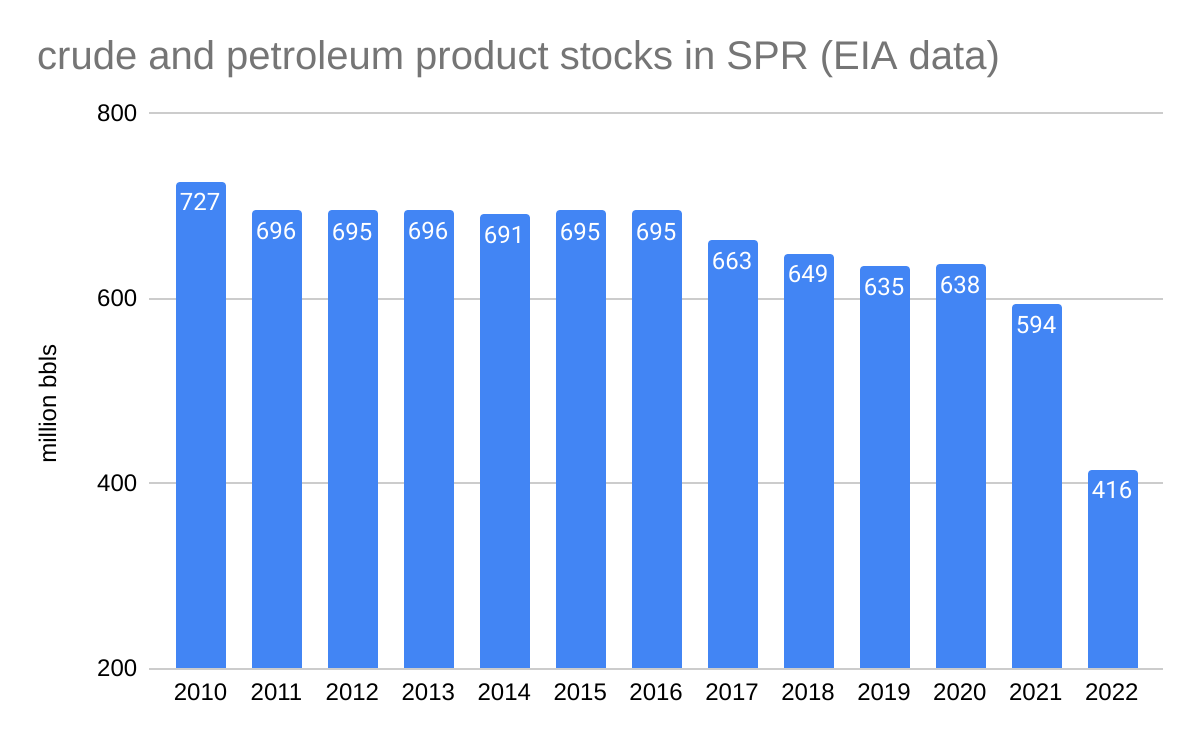
- Largest-ever one year SPR decline – 203 million bbls or 32.8% (9/24/2021 to 9/30/2022)
- 42.8% decline since 2010
- 78 consecutive weeks of decline – 4/9/2021 to 9/30/2022
- 84 million bbls below the strategically important 500 million barrel threshold which was first breached (on the downside) on 6/24/2022
- Lowest inventory since 7/6/1984 when the SPR was being filled
Posted in energy policy | Tagged dubious milestones, SPR depletion, Strategic Petroleum Reserve | Leave a Comment »
“The American people have moved on. The President himself has declared ‘the Pandemic is over.’ Yet, we continue holding fast to an outdated mandate, purging hundreds of dedicated sailors, even though we struggle to meet our recruiting goals. It is now time to take a pause, reevaluate, and assess what this is costing readiness, the taxpayer, and the public perception of how we treat our people,” he wrote in the letter.
Retired Coast Guard Vice Admiral William “Dean” Lee
Meanwhile, a Coast Guard hero during Hurricane Ian is about to be discharged for refusing the vaccine. He is one of 2632 Coast Guard members who refused the shots.

As previously noted, the Coast Guard expelled 7 cadets from the Academy over their Covid vaccination status.
Posted in Florida, hurricanes | Tagged Admiral William Lee, Coast Guard, hurricane hero, vaccine mandate, Zach Loesch | Leave a Comment »
Sept 30 (Reuters) – The ruptures on the Nord Stream natural gas pipeline system under the Baltic Sea have led to what is likely the biggest single release of climate-damaging methane ever recorded, the United Nations Environment Programme said on Friday.
“This is really bad, most likely the largest emission event ever detected,” Manfredi Caltagirone, head of the IMEO for UNEP, told Reuters. “This is not helpful in a moment when we absolutely need to reduce emissions.”
Researchers at GHGSat, which uses satellites to monitor methane emissions, estimated the leak rate from one of four rupture points was 22,920 kilograms per hour. That is equivalent to burning about 630,000 pounds of coal every hour, GHGSat said in a statement.
The Nord Stream methane release, while puzzling and rather frightening given the potential for escalating international tensions, was not an environmental disaster or even a major environmental setback.
Some perspective:
- estimate for the main Nord Stream leak (likely the maximum or near-maximum rate) = 22,930 kg/hr
- 22,930 kg/h = 550,320 kg/day = 550.320 x 10⁶ g/day
- total methane source for North American coastal waters (NASEM, Oil in the Sea, p. 63) = 4 – 20 Tg/yr
- 10 Tg/yr (i.e. 10 x 1012 g/yr) = 0.027 x 10¹² g/day = 27000 x 106 g/day
- This is ~50 times the temporary (maximum?) daily rate for the Nord Stream leak
- North American input from seafloor seepage only (NASEM, Oil in the Sea, p. 63) = 2 – 9 Tg/yr
- assuming 5 x 10¹² g/year or 13700 x 106 g/day
- This is ~25 times the temporary (maximum?) daily rate for the Nord Stream leak
Posted in climate, pipelines, seeps | Tagged methane inputs, NordStream, Oil in the Sea, pipeline leaks | Leave a Comment »
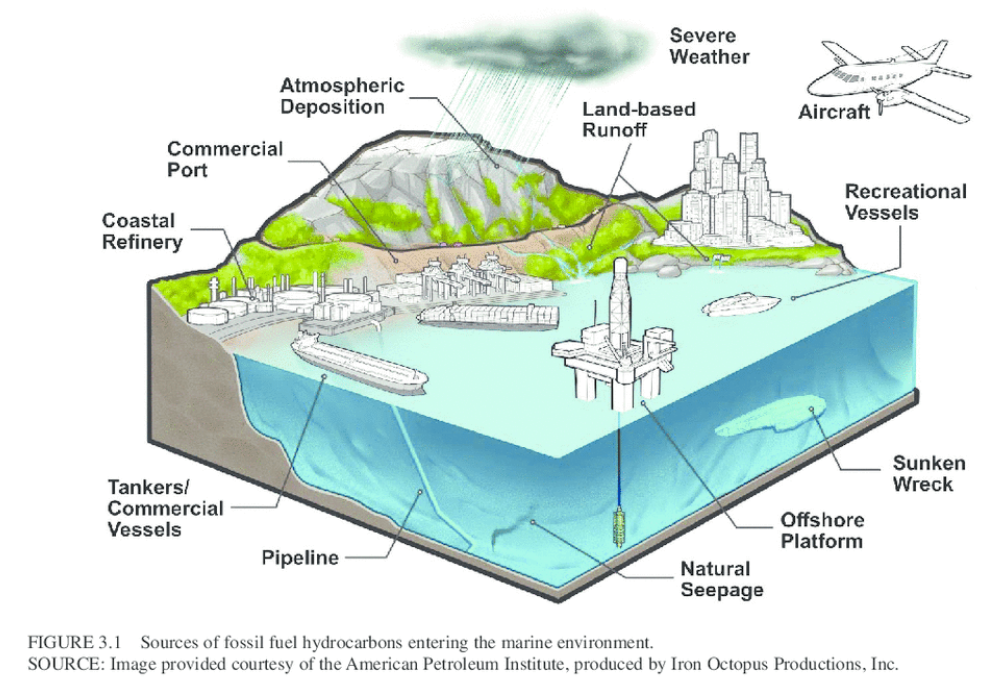
The National Academies have released Oil in the Sea IV, which updates estimates of oil entering North American seas. This is the third update since the publication of Oil in the Sea in 1985.
The updated inputs and seeps summary tables are pasted below. Some comments:
- The Oil in the Sea reports are important in that they provide perspective on natural inputs and those associated with man’s activities. The estimates generate informed discussion about the relative significance of the various inputs.
- The estimate for land-based sources, which far outweigh all other sources, increased dramatically from the previous report.
- The oil seepage estimate was reduced by 37.5%, owing to methodology.
- The difference between the itemized seepage total in Table 3.2 (109,000 mta) and the seepage total in Table 3.1 (100,000 mta) is not explained.
- The authors assume zero oil seepage in the entire US and Canadian Atlantic, and Arctic offshore. This is highly unlikely given the widespread presence of methane seeps in the Atlantic, the numerous oil seeps identified offshore Labrador, and the MMS/BOEM report on Arctic seepage.
- The estimate for platform spills (excluding Macondo and the MC-20 seepage) was significantly and inexplicably increased from the previous report, and is well above what BSEE data indicate for that period. No data or justification are provided.
- The statement (p. 58) that “spills occurred more frequently in offshore waters than nearshore waters” is puzzling and unsubstantiated.


Posted in offshore, Offshore Energy - General, oil spill response | Tagged NASEM, Oil in the Sea IV, oil inputs, oil seeps, oil spills | Leave a Comment »

Posted in Gulf of Mexico, Offshore Energy - General | Tagged EIA, Gulf of Mexico production, July oil production | Leave a Comment »

These dedicated and selfless volunteers are assisting in Florida rescue and recovery missions, and are once again making us proud!
Posted in hurricanes, Uncategorized | Tagged Cajun Navy, Florida, Hurricane Ian | Leave a Comment »
-The government has decided to implement measures to strengthen preparedness related to infrastructure, land facilities and installations on the Norwegian continental shelf.
-Part of the background for the increased preparedness is reports of increased drone activity on the Norwegian continental shelf that we have seen in recent weeks. It concerns drones of various sizes. Activity has been increasing, especially in September.
We have called for increased vigilance from all operators and shipowners on the Norwegian continental shelf.
Circumstances where drones have violated safety zones around facilities are now being investigated by the police. We refer to Sør-Vest Police District for questions about this.
-On Tuesday, it became known that the Nord Stream 1 and 2 gas pipelines were damaged, probably due to sabotage. The Norwegian Petroleum Safety Authority does not want to speculate on who is behind it, or other circumstances related to the incident.
-On Thursday 29 September, we invited the parties in the oil and gas industry to an extraordinary meeting in the Security Forum to discuss the ongoing events
PSA Norway
Posted in Norway, Offshore Energy - General | Tagged drones, Nord Stream, offshore security, PSA Norway, special meeting | Leave a Comment »
Germany’s navy is contributing to the investigation into the Nord Stream 1 and 2 gas pipeline leaks, said Defence Minister Christine Lambrecht, who added that the situation must be clarified and those responsible must be identified quickly.
Reuters
Russia’s FSB security service is investigating the damage sustained by the Nord Stream gas pipelines under the Baltic Sea as “international terrorism”, the Interfax news agency cited the general prosecutor’s office as saying on Wednesday.
Reuters
Meanwhile, “the U.S. is supporting efforts to investigate,” whatever that means.
Here is Al Jazeera’s summary video:
Posted in accidents, energy policy, pipelines | Tagged German Navy, NordStream, pipeline leaks, Russia | Leave a Comment »
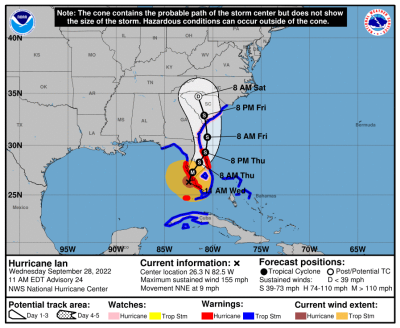
Some production has already resumed as BSEE reports that 157,706 BOPD were shut-in as of 12:30 pm ET today, down from 190,358 in yesterday’s report.
Posted in Gulf of Mexico, hurricanes, Offshore Energy - General | Tagged Gulf of Mexico, Hurricane Ian, production shut-in | Leave a Comment »
 Bud's Offshore Energy (BOE)