Feeds:
Posts
Comments

Archive for the ‘Wind Energy’ Category

Dominion’s suit challenging the Coastal Virginia Offshore Wind suspension order is attached.

Summary: “BOEM’s order sets forth no rational basis, cannot be reconciled with BOEM’s own regulations and prior issued lease terms and approvals, is arbitrary and capricious, is procedurally deficient, violates the Outer Continental Shelf Lands Act (“OCSLA”), and infringes upon constitutional principles that limit actions by the Executive Branch. This Court must therefore vacate the Order and enjoin BOEM from taking further action with respect to that Order.”

Key points raised by Dominion:

  • Dominion Energy Virginia (DEV) has spent approximately $8.9 billion to develop CVOW to date, which is over two-thirds of the total projected cost of $11.2 billion.
  • BOEM and Interior afforded DEV no advance warning or due process regarding the Order for CVOW.
  • The Order alleges no CVOW violation or deficiency.
  • The Order points to unnamed “national security threats” based on a November 2025 “additional assessment regarding the national security implications of offshore wind projects” by DoD, “including the rapid evolution of relevant adversary technologies and the resulting direct impacts to national security from offshore wind projects” generally.
  • The Order deems this information “new” and “classified” without any justification or detail. Moreover, as BOEM and DoD should know, certain DEV officials have security clearances to receive and review classified information, yet never were afforded such an opportunity prior to issuance of the Order.
  • DEV is suffering more than $5 million per day in losses solely for costs relating to vessel services associated with the Order. DEV is also incurring losses related to additional storage costs for the significant amount of equipment, idle workforce, contractual penalties, and additional costs.
  • BOEM’s Order comprises a single page, identifies no specific concerns, and provides no supporting documentation.
  • Agencies are required to consider costs and benefits in their decision-making
  • Agencies are required to consider alternatives in their decision-making.
  • The CVOW Order unlawfully deprives DEV of a property interest without due process.

    Dominion’s weakest argument follows (bad State legislation shouldn’t dictate Federal energy policy):

    CVOW is critical to Virginia’s legislative clean energy directive and DEV’s commitment to achieving net-zero emissions. The VCEA requires the transition of Virginia’s electric grid to 100 percent non-carbon producing energy generation by 2045. Va. Code § 56-585.5. The VCEA also states that the construction of Virginia offshore wind facilities is in the public interest. Va. Code § 56-585.1:11 (C)(1).
      Read Full Post »

      Attached is the letter sent to operators of the 5 projects that have been suspended. The cited regulation reads as follows:

      § 585.417 When may BOEM order a suspension?

      BOEM may order a suspension under the following circumstances:

      (a) When necessary to comply with judicial decrees prohibiting some or all activities under your lease; or

      (b) When the suspension is necessary for reasons of national security or defense.

      Read Full Post »

      Excerpts from an excellent opinion piece by Derrick Max of the Thomas Jefferson Institute for Public Policy:

      Coastal Virginia Offshore Wind (CVOW) is no ordinary renewable project. It was created by legislative command. The 2020 Virginia Clean Economy Act (VCEA) declared Dominion’s 2.6-gigawatt wind farm “in the public interest,” effectively tying the hands of the State Corporation Commission and guaranteeing Dominion full cost recovery and profit. The risk doesn’t sit with shareholders — it sits with Virginia’s ratepayers.

      The Thomas Jefferson Institute opposed that structure from the start. We warned that forcing captive customers to underwrite an unproven, high-cost project located in a hurricane prone region would expose Virginians to escalating bills with little accountability. Yet when a group recently asked the federal government to shut CVOW down, we declined to join. Why? Because government shouldn’t pick winners and losers — not when it mandates projects, and not when it stops them. Especially when a project is in its final stretch and no economic analysis of such a decision has been completed (or shared). 

      Virginia’s offshore wind story shows how risky it is when government drives energy decisions by decree. One administration mandates a massive buildout; the next halts it over security fears. Businesses can’t plan around that. Ratepayers shouldn’t have to pay for it.

      Read Full Post »

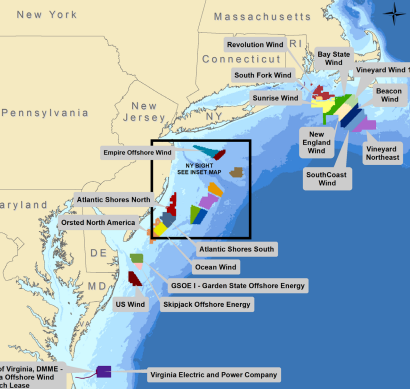
      The suspended leases are for Vineyard Wind 1, Revolution Wind, Sunrise Wind, Empire Wind, and Coastal Virginia Offshore Wind. (See the map below).These are the only Atlantic Wind projects under construction.

      Given the $billions in expenditures to date and coastal State support for these projects, expect negotiated mitigations or litigation.

      Read Full Post »

      Read Full Post »

      7/13/2024 Vineyard Wind turbine blade failure offshore Nantucket

      The attached Memorandum of Understanding between Vineyard Wind (VW) and the Town of Nantucket is long on bureaucratic procedures and short on risk mitigation and penalties.

      The agreement details requirements for monthly reports, liaisons, written correspondence, plan reviews, and participation on incident management teams, but excludes any monetary penalties for past or future incidents. (With regard to penalties, should BSEE have assessed civil penalties for the 2024 turbine incident in accordance with 30 CFR § 285.400 (f)? This was a major pollution event.)

      This MOU provision gives the impression that the Town is subordinate to VW:

      “The Town will provide Vineyard Wind 1 up to 4 business days, if required, to identify and correct errors in the Town’s intended public communications about the Project.”

      The responsible party should not be exercising oversight over the communications of an affected local government. Can you imagine Santa Barbara County reaching such an agreement with Sable Offshore?

      Finally, the MOU further establishes the Town as a de facto partner in the project. VW, not the Town, is the responsible party and must be held fully accountable for project performance.

      Read Full Post »

      Judge Patti Saris vacated part 2 of Trump’s 1/20/2025 “Wind Memo.” Part 1, which withdrew all OCS lands from wind leasing, was not in dispute. Part 2 suspended issuing wind energy permits and other authorizations.

      The judge ruled (full order attached) that the suspension of wind permitting violates Administrative Procedures Act provisions requiring agencies “to proceed within a reasonable time and to set and complete proceedings expeditiously.

      She concluded further that “the moratorium halts all wind energy authorizations indefinitely, pending a comprehensive assessment with no timeline, which is inconsistent with statutory deadlines and general commands for prompt processing in laws like OCSLA, the Clean Water Act, and others governing wind projects.

      Although the judge’s assessment of the permitting moratorium seems sound, the merits of offshore wind as a primary energy source remain very much in doubt.

      Read Full Post »

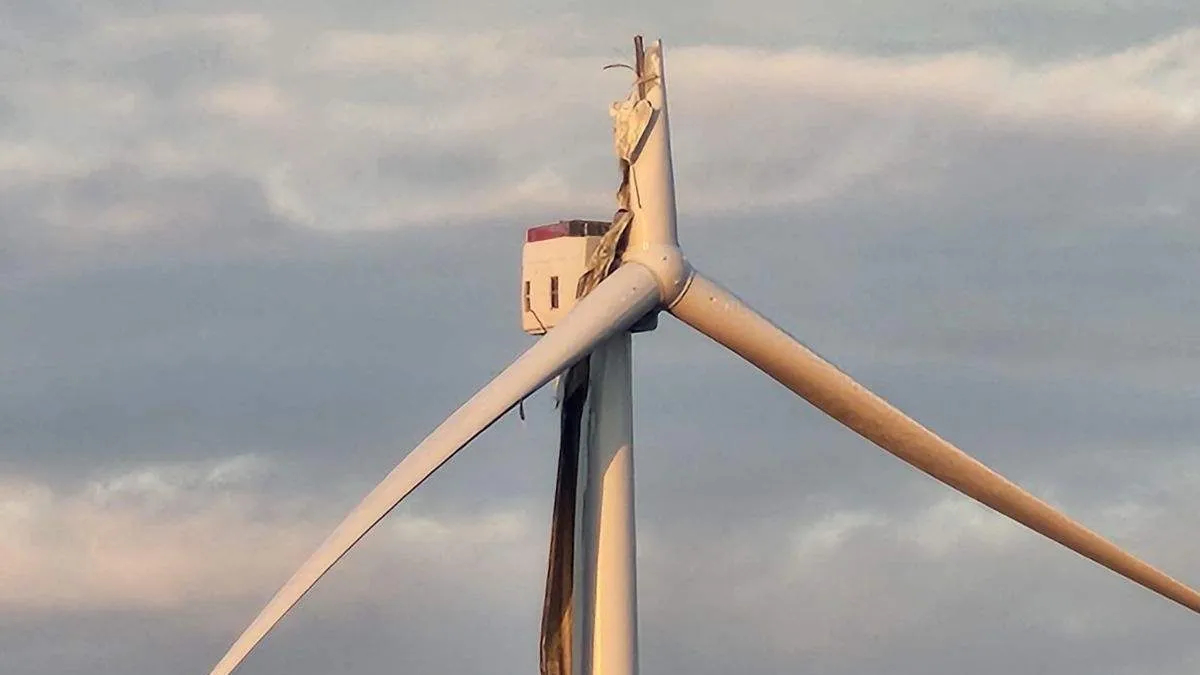
      Vineyard Wind turbine blade that was damaged on July 13, 2024, captured by a New Bedford commercial fisherman. Photo courtesy of Anthony Seiger

      Excellent New Bedford Light piece on the unacceptable delay in completing the blade failure investigation report.

      The Town of Nantucket’s attorney, Greg Werkheiser of Cultural Heritage Partners, told The Light last month that “it’s taken far too long” to get a final report on the blade failure. 

      It’s noteworthy that there have also been unacceptable delays in issuing panel reports for serious offshore oil and gas incidents:

      ncident datereport dateelapsed time (months)incident type
      5/15/202110/31/202329.5fatality
      1/24/20217/24/202330fatality
      8/23/20202/15/202330fatality
      7/25/20202/15/202331spill

      Read Full Post »

      “So, the safety culture is fine because we don’t report when people die.” Former Ørsted safety head, Eskild Lund Sørensen, accuses offshore wind body G+ of cherry picking data. The 2024 G+ incident data report is attached.

      Member companies, which include major players such as Ørsted, Equinor, Vattenfall, RWE, and CIP, report quarterly data on accidents, near-misses, hazardous observations, and equipment damage. As is the case with most industry reporting schemes, anonymity is prioritized over transparency.

      Sørensen asserts that the G+ wind industry data are incomplete: ”It shows that what is reported under the guidelines has gone down, and also that there is a cut off on what is being reported that does not include the full value chain on the industry.” He notes that a contractor to Northland Power from Canada, a member of G+, was involved in a 2024 workplace accident in Taiwan that resulted in three fatalities. (It’s also noteworthy that Equinor’s 2024 Empire Wind fatality was not included.)

      Sørensen:There have been no significant improvements in the last 10 years. Safety in offshore wind is neither getting worse nor better. There are no signs of that.”

      I’m speaking up because we owe people the truth. If we’re not honest about the actual safety conditions in offshore wind, we can’t change them. Misinformation about workplace safety creates a dangerous illusion that everything is “under control”, while too many people are getting hurt. But when we dare to speak about reality as it is, we create the foundation for a safer, faster, and truly sustainable energy transition,” Sørensen says.

      ”And then it becomes difficult to learn if you have to wait for something to go through 57 gates and down past legal,” he says. (Sound familiar?)

      In the U.S., both industry and govt need to do a better job of sharing complete incident data in a timely manner.

      Read Full Post »

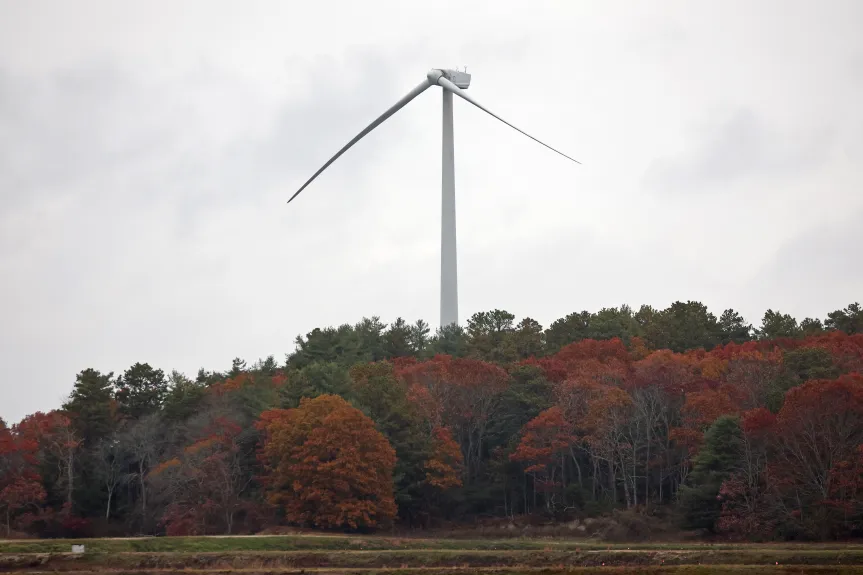
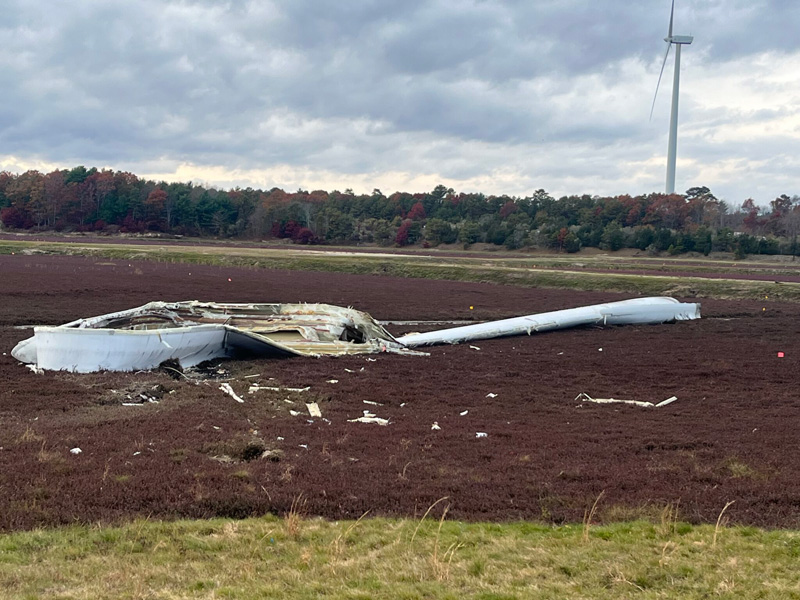
      Plymouth MA wind turbine that lost a blade. (Stuart Cahill/Boston Herald)

      Friday’s turbine blade failure in Plymouth MA is perhaps getting added attention given its proximity to the 7/13/2024 Vineyard Wind blade failure offshore Nantucket. The Plymouth blade landed in a nearby cranberry bog (video and picture below).

      Per the MV Times, the turbines for the Plymouth project were manufactured by Gamesa, which is now part of Siemens Gamesa. Both the South Fork Wind and Revolution Wind projects off the coast of the Martha’s Vineyard are being developed by Ørsted using turbines from Siemens Gamesa. Coastal Virginia Offshore Wind, the largest offshore wind project in the United States, is also being developed with Siemens Gamesa turbines. This is not to imply a higher degree of risk for those turbines. Vineyard Wind, where the only US offshore failure has occurred to date, is using GE Vernova turbines.

      Unfortunately, turbine blade failures are much too common. Last October, Lars Herbst reported, based on a Wind Power article, that “with an estimated 700,000 blades in operation globally, there are, on average, 3,800 incidents of blade failure each year.” Lars noted that the annual blade failure rate of about 0.5% translates to 1.5% of all operating wind turbines experiencing a blade failure every year, a remarkably high failure frequency.

      Scotland Against Spin data indicate that blade failure is the second most common accident type in the wind industry, and the most common cause of accidents at operational wind turbine sites. SAS reports further that pieces of blade are documented as travelling up to one mile, and have gone through the roofs and walls of nearby buildings.

      Lastly, we are still awaiting BSEE’s report on the Vineyard Wind failures so we can better understand what happened and why.

      Read Full Post »

      « Newer Posts - Older Posts »