Archive for the ‘Uncategorized’ Category
Updated Norwegian Regulations
Posted in Norway, Offshore Energy - General, Uncategorized, tagged Norway, offshore drilling, PSA, safety on January 5, 2011| Leave a Comment »

BOE Receives Report Card from WordPress.com
Posted in Uncategorized, tagged BOE, Colin Leach, Malcolm Sharples, Odd Finnestad on January 4, 2011| 2 Comments »
The folks at WordPress.com sent us a blog health report and it looks like we are doing surprisingly well:

The Blog-Health-o-Meter™ reads Wow!
WordPress.com added:
The Louvre Museum has 8.5 million visitors per year. This blog was viewed about 71,000 times in 2010. If it were an exhibit at The Louvre Museum, it would take 3 days for that many people to see it.
In 2010, there were 470 new posts, not bad for the first year! There were 412 pictures uploaded, taking up a total of 97mb. That’s about 1 pictures per day.
We did okay for an obscure blog that accepts no sponsorships, advertisements, or donations, and focuses on niche safety and regulatory issues. Thanks for your support.
Among the many BOE contributors, special thanks go to Odd Finnestad, Colin Leach, and Malcolm Sharples. These internationally recognized experts have voluntarily provided suggestions, data, and and informed analyses. It’s a pleasure working with them and the others who have contributed, some of whom prefer to remain anonymous.
Over the past year, I have heard from many dedicated energy professionals and safety leaders. Because of their commitment and enthusiasm, I am optimistic that we will resolve our issues and move forward in a manner that benefits the offshore industry and society.
“Neither snow nor rain nor heat nor gloom of night ….”
Posted in Uncategorized, tagged Michael de Vos on January 4, 2011| Leave a Comment »

Michael de Vos
The cold Dutch winter hasn’t kept BOE friend and sports enthusiast Michael de Vos from conducting his critical safety inspections for the Netherlands State Supervision of Mines. Michael just finds new and innovative ways to deal with the conditions.
Brazil Leads the Way
Posted in Uncategorized on January 3, 2011| Leave a Comment »
Almost 10 years ago, Brazil experience its own offshore tragedy when the P-36 floating production facility exploded and sank killing 11 workers (sadly, the same number of lives that were lost on the Deepwater Horizon). Brazil has recovered to become a world leader in deep water production and technology. Ten years from now, will the US still be mired in Macondo litigation, reforms, and access and permitting snarls; or will we once again be a leader in deep water innovation and production?
Malcolm Sharples sent 3 excellent articles which have been translated from Portugese. Links to the articles and excerpts are posted below: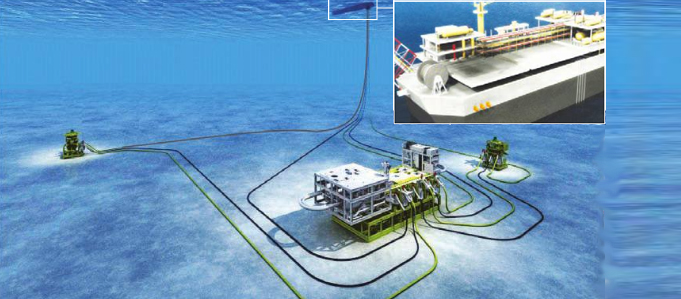
The legend of Atlantis, the Lost City, was widely portrayed in books, drawings and film in the twentieth century. In the real world in the XXI century, Petrobras is preparing to create real cities underwater, which will mark a new phase in the exploration and production of oil at great depths, in the pre-salt. On the seabed, more than 2000 meters under the surface, they will install the major equipment that now operate on the platforms, allowing them to become smaller, lighter and, most importantly, cheaper. The entire system will have a high degree of automation, with part of the operation controlled remotely.
The underwater cities of Petrobras will be inhabited by machines, equipment and giant robots tasked to inspect production systems to extract millions of barrels of oil. Sounds like science fiction, but it is one of the most important aspects of research carried out by Petrobras in partnership with universities and suppliers. “Our goal in ten years is to not depend on platforms,” said Carlos Tadeu Fraga, executive manager of Petrobras Research Center (Cenpes). Whether this is possible, only time will tell. He tells of an ambitious objective which is to put on the seabed in a horizon of ten years, the processing plants, compression systems, separation equipment (oil, gas, water and sand) and even energy generation modules needed to make everything work.
The Offshore Industry’s Silicon Valley

Petrobras Research Center
If California has its Silicon Valley, a region that brings together high-tech companies, Rio moves to create a Pre-Salt Valley or Valley Energy. This hub, which brings together the experts of oil, is under development in the technology park at the Federal University of Rio de Janeiro (UFRJ), in Fundão Island, where Petrobras inaugurated the new building, expanding its research center. There are technologies being studied for electromagnetic characterization of deep reservoirs, nuclear magnetic resonance and special equipment to drill the pre-salt in a safe and fast.
Brazil will be the technological center of oil and gas in the next decade. Petrobras has a contractual obligation with the National Petroleum Agency (ANP) to invest at least 1% of gross revenue of fields to pay in special participation in R & D projects.

Among the developments currently underway are two software systems: Environ, where you can view details of equipment platforms in 3D; and integrated exploration and production system (Siviep), which shows the fields and geological formations below the seabed. And both should have the first versions available for use in July 2011.
Happy New Year!
Posted in Uncategorized on December 31, 2010| Leave a Comment »

Memories of 2010 will not soon be washed away, nor should they be. These memories will help guide us into the future.
Obviously, big challenges lie ahead for the offshore oil and gas sector. Open and honest communication will be especially critical in 2011. No company or agency can resolve the issues independently, and everyone must be willing to participate.
As always, I’ll celebrate at midnight GMT, and will be fast asleep when the new year officially arrives at BOE World Headquarters :). Here’s to a successful and fulfilling 2011!
Posted in Uncategorized, tagged $5 gasoline, 2011, Hofmeister on December 30, 2010| 1 Comment »
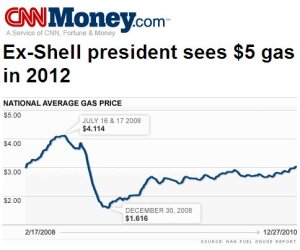
John Hofmeister sure knows how to make headlines. I suspect he may be right on this one.
If we stay on our present course there is no question but that prices will rise to the $5.00 gallon level by 2012 in my opinion. CNN Interview
Conflicting fears will shape the offshore energy policy debate in 2011 – fear of another Macondo vs. fear of soaring oil prices. Industry and government need to make the necessary changes in safety programs and move ahead. We can’t afford to embargo ourselves.
A Special Holiday Gift for the Offshore Energy Community
Posted in Uncategorized, tagged art, masterpiece, offshore drilling, Rig at Sunset on December 23, 2010| Leave a Comment »
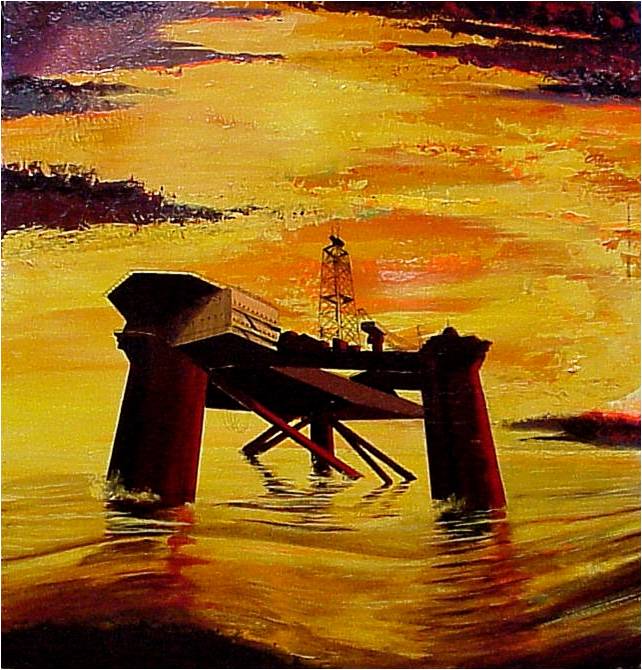
Posted with the approval of the Rig at Sunset Foundation
As a holiday gift to our readers, BOE has obtained exclusive rights to post this picture of the masterpiece “Rig at Sunset,” the world’s most famous and artistically significant painting of an offshore drilling rig.
“Rig at Sunset” was painted 45 years ago by a US Geological Survey (USGS) employee who has chosen to remain anonymous. Initially, the masterpiece was presented to USGS (later MMS) engineers and scientists who had made important contributions to the offshore oil and gas program. Understandably, the intended recipients were so humbled by the magnificence of the painting that they could not accept it. As the painting grew in value and international prominence, framed copies were presented to retirees and the original painting was kept at an undisclosed location.
Great museums have an eye for artwork that is bold and unique, and curators soon lined up for an opportunity to exhibit “Rig at Sunset.” The masterpiece has now appeared at the world’s top art museums including the Louvre, the National Gallery, the Tate in London, the Rijksmuseum in Amsterdam, the Norwegian Petroleum Museum in Stavanger, and the Jo Ann Rose Gallery at the Reston Community Center. While the permanent home of the painting is a well kept secret, it is rumored to be a maximum security facility in historic (and heavenly) Herndon, Virginia, the gateway to Dulles International Airport.
At a later date, BOE will explore the painting’s symbolism and artistic significance, but for now we just want you to appreciate its stunning beauty. Enjoy the holidays!
Wave Power and Beauty
Posted in Uncategorized on December 9, 2010| Leave a Comment »

Clark Little photo, Hawaii
Check out this Hawaii news piece about Clark Little’s photography!
Long Overdue: Failure Reporting System for BOPE
Posted in drilling, Uncategorized, tagged BOP, BOPE, Deepwater Horizon, drilling, failure reporting, macondo, Malcolm Sharples, offshore oil, safety, well control on November 23, 2010| Leave a Comment »
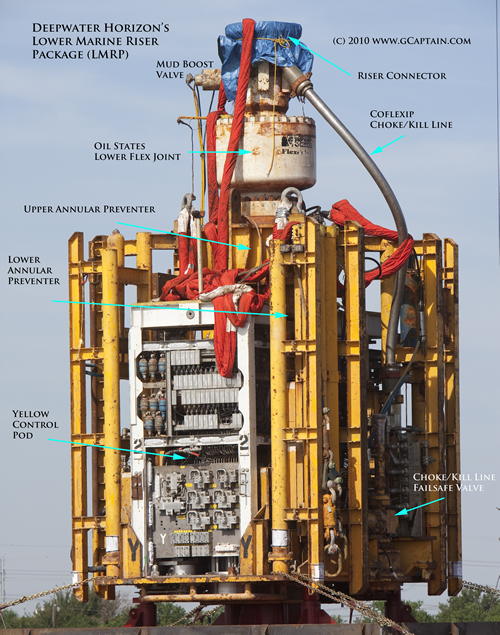
BOP stack awaiting post-Macondo inspection (from gCaptain.com)
In my 11 May 2010 testimony before the Senate Energy and Natural Resources Committee, I made ten recommendations. While many of the issues raised in that testimony are being addressed, one of the more important recommendations (no. 4) has received little or no attention. This recommendation calls for a public or private system for collecting and assessing failure date for blowout prevention equipment. To the best of my knowledge, the only publicly available performance data for BOPE were collected by MMS and SINTEF and pertain to failures during BOP pressure testing, not failures during other operations. How can we have a credible safety system without comprehensive failure data for such critical well control equipment?
Dr. Malcolm Sharples, an important BOE contributor, identified a number of BOP performance issues since Macondo. Here are a few examples:
- During routine tests on the device, the locking system of one of the rams jammed in a locked position. Sevan is working with Petrobras and the supplier, Cameron, to find a solution.
- Reliance suspended all drilling work in the block after the Transocean rig Deepwater Expedition developed technical problems in its BOP. Reliance was drilling the KGV-D3-W1 well in the contract area since April 2010.
- The rig was offshore Australia for Shell early last month when newly installed BOP components failed during operations. Following several unsuccessful attempts to rectify the problems in the field, the failing BOP component is currently undergoing repairs in Singapore.
How is this information not important to every operator, regulator, and drilling contractor? A comprehensive BOP failure reporting system should be a high and immediate priority for the offshore industry. The information should be verified and published so that all may learn and future performance improved. Requirements for providing such information should be included in contracts and, if necessary, regulations.
An other major void that I have been talking about for years, without much success, is the absence of a comprehensive and verified international incident reporting system. I assumed this would be universally recognized immediate necessity, and a critical element of the offshore industry’s initiatives agenda. Apparently that is not the case. More on this to follow.
Heroes not Villains
Posted in Uncategorized, tagged bulldozer, mammoths, offshore workers, safety, safety culture, safety leadership training on November 22, 2010| Leave a Comment »

Every day workers demonstrate that they want to do their jobs well, prevent accidents, and protect the environment. Only a few workers are “Not My Job Award” candidates. A bulldozer driver did the right thing in Colorado and the result is the fossil find of the century:
The idea to dig at Snowmass was sparked after a bulldozer driver stumbled upon what he believed to be the remains of a mammoth in the small town’s reservoir. The driver contacted the Denver Museum of Natural Science about his discovery, and the museum immediately sent up a team to investigate, uncovering a hidden trove of prehistoric remnants unlike any other.
While the mammoth fossils and the scientists are receiving most of the attention, the real star is the bulldozer driver.
Lately, we have heard a lot about offshore workers who made mistakes, and it’s important that we learn more about those mistakes so we can prevent their recurrence. However, workers have the most at stake and are the people who are most committed to accident prevention. We need to embrace this commitment by fostering a culture that allows workers to be safety leaders, not just implementers who follow directives from managers and regulators.
 Bud's Offshore Energy (BOE)