Feeds:
Posts
Comments

Archive for the ‘energy policy’ Category

Liz is an experienced attorney and leader in clean energy, climate change, and environmental law and policy. A member of the Biden-Harris administration since January 20, 2021, Liz has served as Senior Counselor to Secretary Haaland with an emphasis on water policy and climate change resilience. In this role, Liz also served as Chair of the Indian Water Rights Working Group, which manages, negotiates and implements settlements of water rights claims.

Prior to joining the Administration, Liz was Deputy Director of the non-partisan State Energy & Environmental Impact Center at NYU School of Law, which supports state Attorneys General addressing clean energy, climate, and environmental initiatives of regional and national importance. President Biden is the third President under which Liz has served at Interior, having worked for both the Clinton and Obama administrations. Under Secretaries Ken Salazar and Sally Jewell, Liz served as Interior’s Associate Deputy Secretary as well as Principal Deputy Assistant Secretary in the Office of Policy, Management and Budget. She was a key architect of the Obama Administration’s work to create a new offshore wind industry and leasing program.

DOI

Congratulations to Ms. Klein on being appointed to lead the Bureau of Ocean Energy Management. In addition to her commendable support for offshore wind energy, I trust that she appreciates the national importance of the OCS oil and gas program and the need for regular lease sales.

Read Full Post »

Ram Powell TLP
  • Talos has announced commercial discoveries at its Lime Rock and Venice prospects.
  • Both discoveries are near the company’s Ram Powell platform, where future production will flow via subsea tiebacks.
  • The Lime Rock prospect was acquired in Lease Sale 256 in November of 2020.
  • The new discoveries will help sustain production at Ram Powell, an early tension leg platform that has produced more than 250 million boe.
  • Ram Powell was the deepest production facility in the world (water depth of 3216′) when it was installed by Shell in 1997.
  • Access to nearby resources through regular lease sales facilitates continued production from existing platforms, reducing costs and environmental impacts.

Read Full Post »

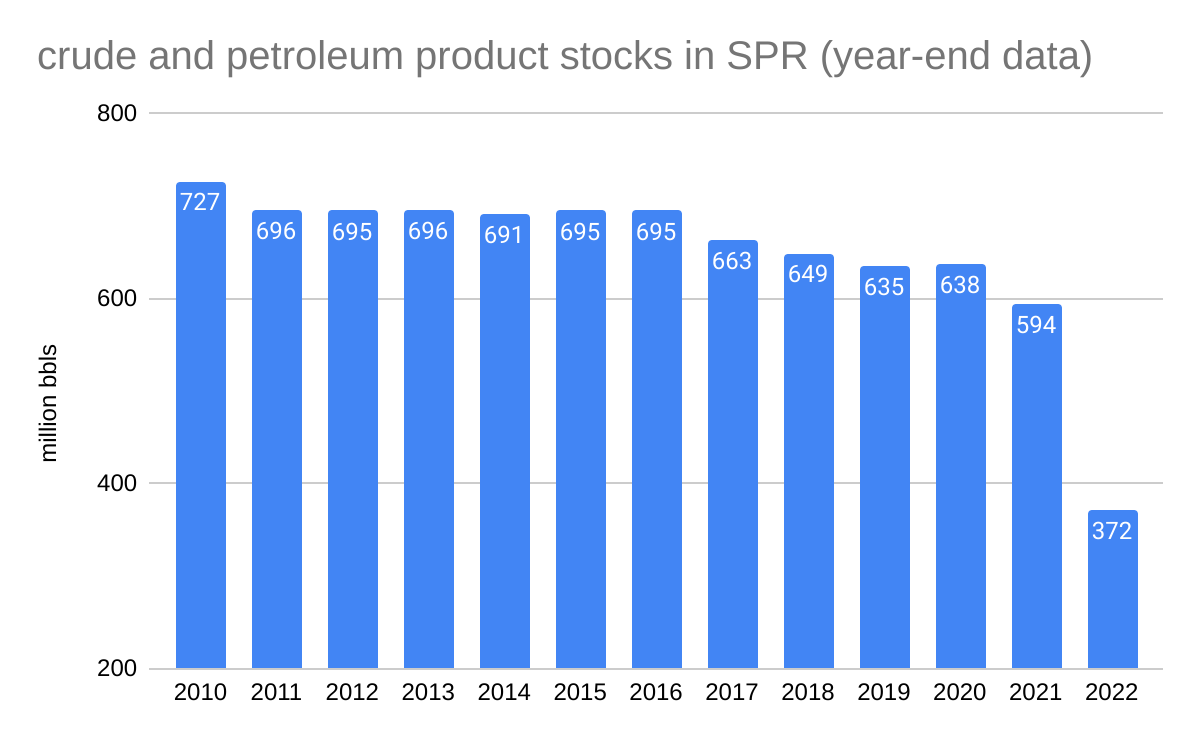
  • Reserve down to 372.4 million bbls as of 12/30/2022
  • 222 million bbl decline (37.4%) in 2022
  • Lowest volume since 12/2/1983
  • Reserve is now depleted by nearly 1/2 (49%) from its capacity of 727 million bbls

Read Full Post »

“Mom” (US govt) strongly and openly favors one child (offshore wind) over the other (offshore oil and gas). As a result, beneficial family synergy is not realized, and neither “child” reaches her full potential.

The wind program was intended to complement the oil and gas program, not replace it.

These articles highlight some of the challenges facing offshore wind:

  • WSJ: Soaring Costs Threaten U.S. Offshore-Wind Buildout
  • Bloomberg: US Ignored Own Scientists’ Warning in Backing Atlantic Wind Farm
  • NJ.com: Offshore wind is on N.J.’s horizon but activists worry of impact to whales, economy, the view

Read Full Post »

photo courtesy of Lars Herbst

BOE an independent, unsponsored blog that is dedicated to offshore safety, pollution prevention, energy production, effective regulation, and responsible energy policy. If you would like to submit a post, leave a comment to that effect at any time.

Happy New Year! Bud

Read Full Post »

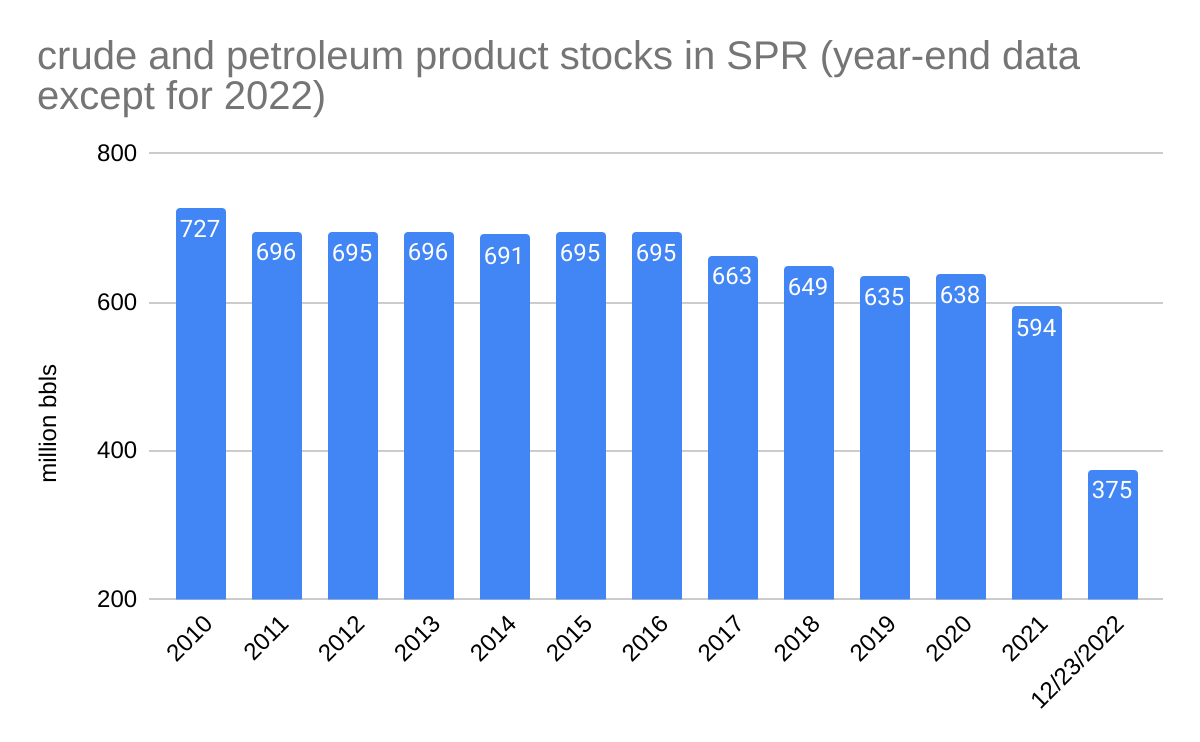
More “free” oil was withdrawn from the SPR, which has sunk to the lowest level (375.1 million bbls) since Christmas 1983. More rational oil and gas leasing policies would have been a far better gift, particularly for our children and grandchildren.

The “pilot” refill program is scheduled to begin in February. We’ll see how that goes.

Read Full Post »

Carbon-Zero US LLC of Dallas (a Cox Oil affiliate) has applied for up to $12 million in U.S. Department of Energy funds to develop a pilot sequestration hub in offshore storage fields about 20 miles from Grand Isle, according to officials from Cox Operating LLC, the Dallas operator that owns some of the storage fields.

Cox Operating LLC will “repurpose facilities and equipment” for the carbon storage project, according to a news release.

The Advocate

Should this company be authorized to repurpose Gulf of Mexico facilities for carbon sequestration?

  • Per BSEE Incident of Non-Compliance (INC) data for 2022, Cox had more component shut-in INCs (132) than any other company. Cox was second to the Fieldwood companies in the number of warning and facility shut-in INCs, and in the total number of INCs. 48% of the Cox INCs required either a component or facility shut-in.
  • Cox had an INC/facility-inspection ratio of 0.77, nearly 50% higher than the GoM average of 0.53.
  • Per the posted BSEE district investigation reports for 2022, Cox was responsible for 9 of the 30 incidents that were significant enough to require investigation. That is more than twice as many as any other company (next highest was 4).
  • The incidents included 3 serious injuries, 2 fires, a large gas leak, and oil spills of 114, 129, and 660 gallons. Per the posted reports, only one other company had an oil spill of >1 bbl. (Note: Only spills of > 1 bbl are routinely investigated by BSEE. One bbl = 42 gallons.)
  • While INCs were issued for only 3 of the 9 Cox incidents, a review of the reports suggests that INCs should have been issued for at least 4 of the other incidents.
  • Cox operates 375 platforms with installation dates as early as 1949. 134 of their platforms are > 50 years old. Only 66 were installed in the last 20 years and only 6 in the last 10 years (most recent December 2014). How will the carbon sequestration plans affect their massive decommissioning obligations?
  • Many of the Cox platforms were assigned by predecessor lessees. Those predecessors can only be held responsible for the decommissioning of facilities they installed, not for more recent wells or platforms and not for facilities that are repurposed for carbon sequestration.

Other more generic issues should be addressed before DOE awards funds for offshore sequestration projects.

Also, as noted in the discussion of Exxon’s 94 Sale 257 oil and gas leases, a competitively issued alternate use RUE is required (30 CFR § 585.1007) before sequestration operations may be conducted on an oil and gas lease.

Read Full Post »

Nothing new or surprising, but an interesting read nonetheless.

All you need to know about how the vaunted ‘energy transition’ is going as 2022 comes to its merciful close is to read the headline of a Reuters story published last week: “Global coal consumption to reach all-time high this year – IEA”.

That isn’t how the narrative surrounding the energy transition assumed this would all be going in the year 2022. Certainly, it isn’t how IEA head Fatih Birol has wanted it to go, given his insistence that “more wind and solar” is the answer to seemingly every energy-related question.

Read Full Post »

In October, the President announced a plan to replenish the SPR using updated authorities that allow for fixed-price purchases of crude oil. Relative to conventional purchase contracts that expose producers to volatile crude prices, this new approach, when used at scale, can give producers the assurance to make investments today, knowing that the price they receive when they sell to the SPR will be locked in place. Today’s notice will pilot this new approach by starting with a purchase of up to 3 million barrels of crude oil.  

DOE

Note that these pilot deliveries will not begin until Feb. 2023 and will total < 3 million barrels. The reserve is 349 million bbls below capacity, and 216 million bbls have been withdrawn this year.

Read Full Post »

… this New York state legislation is perfect.

NY State Senate Bill S9612 (proposed)

§ 328-a provides that no fossil fuel industry member, as that term is defined in the bill, shall knowingly or recklessly create or contribute to a condition that endangers the safety or health of the public by
extracting, storing, transporting, refining, importing, reporting, producing, manufacturing, distributing. compounding, marketing, or sale of a "qualified product".

328-b declares that a violation of the new article that results in any harm shall be deemed climate negligence regardless of when the underlying conduct occurred.

328-c prohibits governmental enforcement. (i.e. prohibits govt intervention on behalf of the accused company)

328-d provides that any person, firm, corporation, or association that has been damaged as a result of a fossil fuel industry member's acts or omissions in violation of this article shall be entitled to bring an
action for recovery of damages.

This non-attorney suspects that the legislation might conflict with the Commerce Clause of the US Constitution (Article 1, Section 8, Clause 3), which gives Congress the power “to regulate commerce with foreign nations, and among the several states, and with the Indian tribes.” New York produces little oil, gas, or coal, so the legislation would largely affect operations that are conducted in other states, on Federal lands, or in foreign countries.

Read Full Post »

« Newer Posts - Older Posts »