Whoever blew up the Nord Stream pipelines was not entirely successful in that one of the Nord Stream 2 lines was apparently undamaged. What is next for that line? Will the two Nord Stream 1 and the other Nord Stream 2 pipelines be repaired?
Archive for the ‘energy policy’ Category
December 2022 GoM production data are now posted
Posted in energy policy, Gulf of Mexico, hurricanes, Offshore Energy - General, tagged 2022 oil production, BOEM, energy transition, Gulf of Mexico, Gulf of Mexico production, production forecast on March 1, 2023| Leave a Comment »
Comments on 2022 oil production:
- Solid year given governmental ambivilence and corporate uncertainties
- Below BOEM production forecast.
- The 2019 annual production record remains intact at 1.897 million bopd, but could be exceeded in 2023 if (1) projected deepwater startups are on schedule, (2) prices remain above $70/bbl, (3) depletion is effectively managed, and (4) the hurricane season is again favorable
- The 2 million bopd average seems elusive, but could be surpassed in one of the next few years. After that, a greater commitment on the part of government and industry will be needed.
- The “energy transition” will not affect oil and gas demand for the foreseeable future, more nuclear power plants are not being built, and shale has its limitations. We better not neglect what is left of the OCS oil and gas program.

Would BOEM’s new bid adequacy procedures have changed the outcome of Sale 257 or prior lease sales?
Posted in energy policy, Gulf of Mexico, Offshore Energy - General, Regulation, tagged bid adequacy procedures, BOEM, Lease Sale 257 on February 28, 2023| Leave a Comment »
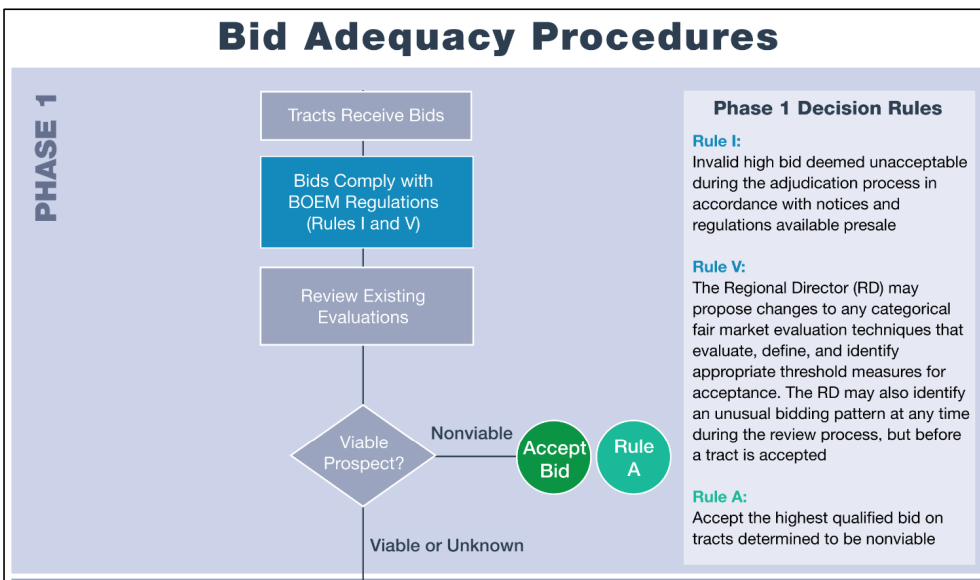
BOEM’s new procedures, which have been published for public comment, seem reasonable. However, it would be helpful to learn more about the testing of the new methodology. (See the quote below). Further, would the rejected Sale 257 bid have been accepted? What was the LBCI for that tract? Would any accepted Sale 257 bids have been rejected? Would the outcome of other sales have been affected?
After a 2-year comprehensive technical review of the delayed valuation methodology, BOEM intends to replace the delayed valuation methodology with a statistical lower bound confidence interval (LBCI) at a 90 percent confidence level as a decision criterion for accepting or rejecting qualified high bids on tracts offered in OCS oil and gas lease sales. Following extensive testing of the alternative approaches using both historical and current lease sale tract data and existing BOEM cash flow simulation models, BOEM determined that the LBCI approach would be the most appropriate substitute for the delayed valuation methodology. The LBCI is a statistical concept that captures the lower bound of a range of values encompassing the true unknown mean of the risked present worth of the resources at the time of the lease sale. The LBCI incorporates the uncertainty of parameters unique to the valuation of each OCS oil and gas lease sale tract. These parameters may include, but are not limited to, subsurface characterization of reservoir properties, cost and timing of the development, and projected revenues. Unlike the delayed valuation methodology, the LBCI approach would not require that BOEM estimate the time delay period between the current OCS oil and gas lease sale and the projected next lease sale. As such, BOEM finds the LBCI to be a better approach going forward.
Federal Register
Below is the flow chart for the new procedures. It’s interesting that high bids on nonviable tracts are automatically (and gratefully) accepted! 😉

Bid rejection and lingering Lease Sale 257 mysteries
Posted in CCS, energy policy, Gulf of Mexico, Offshore Energy - General, tagged BHP, BOEM, bp, carbon sequestration, Chevron, Exxon, Lease Sale 257, Lease Sale 259, rejected bid, Talos on February 27, 2023| Leave a Comment »

BOEM published their Sale 257 Decision Matrix on Friday (2/24/2023), and my previous speculation regarding the rejected Sale 257 high bid has proven to be partially incorrect. The rejected high bid was submitted by BP and Talos and was for Green Canyon Block 777. BOEM’s analytics assigned a Mean of the Range-of-Value (MROV) of $4.4 million to that tract, which tied for the highest MROV for any tract receiving a bid. The BP/Talos bid was $1.8 million or just 40% of BOEM’s MROV. BOEM’s tract evaluation is interesting given that the other bid on this wildcat tract (by Chevron, $1.185 million) was considerably lower than the rejected BP/Talos bid.
The Sale 257 bid that I thought might have been rejected was for lease G37261. This lease was never issued per the lease inquiry data base and the final bid recap. BHP’s bid of $3.6 million for that tract (Green Canyon Block 79) was more than 5 times BOEM’s MROV of $576,000, and was accepted per the decision matrix. Why was the lease never issued?
Both Green Canyon 79 and 777 should again be for sale in legislatively mandated Sale 259, which will be held in just a few weeks on March 29, 2023, just 2 days prior to the deadline. It will be interesting to see what the bidding on those tracts looks like.
Meanwhile, Exxon and BOEM are still mum about the 94 Sale 257 oil and gas leases that Exxon acquired for carbon sequestration purposes. Note the large patches of blue just offshore Texas on the map above. These leases were all valued by BOEM at only $144,000 each, which is equivalent to the minimum bid of $25/acre. This valuation reflects the absence of perceived value for oil and gas production purposes. Exxon bid $158,400 for each tract, $27.50/acre or 10% higher than the minimum bid. Given that (1) the Notice of Sale only provided for lease acquisition for oil and gas exploration and production purposes, and (2) it was common knowledge that these tracts were acquired for carbon sequestration, should these bids have been rejected?
Atlantic whale deaths:Imagine the furor if there were oil and gas operations in the region
Posted in climate, energy policy, Offshore Energy - General, Offshore Wind, tagged Atlantic whale deaths, nonassociated gas, offshore oil and gas, Offshore Wind on February 20, 2023| Leave a Comment »

While it’s highly unlikely that wind turbine siting activities are responsible for the alarming number of whale deaths, some of the vociferous wind industry defenders would have been among the first to point the finger at oil and gas operations if there were any in the US Atlantic.
Some quotes from a recent USA Today article followed by BOE comments:
“It’s just a cynical disinformation campaign,” said Greenpeace’s oceans director John Hocevar. “It doesn’t seem to worry them that it’s not based in any kind of evidence.” (Comment: World class chutzpah on the part of Greenpeace, the master of disinformation.)
Gib Brogan, a campaign director with Oceana, an international ocean advocacy group, said those opposed to wind power are using a spate of whale deaths in the area as an opportunity. (Comment: Does Oceana suddenly find this type of opportunism to be shocking?)
“Groups opposed to clean energy projects spread baseless misinformation that has been debunked by scientists and experts,” said JC Sandberg, chief advocacy officer with the American Clean Power Association, a renewable energy trade group. (Comments: Use of the term “clean energy” is clever advocacy that serves to discredit other forms of energy. All energy sources have pros and cons, environmentally and otherwise. Wind and solar have significant visual, space preemption, navigation, wildlife risk, and intermittency issues, and are heavily dependent on subsidies and mandates. When all issues are considered, one could argue, as we have, that offshore gas, particularly nonassociated gas, is perhaps the environmentally preferred energy alternative.)
Nord Stream: Nothing new, but a good overview by Briahna Joy Gray (The Hill)
Posted in energy policy, pipelines, tagged Briahna Joy Gray, Nord Stream, Seymour Hersh, the Hill on February 19, 2023| Leave a Comment »
The corporate media is disinterested (which is a story by itself), but independent journalists like Briahna Joy Gray are coming to the fore.
More Nord Stream from Seymour Hersh and Jeffrey Sachs
Posted in energy policy, Norway, Offshore Energy - General, pipelines, tagged Berliner Zeitung, Nord Stream, Seymour Hersh on February 16, 2023| Leave a Comment »
From a Hersh interview with Fabian Scheidler of the Berliner Zeitung:
- 8 “bombs” were placed near the island of Bornholm in the Baltic Sea, six of which exploded in a rather flat area. The explosives destroyed three of the four Nord Stream 1 and 2 gas pipelines. (This explains why one of the four pipelines wasn’t damaged. Presumably, concerns about the unexploded ordinance have been addressed by Sweden.)
- Norway identified a relatively shallow area (80m water depth) near Bornholm.
- It only took a few hours to place the explosives
- No one in Congress was informed of the plan
- In response to criticism about his reliance on unidentified sources, Hersh said that many of his articles were dependent on such sources. If his sources were named, they would be fired or worse.
Below is a very good Jeffrey Sachs interview (new) with appropriate pushback from the host Freddie Sayers. Nothing really new, but both Sachs and Sayers are informed and articulate. Worth viewing.
Methane emissions: Nord Stream > offshore leasing
Posted in climate, energy policy, Gulf of Mexico, Offshore Energy - General, tagged BOEM, GHG emissions, lease sales, methane, Nord Stream, OCS oil and gas program on February 14, 2023| Leave a Comment »
The Nord Stream sabotage likely released more methane than the complete lifecycle of a GoM lease sale (upstream and downstream). Also, the Nord Stream explosions may have released more methane than is emitted by all US offshore producers in an entire year. Here are the numbers:
| Source of Methane | CH4 emissions (1000s of tons) |
| Nord Stream (probable range) | 100-400 |
| Nord Stream (maximum) | 500 |
| Nord Stream – first 48 hrs (CAMS est) | 175 |
| all US offshore production in 2020 (EPA) | 193 |
| all US on- and offshore exploration in 2020 (EPA) | 12 |
| lifecycle upstream emissions from a typical GoM lease sale (BOEM) | 118 |
| lifecycle up- and downstream emissions from a typical GoM sale (BOEM) | 151 |
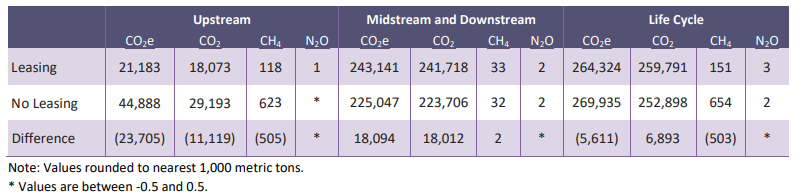
Finally, remember that offshore oil and gas leasing results in a net reduction in GHG emissions.
The No Leasing scenario results in roughly double the CO2e emissions for upstream activities compared to those of the Leasing scenario, given that, collectively, the substitute energy sources have higher GHG emissions per unit of production (also known as “GHG intensity”) compared to the forgone domestically produced OCS oil and natural gas of the Leasing scenario.
BOEM
Even when mid- and downstream emissions are included, leasing is preferable to no leasing. See the table below from the BOEM report:
Bottom line: we need more energy leasing and less military aggression!
Will the Nord Stream Pipeline Blasts ever be Investigated?
Posted in energy policy, Offshore Energy - General, pipelines, tagged CIA, Judge Napolitano, Nord Stream, Phil Giraldi, Seymour Hersh on February 14, 2023| Leave a Comment »
First Seymour Hersh interview since his Nord Stream article
Posted in energy policy, Interviews, Norway, Offshore Energy - General, pipelines, tagged Nord Stream, sabotage, Seymour Hersh on February 13, 2023| 2 Comments »

Much of the discussion was about his career and the state of journalism. Some of Hersh’s comments on his Nord Stream story:
- He will protect his sources as he always has
- The Nord Stream Pipeline sabotage was “stupid beyond belief”
- “Pipeline industry knows what happened”
- Only one major news show (Tucker Carlson) has contacted him and Hersh chose not to be interviewed
- He was shocked that no other news organization pursued the story
- He has received 1600 emails in 2.5 days since the article was published
 Bud's Offshore Energy (BOE)