Feeds:
Posts
Comments

Archive for the ‘drilling’ Category

Well, well. In early March, Cuba will commence with deep water drilling under contract with Repsol and Statoil ASA, using an older rig that was recently rehabbed by the Chinese. Reports indicate that it has fewer safety features than the BP’s infamous Deepwater Horizon. The site is located a scant sixty miles southeast of Key West, Florida. Benzinga.com

There are some  errors and unsupported opinions in this article, so I would take the March spud date with a grain of salt.  As confirmed by Rigzone, the Saipem Scarabeo 9 is a new rig, not a rebuild. It was built in China and commissioned in Singapore. The inflammatory comment about the rig having fewer safety features than the Deepwater Horizon is also without substance. Everything about the Scarabeo 9 appears to be state-of-the-art.

While a projected 2011 spud date has been reported and appears likely, Cuba’s deepwater drilling program has been marked by repeated delays. BOE has seen no confirmation that the rig has arrived or is en route to Cuba. We would appreciate any updates that others might be able to provide.

Read Full Post »

Associated Press story forwarded by Cheryl Anderson:

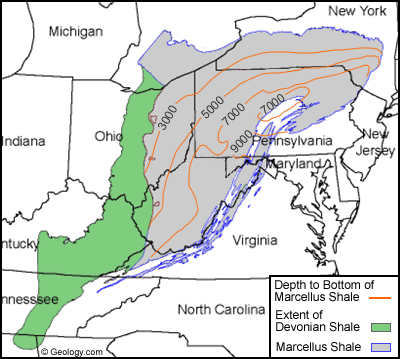
In the two years since the frenzy of activity began in the vast underground rock formation known as the Marcellus Shale, Pennsylvania has been the only state allowing waterways to serve as the primary disposal place for the huge amounts of wastewater produced by a drilling technique called hydraulic fracturing, or fracking.

State regulators, initially caught flat-footed, tightened the rules this year for any new water treatment plants but allowed any existing operations to continue discharging water into rivers.

Pennsylvania shale gas producers seem to be getting the message, but the industry is once again in a reactive mode. Where was the leadership during the critical first two years?  Why were new regulations needed to address the obvious?

Records verifying industry claims of a major dropoff in wastewater discharges to rivers will not be available until midwinter, but John Hanger, secretary of Pennsylvania’s Department of Environmental Protection, said he believed that the amount of drilling wastewater being recycled is now about 70 percent — an achievement he credits to tighter state regulation pushing the industry to change its ways.

“The new rules, so far, appear to be working,” he said. “If our rules were not changed … we would have all of it being dumped in the environment, because it is the lowest cost option,” Hanger said.

That last sentence must be painful reading for industry’s true safety and environmental leaders. The Marcellus Coalition, and the rest of us, need to remember this message:

We’re all in this together. We’re all only as good as whoever had a mistake this morning.

Read Full Post »

Encouraging and prudent decision:

The Bureau of Ocean Energy Management, Regulation and Enforcement (BOEMRE) today notified 13 companies whose deepwater drilling activities were suspended by last year’s deepwater drilling moratorium that they may be able to resume those previously-approved activities without the need to submit revised exploration or development plans for supplemental National Environmental Policy Act (NEPA) reviews. Before resuming those activities without additional NEPA review, however, the companies must comply with BOEMRE’s new policies and regulations.

The resumption of operations on suspended wells was the major concern of some operators and had the potential to delay anticipated new production.

Read Full Post »

Wall Street Journal on on Gulf delays

The Energy Information Administration, the research arm of the Department of Energy, last month predicted that domestic offshore oil production will fall 13% this year from 2010 due to the moratorium and the slow return to drilling; a year ago, the agency predicted offshore production would rise 6% in 2011. The difference: a loss of about 220,000 barrels of oil a day.

UK moves ahead with deepwater drilling

MPs have ruled out a moratorium on deep water drilling in the North Sea, despite concerns it could lead to a disaster worse than BP’s oil spill in the Gulf of Mexico last year.

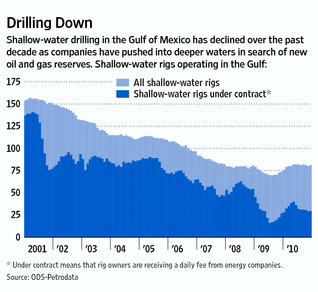
Shallow water struggle (Wall Street Journal)

From bad to worse for shelf operations:

“We were on our knees when Macondo hit,” said Jim Noe, senior vice president and general counsel for Hercules.

Read Full Post »

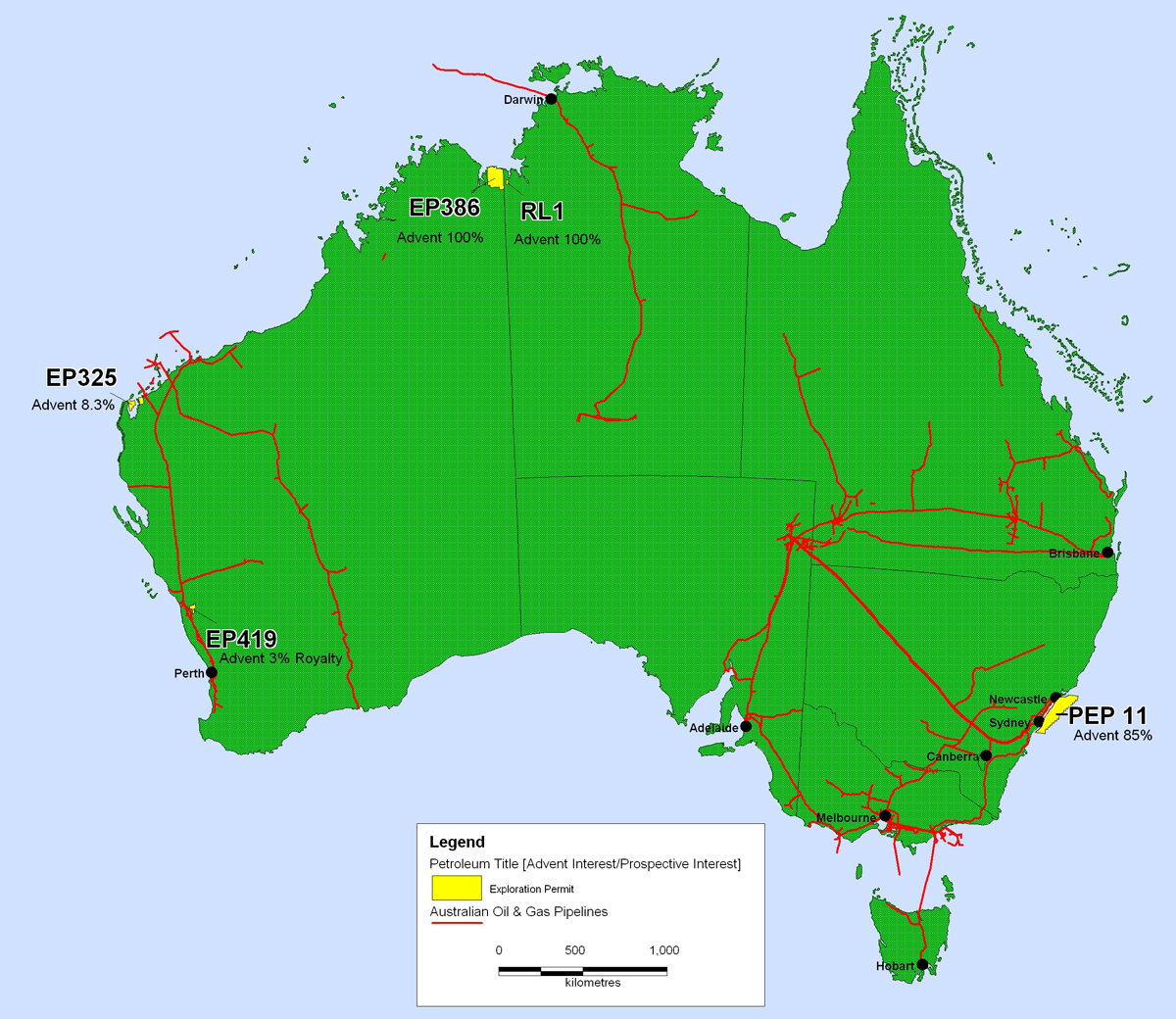
It looks like Montara has not affected frontier exploratory drilling offshore Australia.  Per Upstream:

New Seaclem-1 will be the first well to be drilled off the New South Wales coast and will target an estimated 6 trillion cubic feet of gas in the Great White & Marlin prospects.

Well site is in PEP-11 (Advent Energy map)

Read Full Post »

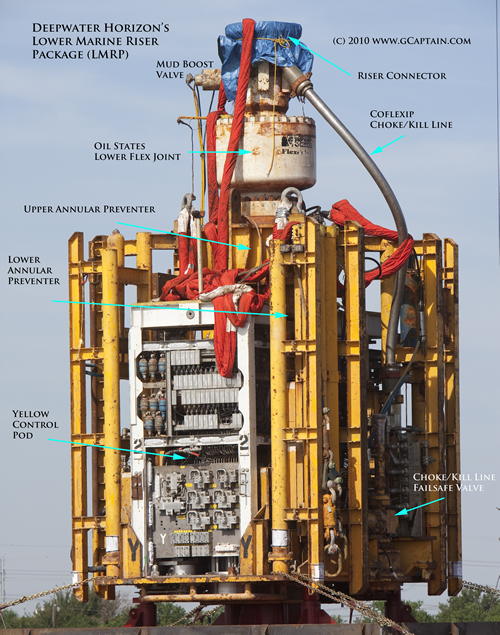
BOP stack awaiting post-Macondo inspection (from gCaptain.com)

In my 11 May 2010 testimony before the Senate Energy and Natural Resources Committee, I made ten recommendations. While many of the issues raised in that testimony are being addressed, one of the more important recommendations (no. 4) has received little or no attention. This recommendation calls for a public or private system for collecting and assessing failure date for blowout prevention equipment.  To the best of my knowledge, the only publicly available performance data for BOPE were collected by MMS and SINTEF and pertain to failures during BOP pressure testing, not failures during other operations.  How can we have a credible safety system without comprehensive failure data for such critical well control equipment?

Dr. Malcolm Sharples, an important BOE contributor, identified a number of BOP performance issues since Macondo.  Here are a few examples:

  1. During routine tests on the device, the locking system of one of the rams jammed in a locked position. Sevan is working with Petrobras and the supplier, Cameron, to find a solution.
  2. Reliance suspended all drilling work in the block after the Transocean rig Deepwater Expedition developed technical problems in its BOP. Reliance was drilling the KGV-D3-W1 well in the contract area since April 2010.
  3. The rig was offshore Australia for Shell early last month when newly installed BOP components failed during operations. Following several unsuccessful attempts to rectify the problems in the field, the failing BOP component is currently undergoing repairs in Singapore.

How is this information not important to every operator, regulator, and drilling contractor?  A comprehensive BOP failure reporting system should be a high and immediate priority for the offshore industry.  The information should be verified and published so that all may learn and future performance improved. Requirements for providing such information should be included in contracts and, if necessary, regulations.

An other major void that I have been talking about for years, without much success, is the absence of a comprehensive and verified international incident reporting system.  I assumed this would be universally recognized immediate necessity, and a critical element of the offshore industry’s initiatives agenda. Apparently that is not the case.  More on this to follow.

Read Full Post »
Upstream was in attendance at today’s Arctic Oil & Gas Conference in Oslo and posted an interesting report. At the conference, Cairn Energy’s Engineering and Operations Director Phil Tracy wisely avoided the “can’t happen here, can’t happen again, can’t happen to me” traps.  Instead, he correctly noted that:

An uninformed public are looking for guarantees we cannot give.

Kudos to Mr. Tracy.  We are not politicians, and must be open and honest with the public.  Yes, a disaster can happen again, but we will do everything possible to prevent it.  While the professional opposition and their political leadership will never be satisfied, the public at large appreciates candid and honest responses.

I was personally required to give a point by point by point submission (covering HSE) to the Greenlandic authorities. Phil Tracy

I have to give high marks to Greenland.  They resisted the cry to prohibit drilling, but challenged the operator and insisted on a top-notch operation.  Well done!


Cairn operation offshore Greenland. Greenpeace provides moral support.


Read Full Post »

I’ve been saving  this interesting comment from the CEO of the company that drilled the successful rescue well. Now that the miners are being rescued and we can smile, I’ve pasted it below 🙂

The pressure really started to build. We’re not used to drilling for people. Andrew Schmitt, CEO, Layne Christensen Co.

Here is a little information on the rescue well:

The Layne-Geotec team worked carefully, starting with a 5-inch hole dug through 2,300 feet of the hard rock until they broke through. From there, they made another pass, this time expanding it to 12 inches. Finally, with a third pass, they increased the hole to the 26 inches needed for the rescue capsule, all the while concerned about a collapse. They finished the job in 33 days, well ahead of predictions.

Comment: In the past year, we have seen the tragic consequences of a drilling operation that went awry.  We have also seen the industry’s technical precision demonstrated in drilling the Macondo relief well and have watched drillers save lives in Chile. Regardless of how you feel about drilling, the intentions are good – to find and produce commodities that are in much demand (typically oil, gas, or freshwater) , and to make a return on your investment.  The challenge is to minimize the safety and environmental risks associated with these operations, and to do so consistently, effectively, and efficiently.

Read Full Post »

The White House said Tuesday the government will lift a moratorium on deep water oil drilling in the Gulf of Mexico “very soon” – likely this week. Washington Post

Read Full Post »

The complete interim final Drilling Safety Rule is now posted on the Federal Register site.  This rule was announced on 30 September along with the Safety and Environmental Management System rule. The latter rule has not yet been posted by the Federal Register.

The Drilling Safety Rule is effective immediately.  With regard to comments:

While BOEMRE will not solicit comments before the effective date, BOEMRE will accept and consider public comments on this rule that are submitted within 60 days of its publication in the Federal Register. After reviewing the public comments, BOEMRE will publish a notice in the Federal Register that will respond to comments and will either:

1. confirm this rule as a final rule with no additional changes, or

2. issue a revised final rule with modifications, based on public comments.

Read Full Post »

« Newer Posts - Older Posts »