Despite scientific support, California’s “rigs to reefs” program has made little progress. Comments in yesterday’s LA Times article help explain why:
Fed by concerns from some environmental advocates and a skepticism about the motives of California’s billion-dollar oil industry, the Rigs to Reefs program that passed in 2010 was so complicated by political compromise that the permitting process became almost unworkable, (State Sen.) Hertzberg said.
Not a single oil company has applied in the history of the program, according to the State Lands Commission, which has jurisdiction over state waters.
“Oil companies want a clear path to compliance,” he said. “They’re operating in many cases at a loss, but it’s cheaper to operate at a loss than it is to face millions for decommissioning.”
Were it not for the surprising CCS bidding, which was accomplished without public notice, last week’s Gulf of Mexico sale would have been pretty ordinary – $177 million on 214 tracts.
A 1981 lease sale offshore California was quite another matter. That sale (no. 53) set records that will never be surpassed. A single lease (OCS-P 0450) encompassing a little more than 5000 acres was sold to Chevron and Phillips for an astounding $333 million. This equates to$1.013 billion in 2021 dollars. That single bid (in 1981 dollars) exceeds the total high bids for any Gulf of Mexico sale since 2015.
High bids for Sale 53 totaled $2.3 billion ($7.0 billion in 2021 dollars!) for only 81 tracts. A GoM sale in 2008 received $3.7 billion in high bids, but that was for 603 tracts.
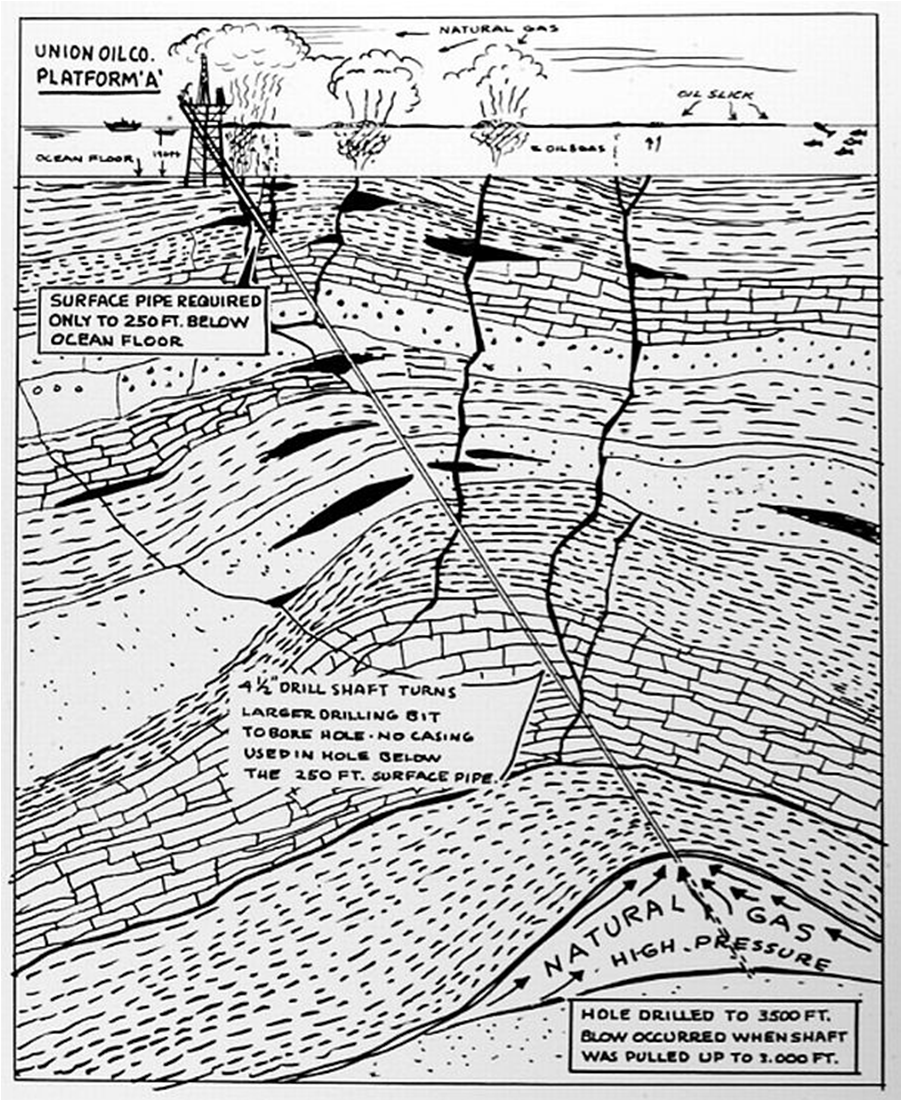
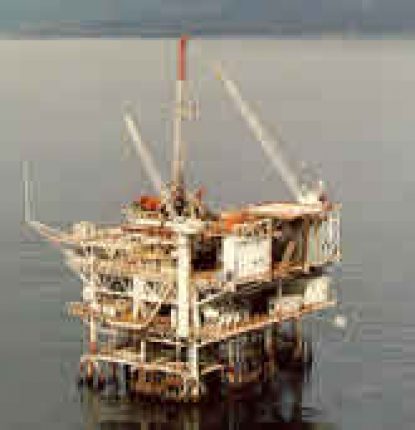
Unfortunately, production from lease 0450 never met expectations. Platform Hidalgo (0450) and the other two Pt. Arguello field platforms (Harvest and Hermosa) are no longer producing and are in the process of being decommissioned. An interesting criminal case involving Platform Harvest, then operated by Texaco, will be discussed at a later date.
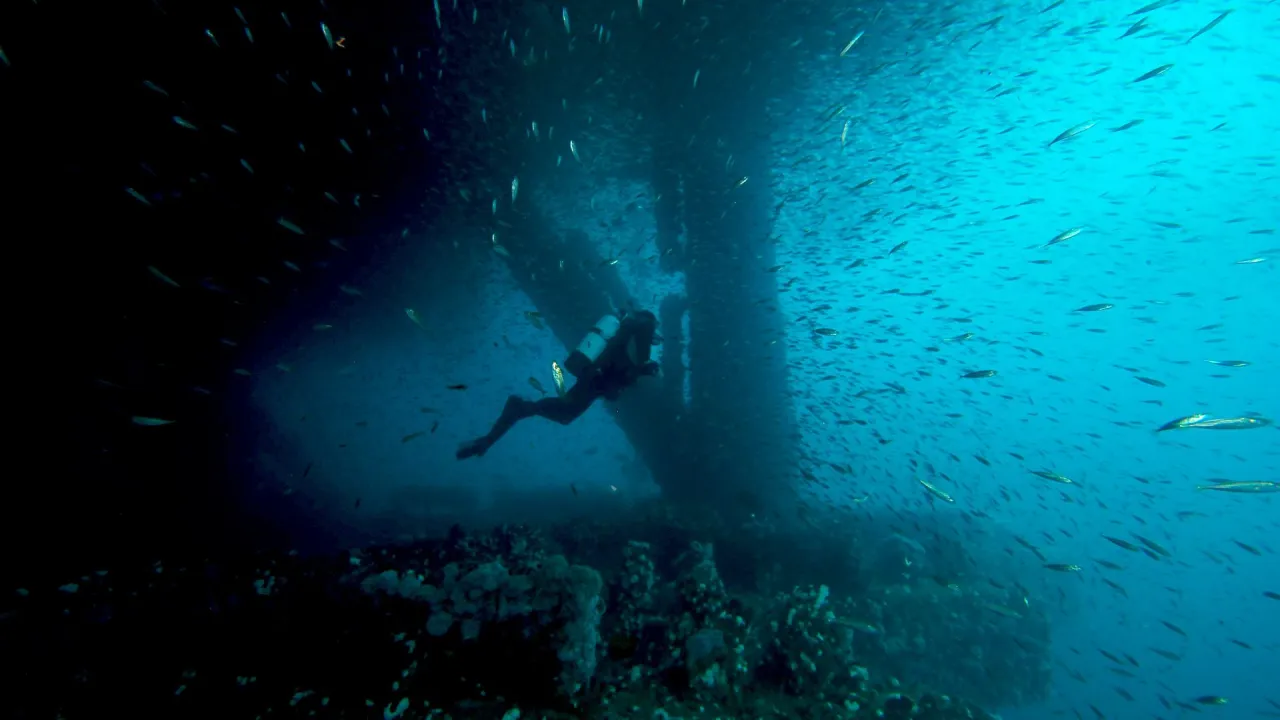
Veteran marine science advocate Jerry Schubel, former president of Long Beach’s Aquarium of the Pacific, is among those pushing for offshore oil platforms to be transformed for new ocean uses. He points out that the underwater portion of the structures already are a boon to marine life.
“They have enormous value as ecosystems because of the life that has grown on and around them,” he said.
He points out that other states have rigs-to-reefs programs — and California does as well, though it needs funding before it can function. Once the ball gets rolling, oil companies could be tapped to cover costs with fees drawn from the money they would save by not having to haul dismantled rigs ashore. Schubel estimated that turning platforms into reefs could cut decommissioning costs in half.
But Schubel says artificial reefs should be just the beginning. How about fish farms? Research labs? Windmills? Hotels for divers?
“The uses,” he said, “are limited only by our imagination.”
Due to water currents and a robust emergency clean-up effort, local beaches and ocean were re-opened on Oct. 11. By mid October, walking along the wide, sandy beaches there’s no sign of the spill as dolphins and surfers share the waves against a backdrop of cargo ships, oil rigs and the soft silhouette of Catalina Island.
“Right now, there’s high confidence that the spill was approximately 24,696 gallons. The exact number won’t be able to be verified until the investigation has been completed. But there’s high confidence in that number,” Shaye said.
“Our world environment is very resilient, which is a positive thing,” Shaye said. “As far as the birds and wildlife; there have been some deaths, as happens in this kind of situation. But quite a few have been rehabilitated and released back into their environment.
A group of environmental organizations demanded Wednesday that the Biden administration suspend and cancel oil and gas leases in federal waters off the California coast after a recent crude oil spill.
While not the disaster that some had predicted, this spill is another setback for California offshore production. However, cancellation of the remaining producing leases would be a very difficult and costly proposition for the Federal government. At this time, the Beta Unit operator appears to be minimally responsible for the spill, so what would be the basis for cancelling those leases? Cancelling other producible leases would be even more problematic.
85% of pipeline incidents reported to PHMSA from 2002-2009 occurred irrespective of the age of the pipeline, with just 15% related in some way to the age of the pipeline.
The properties of the steels which comprise natural gas pipelines do not change with time; that is, pipe does not “wear out.”
The fitness of a pipeline for service does not necessarily expire at some point in time.
The integrity of those pipelines for which the fitness for service may degrade with the passage of time can be assessed periodically. Timely repairs – and other mitigation efforts – based on those assessments will ensure the pipeline’s continued fitness for service.
A well-maintained and periodically assessed pipeline can safely transport natural gas indefinitely.
This quote from an AP article is consistent with the view expressed here after our review of the inspection reports for the Beta Unit (Platform Elly to shore) pipeline. Further per the AP article:
Safety inspections in 2015, 2017 and 2019 found anomalies in Amplify’s pipeline, including instances of metal loss and three dents that were previously repaired. But several experts who reviewed the reports said the metal loss — which can be a sign of a pipe wall thinning as it corrodes with age — was relatively minor. The dents were not in the same area as the spill.
The 16” oil pipeline was found to be in good condition with no visible damage or anomalies. One (1) CP test point that was installed in 2014 was found to be displaced from its location on the pipeline (this was also noted in the 2018 survey), and no damage was noted at the location (Fix #101).
Aqueos inspection report, May 2020
Pipe‐to‐electrolyte potential values recorded were: ‐ 921 millivolts (mV) on the 6” gas pipeline ‐ 910 millivolts (mV) on the 10” water pipeline ‐ 963 millivolts (mV) on the 10” gross fluids pipeline ‐ 906 millivolts (mV) on the 16” oil pipeline
As the NACE Standard SP0169‐2013 “Control of External Corrosion on Underground or Submerged Metallic Pipelines” criterion is ‐800 mV, all readings indicate that Cathodic Potential is within specifications.
Aqueos inspection report, May 2020
Metal loss data from Baker Hughes internal inspection (12/2019):
The metal loss findings are consistent with those reported in a previous internal inspection (Baker Hughes, 11/2017).
BSEE has general authority to require pipeline inspections under 30 CFR 250.1005. BSEE, the State Lands Commission, and the operator appear to have implemented an effective inspection program for the Beta Unit.
Matt Harty, a 61-year-old retired construction supervisor from the nearby community of Seal Beach, said he was glad to return to the waves in Huntington Beach with other early morning surfers. He said he’s seen oil spills before and this one didn’t seem that bad, and in fact, the beach looks great.
“This is the cleanest I’ve seen the beach in years, right, because there’s been nobody here for a week,” Harty said. “I think they cleaned it up really well.”
While the size of the spill isn’t known, the Coast Guard on Thursday slightly revised the parameters of the estimates to at least about 25,000 gallons (95,000 liters) and no more than 132,000 gallons (500,000 liters).
So far the impact on wildlife has been minimal – 10 dead birds and another 25 recovered alive and treated – but environmentalists caution the long-term impacts could be much greater.
AP 10/9
Comment: One gets the sense that some anti-production activists are disappointed that the spill is not the environmental disaster needed to end oil and gas production in U.S. offshore waters, that the pipeline operator is (at most) only partially responsible, and that the primary regulators have been doing their job despite outdated regulations and jurisdictional uncertainty.
So far, two proposed class-action lawsuits have been filed on behalf of a disc jockey who runs beachfront events in Huntington Beach and a surf school that operates in the city known as “Surf City USA.”
As we have been suggesting for several days, the initial spill estimate was too conservative (high) and assumed near total losses from the pipeline. The Coast Guard has now established a “minimum” estimate which is identical to the spill volume cited in footnote 2 of the PHMSA Order. This estimate was presumably determined after a review of meter data.
Coast Guard Capt. Rebecca Ore said at a media briefing that officials “have assessed and verified pipeline data, and made a determination that the minimum amount of crude oil released from that pipeline is 588 barrels of oil,” which equals about 24,696 gallons.
Asked whether the lower estimate of oil released could mean beaches reopen sooner, Huntington Beach Mayor Kim Carr said she was “cautiously optimistic that it will be sooner than later.”