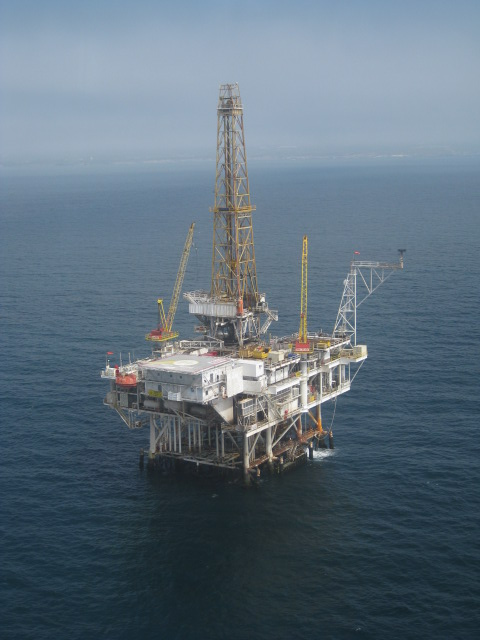
My former colleague John Smith, an expert on Pacific Region decommissioning, advises me that production has ceased at Platform Irene in the Santa Maria Basin offshore California. Irene, the first platform installed in the Santa Maria District in 1985, was a milestone in Pacific OCS development.
Only 7 of the 23 Pacific OCS platforms are still producing. Attached is an updated summary table that John prepared for an upcoming SPE event in Alaska.
As we approach the end of 2022, I’m still waiting for:
Nord Stream Pipelines sabotage report(s): Will Denmark, Germany, and Sweden publish reports? Will the responsible parties be identified? I surely hope this wasn’t a US/UK operation.
Huntington Beach Pipeline Spill investigation report: >14 months since the spill and still no report. What vessel(s) struck the pipeline? The pipeline operator seems to have had minimal responsibility but has been vilified. How will the vessel owner(s) be penalized?
Offshore Incident Statistics (BSEE): Still no data for 2021 or 2022. The previous OCS safety regulator (MMS) updated these tables at the end of each quarter.
BSEE/Coast Guard investigation reports for two 2020 GoM occupational fatalities that have yet to be documented. Also waiting for the reports on a 1/24/2021 fatality, a 5/15/2021 explosion and fatality, and a 3/25/2022 fatality. Lives were lost. When will we find out what happened and why?
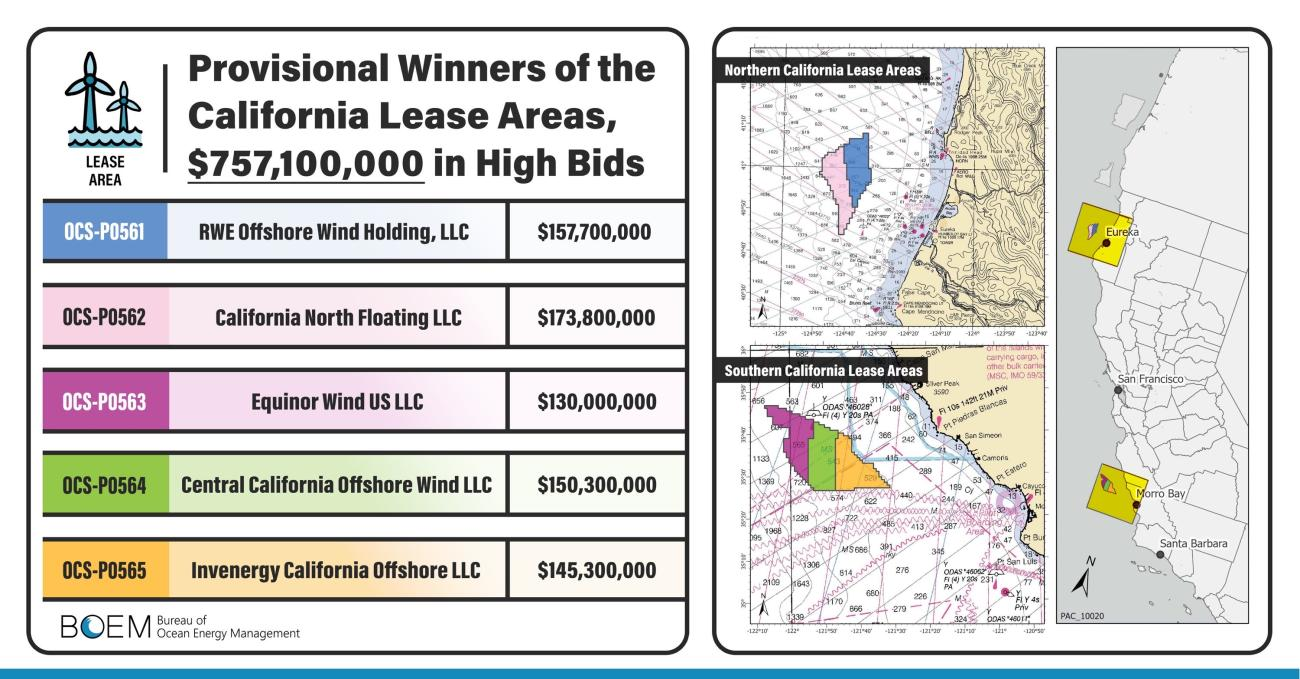
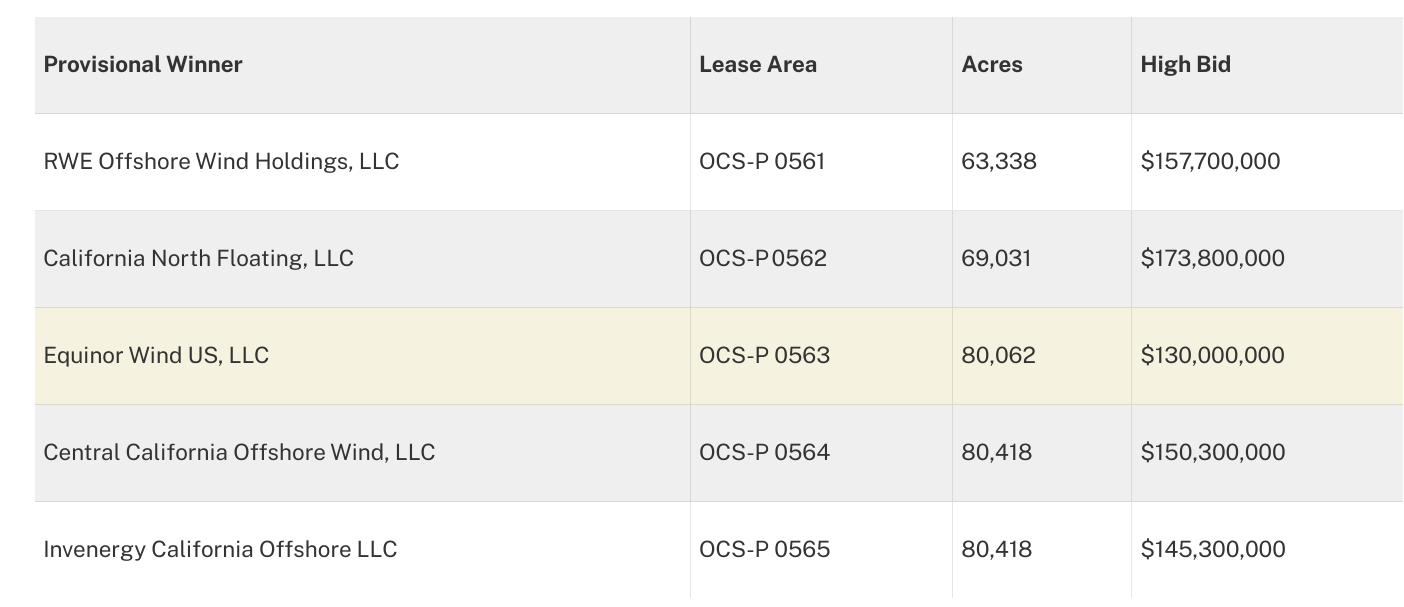
Only Equinor is a familiar name to the offshore oil and gas industry, so here are some blurbs about the other high bidders.
California North Floating, LLC, is a subsidiary of Copenhagen Infrastructure Partners (CIP). Since entering the US offshore market in 2016, CIP has built a leading offshore wind position through its affiliate Vineyard Offshore. This includes Vineyard Wind 1, the country’s first commercial scale offshore wind project which is currently under construction, as well as two lease areas under development totaling approximately 5.0 GW off the coast of Massachusetts and New York.
Central California Offshore Wind is managed by an East Coast offshore wind energy company, Ocean Winds North America LLC, which formed a joint venture with the Canada Pension Plan Investment Board to win the lease. Ocean Winds has more than 10 years of experience in floating offshore wind, most notably through the development and operation of Windfloat Atlantic (offshore Portugal), the world’s first fully commercially operational floating offshore wind farm
Equinor, a Norwegian company, is a major international oil and gas producer, an important wind energy investor, and a leader in the development of floating wind turbine technology. Equinor operates the Hywind Tampen floating offshore wind farm which will supply power to Norwegian offshore oil and gas fields.
Invenergy and its affiliated companies develop, own, and operate large-scale renewable and other clean energy generation and storage facilities in the Americas, Europe and Asia. Invenergy’s home office is located in Chicago, and it has regional development offices in the United States, Canada, Mexico, Spain, Japan, Poland, and Scotland.
RWE Renewables has experience covering the offshore and onshore wind energy value chain from development to construction and operation. These activities are the responsibility of two functional units, “Unit Renewables Europe & Australia” and “Unit Offshore Wind”, as well as the subsidiary RWE Renewables Americas. RWE Renewables also invests in large-scale solar projects and supports power producers, plant operators and other stakeholders in the development, construction and operation of photovoltaic and solar energy plants as well as in the construction of battery storage systems. The focus is on large-scale industrial projects.
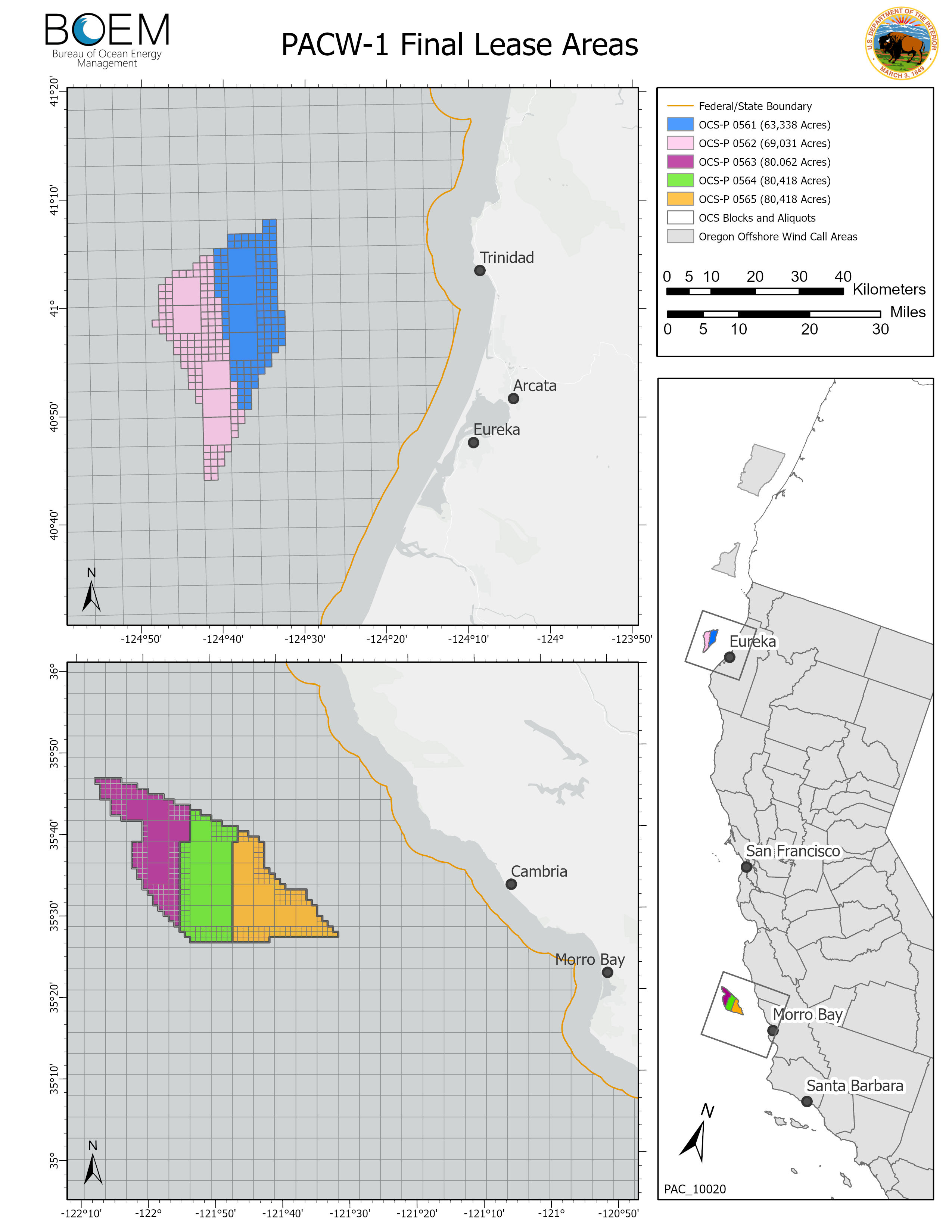
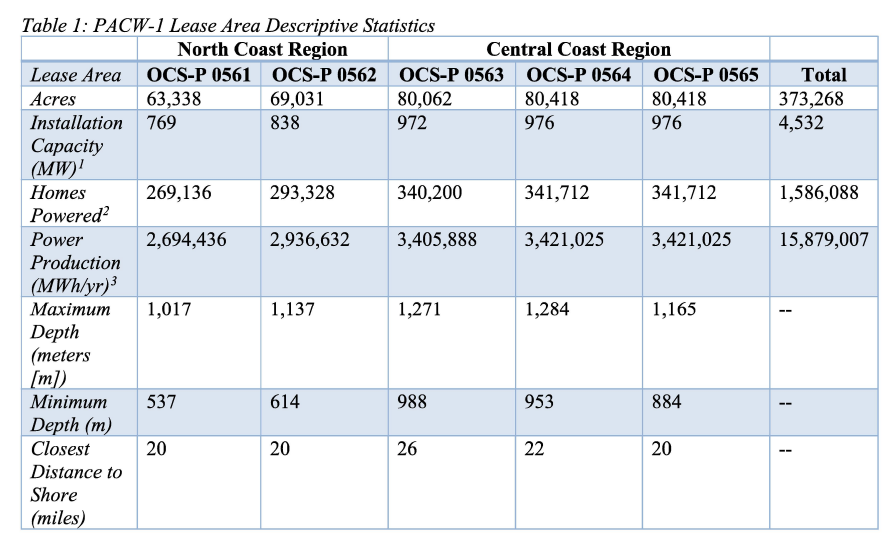
The California wind sale bidding, while lower than the record Atlantic sale in February, was extraordinary given that the 5 leases are relatively distant from shore (20+ miles) and in water depths (537 to 1284 m) that dictate the use of floating turbines. Generous subsidies, credits, and State mandates no doubt contributed to the seemingly inflated bidding, as did an auction system that is designed to maximize bonus payments.
Given the slow progress in US offshore wind development, the setbacks the industry is experiencing, the added challenges associated with commercial deepwater development, the potential cost burden on taxpayers and power customers, and the government’s financial and policy support, a more development-friendly leasing system would seem to be prudent. BOEM took a step in that direction with the with the limited training and supply chain credits provided for in the Sale Notice, but fundamental changes in the auction system may be desirable.
The biggest difference between the wind and the oil and gas programs may be the way the sales are conducted. For oil and gas leases, you submit a single sealed bid. Here is a simplified description of how a wind lease sale is conducted:
At the start of each round, BOEM will state an asking price for each Lease Area. A bid at the full asking price is referred to as a “live bid.”
If the bidder has qualified for a non-monetary credit, it will meet the asking price by submitting a multiple-factor bid—that is, a live bid that consists of a monetary (cash) element and a non-monetary credit.
To participate in the next round of the auction, a bidder is required to have submitted a live bid for one of the Lease Areas (or have a carried-forward bid) in each previous round.
As long as there are two or more live bids (including carried-forward bids) for at least one of the Lease Areas, the auction moves to the next round
If there was only one live bid (including carried-forward bids) or no live bids for a Lease Area in the previous round, the asking price would not be increased.
A live bid would automatically be carried forward if it was uncontested in the previous round, and the bidder who placed the uncontested bid would not be permitted to place any other bid in the current round of the auction.
Conversely, if a live bid was contested in the previous round, the bidder who placed the contested bid would be free to bid on any Lease Area in the auction in the next round, at the new asking price.
If a bidder decides to stop bidding before the final round of the auction, there are circumstances in which the bidder could nonetheless win a lease.
Between rounds, BOEM will disclose to all bidders that submitted bids: (1) the number of live bids (including carried-forward bids) for each Lease Area in the previous round of the auction.
In any round after the first round, a bidder may submit an “exit bid” only for the same Lease Area as the bidder’s contested live bid in the previous round. An exit bid is a bid that is greater than the previous round’s asking price, but less than the current round’s asking price.
The auction ends (finally) when a round occurs in which each of the Lease Areas in the auction receives one or zero live bids (including carried-forward bids), regardless of the number of exit bids on any Lease Area.
Perfectly clear? You can read the full description in the Sale Notice.
Is this the best way to award offshore wind leases?
As a result of a provision in the Inflation Reduction Act, leases may be sold but not awarded. See the paragraph below that was inserted at the end of the sale notice. No wind leases may be issued until Sale 259 oil and gas leases are issued (presumably late next spring).
XV. Compliance With the Inflation Reduction Act (Pub. L. 117-169 (Aug. 16, 2022)(Hereinafter, the “IRA”):
Section 50265(b)(2) of the IRA provides that “[d]uring the 10-year period beginning on the date of enactment of this Act . . . the Secretary may not issue a lease for offshore wind development under section 8(p)(1)(C) of the Outer Continental Shelf Lands Act (43 U.S.C. 1337(p)(1)(C)) unless— (A) an offshore lease sale has been held during the 1-year period ending on the date of the issuance of the lease for offshore wind development; and (B) the sum total of acres offered for lease in offshore lease sales during the 1-year period ending on the date of the issuance of the lease for offshore wind development is not less than 60,000,000 acres.” Section 50264(d) of the IRA provides that “. . . not later than March 31, 2023, the Secretary shall conduct Lease Sale 259[.]” Conducting Lease Sale 259 is needed for BOEM to satisfy the requirements in section 50265(b)(2) of the IRA and issue the leases resulting from this lease sale. Notwithstanding the foregoing, nothing in the IRA prevents BOEM from holding this auction.
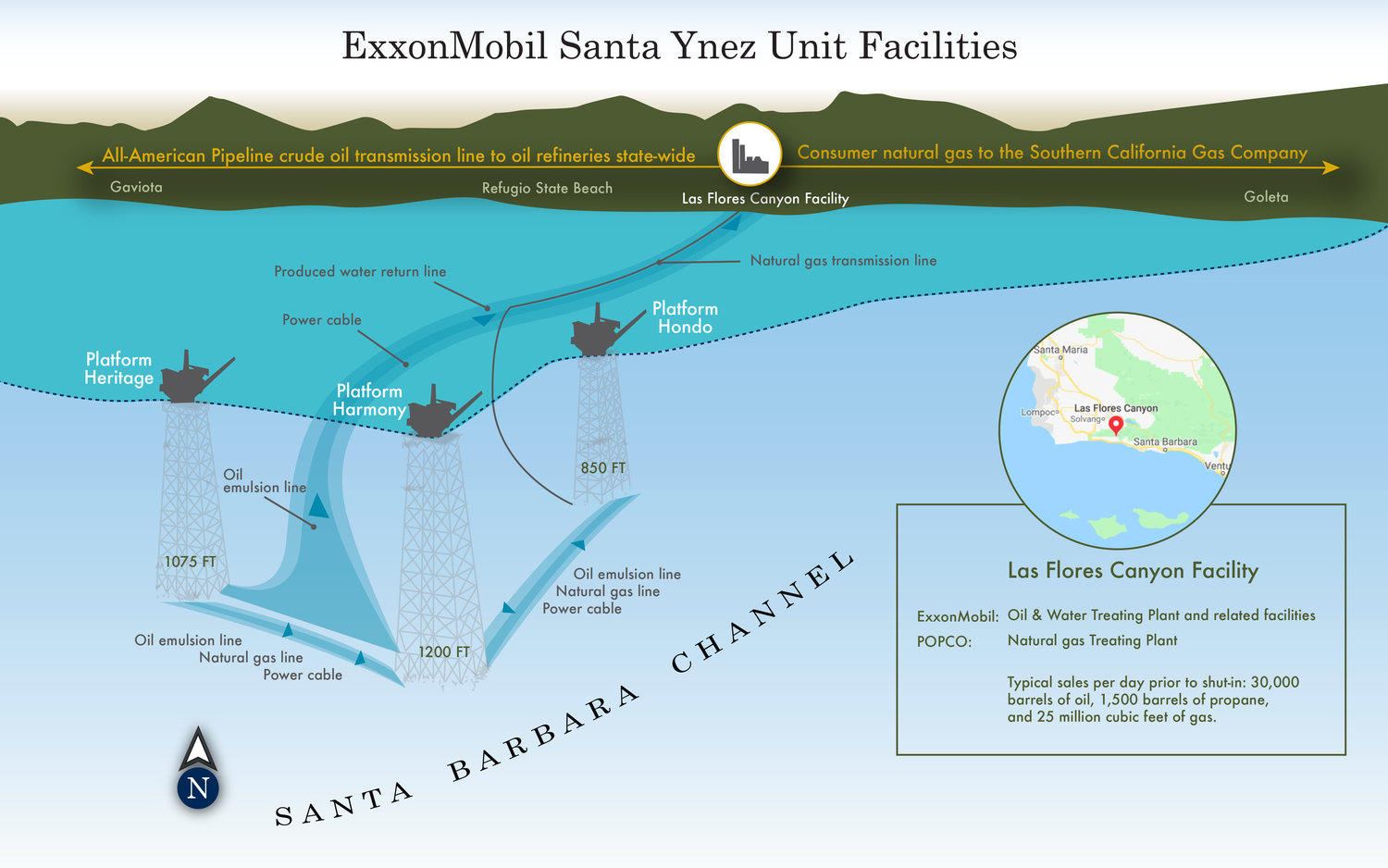
HOUSTON, Nov 6 (Reuters) – Exxon Mobil Corp will take up to a $2 billion loss on the highly leveraged sale of a troubled California offshore oil and gas field that have been idled since a 2015 pipeline spill.
Sable Offshore, a blank check company founded by industry veteran James Flores, will borrow 97% of the $643 million purchase price from Exxon under a five-year loan. Blank check companies raise money to acquire operating businesses. If Flores fails to restart production at the Santa Ynez field by the start of 2026, Exxon could take back the entire operation, Sable disclosed in a filing.Flores will seek permits to restart Santa Ynez and expects to pump about 28,100 barrels of oil and gas per day beginning in 2024, according to a Sable investor presentation. The field has 112 wells and the potential for at least another 100 wells, its presentation showed.
Jim Flores is well known in the offshore industry dating back to his days as CEO of Flores & Rucks, a Gulf of Mexico exploration and production company, in the 1990’s.
And Exxon is no doubt still on the hook for decommissioning these massive platforms.
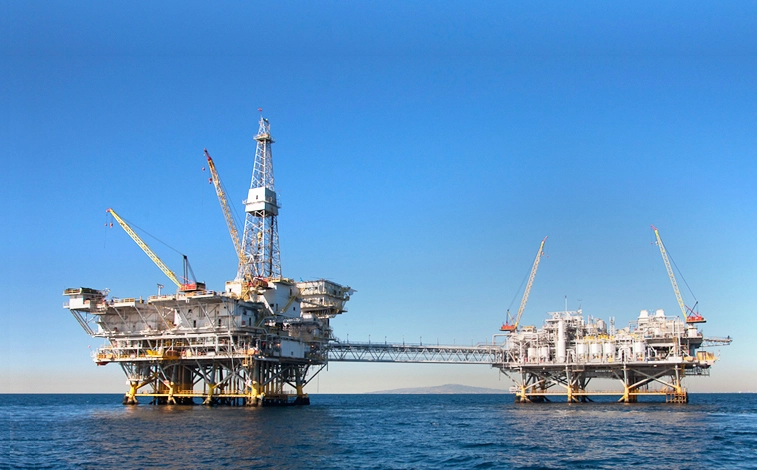
The 23 platforms in Federal waters offshore California are from 33 to 55 years old. Most are no longer producing and 8 are on terminated leases. Some of the platforms are massive structures in water depths up to 1200′ (list of platforms and map below).
BOEM’s draft programmatic EIS evaluates 4 decommissioning alternatives, none of which appear to be workable for a combination of economic, environmental, and legal reasons:
Alternatives 2 and 3 evaluate prudent and environmentally responsible partial removal options. Unfortunately, partial removal and reefing are not feasible under the California Resources Legacy Act (AB 2503). This legislation holds the donating company perpetually liable for any damages associated with the reef structure. While not assuming any liability, the State nonetheless collects 80% of the savings (reefing vs. complete removal). As a result, it’s no surprise that no company has applied to participate in the State’s program.
Alternative 4 calls for leaving platforms and pipelines in place after emptying tanks and flushing pipelines. This “no action” baseline alternative violates the lease agreement and 30 CFR 250.1725, and would only be permissible if an alternate use was approved for the platforms per 30 CFR Part 585.
The EIS, with minimal discussion and no supporting data, rules out alternate uses at any of the 23 platforms. This exclusion would seem to be premature given the win-win-win opportunities for industry, government (Federal, State, and local), and academia. These include deferred decommissioning liabilities, a wide range of research opportunities, security and defense applications, weather observation and climate studies, maritime communications support, education programs, marine seismicity studies, and hydrokinetic energy projects. With proper maintenance, platforms can continue to provide social benefits long after all wells are plugged and production equipment is removed. However, once removed, replacement costs would be prohibitive.
Lastly, the EIS avoids the thorny financial responsibility issues that will complicate decommissioning decisions. Note the questions raised in the “troubling case of platforms Hogan and Houchin.”
Those wishing to comment on the draft EIS should follow the posted instructions.
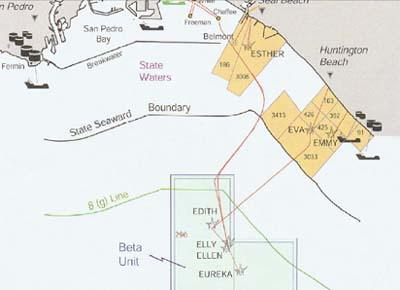
From 1997 to 2007, Aera operated the Beta Unit offshore Huntington Beach. Since selling those facilities, all Aera operations have been conducted onshore, primarily in Kern County, a historically important California oil production area. Aera will continue to operate these onshore properties for IKAV, which looks like an interesting company.




 Bud's Offshore Energy (BOE)