- The big question with regard to acoustic backup systems for BOPs is whether ambient noise associated with a seafloor blowout prevents the signal from being reliably received. The Macondo well would seem to provide an excellent opportunity for testing acoustic systems to see how effectively the signals are received under such challenging conditions. Too late?
- Still no regular relief well reports, but Admiral Allen commented yesterday that they only have about 200′ to drill. I’m assuming the 9 7/8″ liner has been set. If all this is accurate and there are no weather or technical delays, they should be ready to intercept the well bore soon (1-2 weeks?), even with the added time for special ranging and directional surveys.
- Unless the relief well is delayed, it doesn’t seem to make sense to change the LMRP cap at this time. Collection might improve somewhat with the new cap, but the well would be wide open during the change.
- Day 21 since the Montara report was delivered to the Ministry, and there are no recent news updates. No interest?
- Very good article in Platts as the media begins to show more interest in regulatory approaches.
Archive for the ‘well control incidents’ Category
Acoustic switches, etc
Posted in accidents, well control incidents, tagged acoustic BOP, Australia, blowouts, Deepwater Horizon, drilling, Gulf of Mexico, macondo, Montara, well control on July 8, 2010| Leave a Comment »
Small Request for the Unified Command
Posted in accidents, well control incidents, tagged Deepwater Horizon, Gulf of Mexico, macondo, relief well, safety, unified command, well control on July 7, 2010| Leave a Comment »
Those of us on the “Deepwater Response External Affairs” Mailing List received ten email updates yesterday. Not one included relief well information. The relief well information that has been provided has been inconsistent and contradictory.
Given the importance of these wells and the apparent confusion among observers (a number of whom have contacted BOE), a daily relief well update would be appreciated, at least for the primary well. It would be helpful if the subject line said “relief well update.” This update should include the precise relief well depth, whether the depth is measured (total length) or true vertical, and the point of reference (e.g. below the sea floor). A short summary of the operations over the past 24 hours would also be helpful.
Montara Vigil Continues, Macondo Relief?, More Regulatory Theory
Posted in accidents, well control incidents, tagged Australia, blowouts, Gulf of Mexico, macondo, Montara, offshore oil, relief well, well control on July 6, 2010| Leave a Comment »
- Montara watch: 19 days have now elapsed since the Montara Inquiry Report was presented to Minister Ferguson, and there are no recent media updates on the release of the report. Meanwhile, Australian radio has a good piece on Montara – long, but worth the time.
- Macondo: The relief well reports continue to be sketchy and inconsistent. On July 4, the Unified Command reported that the primary relief well had reached 17,400′ (presumably measured depth), while BP’s update for the same date indicated that the first well had reached 17,725′ (this too must also be measure depth, not true vertical depth). It’s unclear whether the final casing (9 7/8″ liner) has been set. Admiral Allen will likely provide a better update today.
- More regulatory philosophy: The regulatory system is at least as important as the specific operating requirements. This UNEP piece provides a good summary of the strengths and weaknesses of different approaches.
Preventing Future Blowouts and Limiting their Effects
Posted in accidents, well control incidents, tagged blowouts, Colin Leach, Deepwater Horizon, drilling, Gulf of Mexico, macondo, safety, well control on July 5, 2010| Leave a Comment »

BOE friend and internationally recognized well control expert Colin Leach has submitted an excellent paper suggesting new procedures that will improve well design and intervention. Click here to read Colin’s paper.
The goal is to eliminate the possibility of what actually could happen not being recognized (at the time of the design). This is achieved by having a core of knowledge against which individual operating companies and outside assessors can assess designs and approaches. Communication between the operator and the “knowledge core”would be confidential as long as a well control incident did not occur. The format of this “knowledge core” is such that it eliminates the “committee think” within an operating company where a dissenting individual (who is actually knowledgeable) can be overruled by a committee vote.
Relief Well Down to 11817′ TVD BOF
Posted in accidents, well control incidents, tagged accidents, blowouts, Deepwater Horizon, drilling, Gulf of Mexico, macondo, relief well, safety, well control on July 2, 2010| Leave a Comment »

bottom of the flowing Macondo well
Based on the latest information provided by Admiral Allen, the relief well has reached 11817′ below the sea floor and is thus only 273′ above the 9 7/8″ casing shoe on the flowing Macondo well. After drilling another 200+ feet, they will open (enlarge) the relief well and install a 9 7/8″ liner. They will then drill a few hundred feet beneath the liner and intercept the flowing well. They will presumably kill the flow in the annulus outside the casing (assuming that is a flow path) with heavy mud before milling into the 7″ casing, killing any flow inside that casing, and plugging the well bore with cement. Stay tuned.
Relief Well Status Per Admiral Allen
Posted in accidents, well control incidents, tagged accidents, blowouts, DD3, Gulf of Mexico, macondo, oil spill, relief well, safety, well control on July 2, 2010| 1 Comment »
Regarding the relief wells, Development Driller III now is at a distance of 11,641 feet below the seafloor. As you know, they’re going through a series of operations which we call ranging. They’re into their fourth cycle of this. In ranging, they withdraw the drill pipe and put down an electrical cable and actually try and sense the magnetic field around the wellbore. They are within around 15 feet of the wellbore at this point. They will continue down 700, 800 more feet, slowly close into the wellbore, and when they know they’ve got it exactly in range, know exactly where the drill pipe is in relation to the wellbore, then they will attempt to move in and drill through the wellbore and then the casing as well. At that point they’ll be in a position to be able to try the bottom kill or to be able to insert the mud, and hopefully after that, put a cement plug in that will kill the well.
Relief Well Fever
Posted in accidents, well control incidents, tagged accidents, blowouts, DD3, Deepwater Horizon, Gulf of Mexico, macondo, relief well, well control on July 1, 2010| Leave a Comment »

DD3
BOE doesn’t really care about where LeBron James chooses to play basketball, but we are big fans of the team on the Development Driller III or DD3. The DD3 crew, some of whom are Deepwater Horizon survivors, is ahead of schedule and predictions for an early intercept and well kill are approaching irrational exuberance levels. This may be the most important well in history, and crew has responded to the challenge.
 After the DD3 crew finishes the job, we owe them a victory parade in New Orleans. “Throw me somethin’ mista! 🙂
Posted in accidents, well control incidents, tagged accidents, blowouts, Deepwater Horizon, international, Jane Cutler, macondo, Montara, NOPSA, offshore oil, safety, well control on June 30, 2010| Leave a Comment »
Interesting comments from Jane Cutler, CEO of Australia’s National Offshore Safety Petroleum Safety Authority, in NOPSA’s excellent newsletter:
The incidents in the Gulf of Mexico (Deepwater Horizon) and at the Montara wellhead platform are different in many respects, particularly in technical matters. However, they share some common factors prompting regulatory action.
I agree entirely with Ms. Cutler. International regulators and operators must work in concert to address and resolve these issues.
Updates on the relief wells
Posted in accidents, well control incidents, tagged accidents, blowouts, Deepwater Horizon, drilling, Gulf of Mexico, macondo, offshore oil, oil spill, relief well, safety, well control on June 29, 2010| Leave a Comment »
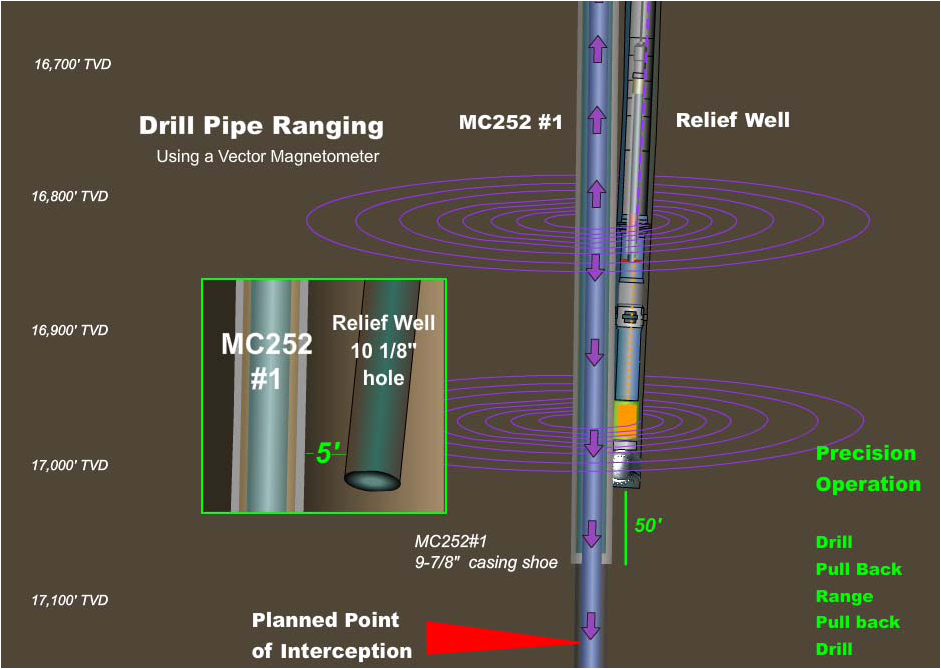
BP has released a slide presentation and animation on the relief wells showing the intercept point below the 9 7/8″ casing shoe. The exact sequence of operations once they reach the intercept point will be interesting to observe. They should encounter flow when they reach the 7″ casing annulus (assuming that is a flow path; there still seems to be some uncertainty in that regard). Will they attempt to kill the flow in the annulus before milling into the 7″ casing? Is there flow inside the 7″ casing via channels in the casing shoe? Is there drill pipe inside the casing?
More Montara and Macondo
Posted in accidents, well control incidents, tagged 76, Australia, blowouts, BOE, Deepwater Royalty Relief Act, macondo, Montara, offshore oil on June 28, 2010| Leave a Comment »
-The duration of the Montara blowout was 75 Days. Ironically, Day 76 of the Macondo blowout will be the 4th of July.
-Eleven days have elapsed since the Montara Report was presented to Minister Ferguson, who has apparently retained his cabinet position in the new government. Now that the cabinet has been settled, perhaps there will be more public clamor for the report?
-Cap Summit in DC? – According to Admiral Allen, government and industry experts will convene on Wednesday to decide whether to change the collection cap. Other designs would provide a better seal and facilitate higher recovery rates via free-standing risers, but the well would flow unabated during the changeover.
-More Macondo irony: Since the oil spilled is “avoidably lost,” royalties will presumably be due on both the oil spilled and the oil “produced” at Macondo. However, for fields in water depths greater than 800m, the Deepwater Royalty Relief Act of 1995 exempts the first 87.5 million barrels of oil equivalent from Federal royalties. Court interpretations of this poorly written legislation have determined that this relief must be applied on a lease (not field) basis, making the royalty exemption much more generous. Ironically, Kerr McGee (now part of Macondo partner Anadarko) filed the law suit that resulted in this favorable decision for industry. MMS, which has been repeatedly (and incorrectly) denounced for being “too cozy with industry,” fought hard for the less generous interpretation.
 Bud's Offshore Energy (BOE)