Feeds:
Posts
Comments

Archive for the ‘well control incidents’ Category

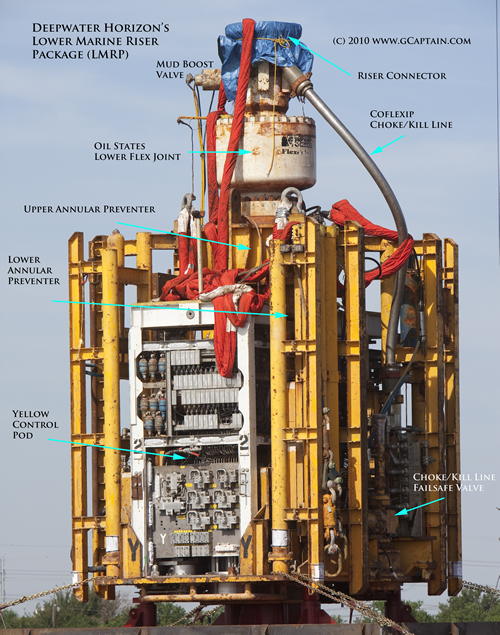
BOP stack awaiting post-Macondo inspection (from gCaptain.com)

Other than the mildly amusing skirmish about the positioning of representatives of the various factions during the inspection process (Hey, how about access for bloggers!) and some silly comments about the independence of the inspection contractor, there has been very little attention paid to the Deepwater Horizon BOP examination that is scheduled to begin today at NASA’s Michoud facility in New Orleans. The absence of media interest is surprising given the importance of this part of the Macondo investigation. Presumably, there will be more extensive coverage beginning today.

While the inspection and testing will be quite technical, some important aspects should be rather straightforward.  What is the position of the rams, particularly the shear ram?  What is the condition of the ram elements and annular preventer?  Is there evidence of control line leakage?  What can be determined about the electronics and the sequencing system designed to automatically actuate the shear ram when power is lost or when the riser is disconnected?

Hopefully, the official investigation website, which currently has no information on the BOP inspection program, will provide updates.  While we don’t expect immediate information on the findings, there should be reports explaining how the inspection program is being conducted and what has been accomplished.

Read Full Post »

Our 15 September post suggested that a properly conducted and interpreted negative pressure test would likely have prevented both the Macondo and Montara blowouts. As more information about Macondo surfaces, there is no dispute about the significance of the negative pressure test errors.  Despite differences of opinion about the contributing factors, all companies involved with the blowout seem to agree that a properly conducted and interpreted negative pressure test would likely have prevented the blowout.

Read Full Post »

I hate to say nice things about lawyers :), but the Commission attorneys handled the two days of hearings very effectively.  The outstanding staff preparation and support were quite obvious.

BOE has have long advocated more industry leadership on guiding principles, incident data gathering and verification, risk assessment, peer-audits, standards improvements, cooperative research, and failure data for critical equipment.  In that regard, we are pleased that Chairmen Reilly and Graham, the other Commissioners, and the industry and government witnesses commented positively on some of these important programs.

We need to effectively manage the safety and environmental risks associated with offshore exploration and production, because we can’t afford the economic and security risks associated with a diminished offshore oil and gas program. BOE advocates conservation and renewables, but projections by IEA and other leading energy forecasters make it clear that oil and gas will continue to be an important part of our energy mix for decades.

Read Full Post »

With all of the discussion about the float collar issues, I thought I was listening to the Montara hearings this morning.   I’m surprised that neither the Commission questioners nor the panelists have mentioned Montara. When you have two major blowouts within 8 months and they have very similar root causes, the similarities should be of enormous interest. The absence of information transfer that might have prevented Macondo should be a major consideration in these and other hearings.

We have been talking about the similarities between Montara and Macondo for months.  Colin Leach’s 28 September post draws further attention to this issue.  Colin also hit the nail on the head with his comment that an additional barrier should have been installed above the float collar before proceeding.

Read Full Post »

Hats off to the Commission attorneys and staff for today’s presentations and questioning.  They were very well prepared, conducted themselves in a professional manner, and focused on the causes (not who should be blamed). The format was excellent with the Commission presenting their tentative findings and then asking the industry panel how they felt about each finding.

Oddly, the only real speculation was by the industry panelists, most notably the comments below about the flow path and BOP performance. Not very subtle!

Read Full Post »

Based on lower than expected pressure readings during the cementing operation, Halliburton (Richard Vargo) contends that hydrocarbons entered the annulus (outside production casing) during cementing, rose to the wellhead before the seal assembly was set, and raised the seal assembly after it was set.  They believe that subsequent flow was inside production casing, but that the initial burst was up the annulus. This position is inconsistent with current view of the Commission and all of the other parties.

Read Full Post »

The incident occurred on 19 May 2010.  We appreciate Statoil’s timely completion and public release of the report.  The report is in Norwegian, but an English summary is provided.

What happened:

  1. A platform well on Gullfaks C was drilled in managed pressure drilling (MPD) mode to a total depth of 4800 meters.
  2. During the final circulation and hole cleaning of the reservoir section, a leak in the 13 3/8” casing resulted in loss of drilling fluid (mud) to the formation.
  3. The loss of back pressure led to an influx of hydrocarbons from the exposed reservoirs until solids or cuttings packed off the well by the 9 5/8” liner shoe.
  4. The well control operation continued for almost two months before the well barriers were reinstated.

Statoil’s near-term action items:

  1. Develop new acceptance criteria and best practices for MPD on Gullfaks.
  2. Update pressure prognoses for the field.
  3. Document that the shear ram is capable of cutting the drill string.
  4. Change the shift relief plan for the Drilling Supervisor and Toolpusher on Gullfaks C.
  5. Review the procedures for communication and mustering with the emergency preparedness organization.

Read Full Post »

The hearing will focus on the causes of the Deepwater Horizon explosion and will be broadcast live on C-SPAN2.  The panelists and speakers are listed here.

Read Full Post »

Those who read this obscure blog regularly know that we have been railing about the release of the Montara Inquiry Report since it was delivered to Energy Minister Ferguson on 18 June 2010. The report has now sat on the Minister’s desk for nearly twice as long as the Montara well flowed into the Timor Sea at an announced rate (cough, cough) of 400 barrels per day.

BOE wants to thank Minister Ferguson for helping teach us the virtue of patience, an important life skill that some of us had not previously mastered. In our newly enlightened state, we are becoming more observant. As a result, we noticed that the Australian Senate has already passed legislation strengthening the National Offshore Petroleum Safety Authority (NOPSA).

After reviewing information about the legislation here and here, I am a bit confused about the changes being enacted.  However, if the concerns (below) of Tina Hunter, an Assistant Professor at Bond University who had previously submitted testimony to the Montara Inquiry, have not been yet been addressed, Parliament needs to revise the legislation.  Multiple regulators are a problem, not a solution.  (The US needs to take notice.)

These legislative changes proposed will still split the responsibilities for Well Operations Management Plans between NOPSA and the responsible Delegated Authority (who assesses the well design and construction and drilling applications)….Furthermore, the regulatory amendments do not consider the environmental regulation of well operations and integrity, which also remains with the relevant Commonwealth or State Authority. Therefore, whilst in principle these proposed legislative amendments will provide benefits for the regulation of well integrity, it will still split the regulatory responsibility of well integrity between multiple regulators. Tina Hunter

Read Full Post »

BP is now estimating total Macondo response and damage costs at $39.9 billion. I would guess that only 4 or 5 other operating companies could have survived this type of hit.

Hopefully, every offshore operator is keeping this in mind when formulating safety management programs and training, research, and standards budgets.  Companies claiming that such disasters couldn’t happen to them are simply demonstrating that they could, because no company with a proper safety culture would make such a statement.

Read Full Post »

« Newer Posts - Older Posts »