Feeds:
Posts
Comments

Archive for the ‘accidents’ Category

Capping Stack BOP onboard the Transocean Discoverer Inspiration close to the MC252 location 7 July 2010.

Capping Stack BOP Before Installation on Well

Here we go ……

  1. Close rams to shut-in flow from the top while allowing flow through choke and kill lines on sides of capping stack.
  2. Slowly close kill line.
  3. Slowly close choke line.
  4. If the pressure holds through all 3 steps, Secretary Chu does a touchdown dance in the BP control room (BOE exclusive :))

Other:

  1. Operation will be halted every 6 hours to monitor pressure;
  2. Ongoing ROV monitoring of well and seafloor;
  3. Remote sensing systems looking for evidence of leakage outside the wellbore;
  4. Up to a 48 hour process

Read Full Post »

Today I met with Secretary Chu, Marcia McNutt and other scientists and geologists as well as officials from BP and other industry representatives as we continue to prepare and review protocols for the well integrity test – including the seismic mapping run that was made around the well site this morning. As a result of these discussions, we decided that the process may benefit from additional analysis that will be performed tonight and tomorrow. ~ Admiral Allen

This well integrity test delay is probably reasonable and prudent, but one does wonder about the number of scientists involved, and whether the seismic data interpretations are sufficiently accurate to reliably assess fracturing and channeling risks.   

At this point, you could argue that a complete shut-in is not necessary.  However, the test probably still makes sense for the purpose of gathering useful well integrity data before the relief well hits its target, and for determining whether the well could be shut-in during a lenghty hurricane evacuation.

Read Full Post »

  1. Presumably BP is very slowly and carefully shutting in Macondo with the newly installed cap.  Wellhead pressures are no doubt being very closely monitored.  The strength of the 16″ casing is a concern as is the potenital for creating channels back to the surface.  Those types of problems must be avoided.
  2. How concerned was the BP team about attempting the bottom kill without the sealing cap in place?  Is the cap needed to create sufficient back-pressure and reduce the weight requirements for the kill mud?  Absent the cap, would the required kill weight be high enough to seriously risk fracturing outside the production casing and causing an underground blowout?
  3. If BP can successfully shut-in the well, that will of course be fantastic news.  However, questions must be raised about the sequence of intervention attempts and the reasons why such a sealing cap wasn’t tried sooner.  The more we can minimize the screaming and finger-pointing, the more public and private benefit will be derived from this discussion.
  4. Can we broker a cease-fire in the moratorium debate and focus our collective energy on addressing the immediate technical and policy issues at hand?  In the interim, each well should be carefully considered on a case-by-case basis.  Water depth is only one consideration, and may prove to be a relatively minor factor in the Macondo blowout.
  5. We need to create an environment for leadership, ingenuity, and continuous improvement.  The focus has to be on comprehensive safety achievement.

Read Full Post »

The Federal Government is unnecessarily delaying the release of a report into last year’s Montara oil spill off Australia’s north coast, the Northern Territory Opposition says.

link

On a related note, it would be great if preliminary findings from the DOI/DHS Macondo investigation could be released as soon as possible.  There is much work to be done and all interested parties (in the US and elsewhere) need the best available information so that they can assess their programs.  Better to err on the side of releasing findings to soon with any necessary caveats and disclaimers.  In that regard, the House Committee on Energy and Commerce has done a good job of making their findings available without delay.

Read Full Post »

Notes:

  1. Click on the diagram to enlarge
  2. The 9 7/8″ liner has NOT been run yet.
  3. Note the cement bond log.  3 months too late?
  4. Step 2 is to intercept and kill the flow in the annulus.  If there is no flow inside the 7″ casing, step 2 will kill the well.  This step is scheduled to be completed by the end of July.
  5. Step 3 will be necessary to make sure the production casing is plugged, even it there is no flow inside that casing.
  6. The timeframes are understandably conservative.

Read Full Post »

Regarding the relief wells, Development Driller III, which is the lead drilling rig for the relief wells is now at 17,780 feet measured depth, within a couple hundred feet of the proposed penetration point of the wellbore.

Admiral Allen: Thank you for reading BOE and responding to our request.  You even specified “measured depth!”

Relief Well Team:  Great work!  Time to finish the job!

Read Full Post »

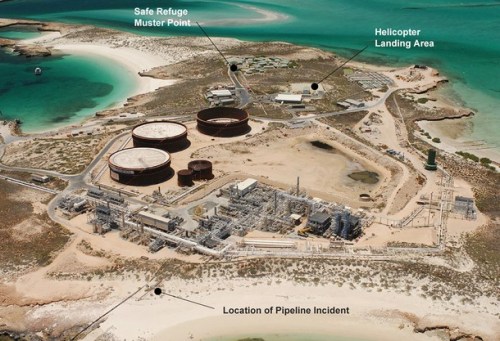
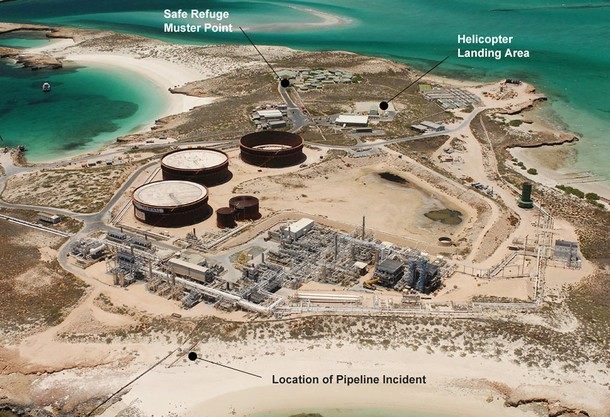
Varanus Island, Western Australia

Odd Finnestad, BOE’s Senior Vice-President for International Activities (note the recent promotion), and his talented, multi-lingual staff keep close tabs on investigations and accident reports worldwide.  Odd thinks we may be in for a long wait for the Montara report, so the BOE cyber vigil will not include any rash measures like hunger strikes.

While Australia does a great job of investigating, holding hearings, and preparing reports, they seem to struggle with the simple step of releasing those reports.  Odd reminds us that the report on the 2008 Varanus Island gas plant explosion has still not been released.  This important accident reduced Western Australia’s gas supply by one-third, and thus had major economic consequences. The Veranus report was finalized in June 2009, but maneuvering by the responsible party and legal reviews within the Western Australia Ministry for Mines and Petroleum have kept this report under wraps.  Now we are getting the same uncomfortable feeling about the Montara report.  Perhaps, Minister Ferguson will prove us wrong and release the Montara report without further delay.  We hope so!

Read Full Post »

  1. The big question with regard to acoustic backup systems for BOPs is whether ambient noise associated with a seafloor blowout prevents the signal from being reliably received.  The Macondo well would seem to provide an excellent opportunity for testing acoustic systems to see how effectively the signals are received under such challenging conditions.  Too late?
  2. Still no regular relief well reports, but Admiral Allen commented yesterday that they only have about 200′ to drill.  I’m assuming the 9 7/8″ liner has been set.  If all this is accurate and there are no weather or technical delays, they should be ready to intercept the well bore soon (1-2 weeks?), even with the added time for special ranging and directional surveys.
  3. Unless the relief well is delayed, it doesn’t seem to make sense to change the LMRP cap at this time.  Collection might improve somewhat with the new cap, but the well would be wide open during the change.
  4. Day 21 since the Montara report was delivered to the Ministry, and there are no recent news updates.  No interest?
  5. Very good article in Platts as the media begins to show more interest in regulatory approaches.

Read Full Post »

Those of us on the “Deepwater Response External Affairs” Mailing List received ten email updates yesterday.  Not one included relief well information. The relief well information that has been provided has been inconsistent and contradictory.

Given the importance of these wells and the apparent confusion among observers (a number of whom have contacted BOE), a daily relief well update would be appreciated, at least for the primary well.  It would be helpful if the subject line said “relief well update.”  This update should include the precise relief well depth, whether the depth is measured (total length) or true vertical, and the point of reference (e.g. below the sea floor).   A short summary of the operations over the past 24 hours would also be helpful.

Read Full Post »

  1. Montara watch: 19 days have now elapsed since the Montara Inquiry Report was presented to Minister Ferguson, and there are no recent media updates on the release of the report. Meanwhile, Australian radio has a good piece on Montara – long, but worth the time.
  2. Macondo: The relief well reports continue to be sketchy and inconsistent.  On July 4, the Unified Command reported that the primary relief well had reached 17,400′ (presumably measured depth), while  BP’s update for the same date indicated that the first well had reached 17,725′ (this too must also be measure depth, not true vertical depth).  It’s unclear whether the final casing (9 7/8″ liner) has been set.  Admiral Allen will likely provide a better update today.
  3. More regulatory philosophy: The regulatory system is at least as important as the specific operating requirements.   This UNEP piece provides a good summary of the strengths and weaknesses of different approaches.

Read Full Post »

« Newer Posts - Older Posts »