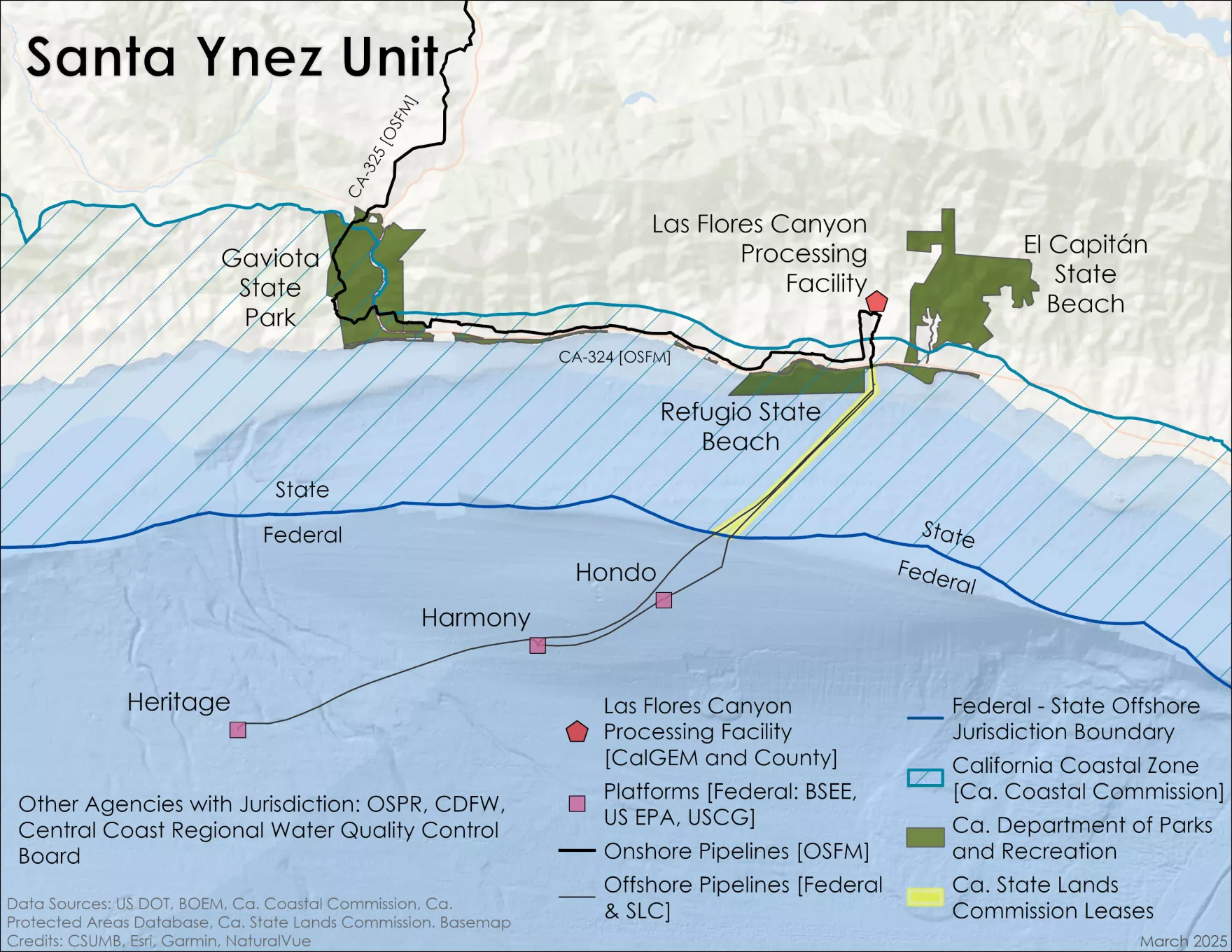
As posted on 9/10/2025 (prior to PHMSA’s assertion of jurisdiction): Given that the Sable pipeline will carry OCS production, it would seem to fundamentally be an interstate line (Federal jurisdiction), as it was when owned by Plains. Could DOT reverse the 2016 letter agreement? That is conjecture for the attorneys and courts to consider.
A new Bloomberg Law article explains PHMSA’s position after a challenge by the California AG:
PHMSA said state-based hurdles are preempted by federal authorizations in the emergency permit notice letter the agency sent to Sable last year. Because the pipeline originates on the Outer Continental Shelf, the system automatically comes under federal oversight, the agency said.
A law professor adds the following:
The administration is invoking interstate commerce to classify the pipeline as a federal issue, “arguing that this is between a place in a state and outside that state,” said Hannah Wiseman, a professor at the Penn State Dickinson Law.
They are claiming this under their interpretational authority, as opposed to the actual language of the Pipeline Safety Act,” she said.
The language of the law only assigns PHMSA jurisdiction over oil operations that run outside or between state lines, but here the agency is arguing the pipeline’s start point is on the OCS, not at the onshore processing facility, she said.
Not mentioned in the article but pertinent:
- In PHMSA’s favor, the onshore pipeline was initially under their jurisdiction.
- In California’s favor, a court approved Consent Decree clearly identifies the California Fire Marshal as the sole oversight authority.
Meanwhile, Kruti Shah cleverly summarizes the Santa Ynez Unit story in a series of posts on X. Click on the post below to get the full thread. Great read for Sable/SYU followers:
 Bud's Offshore Energy (BOE)
I agree with the comment in the article that President Trumps National Energy Emergency Proclamation could be the deciding factor in determining whether PHMSA can override California permitting requirements for restarting the SYU pipelines. California is an “energy island” with no pipelines connecting it with U.S. oil and gas production centers, which requires it to rely on imports for 75% of its needs the vast majority of which is imported on tankers. California’s major refineries (concentrated in the Bay Area and Los Angeles) are also specifically configured to process a “heavy sour” crude, the type of crude produced by SYU Platforms Hondo, Harmony, Heritage. Heavy crudes are needed to produce essential fuels like gasoline, diesel, and jet fuel, making heavy oil indispensable for refineries. Within California, there are 41 military airports, 9 international, and 145 private airports that depend on jet fuel produced by the California refineries. In-state production of heavy crude (most from Kern County) has also been dropping primarily due to depletion of oil fields, environmental restrictions, and California energy policy which requires the phase-out of oil and gas extraction by 2045. Approximately 65% of the heavy crude feedstock of California refineries is imported from Iraq (the largest supplier) Brazil, Ecuador, and Guyana, which makes California vulnerable to supply disruptions due to military conflicts, political instability, trade disputes. In short, PHMSA and the Trump administration can make a strong case for restarting the SYU pipelines based on national security considerations. Most likely this case will end up eventually going to the U.S. Supreme Court if Sable overcomes its financial challenges, or if the SYU facilities revert to ExxonMobil and it decides to take on the task of restarting SYU production
Excellent analysis.