Transocean Ltd. (RIG, RIGN.VX) said Thursday that a Swiss administrative court ruled that the company cannot pay out about $1 billion to shareholders because of the numerous Deepwater Horizon-related lawsuits pending against the rig owner in the U.S. Wall Street Journal
Posts Tagged ‘well control’
Swiss court blocks Transocean dividend payment
Posted in accidents, well control incidents, tagged accidents, Andarko, blowouts, bp, Cameron, Deepwater Horizon, drilling, Gulf of Mexico, macondo, Mitsui, offshore oil, safety, Switzerland, transocean, well control on December 11, 2010| Leave a Comment »
Good Wall Street Journal Article
Posted in accidents, well control incidents, tagged accidents, Australia, blowouts, Deepwater Horizon, drilling, Gulf of Mexico, macondo, Montara, offshore oil, oil spill, safety, well control on December 9, 2010| Leave a Comment »
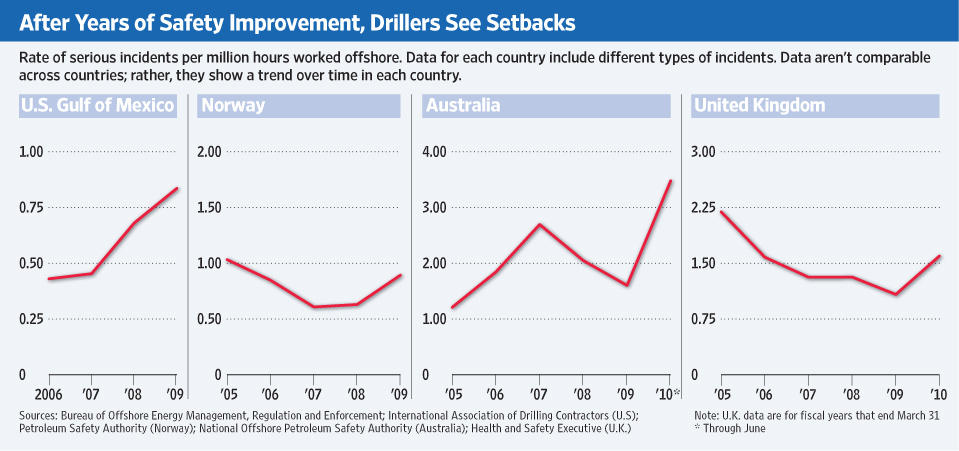
While the significance of these charts is debatable, the occurrence of two historic blowouts – Montara and Macondo – within an eight month period is a clear signal that we have problems. The disturbing similarities in these two blowouts tell us that well construction, monitoring, barrier verification, and personnel training practices are not where they should be.
More from the BOEMRE-CG Macondo Hearings
Posted in accidents, well control incidents, tagged accidents, blowouts, BOEMRE, Coast Guard, Deepwater Horizon, Gulf of Mexico, macondo, offshore oil, oil spill, safety, well control on December 8, 2010| Leave a Comment »
Workers on the doomed Gulf of Mexico oil rig were distracted by multiple activities going on simultaneously and didn’t try to shut the well until 49 minutes after potentially explosive gas particles began flowing in, a BP vice president told a federal investigative panel Wednesday.
Posted in accidents, well control incidents, tagged accidents, blowouts, Canada, CBC, Deepwater Horizon, drilling, Gulf of Mexico, macondo, offshore oil, oil spill, safety, well control on December 8, 2010| Leave a Comment »
 Blowout: Is Canada Next?

Thursday, December 9, 2010 at 9 pm on CBC-TV
If the title and announcement for this CBC documentary are indicators, this won’t be a scholarly review of the risks associated with Canadian offshore exploration and development. Nonetheless, those of you who can view CBC programming may want to tune in and see what they have to say.
National Commission Recommends “Safety Institute”
Posted in accidents, tagged accidents, Deepwater Horizon, Gulf of Mexico, macondo, National Commission, offshore oil, safety, Safety Institute, well control on December 2, 2010| 1 Comment »
As presented this morning:
- Core mission: achieve excellence in system safety across offshore oil and gas industryIndependent auditing function
- Cannot lobby – cannot be the American Petroleum Institute
- Company CEOs and boards of directors provide leadership and ensure engagement of employees with it
- Institute is empowered to use real rewards and sanctions to help all industry players overcome the enemies of safety –ignorance, arrogance, and complacency.
Australian Government accepts 92 Montara Commission recommendations; or did they?
Posted in accidents, well control incidents, tagged Australia, Montara, offshore oil, relief well, safety, well control on December 1, 2010| Leave a Comment »
According to the Australian Government’s report:
The draft Government response proposes accepting 92 recommendations, noting 10, and not accepting three. The three recommendations that are proposed not to be accepted relate to actions which are technically inappropriate.
While these numbers imply nearly complete Government concurrence with the Commission’s recommendations, the recommendation and response tables (beginning on page 17) tell a somewhat different story. A few examples follow:
- For some of the recommendations, the Government’s acceptance seems to have little significance. For example, recommendation 11 calls for a Memorandum of Agreement (MOA) among operators to provide emergency assistance in the event of a blowout. The Government “accepts” this recommendation by commenting that such an MOA is an industry matter. Since the Commission recommended that operators enter into a MOA, they clearly understood that this was an industry matter. That’s not the point. The Commission would no doubt like the Government to exercise its influence and authority to ensure that the MOA was prepared and executed in a timely manner. The Government made no such commitment in its response. When the Montara well blew out, every operator and drilling contractor in the region should have been prepared to suspend operations immediately and move their rig to the site. For reasons that remain unclear, that does not appear to have been the case.
- Other recommendations are accepted/dismissed by saying that the recommended action is “accepted industry practice.” While that may be true, the Commission is reminding us that there are problems and inconsistencies in the way industry interprets and applies these practices. How will the Government ensure that these challenges are addressed?
- Recommendation 19 calls for operators “to inform regulators of the proposed removal of a barrier, even if they consider that well integrity is not thereby compromised.” The recommendation specifically states that the “the information should be presented by way of a special report.” The Government’s “acceptance in part” reads like “rejection in full,” since the Government comments that existing rules cover this and that the providing this information in the daily drilling report is sufficient.
- Very good well control recommendations (57-62) are seemingly dismissed (although the text says they are accepted) by saying that “this is primarily an industry operational matter” and “the Government notes that operators already have well control and operating standards in place.” How is that “accepting” the recommendation? Yes, this is an industry matter, but improvements are needed in the standards and training, and it’s the Government’s responsibility to make sure that industry makes these improvements.
- Recommendation 65 pertains to safety culture issues that apply to well control. The Government dismisses the recommendation (“accepted in principle”) as an industry matter. Can the Government can do nothing to promote safety culture? Norway has had a safety culture regulation since 2002 and Dr. Mark Fleming, a leading researcher on the topic, made it quite clear in his Vancouver presentation that the Government can and must influence safety culture.
In accepting the Commission’s recommendations, the Government has an obligation to be make sure they are implemented, regardless of which party has primary responsibility for the action.
Well Capping Operations: Montara vs. Macondo
Posted in accidents, well control incidents, tagged accidents, Australia, blowouts, drilling, Gulf of Mexico, macondo, Montara, offshore oil, relief well, safety, well control on November 30, 2010| Leave a Comment »

West Atlas Jackup and Montara Wellhead Platform
While there has been much post-Macondo discussion about the complexity of subsea containment and capping operations for deepwater wells, Macondo was ultimately capped and killed before being intersected by the relief well. The same cannot be said for the shallow water Montara well, which was killed by a relief well after flowing for 74 days.
Capping a flowing well is never routine, regardless of the water depth. However, the safety risks are greater for surface wells. Those risks combined with the low probability of success are why a capping operation was not even attempted at Montara. These were the concerns:
- The risk of a fatality was estimated at an alarming 25-30%.
- The risk of ignition while retracting the cantilever of the West Atlas jackup, a necessary step in the capping operation, was high.
- Only the 20-inch casing was tied-back to the wellhead platform. The 13 3/8″ casing was suspended just above the water surface. (According to testimony during the inquiry, the 13 3/8″ casing was not cemented back inside the 20″ casing.)
- Unless they were going to tie-back the 13 3/8″ casing while the well was flowing (probably not feasible and not mentioned as a possibility in the Inquiry report), they would have had to install a specially made BOP on the 20.” If they were able to install this BOP and shut-in the well, flow would have undoubtedly broached the casing at the 20″ inch shoe. One possible alternative may have been to install a diverter under the BOP and attempt a dynamic kill operation (i.e. direct the flow downwind and away from the rig while pumping mud down the well). This too would have been complex and risky.
Given the very high safety risk and the low probability of success, I believe the regulator and operator made the correct decision in forgoing a capping attempt. The experiences at Macondo and Montara indicate that capping considerations must be taken into account during well planning activities for both subsea and surface wells, and that they latter pose greater safety risks. Given the fire potential, having the wellhead at the surface is not an advantage when it comes to capping a flowing well. It’s better to have the wellhead on the seafloor where the robotic equipment is doing the work.
Halliburton cementing study referenced in Montara Report
Posted in accidents, well control incidents, tagged accidents, Australia, blowouts, cementing, drilling, Gulf of Mexico, Halliburton, macondo, Montara, safety, SPE, well control, well integrity on November 29, 2010| Leave a Comment »
I was unaware of the Halliburton study referenced in the Montara Inquiry Report:
A 2001 Halliburton study of USA Gulf of Mexico cementing failures in 4000 wells showed that (i) approximately one in six casing shoes required remedial work after primary cementing (by way of a so‐called ‘squeeze job’); and (ii) intermediate casing shoes failed shoe tests 70 per cent more often than shallower casings because they were more likely to be over‐displaced.
This paper was presented at an SPE conference in New Orleans. Click here to purchase the paper or read a good abstract.
Questions:
- Have other analyses and reports been prepared using these data?
- Would Halliburton make the data base available for the common good if they receive legal protection?
- In light of the worldwide interest in better understanding well integrity risks, would Halliburton and others expand the data base to include other regions?
- Surely, there must be other private data bases that would be useful for assessing operational risks and developing mitigations. Are the owners willing to identify these data bases? Can they be protected from liability risks if they agree to make the information accessible?
Montara Inquiry Report – Cementing Items
Posted in accidents, well control incidents, tagged Australia, blowouts, cementing, Montara, offshore oil, oil spill, well control on November 26, 2010| Leave a Comment »
Selected cementing recommendations from the Montara report:
Recommendation 30: Tracking and analysis of cementing problems/failures should occur to assess industry trends, principal causes, remedial techniques and so on.
Comment: This is an excellent recommendation that needs to be expanded to include other failures (e.g. BOPE) and incident data.
Recommendation 31: It is recommended that industry, regulators, and training/research institutions liaise with one another with a view to developing better techniques for testing and verifying the integrity of cemented casing shoes as barriers (particularly in atypical situations such as where the casing shoe is located within a reservoir in a horizontal or high angle position at great depth).
Recommendation 33: It should be standard industry practice to re‐test a cemented casing shoe (that is, after WOC) whenever the plugs do not bump or the float valves apparently fail. Standard industry practice should require consideration of other tests in addition to a repeat pressure test.
Comment: Negative pressure test guidance should be the highest priority.
Recommendation 37: Consideration should be given to ways to ensure that contractors who are involved in barrier installation (such as cementing companies) have a direct interest in the performance of works to a proper standard. In particular, consideration should be given to (i) preventing contractors from avoiding the economic consequences of negligent installation of barriers; and/or (ii) imposing specific legislative standards of workmanship on contractors with respect to well control (similar to those which presently apply to licensees).
Comment: I’m not sure I agree with this one. It seems to me that one party should be responsible and accountable for the well construction, and that should be the operator. Operators should choose contractors who have outstanding performance records, apply the highest standards, and work effectively with the operator’s team to ensure that barriers are properly installed and tested.
Montara Report Released!
Posted in accidents, well control incidents, tagged accidents, Australia, blowouts, Montara, NOPSA, offshore oil, oil spill, relief well, safety, well control on November 24, 2010| Leave a Comment »
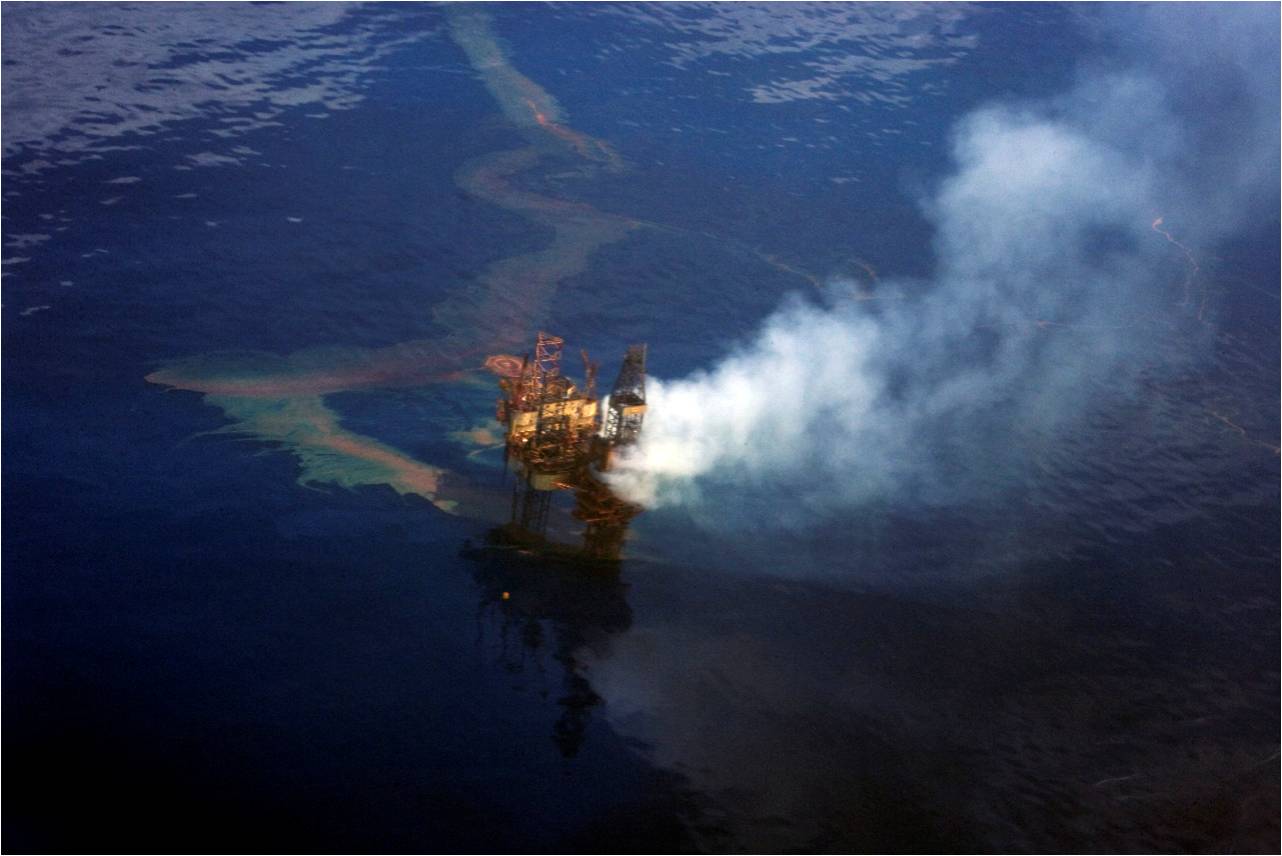
Montara Blowout - Timor Sea
Our virtual vigil is over. I awoke to messages from Odd, Anthea, and Kevin that the day had finally arrived – the Montara Report has been released. Not only do we have the Inquiry report, but also the government’s response and PTTEP’s action plan. We’ll be digesting this over the next few days (along with a turkey dinner), but below are a few key items (direct quotes from the government’s response) that are likely to be of interest to BOE readers:
- To create a single national regulator the Government will expand the functions of the existing National Offshore Petroleum Safety Authority (NOPSA) to include regulation of structural integrity, environment plans and day-to-day operations associated with petroleum activities in Commonwealth waters. There is a fundamental connection between the integrity of structures, the safety of people, and protection of the environment. The expanded authority – to be named the National Offshore Petroleum Safety and Environmental Management Authority (NOPSEMA) – will also regulate safety, integrity and environment plans for minerals extraction and greenhouse gas storage activities in Commonwealth waters.
- In recognition of the global nature of the offshore petroleum industry, and Australia’s increasingly important role, the Government intends to host an international conference for governments, regulators and the offshore petroleum industry to share the lessons from Montara and to learn from the experience of other nations. The conference will beheld in Australia during 2011.
- An important feature of objective-based regulation is that it encourages continuous improvement rather than acompliance mentality. It is essential that a regulatory system encourage the creator of the risk to move beyond minimum standards in a continuous effort for improvement, and not just accept the minimum standard. The risk of specific standards is that they can shift the burden of responsibility from the operator to the government and stifleinnovation. The Australian objective-based regime retains the focus clearly on the operator to evaluate risk andachieve fit for purpose design in order to reduce risk to ‘as low as reasonably practicable’.
 Bud's Offshore Energy (BOE)