Feeds:
Posts
Comments

Posts Tagged ‘well control’

Per the Platts Oilgram report that we posted on 17 March, here is the complete court filing..

These are the additional tests recommended by BP’s consultant Ralph Linenberger:

  • Removal and forensic analysis of each annular element
  • Hydraulic signature testing of the annular preventer operator and ram preventers operators
  • Disassembly and inspection of the annular preventer and ram preventer bonnets
  • Laser scanning of (i) the entire BOP wellbore; (ii) the upper annular packer and upper annular cap; (iii) the inside of the riser kink; and (iv) the wellbore-facing surfaces of the casing shear ram bonnets
  • Hydraulic circuitry pressure test
  • ST lock circuit confirmation
  • Solenoid pie connector pin measurement and corresponding female receptacle analysis.

Is anyone else surprised that some (all?) of these tests hadn’t already been conducted? That would seem to be the biggest revelation from the BP court filing.

Read Full Post »

From Platts Oilgram News:

BP seeks Macondo BOP access to perform tests Washington—BP is seeking access to the Deepwater Horizon blowout preventer so it can run tests the company says the joint investigation has failed to perform. BP filed a motion in US District Court for the Eastern District of Louisiana in New Orleans March 9, asking Judge Carl Barbierto allow the company access to the BOP after the joint investigation being run by the US Coast Guard and the Bureau of Ocean Energy Management, Regulation and Enforcement, is finished with it. The BOP, a five-story stack of valves, sat atop BP’s Macondo well in the Gulf of Mexicoand failed to suppress a blowout April 20,2010. The blowout killed 11 workers fromTransocean’s Deepwater Horizon rig and triggered a massive oil spill. The joint investigation, under the supervision of the Department of Justice, has been conducting tests on the BOP at a NASA facility in Michoud, Louisiana. DNV Columbus washired to conduct the forensic tests and BP,Transocean, and Cameron, which made the BOP, have been observing.The test results are supposed to be delivered to the joint investigation by March 20. Hearings on the BOP are scheduled for the week of April 4. In its motion, BP said it submitted to the Joint Investigation Team a list of highly technical tests it felt should be conducted, but that the final list of approved tests did not include several of the items BP and other companies had requested.“BP, however, believes that performance of these forensic activities will add value to an analysis of why the BOP did not work as intended on April 20, and recommends they be completed,” the company said in its court brief.— Gary Gentile

Read Full Post »

Summit Entertainment, Participant Media and Imagenation Abu Dhabi, have announced that they’ve acquired the film rights to a 2010 New York Times article on the BP oil spill.Forbes

This is the excellent New York Times piece referenced in the quote.

Read Full Post »

Jason Anderson, Dale Burkeen, Donald Clark, Stephen Curtis, Gordon Jones, Roy Wyatt Kemp, Karl Kleppinger, Blair Manuel, Dewey Revette, Shane Roshto and Adam Weise.

They are the 11 workers who died when the Deepwater Horizon burned and sank in the Gulf of Mexico last year.

Their names need to be stated, to be remembered, because they were clearly forgotten as the industry gathered for the CERAWeek conference in Houston this week. Houston Chronicle

Comment: The sad truth is that the Macondo tragedy would have received very little attention if the fatalities were not followed by a major oil spill.  There would have been no moratorium, no National Commission, no Chemical Safety Board review, and no Justice Department investigation.   The last major multi-fatality accident in the Gulf, the South Pass 60 B fire that killed seven workers in 1989, received almost no national attention.  A minor spill offshore California receives more coverage than a multi-fatality event in the Gulf.

When every casualty, every gas release, every well control incident, and every structural failure is fully and publicly reviewed, we will be well on our way toward preventing not only injuries and fatalities, but also spills and environmental damage.

Read Full Post »

From Platts Oilgram News article by Gary Gentile:

The team examining the BOP in Louisiana conducted tests in January and February of this year that showed that with the proper amount of hydraulic fluid pressure, the rams on the BOP would close, according to Dan Tillema, an investigator with the US Chemical Safety Board.

Portions of drill pipe were found in the BOP and the pipe was cut, Tillema said—a sign that the rams did close at some point during the incident.

But Tillema cautions against making any assumptions based on the test results sofar. Some reports have suggested that rubber gaskets around the rams were worn awayby the massive flow of oil and gas gushing from the Macondo well, overcoming the BOP’s capacity. That is just one of several possibilities, Tillema said. “We haven’t made any conclusions yet,” he said.

Read Full Post »

Transocean Ltd., the world’s largest offshore oil driller, may attempt to recover some or all of the Deepwater Horizon rig that exploded and sank during last year’s Macondo well disaster. Bloomberg

U.S. Attorney Steve Overholt told District Judge Carl Barbier that testing of the failed blowout preventor (BOP) that led to the Deepwater Horizon oilrig explosion should be done by the end of this week. Louisiana Record


Read Full Post »

Good Nola.com article on the well containment systems

Comments on well capping and containment:

  1. Capping and containment systems, while important and necessary, are for blowout response, not blowout prevention. Their use, successful or otherwise, would only occur after a series of unacceptable failures.
  2. Having two capping and containment consortia in the Gulf of Mexico (and none anywhere else in the world) does not seem to be very cost effective or efficient.
  3. What are the plans for subsea capping and containment systems elsewhere?
  4. A capping/containment capability would not have saved a single life on the Deepwater Horizon. Verified barriers must be in place to prevent flow from the well bore.
  5. The well responsible for our other major drilling blowout spill (Santa Barbara – 1969), was capped at the surface by closing the blind ram on the BOP shortly after flow began. However, capping doesn’t work if you don’t have a competent well bore. The well flowed through numerous channels back to the seafloor.
  6. Capping subsea wells is safer than capping surface wells.
  7. Capping the Montara blowout (2009) in only 80m of water was neither safe nor technically feasible because of the way the well was suspended. Despite the complete absence of a capping option at Montara, the capping of surface wells has received little attention.
  8. The more critical, but less publicized, post-Macondo initiatives pertain to well design, construction, and verification. In that regard, important new standards, including the Well Construction Interface Document, are scheduled to be completed soon. That work must not be delayed.
  9. While capping stacks and containment systems will only be used in the event of a series of major failures, design and construction procedures are critical every time a well is drilled. The importance of the initial design decisions continues into the production phase and beyond, even after the well has been plugged and abandoned.

Read Full Post »

These hearings should be interesting:

The JIT expects to hold another set of public hearings the week of April 4 to focus specifically on the BOP and findings from the forensic examination. BOEMRE and the USCG expect to issue a joint release regarding the investigation by mid-April.

Read Full Post »

Giant metal shears successfully sliced and closed pipe full of runaway crude in the early moments of last April’s Deepwater Horizon disaster, but the oil blasted through rubber gaskets around the blades and unleashed the nation’s largest spill, according to sources familiar with an ongoing investigation. Houston Chronicle

That would be consistent with the video evidence recorded on the Q4000, but we still need a lot more information about the timing of the shear ram closure, the position of the ram and drill pipe before and after shearing, maintenance, and other important BOP issues.

Kudos to the Chronicle for their ongoing coverage of Macondo issues.

Read Full Post »


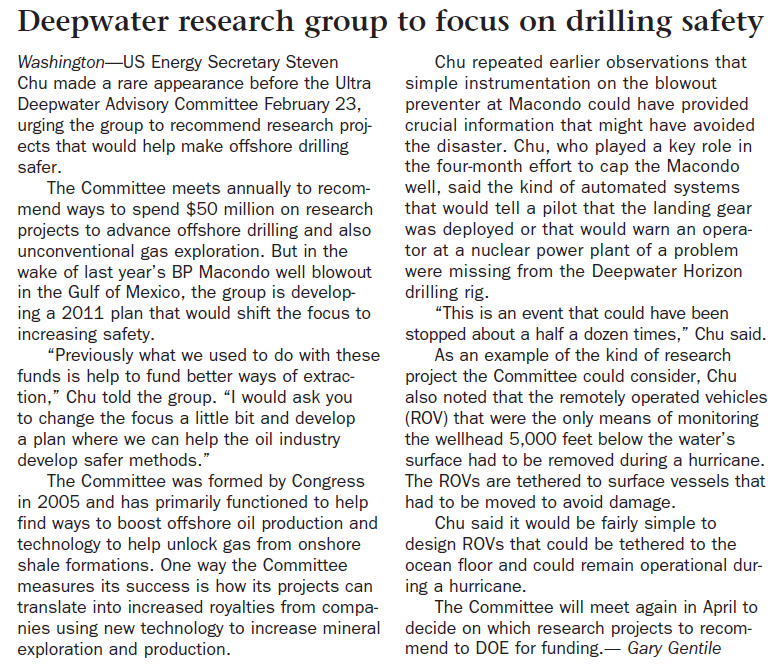
Few Cabinet Secretaries are scientists or engineers, and none has been a Nobel Prize winner. We expect Secretary Chu to be different and yesterday’s meeting with DOE’s Ultra-Deepwater Advisory Committee was not your typical Washington “hit and run” performance. Rather than making a quick speech and running along to his next appointment, Secretary Chu engaged in technical dialogue with our committee for a full hour, offering insights and responding to questions. Among the topics discussed were BOP instrumentation and monitoring, well integrity, ROV/AUV issues, and Macondo findings.

Kudos to Secretary Chu for his commitment to offshore safety.

Gary Gentile published this report on the meeting in Platts Oilgram News. (click on the story to enlarge)

Read Full Post »

« Newer Posts - Older Posts »