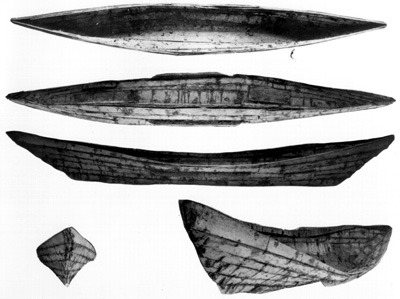
canoe caulked with asphaltum from natural seeps
The first consumers of petroleum used oil that seeped to the surface naturally. Native Americans in California used petroleum seepage to caulk their canoes. Marco Polo witnessed oil being recovered from seeps in 1264 in Baku (then part of Persia).
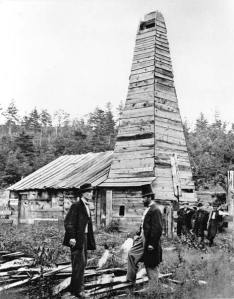
Drake Well, 1859, Titusville, PA
Natural seeps helped Colonel Drake target the first commercial oil well in the U.S. (Titusville, PA, 1859). The amount of oil that seeps to the earth’s surface is surprisingly high. In fact, a Norwegian Petroleum Directorate article on natural seeps estimates that “at least 1/3 of all oil formed below ground escapes to the surface as seepage.”
Natural seepage has increasingly factored into the offshore drilling debate. The MMS Oil Spill Fact Sheet notes that “natural seeps introduce 150 times more oil into U.S. marine waters than do OCS oil and gas activities.” These data are intended to provide context, not to downplay the significance of drilling and production spills. A large spill is an undesirable event at the location where it occurs, regardless of how the spill’s volume compares with regional, national, or international seepage totals.
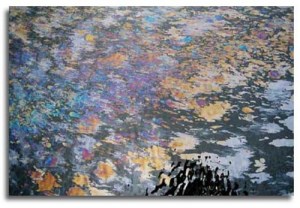
Natural Seeps, Coal Oil Point
A California advocacy group, Stop Oil Seeps, has taken the “seep argument” a step farther by promoting offshore production as a means of reducing natural seepage and the associated air and water pollution.
While SOS’s position is interesting and perhaps justified for areas like Coal Oil Point (Santa Barbara Channel), not all production prevents or reduces seepage. Offshore oil and gas seepage results when hydrocarbon-bearing formations are exposed to the sea floor either directly or via fractured or permeable overlying sediments. Where such conditions do not exist, oil and gas production will not reduce seepage. SOS’s enthusiastic support for California offshore production is refreshing, but advocates should exercise caution in making claims regarding seepage reduction. Prospects for seepage reduction from offshore production range from highly likely (Platform Holly and Coal Oil Point) to highly unlikely (deep formations protected with impermeable cap rock).
While we applaud their enthusiastic support for offshore production, the SOS plan raises a number of questions:
- Is SOS suggesting that offshore production only be allowed if such production will reduce seepage?
- How much can offshore production reduce overall seepage in the region? Is it cost-effective and feasible to achieve significant, long-term reductions in seepage that has existed for thousands of years?
- If the objective is to produce oil and gas, and generate the associated revenues, why not say that straight away? Why is seep reduction necessary to justify responsible offshore production?
- Since the resources of the OCS are owned by all Americans, how does California justify “negotiating to retain the full fees and royalties for federal OCS leases and production revenue.” Should Louisiana, Texas, Alaska, and other states also receive all fees and royalties for production from Federal waters? Should these payments be retroactive? Should states also receive all royalties and fees for wind and hydrokinetic energy produced in Federal waters?
While Platform Holly may be a negative spillage facility (i.e. Holly’s seep reduction may significantly exceed the platform’s production spillage), this type of seepage reduction has not been demonstrated at other platforms. Decisions on offshore exploration and development should be driven by the economic, energy security, and environmental benefits. To the extent that production reduces natural seepage, all the better. However, seepage reduction is not a primary reason for producing offshore oil and gas.
Read Full Post »


 Bud's Offshore Energy (BOE)