Feeds:
Posts
Comments

Posts Tagged ‘Petrobras’

The recent departure by Petrobras from Cuba should not be taken as a final verdict on Cuba’s oil and gas potential, or as a signal on possible strained political relations between the governments of Cuba and Brazil.

It was simply an economic and strategic decision by Petrobras, following their long term-vision of focusing resources on developing its recently found 10 billion barrels of deepwater offshore oil and natural gas at the Santos and Campos basins, along the Atlantic coast. As Petrobras CFO Almhir Guilherme Barbassa recently stated in a Forbes interview: “…Petrobras has more to gain from organically growing its position in Brazil than going abroad to expand production.” Cuba Headlines


Read Full Post »

  1. The Petrobras Cascade-Chinook project, which includes the first Floating Production Storage and Offloading (FPSO) facility in the Gulf of Mexico, received final approval.
  2. The US will be a major purchaser of Brazilian (Petrobras) deepwater oil production. Will some of the tankers pass through US offshore areas that are closed to exploration and production?

Read Full Post »

The tragedy in Japan has added yet more uncertainty to nervous energy markets:
Japan will likely need more imported oil and natural gas due to closures of nuclear reactors caused by Friday’s earthquake and tsunami, but volumes can’t be calculated accurately as it is unclear how much industrial output has been affected by the disaster and how long power nuclear and thermal power plants will remain closed. Wall Street Journal
It’s much too early to gauge how the nuclear power industry, which some have touted as a model for safety achievement, will be affected.
    Standards news and discussion:
    Offshore Safety Institute?
    The CEOs of major oil and gascompanies will meet March 18 to decide how to proceed with the formation of a US offshore drilling safety institute, William Reilly, the co-chair of the National Oil Spill Commission, said March 8. Platts Oilgram News
    New twist in Cuban drilling drama – Petrobras relinquishes interest
    Marco Aurelio Garcia, foreign policy adviser to President Dilma Rousseff, told reporters in Havana exploratory work off Cuba’s northern coast had not shown good results and that Brazil wanted to concentrate on its own oil fields.
    Since BP’s disastrous Deepwater Horizon accident in the Gulf of Mexico last April, the risks of offshore oil drilling have been a hot topic. One place it isn’t questioned much is Brazil, whose oil production industry is one of the fastest-growing in the world because of vast new deepwater oil reservoirs discovered in the past five years.
    Mexican Deepwater Update (Platts Oilgram News)
    Pemex has just begun to explore in Mexico’s Gulf of Mexico waters deeper than 1,000 feet, but 28 billion undiscovered barrels of oilequivalent are thought to exist in that area, some of which borders US territorial waters. Pemex officials said the company is forging a development plan for its first deepwater field, Lakach, located northeast of the state of Veracruz in about 3,200 feet of water. First production is expected in 2015.
    Environmentalists are furious at a proposal by the petroleum company Shell to start exploration drilling off one of Western Australia’s most treasured reefs. Ningaloo Reef off the north-west coast, has been nominated for World Heritage listing.

Read Full Post »

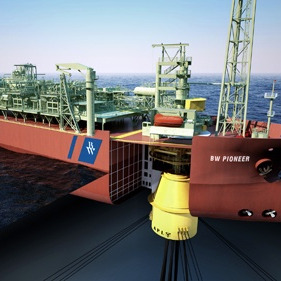
BW Pioneer

The US Coast Guard has issued the first ever Certificate of Compliance for a Floating Production Storage and Offloading (FPSO) facility in the Gulf of Mexico.

The BW Pioneer, under lease to Petrobras, will operate in the Cascade and Chinook fields.

Read Full Post »

BOE’s Chery Anderson has alerted us that the Petrobras P-33 platform, which had been shut-in at the direction of the Brazilian regulators, has resumed production. Unfortunately, as has been the case with many post-Macondo articles, the author felt compelled to link the Petrobras problem to deep water.

…the accident once again raised concerns about the safety of deep-water oil output in the wake of last year’s disaster in the U.S Gulf of Mexico.

Contrary to popular opinion, water depth was a relatively minor factor in the Macondo blowout, and had nothing to do with the maintenance issues at the P-33 and other Campos basin facilities. Shallow water was a more significant contributing factor to the Montara blowout (batched completions, mudline suspensions, and two-stage platform installation) than deep water was at Macondo.

Read Full Post »

Reposted from Platt’s Oilgram News (31 January 2011):

Brazil’s Petrobras said January 28 it was forced to shut output at its Cherne II production platform after a January 19 fire on the structure, one of the oldest working in the offshore Campos Basin. The fire in an oil transfer pump unit was brought under control without injuries to crew members, damage to the environment or major structural damage to the platform, Petrobras said in a statement. The platform was producing about 9,300 b/d of crude oil when output was shut, Petrobras said, adding the field should be ready to restart production on February 1. Brazilian oil regulators, the country’s navy and environmental officials, and Petrobras technicians are investigating the cause of the fire, Petrobras said. The platform is one of two in the Chernefield, which recorded output of about 22,000 b/d of crude in November. Brazil’s petroleum regulator had an on-site inspection of the platform scheduled for June.—Jeb Blount

Read Full Post »

Courtesy of Upstream:

UK Workers Accuse Transocean of Bullying and Intimidation.

Union Calls for Shutdown of the P-31, 33, and 35 Floating Production Facilities offshore Brazil.

Read Full Post »

The above photo, which was sent to BOE in an email message, illustrates that BOP tests are not risk free.  Apparently a pipe ram was blown out of the BOP during a stump (pressure) test prior to running the stack.  Fortunately, no injuries were reported.

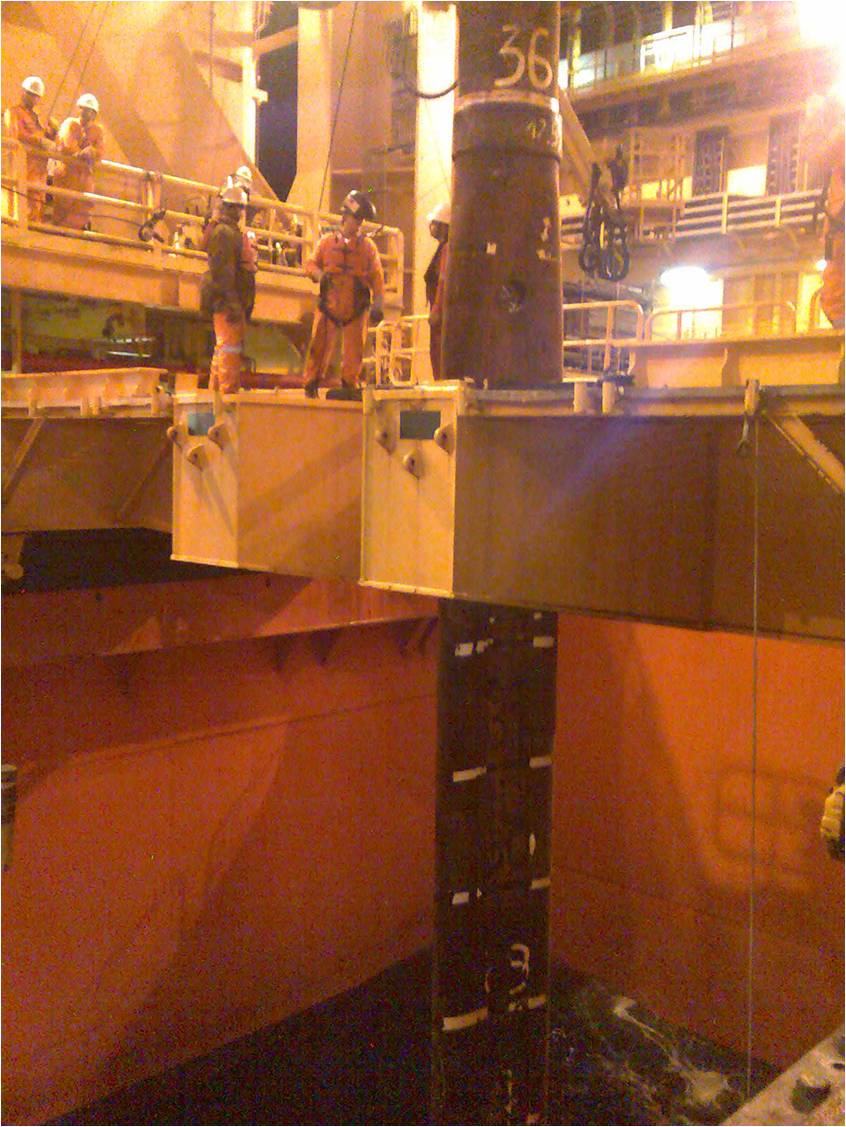
Also (below), the 36″ conductor casing was flattened when the casing was run without ensuring that it was filled with sea water.

According to RigZone, the West Polaris is working for Petrobras offshore Brazil.

Read Full Post »