Feeds:
Posts
Comments

Posts Tagged ‘oil spill’

In the Wall Street Journal, Rex Tillerson says that the Macondo blowout was not caused by systemic problems within the industry:

The explosion aboard the Deepwater Horizon rig, resulting in the massive oil spill in the Gulf of Mexico, was caused by its operators’ decisions and not by general problems in the oil industry, Exxon Mobil Corp. Chief Executive Rex Tillerson said Thursday.

But then seems to contradict that statement:

“It’s really up to the industry” to make sure regulation is strong and disasters like these don’t happen again, he said.

So, isn’t the second quote acknowledging a systemic problem?

Read Full Post »

Wall Street Journal

The conclusions of the presidential commission’s inquiry into the causes of the Deepwater Horizon accident published Thursday make it increasingly likely that BP will not be found grossly negligent and will avoid the harshest financial penalties for the Gulf of Mexico oil spill.

Pre-trial orders

Siding with arguments by the Plaintiffs, Judge Barbier concluded that the depositions should go forward in New Orleans, rather than in Houston as preferred by BP.

BP vs. TO vs. Halliburton (quotes from New York Times article)

In a statement on Wednesday, BP noted that the commission had found fault with a number of companies, not only BP, the main owner of the well.

Halliburton said in a statement that it had acted at BP’s direction in preparing and injecting cement into the well. It said tests the panel identified as indicating problems with its cement formula were preliminary and did not contribute to the disaster. Halliburton also criticized the commission for what it called selective omissions of exculpatory material it gave to the panel’s staff.

A spokesman for Transocean said that BP, not Transocean, made the major decisions in the hours before the blowout. “Based on the limited information made available to them, the Transocean crew took appropriate actions to gain control of the well,” the spokesman said. “They were well trained and considered to be among the best in the business.”

Read Full Post »

A colleague sent a link to a Marathon Oil Company Macondo presentation that was posted by the Houston Chronicle. The presentation was intended for internal training and discussion purposes.

Firstly, I applaud Marathon for ensuring that the blowout is studied and debated within the company. Hopefully, they did the same thing for Montara, have a good internal system for studying accidents throughout the industry, and thoroughly investigate all of Marathon’s incidents and near misses.

I thought Marathon’s comments about safety culture were particularly interesting, including these on slide 58:

Although harder to define and measure, and even more difficult to regulate, we pointed to our culture as the single most important differentiating attribute when comparing us to BP.

In a recent meeting with an individual who has numerous dealings with BP, he observed that regardless of the purpose of the gathering (planning session to morning rig call), it is almost impossible to determine who is ultimately responsible and accountable for the operation being discussed. Evidence of this exists in the very report this presentation was derived from.
I wonder what convinces Marathon that their safety culture is superior. The above anecdote, while interesting, doesn’t tell us much. Prior to Macondo (and perhaps even after the blowout), I’ll bet most BP employees thought that they had a strong safety culture. Ditto for Transocean. Does Marathon have any better evidence demonstrating the strength of their safety culture? If not, what makes them so confident? Does Marathon have a process for assessing and monitoring the attitude and commitment of their employees? Have they conducted regular internal surveys to gauge safety culture? My sense is that they have not. If they had, they could make their case without the very subjective comparison with BP.

Read Full Post »
BOE applauds retired offshore regulators Ian Whewell (UK HSE) and John Clegg (NOPSA Australia) for their excellent participation in yesterday’s hearings. No one is wiser than a retired regulator. 😉

Also, Magne Ognedal overcame technical glitches to make an important long-distance contribution from Norway.  Those who have not yet read our interview with Magne should take the time to do so.  In this interview, which was conducted before Macondo, Magne concisely answers most of the questions about the Norwegian regime and regulatory philosophy that have arisen since the blowout.

Read Full Post »

In addition to suing for damages, the Justice Department is seeking civil penalties.  The amount has not been specified.

In the complaint, the United States alleges violations of federal safety and operational regulations, including:

  • Failure to take necessary precautions to secure the Macondo Well prior to the April 20th explosion;
  • Failure to utilize the safest drilling technology to monitor the well’s condition;
  • Failure to maintain continuous surveillance of the well; and
  • Failure to utilize and maintain equipment and materials that were available and necessary to ensure the safety and protection of personnel, property, natural resources, and the environment.

Read Full Post »

Agenda

Live Webcast

Read Full Post »

Helix Q4000

Helix’s system, a competitor to a project led by Exxon Mobil Corp that is still in the planning stages, is built from equipment that was used to siphon oil from the sea floor after BP Plc’s Macondo well ruptured on April 20. Reuters article

Interesting. We don’t know the details, but this would seem to be a cost-effective approach that could be quickly implemented.

Read Full Post »

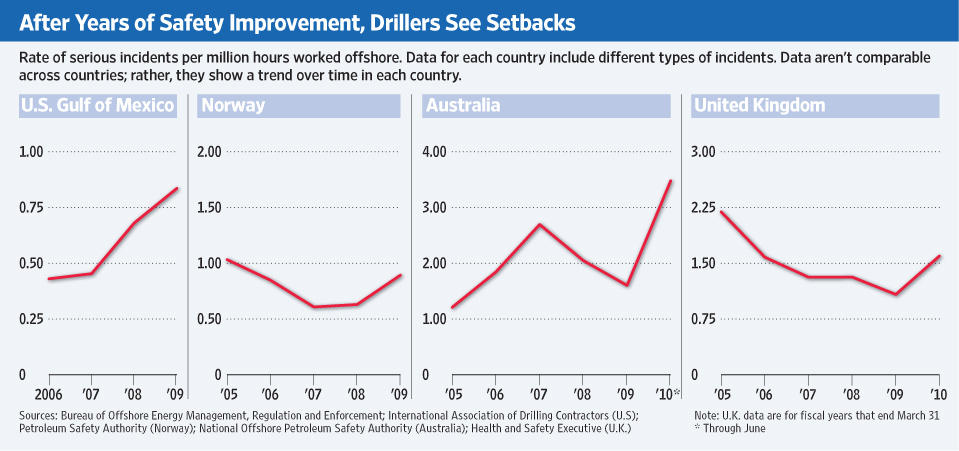
While the significance of these charts is debatable, the occurrence of two historic blowouts – Montara and Macondo – within an eight month period is a clear signal that we have problems. The disturbing similarities in these two blowouts tell us that well construction, monitoring, barrier verification, and personnel training practices are not where they should be.

Link to article

Read Full Post »

Washington Post report:

Workers on the doomed Gulf of Mexico oil rig were distracted by multiple activities going on simultaneously and didn’t try to shut the well until 49 minutes after potentially explosive gas particles began flowing in, a BP vice president told a federal investigative panel Wednesday.

Read Full Post »

Blowout: Is Canada Next?

Thursday, December 9, 2010 at 9 pm on CBC-TV

If the title and announcement for this CBC documentary are indicators, this won’t be a scholarly review of the risks associated with Canadian offshore exploration and development. Nonetheless, those of you who can view CBC programming may want to tune in and see what they have to say.

Read Full Post »

« Newer Posts - Older Posts »