Feeds:
Posts
Comments

Posts Tagged ‘oil spill’

…. and gleeful. 

“Is there likely to be litigation over new drilling permits? You bet there is,” said David Petit, a senior attorney with the Natural Resources Defense Council.

“We’ll definitely litigate it,” Kieran Suckling, executive director of the Center for Biological Diversity, said of the federal approval of Shell’s plan. “It’s patently illegal.”

Environmental Suits Threaten Gulf Drilling- Wall Street Journal

Read Full Post »

Chapter 6

Good Woods Hole Oceanographic Institute videos about their participation in the Deepwater Horizon scientific effort. 

Read Full Post »

oil-eating bacteria

scientists led by Terry Hazen, a microbiologist at Lawrence Berkeley National Laboratory, discovered that cold-loving microbes were making quick work of the oil (Greenwire, Aug. 24, 2010). These bugs were, in effect, oil-seeking missiles. They were highly mobile, armed with swimming flagella and protein sensors that could guide them to their oily prey, according to additional work so far unpublished by Hazen’s group.  New York Times

Read Full Post »

This makes sense

“One of the goals potentially of the MWCC group is to see how we can work together with the Helix group to try to accommodate solutions for all of the Gulf of Mexico,” Dupree (BP) said.

Read Full Post »

AP report:

“The Deepwater Horizon BOP was unreasonably dangerous, and has caused and continues to cause harm, loss, injuries, and damages to BP (and others) stemming from the blowout of Macondo well, the resulting explosion and fire onboard the Deepwater Horizon, the efforts to regain control of the Macondo well, and the oil spill that ensued before control of the Macondo well could be regained,” BP said in the suit.

Read Full Post »

Jupiter Flotel

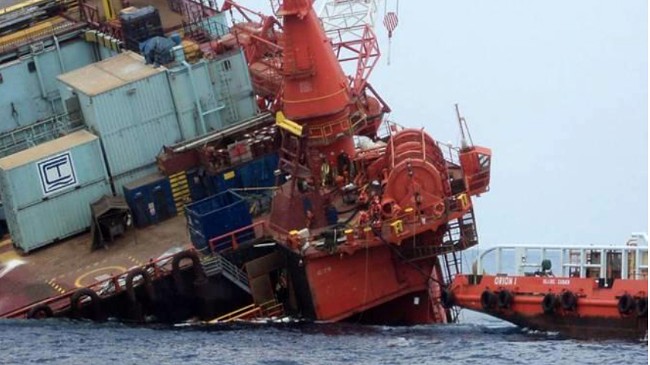
….interest in offshore accidents quickly diminishes.  The Pemex Jupiter semisubmersible quarters facility sank last week with 713 workers aboard (fortunately all were safely evacuated). This stunning near-disaster received minimal coverage. Follow-up reports are non-existent.  As our friend JL Daeschler asked, how does a flotel capsize in calm conditions and shallow water? What went wrong and why? Let’s hope that a comprehensive investigation is conducted and that the findings are shared worldwide (unlike Venezuela’s handling of the Aban Pearl sinking).

As we have noted before, Macondo would have disappeared from the news within a week if the deadly fire and explosion had not been followed by a sustained oil spill. The only investigation would have been by Coast Guard and the Minerals Management Service (which would likely still exist). There would have been no National Commission, National Academy, Chemical Safety Board, or congressional investigations, and prosecution by the Justice Department would have been unlikely.

In the US, offshore spills are media events; other accidents are not. How much attention did the horrific fire and explosion that killed seven workers on the South Pass 60 B Platform receive in 1989? Virtually none. How about the lives lost in helicopter crashes? While the crash that killed 17 off Newfoundland in 2009 has been well studied and reported, offshore helicopter crashes in the US receive almost no attention. Ditto for crane accidents. If we want to build a proper safety culture, we need to pay as much attention to the low-profile accidents as we do the pollution spectaculars, and everyone needs to participate.

Read Full Post »

Good report; worth reading.  Some of the positive points are unlikely to get much attention, so we’ll mention them here:

  1. The National Incident Management System/Incident Command System worked as intended
  2. Personnel provided by the Responsible Party (RP) and Coast Guard personnel worked effectively together, and there was “unity of effort” throughout the response organization.
  3. The team found no evidence of collusion between the Coast Guard and RP.
  4. The response generally benefited from the ability of the Government and the private sector to rapidly assess and adapt to new or unusual contingencies and develop innovative solutions for problems not previously experienced.
  5. The knowledge acquired and capabilities learned from this experience are unprecedented, and should become a basis for significant improvements in planning, preparedness, and response for industry, Government, and the response community.

The “Political Demands” section beginning on page 75 includes relatively candid observations on the challenges associated with the management of such a high profile response.

Read Full Post »

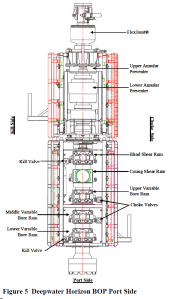
In a previous post, we discussed JL Daeschler’s comments suggesting that the emergency disconnect sequence (EDS) may have actuated the shear ram, but that the sequence aborted when the ram did not close fully. Another knowledgeable commenter, while requesting not to be named, noted that:

Whether the EDS-functions terminated before the sequence was completed is clearly a relevant question.

I agree and believe this possibility may have been dismissed without being fully considered. The DNV report claims that the EDS sequence never actually initiated, probably because of a loss of communication with the stack after the initial explosion.  As evidence, the report offers the following:

There is an account of lights flashing, indicating that the EDS function had initiated. There are no accounts of any specific lights going steady, which would have indicated a function had been completed and confirmed by the subsea control pods.

Comment: Perhaps no light stopped flashing because the first step in the sequence, BSR actuation, was not concluded (i.e. the BSR never fully closed).

Reviewed ROV video indicated no evidence that the sequence had initiated; the LMRP remained latched to the BOP, the Blue and Yellow Control Pod stingers were not retracted.

Comment: This only tells us that the sequence terminated prior to unlatching he LMRP and retracting the pod stingers.  It says nothing about the timing of the BSR closure.

Note that pages 166-167 of the DNV report indicate that the EDS was manually functioned (at the test facility) via surface control and that it functioned as intended.

The report also confirms that the accumulators were functional:

HP Shear Close, EDS, AMF/Deadman and Autoshear have a common reliance on the accumulator bottles (8 x 80 gallon) located on the BOP. Testing of these accumulators determined that they functioned as intended in the as-received condition.

The report goes on to say:

This is further indication the BSR’s were activated either by the Authoshear or possibly the AMF/Deadman functions. No further failure cause analysis was performed.

Comment: So why was the EDS ruled out as the trigger for the BSR activation? Also, if the shear ram was activated by the AMF, why did that sequence terminate after the ram closed (partly)?

Comment on the riser disconnect: While closure of the BSR is a critical first step in the EDS or AMF sequence, riser disconnect, which has received very little attention, is equally important. To prevent flow, you want the well sealed before you disconnect the riser and the column of drilling fluid contained within. However when an EDS is activated, there is a good chance that the well may already have started to flow. Under those circumstances, you need to quickly disconnect the riser so the workers can be removed from the threat. In the case of the Deepwater Horizon, the failure of the riser to disconnect is as significant as the  failure of the BSR to seal the well. Although the EDS may have been activated too late to save the workers who lost their lives, they would likely have been safe if the rig had been disconnected from the well prior to the initial surge.

Read Full Post »

Fair or harsh? You be the judge.

Federal prosecutors are considering whether to pursue manslaughter charges against BP Plc (BP/) managers for decisions made before the Gulf of Mexico oil well explosion last year that killed 11 workers and caused the biggest offshore spill in U.S. history, according to three people familiar with the matter. Bloomberg

Read Full Post »

The American Academy for Microbiology has published an excellent summary document about microbial degradation of oil spills. Take a look; the report is concise and understandable.

Read Full Post »

« Newer Posts - Older Posts »