Posts Tagged ‘offshore oil’
Upstream Reporting Plan for Second BOP
Posted in accidents, well control incidents, tagged accidents, blowouts, Deepwater Horizon, drilling, Gulf of Mexico, macondo, offshore oil, oil spill, safety, well control on May 3, 2010| Leave a Comment »
Reader Input
Posted in accidents, well control incidents, tagged accidents, acoustic BOP, blowouts, Deepwater Horizon, drilling, Gulf of Mexico, macondo, offshore oil, oil spill, safety, well control on May 1, 2010| Leave a Comment »
A couple of points raised by our highly informed readers:
1. With regard to allegations about deficiencies in BP’s Atlantis (deepwater production facility), an industry source closely involved with the project (but not a BP employee) offered the following comment:
Atlantis was by far, in my opinion, the best of the bunch; proceeded as a normal construction project. The PMs were the best I’ve come across
2. While the absence of an acoustic backup system (BOP) no longer seems to be significant in this case, the effectiveness of such systems is an important point of discussion. Some readers have voiced support for acoustic backups. Others believe the ambient noise associated with a seafloor blowout would render these acoustic systems ineffective. Has the noise issue been evaluated? Should a Joint Industry Project be initiated to evaluate the performance of these systems?
Interview with Deepwater Horizon Survivor
Posted in accidents, well control incidents, tagged Australia, blowouts, Deepwater Horizon, drilling, Gulf of Mexico, macondo, offshore oil, safety, well control on May 1, 2010| Leave a Comment »
Mark Levin interviewed a DWH crew member who provides insights regarding the events leading up to the blowout and the evacuation. His comments are generally consistent with the Halliburton release (below) and the “street-talk” about the status of operations at the time of the incident. I suggest that you take a few minutes to listen.
Interesting Release from Halliburton
Posted in accidents, well control incidents, tagged accidents, blowouts, Deepwater Horizon, Gulf of Mexico, macondo, offshore oil, oil spill, safety, well control on April 30, 2010| Leave a Comment »
As one of several service providers on the rig, Halliburton can confirm the following:
— Halliburton performed a variety of services on the rig, including cementing, and had four employees stationed on the rig at the time of the accident. Halliburton’s employees returned to shore safely, due, in part, to the brave rescue efforts by the U.S. Coast Guard and other organizations.
— Halliburton had completed the cementing of the final production casing string in accordance with the well design approximately 20 hours prior to the incident. The cement slurry design was consistent with that utilized in other similar applications.
— In accordance with accepted industry practice approved by our customers, tests demonstrating the integrity of the production casing string were completed.
— At the time of the incident, well operations had not yet reached the point requiring the placement of the final cement plug which would enable the planned temporary abandonment of the well, consistent with normal oilfield practice.
— We are assisting with planning and engineering support for a wide range of options designed to secure the well, including a potential relief well.
Halliburton continues to assist in efforts to identify the factors that may have lead up to the disaster, but it is premature and irresponsible to speculate on any specific causal issues.
Morning Musing
Posted in accidents, well control incidents, tagged accidents, blowouts, drilling, Gulf of Mexico, macondo, offshore oil, oil spill, safety, well control on April 30, 2010| 4 Comments »
- Yesterday’s report that the Horizon crew tried to activate BOPE before evacuating is very significant. We have now learned that the crew, the fail-safe closure mechanisms triggered by the power-loss and riser disconnect, and the ROV backup could not close the rams. Therefore, the absence of an acoustic backup system does not appear to be significant in this incident. An acoustic backup or any other type of backup would just be signaling the BOP to close, the same way the crew and automatic systems did, and the result would have presumably been the same.
- A smart guy in Houston (doesn’t want his name used) raised an interesting thought last night. If they had time between the first flow and the start of the fire, would they have been better off initiating a drive-off routine that disconnected the riser from the well and moved the rig away from the location? (Keep in mind that this was a dynamically positioned rig.) The fire would have been prevented or minimized, lives might have been saved, and the rig would not have sunk. Why not establish an escape option that takes advantage of a DP rig’s mobility?
- The same contact also suggested that continuous pumping of fire-water into internal compartments may have caused the rig to sink.
- Escape procedures and lifeboat issues have not received much attention to date, but are sure to be an important aspect of the investigation.
- MMS postponed the National SAFE Awards scheduled for Monday. This was the correct decision under the circumstances.
Macondo Overnight Update – 29 April
Posted in accidents, well control incidents, tagged accidents, blowouts, Deepwater Horizon, drilling, Gulf of Mexico, in situ burning, macondo, offshore, offshore oil, ohmsett, oil spill, safety, well control on April 29, 2010| Leave a Comment »
- NOAA estimates that flow rate could be up to 5000 BOPD. Comment: The technical basis for this and other flow estimates should be provided.
- First in situ burn conducted successfully. Comment: No surprise. In situ burning is neither new nor unproven. This is the best means of removing large volumes of oil from the water quickly and completely. Kudos to the in situ burning pioneers – Ed Tennyson, Dave Evans, Al Allen, and Merv Fingas. Kudos to the folks at Ohmsett where slick burning and fire booms were tested extensively in a tank. Kudos to Canada and Norway for having the foresight to allow this capability to be tested in experimental offshore spills. Unfortunately, these small, controlled research spills are virtually impossible to conduct in US waters.
- Department of Defense being contacted for suggestions. Comment: Appropriate step, but don’t expect any ideas that have not been previously considered.
- BOP actuation and cementing operations (also a major point of discussion during the Montara hearings in Australia) are receiving press attention. Comment: These issues will be a major focus of the investigation. The findings will be discussed and applied internationally.
- A third oil release point has been identified near the base of the riser.
Macondo – Day 9 Update
Posted in accidents, well control incidents, tagged accidents, blowouts, Deepwater Horizon, drilling, Gulf of Mexico, macondo, offshore oil, oil spill, safety, well control on April 28, 2010| Leave a Comment »
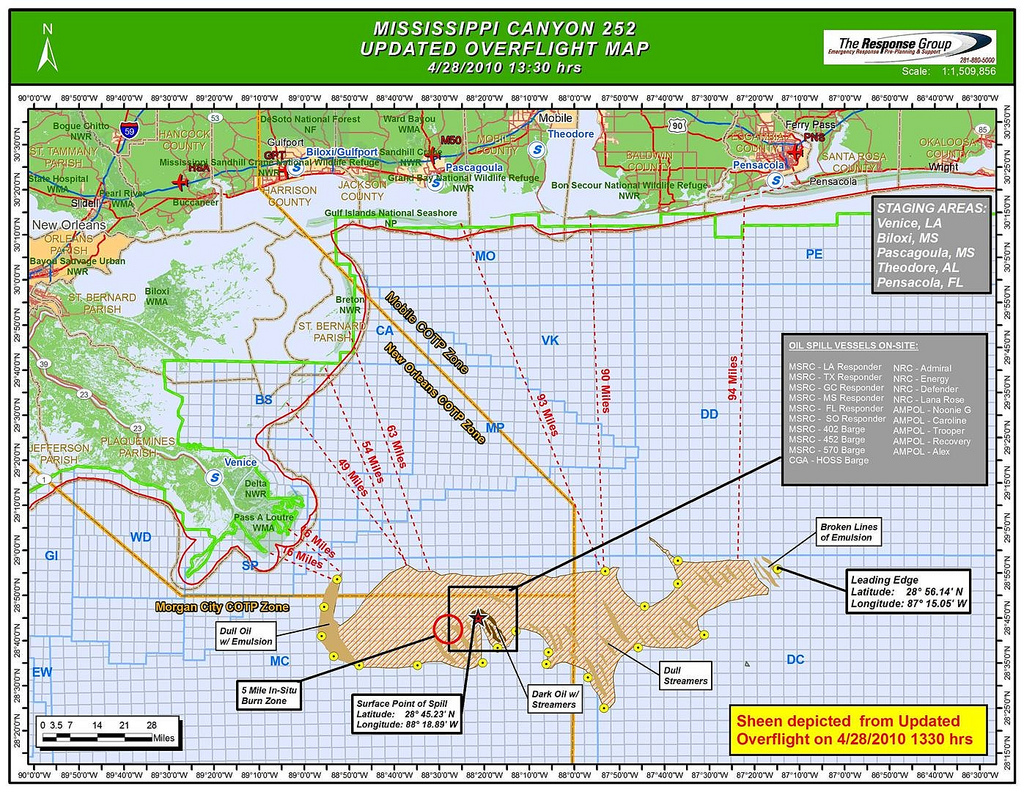
No major new developments were mentioned at today’s Unified Command Briefing (1500 CDT). Summary:
- Still unable to secure the source by actuating BOPE with the ROV. New intervention options are being designed.
- The in situ burn program was scheduled to begin today, but a report is not yet available.
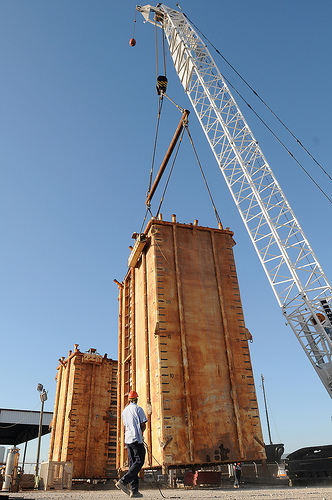
- Subsurface containment and collection system will be ready in 2-4 weeks
- Development Driller III will spud relief well by Friday
- 100,000 feet of boom deployed for coastal protection purposes
- No apparent change in well flow rate.
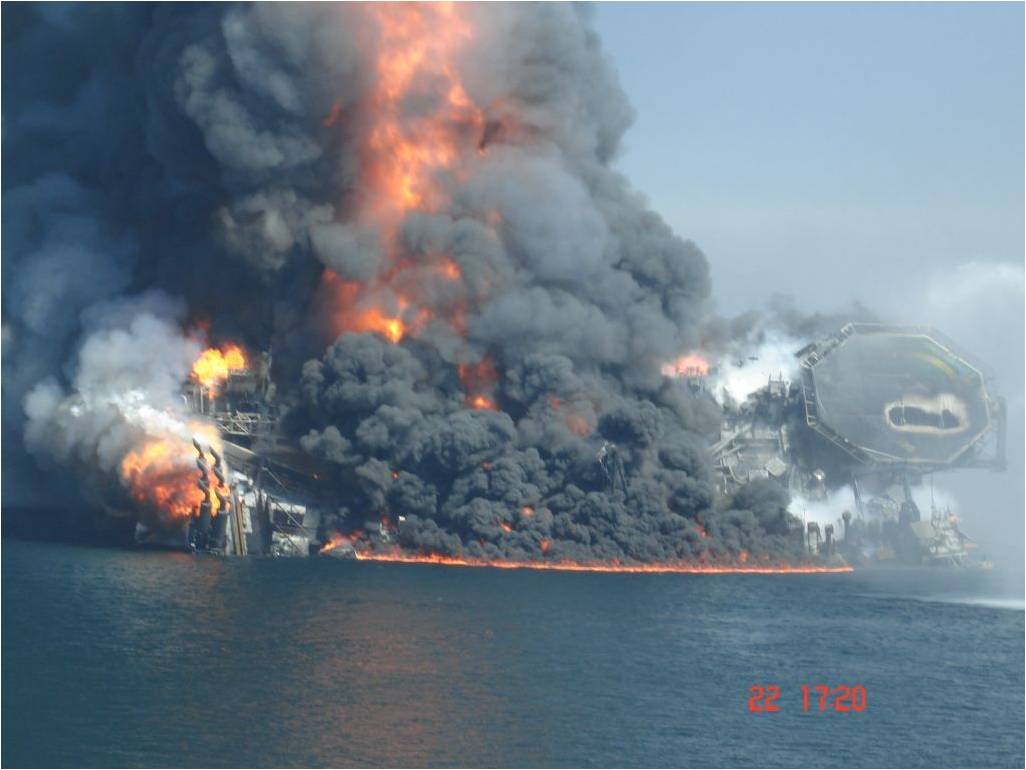
Deepwater Horizon Just Before Sinking
Macondo: Unprecedented Response
Posted in accidents, well control incidents, tagged accidents, blowouts, Deepwater Horizon, drilling, Gulf of Mexico, macondo, offshore oil, oil spill, safety, well control on April 28, 2010| 1 Comment »

Cleanup: Santa Barbara Blowout, 1969
During the 1969 Santa Barbara blowout, dedicated volunteers did their best with straw, wooden booms, detergents, rakes, and their own ingenuity. Fast forward to the Macondo response: stockpiles of tested dispersants and plans for applying them most effectively, fire boom and research data to support burning oil in situ, an armada of skimming vessels, boom deployed by trained personnel, a scientific support team, and a pioneering subsea collection system. Without a doubt, every effort is being made to minimize the damage associated with this spill.
There are 2 suggested improvements that I have alluded to previously. These relate to information that is being provided to the public.
- The data on the volume of oil/water mixture that is being collected would be more useful if we knew the oil fraction. Without this information, the effectiveness of the response and the potential for environmental impacts are difficult to assess. Based on the collection figures provided to date, weather conditions, the seafloor release point for the oil, and the estimated flow rate, I would assume that the mixture is mostly water. If no chemical analyses are available, perhaps an estimate (range) of the oil percentage could be provided.
- Very little specific information is being provided on the important subsea intervention operations. A weekly summary of these operations would be helpful. For each attempt, the procedure and outcome could be provided.
Posted in accidents, well control incidents, tagged accidents, blowouts, Deepwater Horizon, drilling, Gulf of Mexico, macondo, offshore oil, oil spill, safety, well control on April 28, 2010| Leave a Comment »

Macondo Blowout – Day 8 Update
Posted in accidents, well control incidents, tagged accidents, blowouts, drilling, Gulf of Mexico, macondo, offshore oil, oil spill, safety, well control on April 27, 2010| Leave a Comment »
NASA Image
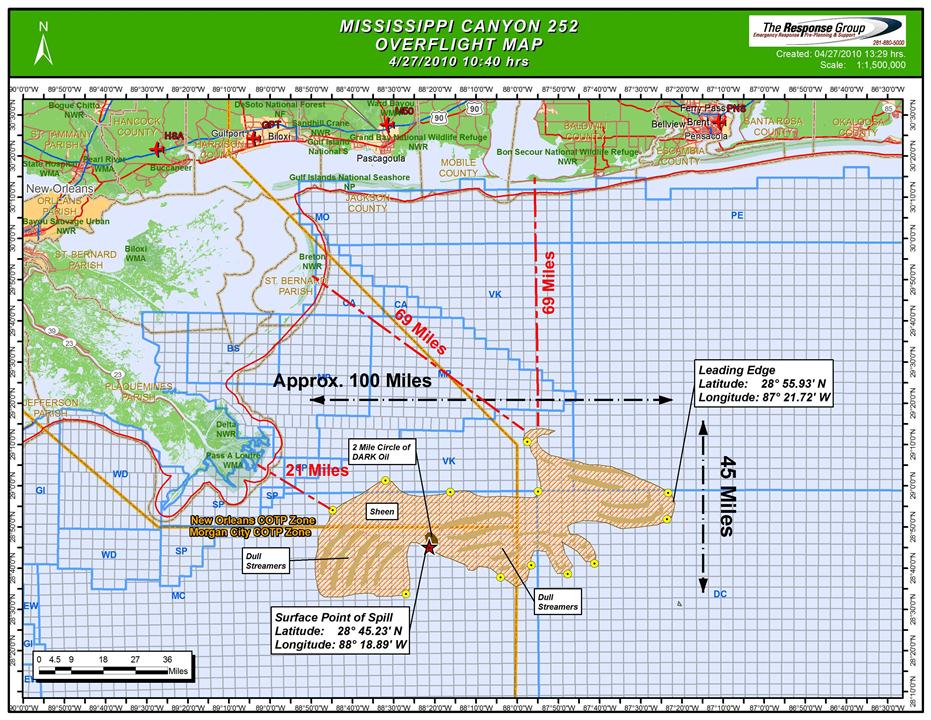
Unified Command News Conference highlights:
- Attempts to actuate the BOPE have not been successful. New options are being developed and applied. 4 ROVs are working around the BOP stack. They are connecting to the stack, but have not been able to successfully actuate rams.
- The shear ram on the BOP stack should have actuated when the rig lost power and when the riser was separated from the stack by ROV.
- The responders are still estimating a 1000 bopd spill rate. This is thought to be the deepest water ever (5000′) for a significant seafloor spill.
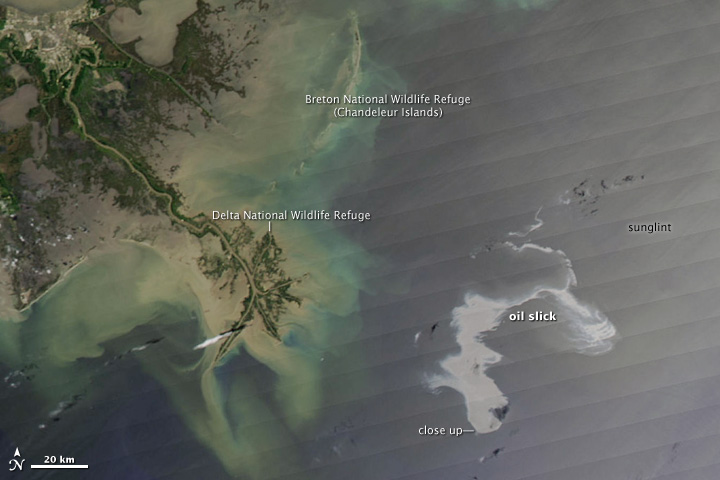
- The leading edge of spill is 20 miles south of Venice, LA. No landfall is suggested in the next 3 days. 3740 barrels of oil water mixture have been recovered. Comment: No information has been provided on the estimated percentage of the mixture that is oil.
- The responders are prepared to remove oil from the water by burning the oil in situ within a fire boom. Comment: Good call. Burning can quickly and completely remove oil from the water if the slick is sufficiently thick. Kudos to my former colleague Ed Tennyson who was the scientific and inspirational leader in developing this response capability.
- The subsurface containment system (seafloor dome) will be ready in 2-4 weeks. Construction is underway. The recovered fluids will be transported to a production system on the Enterprise drill ship.
- The relief well permits will be approved today. The Deepwater Driller III is on location 0.5 miles from the flowing well. The plan is to intercept the 7-inch casing near total depth. Comment: This implies that BP believes the well is flowing inside the production casing and not in the annulus.
- The current cost for the response is more than $6 million per day. Comment: This could easily become the most expensive spill response operation in history.
 Bud's Offshore Energy (BOE)